Past episodes
About Uncommon Knowledge

For more than a decade the Hoover Institution has been producing Uncommon Knowledge with Peter Robinson, a series hosted by Hoover fellow Peter Robinson as an outlet for political leaders, scholars, journalists, and today’s big thinkers to share their views with the world. Guests have included a host of famous figures, including Paul Ryan, Henry Kissinger, Antonin Scalia, Rupert Murdoch, Newt Gingrich, and Christopher Hitchens, along with Hoover fellows such as Condoleezza Rice and George Shultz.

Uncommon Knowledge takes fascinating, accomplished guests, then sits them down with me to talk about the issues of the day,” says Robinson, an author and former speechwriter for President Reagan. “Unhurried, civil, thoughtful, and informed conversation– that’s what we produce. And there isn’t all that much of it around these days.”

The show started life as a television series in 1997 and is now distributed exclusively on the web over a growing network of the largest political websites and channels. To stay tuned for the latest updates on and episodes related to Uncommon Knowledge, follow us on Facebook and Twitter.

Uncommon Knowledge by date

May 19, 2008 | Recorded on April 3, 2008

The Rise and Fall of Liberalism

James Piereson is the director of Manhattan Institute’s Center for the American University and president of the William E. Simon Foundation.

In Camelot and the Cultural Revolution, James Piereson asserts that, “as the 1960’s began, liberalism was … the single most creative and vital force in American politics” and that the Kennedy assassination caused a split within this movement between its more traditional supporters and cultural activists that still exists today. Peter Robinson explores with Piereson how and why this happened -- how “a confident, practical, forward-looking philosophy with a heritage of accomplishment was thus turned into a doctrine of pessimism and self-blame, with a decidedly dark view of American society.” (29:56) Video transcript

May 5, 2008 | Recorded on April 3, 2008

The Word According to Tom Wolfe

Tom Wolfe is the author of numerous bestselling works of fiction and non-fiction.

Peter Robinson engages America’s master novelist in a conversation that ranges from the death of the American novel to the “charming aristocracy” that seeks to dictate literary standards to the intersection of culture and the latest findings in neuroscience. Along the way, Tom Wolfe reaffirms his place as the preeminent chronicler of the changing American scene. (35:51) Video transcript

April 21, 2008 | Recorded on April 3, 2008

Kissinger on War & More

Henry Kissinger

Peter Robinson explores the global challenges confronting American today--from Iraq to Europe to Iran and the dangers of nuclear proliferation--with Kissinger, one of the country's most preeminent foreign policy practitioners. Kissinger asserts that the 1960s myth, that the U.S. government is somehow an evil enterprise, is alive and well. In this environment, he says, our leaders need to present a clear and educated vision of America's role in the world. (36:10) Video transcript

April 7, 2008 | Recorded on March 14, 2008

The Free-Market Case for Green

this is an image

A dedicated, unabashed, free market capitalist, T. J. Rodgers takes a businessman’s and engineer’s view of global warming. How serious is it, and what should we make of the plans offered up by politicians such as Al Gore and Barack Obama to deal with it? If “cap and trade” or pollution taxes on CO2 are not the answer, what is? (39:52) video transcript

March 24, 2008 | Recorded on March 14, 2008

Shultz on Nukes — Then & Now

George P. Shultz

George Shultz, writing with Henry Kissinger and others in the Wall Street Journal late last year, asserted that “nuclear weapons were essential to maintaining international security during the Cold War. …But reliance on nuclear weapons for [the purpose of deterrence] is becoming increasingly hazardous and decreasingly effective,…The world is now on the precipice of a new and dangerous nuclear era.” What made nuclear weapons acceptable then, and so unacceptable today? In answering these questions Shultz addresses the difficult challenges the United States faces as it seeks to curb the nuclear ambitions of North Korea and Iran, and the threat represented by non-nation state actors: the nightmare scenario of a nuclear suitcase bomb detonating in a major American city. (32:06) Video transcript

March 10, 2008 | Recorded on March 6, 2008

Peter Robinson interviews Fresno State Classicist Bruce Thornton about his new book Decline and Fall: Europe's Slow Suicide.

Professor Bruce Thornton of Cal State Fresno

In his new book, Decline and Fall: Europe’s Slow Motion Suicide, Bruce Thornton asserts that Europe has turned its back on the Western tradition to which it owes its greatness. It has abandoned pride in the nation, discarded traditional Christianity, and, in so doing, is without unifying values, ideals, and beliefs. But if Europe is still democratic, and if it still embraces the free market, why should anyone care that Judaeo-Christian religious beliefs are slipping away. The answer lies in the coinciding rise of radical Islam. (35:45) Video transcript

February 25, 2008 | Recorded on February 5, 2008

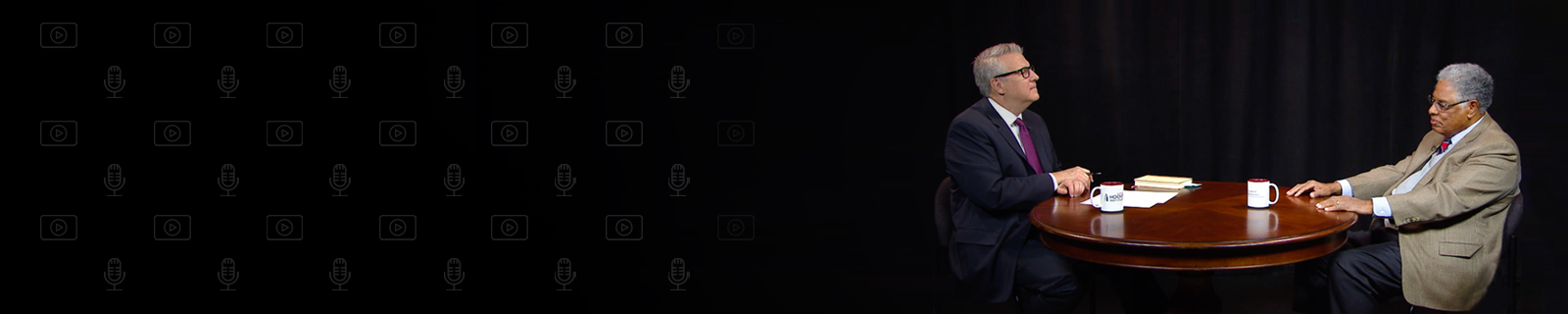
Peter Robinson speaks with Thomas Sowell about his new book Economic Facts and Fallacies

Thomas Sowell is the Rose and Milton Friedman Senior Fellow on Public Policy

Peter Robinson speaks with Thomas Sowell about his new book Economic Facts and Fallacies in which Sowell exposes some of the most popular fallacies about economic issues. Sowell takes on the conventional thinking on a wide swath of America’s economic life, from male-female economic differences to income stagnation, executive pay, and social mobility to economics of higher education. In all cases he demonstrates how economics relates to the social issues that deeply affect our country. (33:21) Video transcript

February 11, 2008 | Recorded on February 11, 2008

The Economy According to Taylor and Judd

this is an image

Are we, in fact, in a recession? If not, is one still headed our way? Economists John Taylor and Kenn Judd discuss not only the state of the current economic slowdown, but how the definition of recession is evolving. (30:58) Video transcript

January 18, 2008 | Recorded on January 18, 2008

Shelby Steele: Barack Obama and the Politics of Race

this is an image

In conversation with Peter Robinson, Shelby Steele explores Barack Obama's candidacy. (33:49) Video transcript

January 14, 2008 | Recorded on January 14, 2008

Uncommon Knowledge: Michael Barone

Michael Barone

To better understand the state of democracy in the United States today, Peter Robinson challenges Michael Barone to explain a series of paradoxes at the heart of our political process: the current state of the Republican Party, the debate over the war in Iraq, and competing tax reform and health-care proposals. Barone also offers his thoughts on the strengths and weaknesses of the current Republican and Democratic presidential candidates. (32:09) Video transcript