
Working Papers
The Anatomy of Capital Returns over the Very Long Run: Germany, 1465–2025
Economics Working Paper 26128
November 6, 2026
Published March 28, 2024
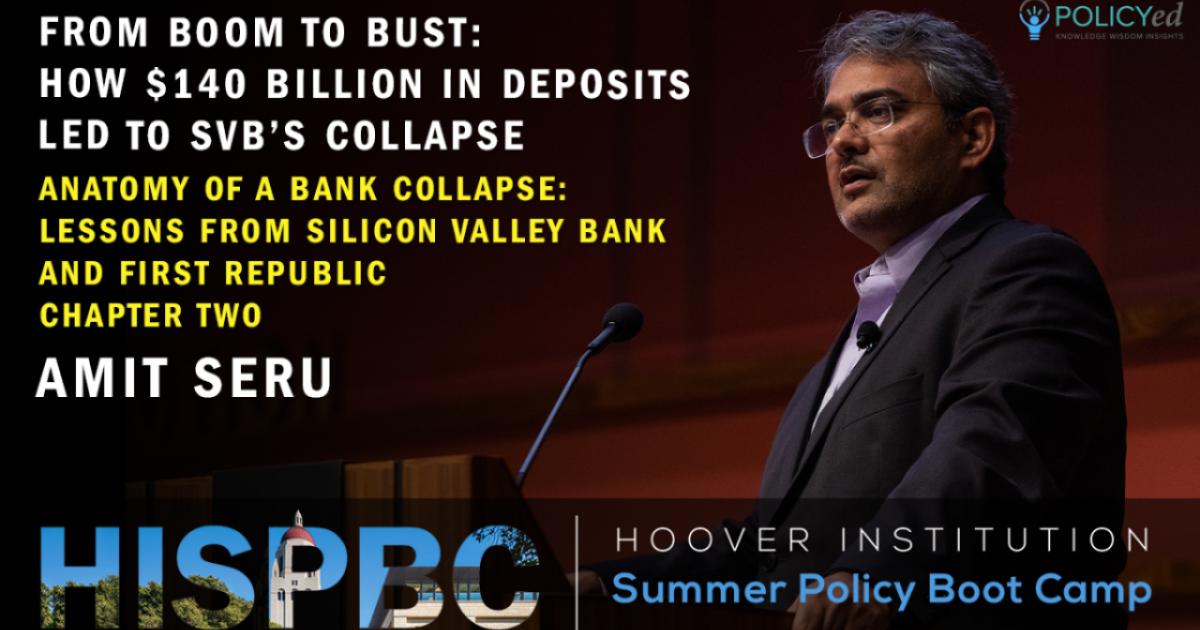
As the United States economy came to a disruptive halt in 2020, Silicon Valley Bank (SVB) experienced a wave of deposits totaling $140 billion. This was the first in a cascade of events which ultimately led to its collapse. As SVB mismanaged its deposits into long-term securities, interest rates rose, resulting in $22 billion in unrealized losses. When investors became spooked, SVB could not survive the inevitable run on the bank thanks in large part to its high proportion of uninsured deposits. Amit Seru shows how SVB’s collapse exposed the vulnerabilities in the United States banking system, raising questions about moral hazard, future bank failures, and bailouts for failing institutions.
The opinions expressed on this website are those of the authors and do not necessarily reflect the opinions of the Hoover Institution or Stanford University. © 2024 by the Board of Trustees of Leland Stanford Junior University.
Working Papers
Economics Working Paper 26128
November 6, 2026
Articles
How do prices work in functioning markets?
November 4, 2026
Articles
Where data centers locate to fuel the growth of artificial intelligence (AI) is of burgeoning political importance with economic and environmental implications. We highlight local factors associated with siting and opposition.
November 3, 2026