Published: October 15, 2019

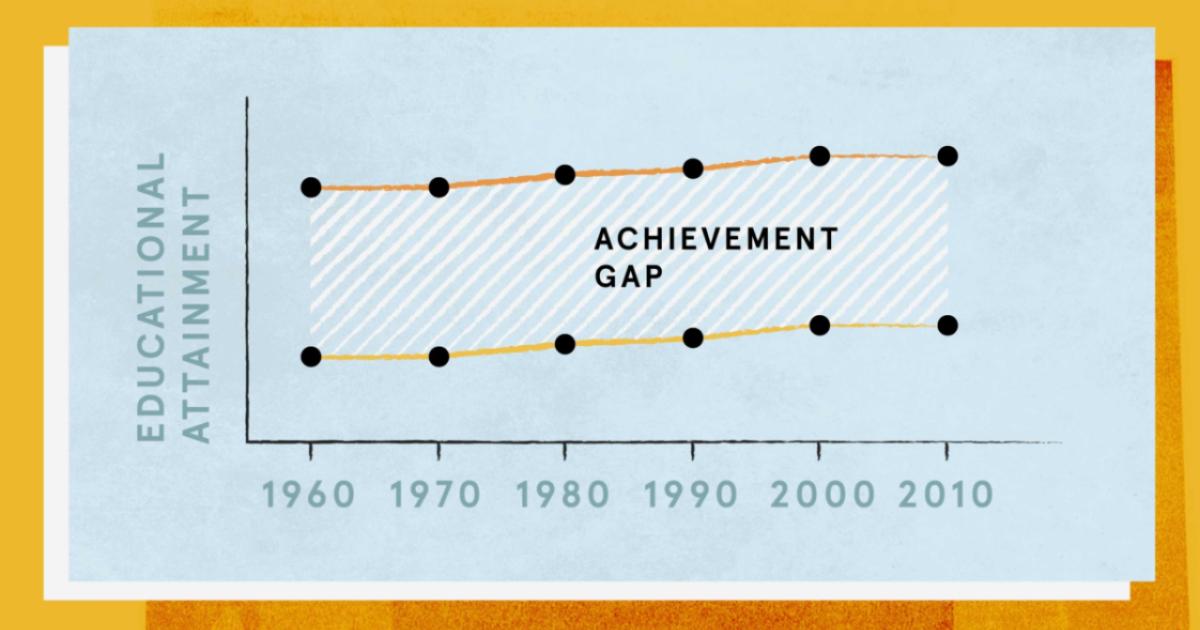
New research shows that the difference in educational attainment between students from higher and lower socioeconomic backgrounds has not changed over the past 50 years. This achievement gap has persisted even though inflation-adjusted spending per student has quadrupled. To help narrow the achievement gap, the United States needs to reconsider its existing course and be open to new directions in education policy.  

Discussion Questions

  1. Why haven't we closed the achievement gap?
  2. What can the schools do to ensure that every student has equitable access to the highest quality educational experiences?

Additional Resources

  • Read “The Achievement Gap Fails to Close” by Eric Hanushek and Paul Peterson, available here
  • Read Eric Hanushek’s interview in “No Change In Student Achievement Gap In Last 50 Years,” available here.
  • Read “The War on Poverty Remains a Stalemate” by Eric Hanushek and Paul Peterson, available here
  • Read “The Unwavering SES Achievement Gap: Trends in U.S. Student Performance” by Eric Hanushek, Paul Peterson, Laura Talpey, and Ludger Woessmann, available here.

Cast

Eric Hanushek

Eric Hanushek

Paul E. Peterson

Paul E. Peterson

New research shows that the difference in educational attainment between students from higher and lower socioeconomic backgrounds - what’s called the achievement gap - has not changed over the past 50 years. 

The gap between the haves and have-nots has remained constant, even while spending per student has quadrupled. 

Since the cognitive skills measured 

by standardized achievement tests 

are a strong predictor of future income 

and economic well-being, 

a persistent achievement gap means it’s harder for low- income Americans to get ahead. 

Social mobility isn’t likely to improve. 

We once thought just providing more money to schools serving disadvantaged students 

would work to bring their achievement up. 

But after spending billions of dollars, we haven’t seen the gap improve. 

The United States needs to reconsider its existing policies aimed at shrinking the achievement gap and be open to new directions in national education policy. 

It should focus on results rather than thinking that more money can solve the problem.

Related

Videos

California’s War On Wealth—And America’s War On Terror

Is the progressive dream of wealth taxes soon to be reality – or a fiscal and economic nightmare – should voters approve Proposition 40 and a one-time 5% tax on the holdings of the Golden State’s billionaire class? And 25 years after one of the darkest days in the republic’s history, what is the legacy of the 9/11 attacks on America?

September 9, 2026

Videos

Professor Sean Westwood Explains How AI Bots Are Faking Human Responses In Online Surveys

Hoover Institution fellow Sean Westwood sounds the alarm after an AI bot he programmed was able to fool online surveys into thinking it was a human respondent. Westwood says or 75 years, the problem with polls was that they sometimes got human opinion wrong. The problem now is that they may not involve humans at all.

September 3, 2026

Videos

How Thomas Sowell Thankfully Made Me A Contrarian Educator

Ian Rowe explains how Thomas Sowell’s uncompromising pursuit of truth inspires students to reject victimhood and become architects of their own lives.

September 8, 2026