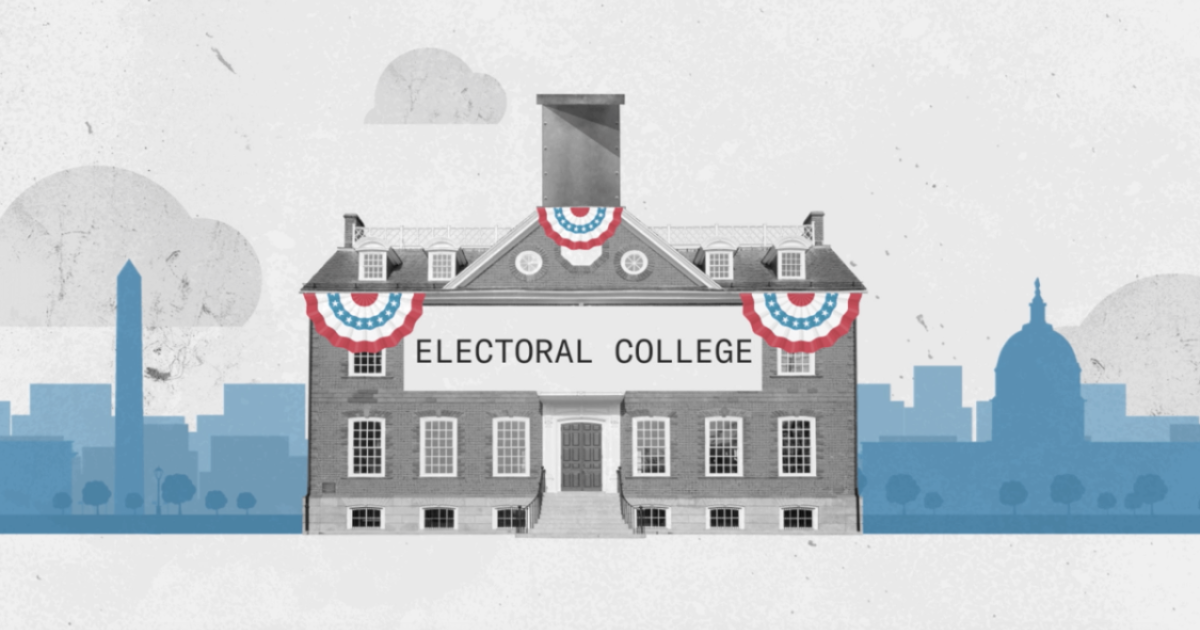
By Constitutional Design: The Electoral College

Published July 21, 2021

Is the Electoral College antidemocratic? The Founders rejected the direct election of the president in order to balance individual liberty against majority rule. In addition, the Electoral College encourages candidates to widen their campaigns and reach out to voters across the nation, leading to less partisanship.

Discussion Questions

  1. Should the Electoral College be abolished?
  2. Why does the Electoral College matter?

Additional Resources

  • Read “A Defense of the Electoral College in the Time of Trump,” by John Yoo. Available here.
  • Listen as John Yoo discusses the constitutionality of changing the Electoral College. Available here.
  • Read “Progressives Are Wrong to Oppose the Electoral College,” by John Yoo. Available here.

Cast

John Yoo

John Yoo

Five US presidents have won the Electoral College while failing to win a majority of the popular vote. Two of them occurred in the last twenty years.

If America embraces democracy as a founding principle, why did the Founding Fathers choose a method for electing presidents that seems so undemocratic?

The Constitution balances several crucial principles - majority rule, decentralization of power, and most importantly: individual liberty.

The House of Representatives reflects the founders' democratic ideals of majority rule, through proportional representation.

The Bill of Rights and the separation of powers reflects the founders’ objective to protect liberty by constraining what the government is permitted to do even with majority support.

The Electoral College also balances these competing principles.

Here's how: Each state receives electors based on their members of the House and Senate. In almost every state, the candidate who wins the popular vote - even by a handful of votes - is awarded ALL of the state's electoral votes, which reflects the democratic voice of the people.

But in order to temper majority rule, the Electoral College also requires candidates to win as many states as possible.

After all, winning one state by a landslide doesn't give a candidate any more electoral votes than winning by a slim margin. The only way to win more electoral college votes is to win more states.

This winner-takes-all system encourages candidates to widen their campaigns to many states, and to build coalitions of voters across different regions, both of which require them to moderate their positions for broader appeal. This reinforces the institutional importance of the states, which act as a valuable check on federal power, in defense of the individual.

In contrast, a direct popular election would encourage candidates to campaign only in the major cities, or to cater to regions or interests that could produce a slim national majority. This would also incentivize candidates to take more extreme and partisan positions, to the benefit of their base and the detriment of everyone else.

The Electoral College’s record isn’t perfect. But it has undoubtedly resulted in fewer populist demagogues than a direct popular election, thereby protecting individual rights.

Despite its criticisms, the Constitutional principles behind the Electoral College continue to simultaneously promote the voice of the majority AND the individual.

The founders got a lot right about our Constitutional structure.

Perhaps there is more wisdom in the Electoral College than most people believe.

Related

Videos

Fighting Hyperinflations Around The World With Steve Hanke

Jon Hartley and Steve Hanke discuss currency boards, dollarization, and fighting inflation around the world.

September 17, 2026

Videos

Spoiler Alert: Can You Get Sued For Revealing A Plot Point?

Can revealing a plot twist get you sued? Inspired by the controversy surrounding HBO’s Lanterns, Eugene Volokh and Jane Bambauer explore the tension between copyright protection and free speech.

September 15, 2026 • 0 Min Watch

Articles

Higher Education Must Overcome Comforting Delusions

It is comforting to suppose that the resentment and anger we provoke arise from misunderstandings on the part of others. 

September 14, 2026