The Dangerous Decade: Can America Deter a War with China?

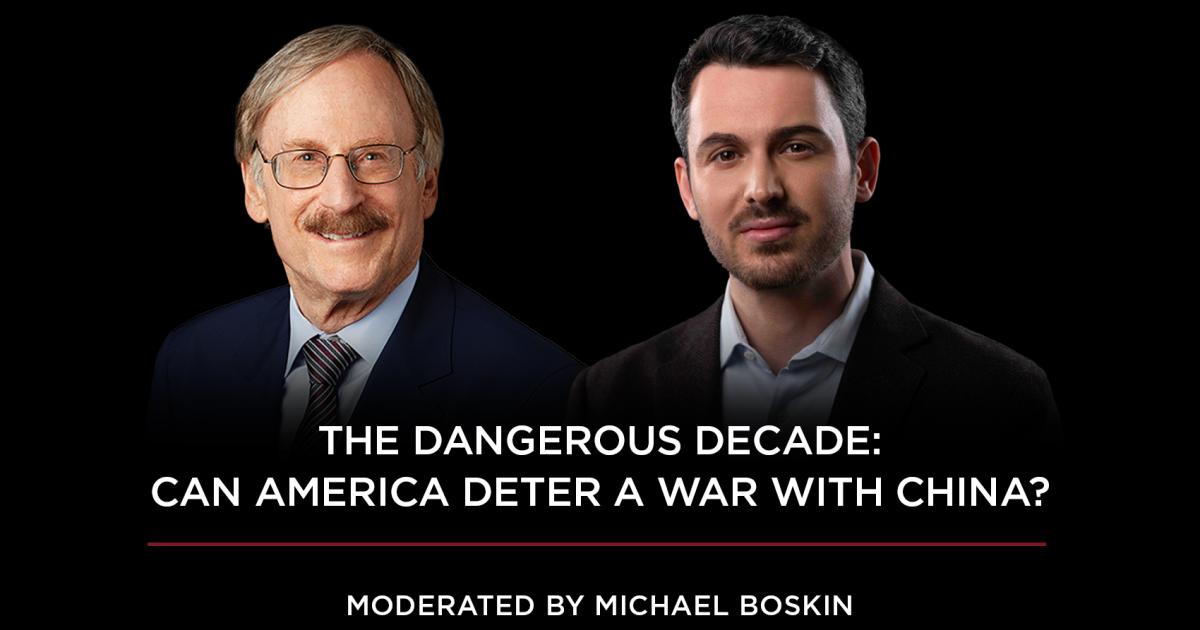
Eyck Freymann, Hoover fellow and author of Defending Taiwan: A Strategy to Prevent War with China and Arsenal of Democracy: Technology, Industry, and Deterrence in an Age of Hard Choices (with Harry Halem), joins Hoover senior fellow Michael J. Boskin to discuss Taiwan’s importance to American security and the global economy, how China might seek to coerce or seize the island, and whether the United States is ready and capable of deterring its principal adversary in such an event.

ABOUT THE SPEAKER

Eyck Freymann is a Hoover Fellow at Stanford University, where he directs the Allied Coordination Working Group. He is also a Non-Resident Research Fellow at Columbia University's Center on Global Energy Policy, the Institute of Geoeconomics in Tokyo, and the China Maritime Studies Institute at the U.S. Naval War College.

Dr. Freymann works on strategies to preserve peace and protect U.S. interests and values in an era of systemic competition with China. He is the author of several books, including the forthcoming Defending Taiwan: A Strategy to Prevent War with China (Oxford, 2026), The Arsenal of Democracy: Technology, Industry, and Deterrence in an Age of Hard Choices (Hoover, 2025), and One Belt One Road: Chinese Power Meets the World (Harvard, 2021). His scholarly work has appeared in The China Quarterly and is forthcoming in International Security.
Cast

Michael J. Boskin

Michael J. Boskin

Eyck Freymann

Eyck Freymann

Related

Event

Money and Power: Historical Lessons for Stablecoins and U.S Dollar Dominance

The Hoover Institution Economic Policy Working Group hosted “Money and Power: Historical Lessons for Stablecoins and U.S Dollar Dominance” with Michael D. Bordo, the Duncan Stewart Distinguished Visiting Fellow at the Hoover Institution.

April 23, 2026

Articles

We Just Created More Than 1,000 Synthetic Controls To Study California's $20 Fast Food Minimum Wage

Synthetic control methods hold the promise of identifying a credible counterfactual by closely reproducing pretreatment outcome paths. Their reliability, however, depends in part on how effectively they constrain researchers’ less-visible degrees of freedom. We explore these methods’ sensitivity by constructing 1440 plausibly defensible specifications to estimate the employment effect of California’s $20 fast-food minimum wage. While over 96 percent of the estimated employment effects are negative, the range is vast, illustrating that synthetic control methods are sensitive to specification choice.

October 30, 2026

Articles

Junk History: Seductive, Dangerous

Inadequate or faulty framing of episodes is worse than an academic failing—it can sabotage real-world decisions.

November 2, 2026