
Articles
How One Lawyer Freed Thousands From Castro’s Cuba
James Donovan proved that patience, respect, and even a fishing rod could accomplish what military force could not.
October 16, 2026
Recorded on July 18, 2019.
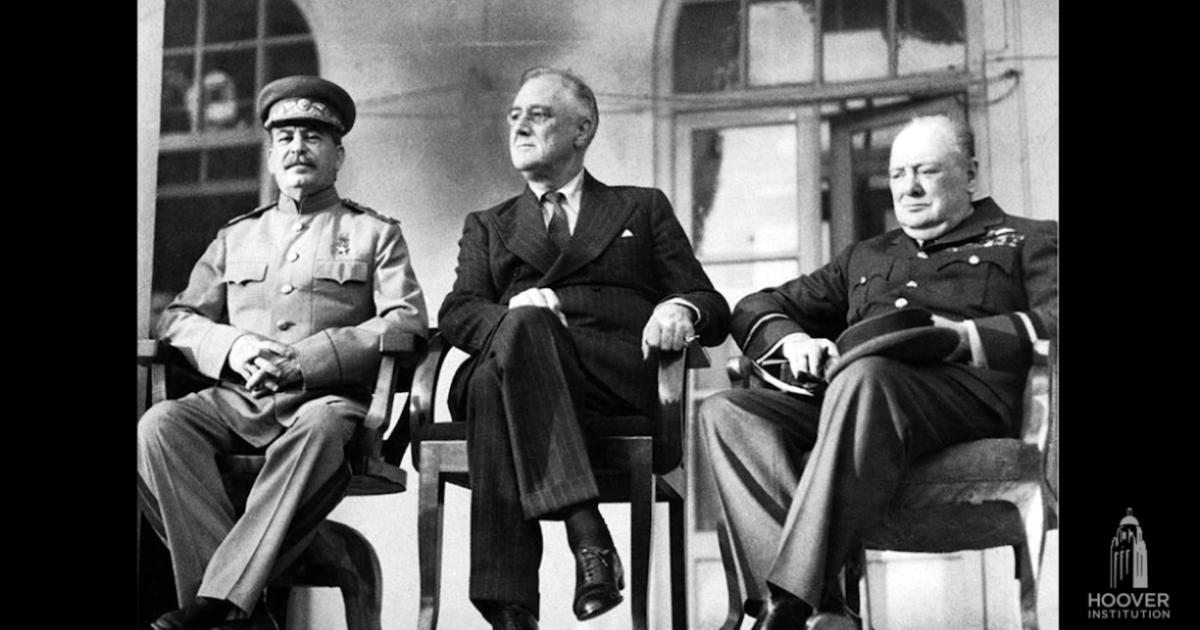
Accomplished historians David Kennedy, author of Freedom from fear; Andrew Roberts, author of Churchill: Walking with Destiny; and Stephen Kotkin, author of Stalin: Waiting for Hitler discuss why the peaceful new international order that Roosevelt, Churchill, and Stalin agreed to establish after crushing Nazi Germany turned instead into each of the Allies pursuing their own national interests amid the Cold War.
What did Roosevelt, Churchill, and Stalin want at the beginning of the Second World War? Peter Robinson starts the discussion by why the “big three” came together as allies in response to Operation Barbarossa during the war. What did the leaders of the “grand alliance” of Britain, the United States, and the Soviet Union want? What were their national interests?
Robinson asks Roberts if Churchill aimed to preserve the British Empire. Roberts explains that Churchill’s interests were just in national survival. As Britain was under the threat of massive invasion from Germany, he wanted to make sure that the Russians stayed in the war until the Germans were wiped out completely. Roberts also notes that Churchill wanted Russia to ensure that the Americans, when they did finally enter the war in December 1941, were guided toward a Mediterranean strategy.
Kennedy discusses Roosevelt’s motive for joining into an alliance in the aftermath of Operation Barbarossa, before officially entering the war. Kennedy says that Roosevelt wanted to make the world safe for the democratic practices and institutions that had already been established, but he did not seek to expand democracy throughout the world. Next, Robinson asks Kotkin about Stalin’s aim for allying with Britain and United States as well as why Stalin did not quickly respond to Hitler’s actions in Soviet Union despite having one of the biggest armies in the world. Kotkin replies that there was misinformation that made Stalin think that Hitler would not actually attack, that Hitler was only amassing the troops to blackmail Stalin into giving up Ukraine and other territories without actually having to fight. Lastly, Kotkin explains, Stalin also joined the grand alliance for national survival.
Robinson then continues the discussion with Roberts, Kennedy, and Kotkin by asking how things turned out for the three allies after the war. They examine who won and who lost over both the short term and the long term, as well as how the postwar world set the stage for the emergence of new strong powers, particularly China.
This event addresses these and many other important lessons and questions:
· What happens when an international system that is supposed to keep the peace among nations breaks down?
· How do nations deal with the breakdown and rebuilding of international order?
· How can Western civilization remain strong?
· What are the defense resources required to protect free countries from unpleasant predators in the world?
Articles
James Donovan proved that patience, respect, and even a fishing rod could accomplish what military force could not.
October 16, 2026
Podcasts
Hoover Institution fellow Lanhee Chen on why good policy so often fails politically.
October 20, 2026
Articles
Ethan Allen, at times “imprudent,” was a timely leader for a country of action.
October 15, 2026