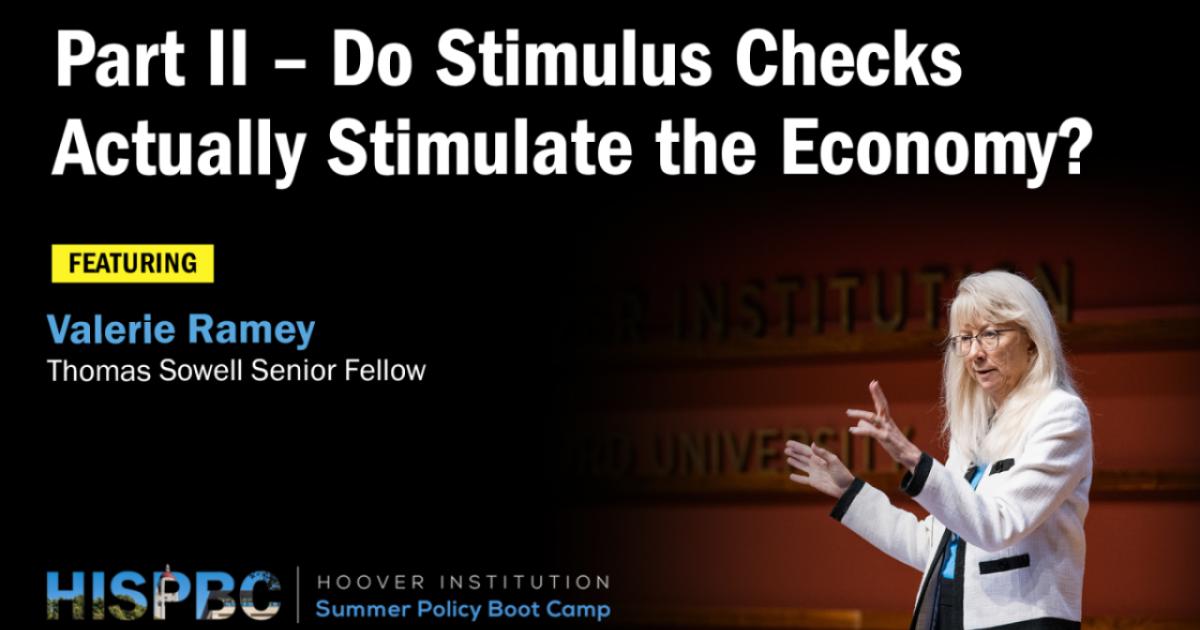
Do Stimulus Checks Actually Stimulate the Economy?

Government stimulus does not produce the same economic payoff simply because money is spent. Evidence from stimulus checks, defense purchases, and infrastructure shows that the size—and timing—of the multiplier depends heavily on how government spends the money.

Not all forms of fiscal stimulus produce the same economic payoff. Evidence from the 2008 US rebates and Singapore suggests that temporary payments to households had only a limited effect on overall consumer spending. Government purchases tend to produce larger short-term gains, while infrastructure can generate stronger benefits over time. Ramey’s broader conclusion is that fiscal stimulus usually delivers less growth than its strongest advocates expect.

Cast

Valerie Ramey

Valerie Ramey

Related

Articles

Data Center Siting And Community Opposition

Where data centers locate to fuel the growth of artificial intelligence (AI) is of burgeoning political importance with economic and environmental implications. We highlight local factors associated with siting and opposition.

November 3, 2026

Event

Money and Power: Historical Lessons for Stablecoins and U.S Dollar Dominance

The Hoover Institution Economic Policy Working Group hosted “Money and Power: Historical Lessons for Stablecoins and U.S Dollar Dominance” with Michael D. Bordo, the Duncan Stewart Distinguished Visiting Fellow at the Hoover Institution.

April 23, 2026

Articles

We Just Created More Than 1,000 Synthetic Controls To Study California's $20 Fast Food Minimum Wage

Synthetic control methods hold the promise of identifying a credible counterfactual by closely reproducing pretreatment outcome paths. Their reliability, however, depends in part on how effectively they constrain researchers’ less-visible degrees of freedom. We explore these methods’ sensitivity by constructing 1440 plausibly defensible specifications to estimate the employment effect of California’s $20 fast-food minimum wage. While over 96 percent of the estimated employment effects are negative, the range is vast, illustrating that synthetic control methods are sensitive to specification choice.

October 30, 2026