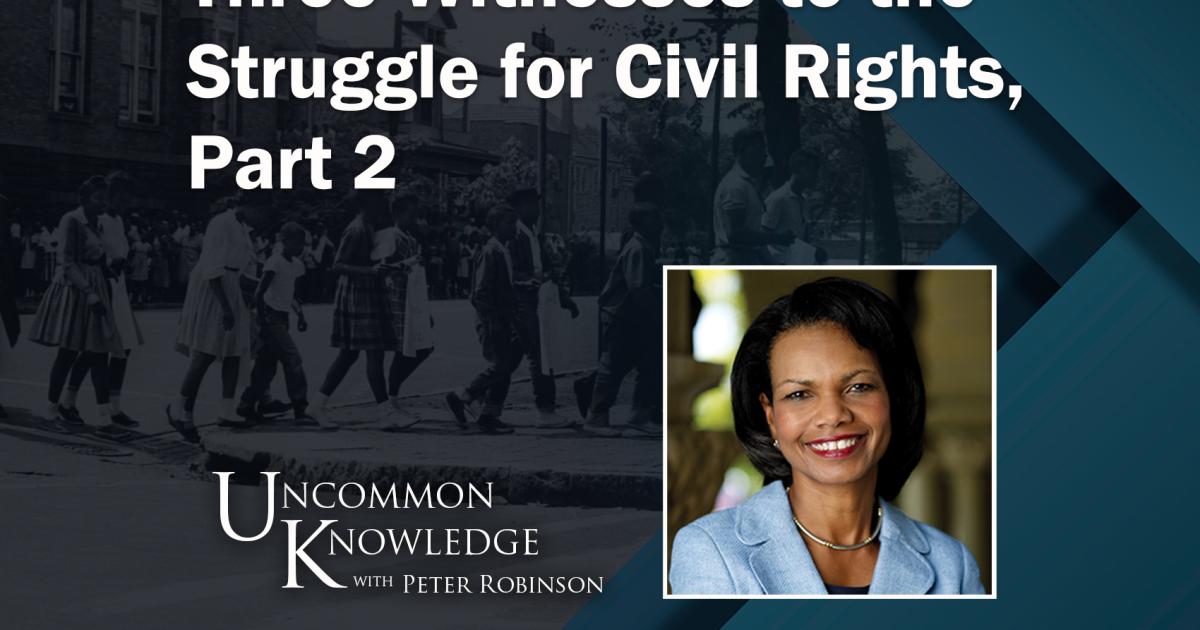
Mary Bush, Freeman Hrabowski, and Condoleezza Rice grew up and were classmates together in segregated Birmingham, Alabama, in the late 1950s and early ’60s. After taking a brief visit with Rice to her childhood home, we gather them again for a second conversation in Birmingham’s Westminster Presbyterian Church, where Rice’s father was pastor during that period. In this second part of our interview, the three lifelong friends further recount what life was like for Blacks in Jim Crow Alabama and the deep bonds that formed in the Black community at the time in order to support one another and to give the children a good education. They discuss how they overcame the structural racism they experienced as children to achieve incredible successes as adults. Lastly, they discuss their views on the recent reckoning with racism in today’s culture and weigh in on the 1619 Project and other social programs.
Cast

Condoleezza Rice

Condoleezza Rice

Related

Podcasts

Amidst “A World Of Generational Change”: 9/11’s Lessons And Legacy

The 9/11 attacks on the US were 25 years ago this week and, while there hasn’t been a second such shock, questions remain as to the Free World’s preparedness, whether a divided America can rediscover unity, and the strength of international alliances. Phillip Zelikow, the Hoover Institution’s Botha-Chan senior fellow and executive director of the 9/11 Commission, discusses lessons learned from the attack.

September 11, 2026 • 0 Min Listen

Articles

Securing the Panama Canal

The Panama Canal—the transoceanic waterway through which five percent of global commerce flows—is critical for U.S. national security.

September 8, 2026

Articles

“A Ship’s A Fool To Fight A Fort”: Chokepoints, Coastal Firepower, And The New Contest For The Maritime Commons

The proliferation of land-based missiles, cheap drones, and integrated anti-access/area-denial networks has overturned centuries of assumptions about naval dominance, allowing regional powers—and their proxies—to hold critical maritime trade at risk. Traditional sea powers must adapt on two fronts: preventing chokepoint closures through deterrence by denial and mitigating them through resilience by design.

September 8, 2026