Articles
The Rich World’s Climate Distraction
The World Bank and other institutions lose their focus on the best ways to help the poor.
September 1, 2026
Published July 12, 2023
Government spending surged during the pandemic but has only slightly decreased, while the projected federal deficit continues to accumulate trillions in debt annually. Historical examples, such as post-World War II and the end of the Cold War, show that substantial cuts in government spending can lead to economic booms. To achieve sustained economic expansion, reducing government involvement in private market decisions is crucial.
Discussion Questions:
Additional Resources:
Government spending during the Covid-19 pandemic grew enormously. Now that the emergency is over, spending has fallen by trillions of dollars.
To make matters worse, the federal deficit is projected to add trillions of dollars of debt every year for the foreseeable future.
Something has to give.
Many worry that big cuts in government spending will lead to a recession.
But America has done it before, with great success.
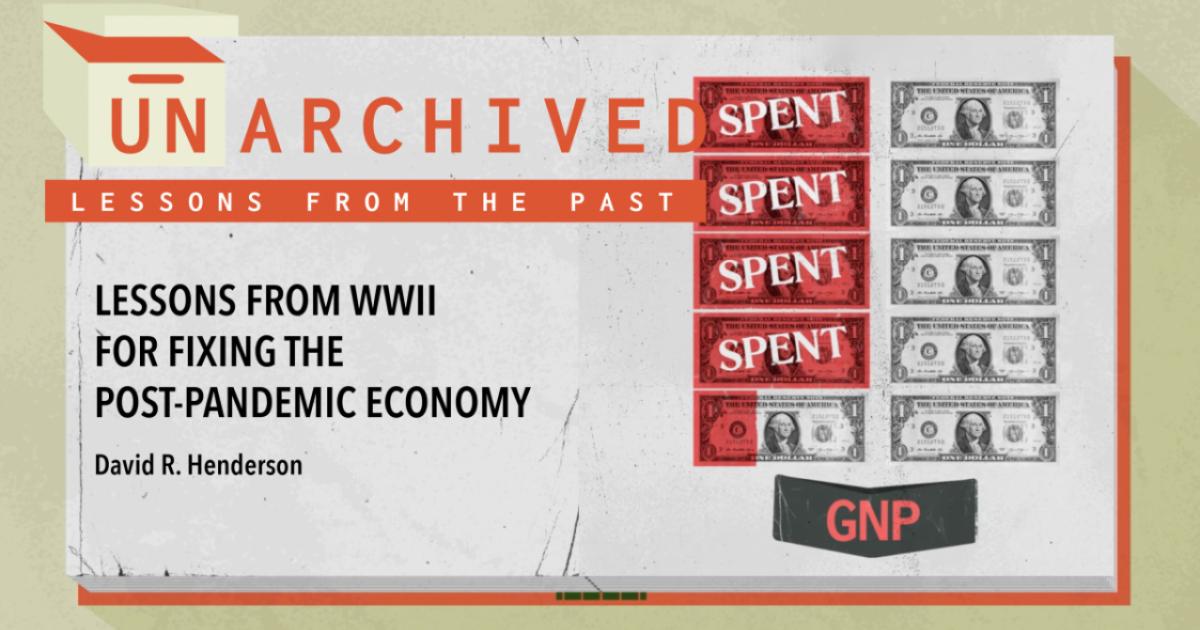
In the four years from peak World War II spending in 1944 to 1948, the U.S. government cut spending by 75 percent.
It brought federal spending down from a peak of 44 percent of gross national product (GNP) in 1944 to only 8.9 percent in 1948, a drop of over 35 percentage points of GNP.
While government spending fell like a stone, President Truman and Congress cut tax rates on individual income slightly, so tax revenues fell by only 10.6%.
Keynesian economists like Paul Samuelson feared that sudden, drastic spending cuts would lead to a large drop in demand for goods and services, causing unemployment to surge.
What actually happened? In the first two transition years after the war, real GNP was more than 17% HIGHER than BEFORE the war.
Unemployment did increase, but only to a peak of 3.9% in 1946.
People bought cars, houses, gas, meat, and everything else they were unable to buy during the war.
Instead of the expected post-war depression, there was a boom.
And as astonishing as it was, it was not a one-time experience.
As the cold war was ending, Presidents H.W. Bush and Clinton brought defense spending down from 5.9 percent of GDP in 1990 to 3.6 percent in 2000.
The result: overall federal spending fell from 22 percent of GDP in 1991 to 18 percent in 2000. And we had a boom in the last half of the 1990s.
Both of these events provide important lessons for today:
1. Even large cuts in government spending don’t automatically produce a recession.
2. Markets, if not subject to price controls, respond quickly and replace government-produced goods and services with private goods and services.
3. When private markets re-take the lead with regard to capital and labor, unemployment and underemployment are mitigated.
Most important, private investment will not happen unless the government reduces its role in making decisions in private markets. They did so at the end of WWII, and must do so again now, so that we can begin a sustained economic expansion.
Articles
The World Bank and other institutions lose their focus on the best ways to help the poor.
September 1, 2026
Videos
Richmond Fed president and CEO Tom Barkin joins Steve to discuss Kevin Warsh’s keynote speech at the Jackson Hole Economic Policy Symposium.
September 4, 2026
Videos
House Financial Services Committee chair French Hill joins Jon Hartley to discuss housing supply in the United States, crypto rules, securities reform, and expanding access to capital.
September 1, 2026