Published April 23, 2020

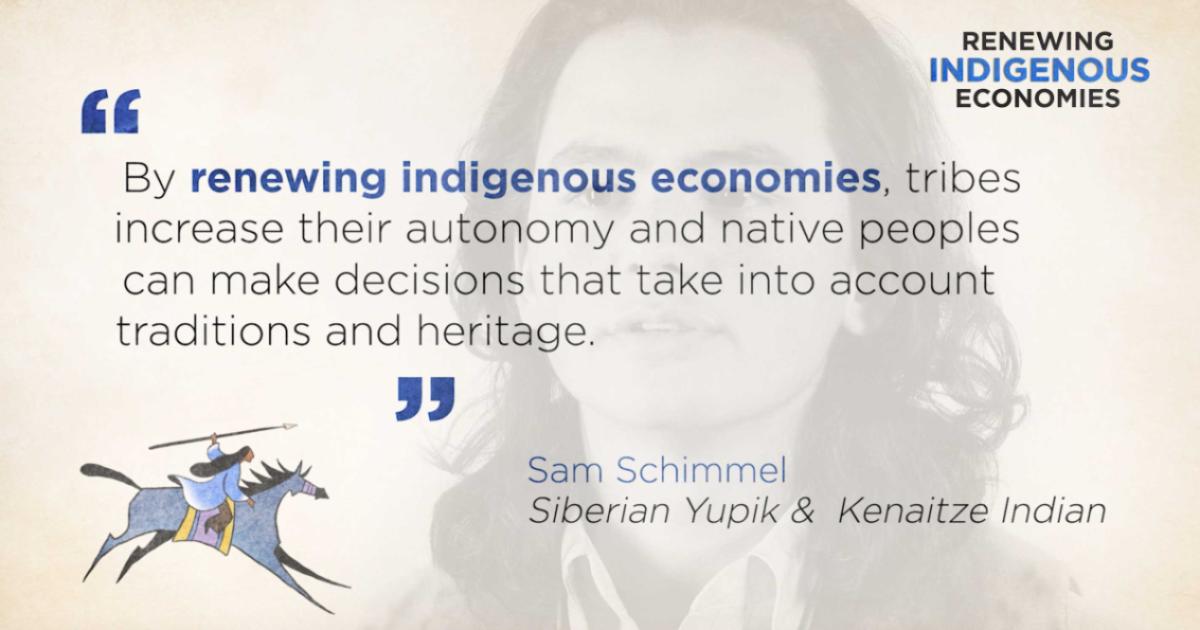
“By renewing indigenous economies, tribes increase their autonomy. When tribes are economically independent, Indian country and Native peoples are best served.”

Sam Schimmel, Siberian Yupik and Kenaitze Indian
Member, Cook Inlet Tribal Council and class of 2022, Stanford University

Sam Schimmel is an Alaska Native with a passion for subsistence hunting and fishing, both of which keep him connected to tradition and infuse his efforts to combat the suicide, drug abuse, and cultural erosion that riddle Native communities. Having seen the effects of climate change in Alaska firsthand, Sam is also working to raise awareness of its impacts on tribal communities. He is an active member of Alaska’s Climate Action Leadership Team and serves on the Cook Inlet Tribal Youth Council as well as the Youth Advisory Board of the Center for Native American Youth.

My name is Sam Schimmel. I am St. Lawrence Island Siberian Yupik and Kenaitze Indian from Alaska. My family represents two distinct Alaska Native communities with separate histories but many shared experiences. Pre contact my ancestors thrived as subsistence hunters, gatherers and traders. They were artisans, architects, and engineers.


40 miles off the coast of Siberia the migration across the Bering land bridge came over our Island. Our ancestors were the connection between the old world and the new world, between the prehistoric and historic.


On the Kenai Peninsula my ancestors’ homeland was the cradle of natural resources with over abundant salmon runs, wild game, and edible plants and berries.


As I learned from stories my elders told me, our people were partners with the land and everything on it. Our histories and traditions are built on a foundation of respect and care, and in stories I learned how those relationships evolved. When we hunt and gather today it is not so different than when we did thousands of years ago. The honor, respect, and strict tradition of following rules our ancestors made back when the times were simple and uncomplicated with the noise of colonialism, has connected us to our land and resources since the beginning.


Thousands of years of survival relied on the predictability and understanding of natural cycles and the trust among the people.


After contact, culture and tradition were held ransom against change. Alcohol and

trading mixed early and Natives did not come out the benefactor of the relationship.

Disease, intentional and unintentional wiped out elders and entire communities.


Missionaries and other opportunists started showing up in weakened Native villages, trying to convert and assimilate all Natives. Government Boarding Schools took our children away so that they could not learn and grow up with their history and traditions, and thus not pass them down to the next generation. The government ceded our lands and used them at their will to harvest resources and put up military bases.


These were devastating transitional periods in our history but we have survived and our traditions and heritage is what has kept us alive.


Today my Alaska Native communities are still artisans, architects, and engineers. We navigate with resilience our ancestors passed down to us. We run corporations, wellness centers, tribal governments… we are integrated into larger economies.


While we always battle with the residue of colonialism as we continue to integrate our culture and traditions into modern, global economies, climate change is the most pressing threat to our communities.


We are losing entire seasons. The ice that once made weather predictable for hunting is gone. As the ice and ice formations disappear our language is changing and words are being lost because they are no longer being used.


It is a new test of our resilience to adapt and change the knowledge that we have forever relied upon to provide for our families.


The diversity of our Alaska Native communities requires every member to help in their own way to promote sustainability and survival.


I have worked with our Governor and continue to work with the National Congress of American Indians to educate, promote, and integrate strategies to combat the impacts of Climate Change. I have also worked with the oil and gas industry leaders to integrate new technologies and foster new ideas and commitments to use resources gained from fossil fuel production to support alternative energy research and application.


We need to be open to new ideas and listen to new narratives and others need to know Natives learn in native ways regardless of how we are taught.


Our solutions will be Native solutions.

Related

VIDEO

Should We Regulate AI (Before It's Too Late)?

Artificial intelligence could become one of the most consequential drivers of productivity and economic growth in a generation. Yet concerns about job displacement, misinformation, and political disruption have prompted calls to regulate the technology before its effects are fully understood. History shows that major innovations disrupt existing industries while creating new forms of work and enterprise that policymakers rarely anticipate. Premature regulation risks entrenching established firms, limiting competition, and expanding government influence over information. The challenge is to address genuine harms while preserving the freedom and experimentation that allow innovation to advance.

Videos

Incentives Are For Losers Featuring Adam Mastroianni

Adam Mastroianni and Russ Roberts explore what it takes to do the right thing when the incentives point the other way.

September 14, 2026

VIDEO

Is Minimum Wage A Dead End?

Minimum wage policy is intended to increase earnings for low-wage workers and reduce poverty. Evidence from state-level increases, however, shows that businesses may respond by changing how many people they employ, how many hours they offer, whom they hire, and how much work they automate. Workers who remain employed may earn more per hour, but others may lose income or job opportunities, while many of those who benefit do not live in poor households. The Earned Income Tax Credit (EITC) directs support toward low-income working families without putting other workers’ jobs or hours at risk.