Videos
The Counter Revolution: Victor Davis Hanson On The Fall And Rise Of Trump
How did Donald Trump go from political defeat and the aftermath of January 6 to a second term in the White House?
October 19, 2026
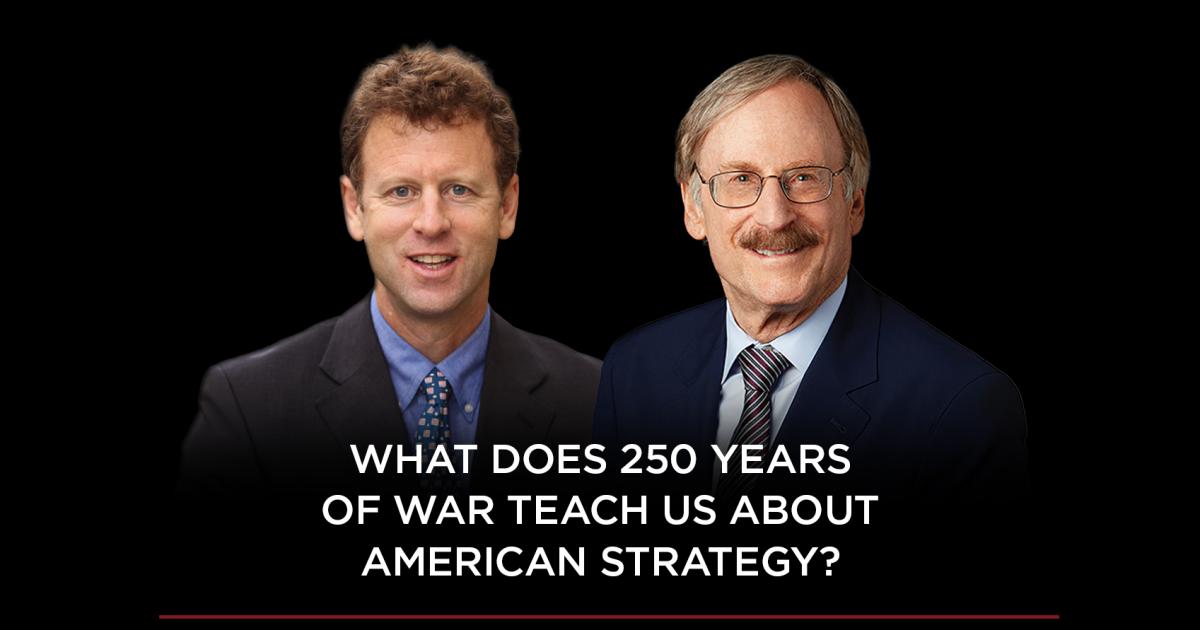
What can 250 years of American military history teach us about today’s challenges? Hoover senior fellow Michael Boskin talks with Brookings Institution senior fellow Michael O’Hanlon, author of To Dare Mighty Things: U.S. Defense Strategy Since the Revolution, about how American military strategy has evolved from the Revolution and the Civil War through two world wars, the Cold War, Vietnam, Iraq, and Afghanistan.
Boskin and O’Hanlon examine where American strategy has succeeded, where it has fallen short, and why deterrence, containment, and alliances have often proved as important as battlefield victories. They also consider what those lessons mean for today’s challenges, including Russia’s war against Ukraine, China and Taiwan, NATO, emerging military technologies, defense spending, and O’Hanlon’s case for “resolute restraint” in American foreign policy.
ABOUT THE SPEAKER
Michael O’Hanlon is the inaugural holder of the Philip H. Knight Chair in Defense and Strategy and director of research in the Foreign Policy program at the Brookings Institution, where he specializes in U.S. defense strategy and budgets, the use of military force, and American national security policy. He is a senior fellow and directs the Strobe Talbott Center on Security, Strategy, and Technology. He is an adjunct professor at Georgetown University and Columbia University, a Lampert Scholar at Colgate University, and a former member of the Pentagon’s Defense Policy Board from 2021 to 2025. His newest book, timed to coincide with the nation’s 250th birthday, is To Dare Mighty Things: U.S. Defense Strategy Since the Revolution (Yale Press, 2026).
Videos
How did Donald Trump go from political defeat and the aftermath of January 6 to a second term in the White House?
October 19, 2026
Videos
Valerie Ramey discusses how Hall’s “New Keynesianism” school of thought impacts modern economic scholarship and its utilization in practical terms, as well as her working relationship with the future laureate, dating back to her graduate-school days, when she served as Hall’s research assistant on matters like the flat tax.
October 16, 2026
Videos
From politics and economics to journalism and culture, leading voices reflect on how Thomas Sowell’s ideas shaped their thinking and continue to inspire new generations.
October 15, 2026