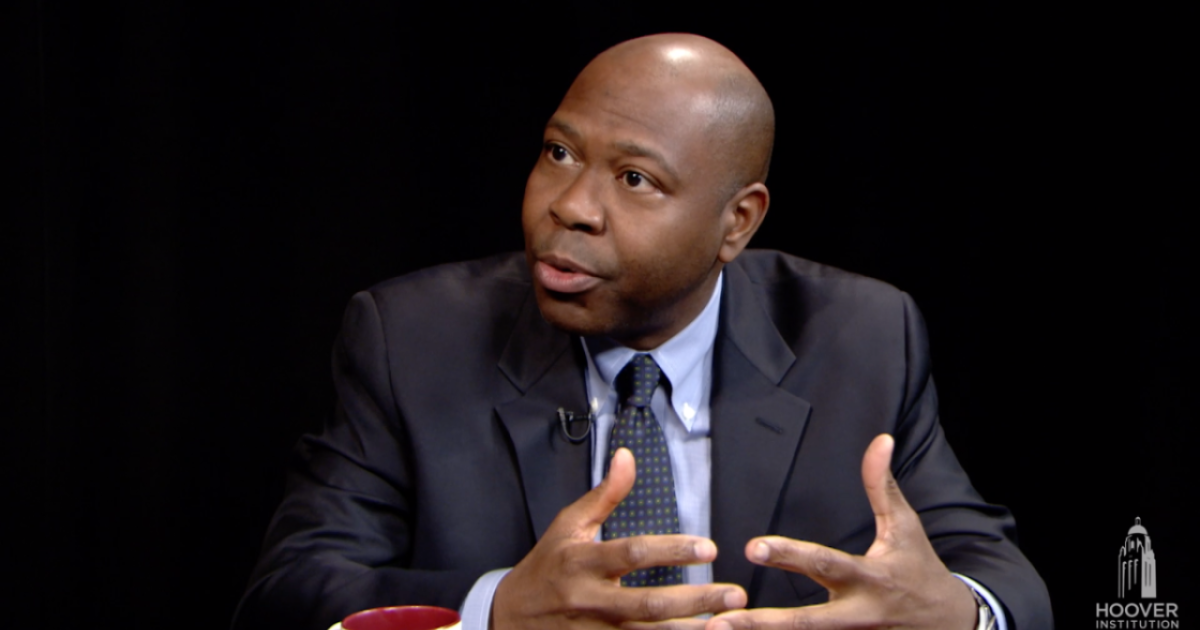
Recorded on February 21, 2019.
What is “false black power?” According to Jason Riley, author of False Black Power?, it is political clout, whereas true black power is human capital and culture. Riley and Peter Robinson dive into the arguments in Riley’s new book, the history of African Americans in the United States, and welfare inequality in black communities.
Riley discusses the Moynihan report of 1965, which documented the rise of black families headed by single women in inner cities and how this report was something black sociologists had already been writing about for several years. He argues that there was clearly a breakdown of the nuclear family and that this is a result of the “Great Society” welfare programs of the 1960s rather than the legacy of slavery or Jim Crow laws.
In the 1960s, Riley posits that the black activist community’s shift towards political engagement was misguided. He argues that the idea of black political clout leading to black economic advancement was misplaced. Other impoverished communities (i.e. Irish, Jewish, and Italian immigrant communities) at various times in American history focused on economic advancement first before trying to achieve political clout, and they were successful. Instead, the black community focused first on electing black politicians, which ended up doing very little for the economic advancement of the community as politicians typically put their own interests first, above their communities’. Riley points out that the economic data shows that black communities became more impoverished under black leadership.
Riley proposes a solution of advocating for more school-choice vouchers, which allow black parents to take better control of their children’s futures and place them in the best schools for them. He also argues for reducing social safety nets, making them a more temporary form of welfare rather than the multigenerational welfare system currently in place.
Other Resources
Please Stop Helping Us, by Jason Riley
Discrimination and Disparities, with Thomas Sowell
Stanford Hoover Institution economist targets socialism, fears ‘we may not make it’
Thomas Sowell: Politicians using race as their ticket to whatever racket they're running
Do you prefer the audio version? You can listen, rate, subscribe, review, and download on the following platforms:
Podbean | Apple Podcasts | Stitcher | RadioPublic | Overcast | Google Play | Google Podcasts | Spotify | TuneIn