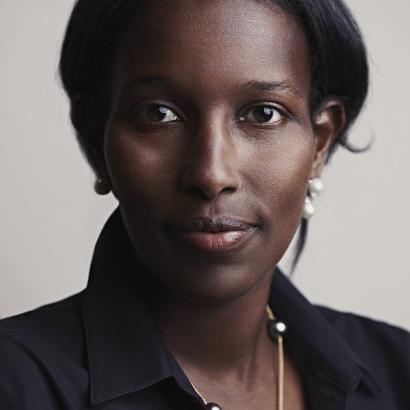
What makes Thomas Sowell an enduring intellectual leader? Roland Fryer, Ayaan Hirsi Ali, and Charles Murray reflect on the ideas and example that have defined Sowell’s influence—and why his work continues to resonate with new generations.
From individual responsibility, culture, and inequality to incentives, dispersed knowledge, and the conflict between constrained and unconstrained visions, Fryer, Hirsi Ali, and Murray explore the breadth of Sowell’s thinking and its continuing relevance to public policy and society. They also consider something deeper: Sowell’s willingness to follow evidence wherever it leads, resist intellectual fashion, and accept the costs of independent thought.
Recorded on October 20, 2025.
ABOUT THE SPEAKERS
Roland G. Fryer, Jr. is a professor of economics at Harvard University. Fryer's research combines economic theory, empirical evidence, and randomized experiments to help design more effective government policies. His work on education, inequality, and race has been widely cited in media outlets and Congressional testimony. Professor Fryer was awarded a MacArthur "Genius" Fellowship and the John Bates Clark Medal -- given by the American Economic Association to the best American Economist under age 40. At age 30, he became the youngest African-American to receive tenure at Harvard. His current research focuses on education reform, social interactions, and police use of force.
Ayaan Hirsi Ali is a research fellow at the Hoover Institution, a member of the Council on Foreign Relations, and a former member of Dutch Parliament. She is the author of the bestsellers Infidel (2007) and Heretic: Why Islam Needs a Reformation Now (2015). Her other notable publications include Prey: Immigration, Islam, and the Erosion of Women’s Rights (2021) and The Challenge of Dawa (2017). Hirsi Ali also publishes regularly on her Substack, Restoring the West, where she promotes free and open discussion in pursuit of the truth and the protection of Western values.
Charles Murray holds the F. A. Hayek Chair Emeritus in Cultural Studies at the American Enterprise Institute. Dr. Murray first came to national attention with the publication of “Losing Ground: American Social Policy, 1950–1980” (Basic Books, 1984), which has been credited as the intellectual foundation for the Welfare Reform Act of 1996. In 1994, “The Bell Curve” (Free Press), a New York Times bestseller he coauthored with the late Richard J. Herrnstein, sparked heated controversy for its analysis of the role of IQ in shaping America’s class structure. Murray is also author of Coming Apart: The State of White America, 1960–2010 (2012) and Human Diversity: The Biology of Gender, Race, and Class (2020), he describes recent developments in genetics and neuroscience that are transforming the social sciences.