Recorded on September 26, 2018.
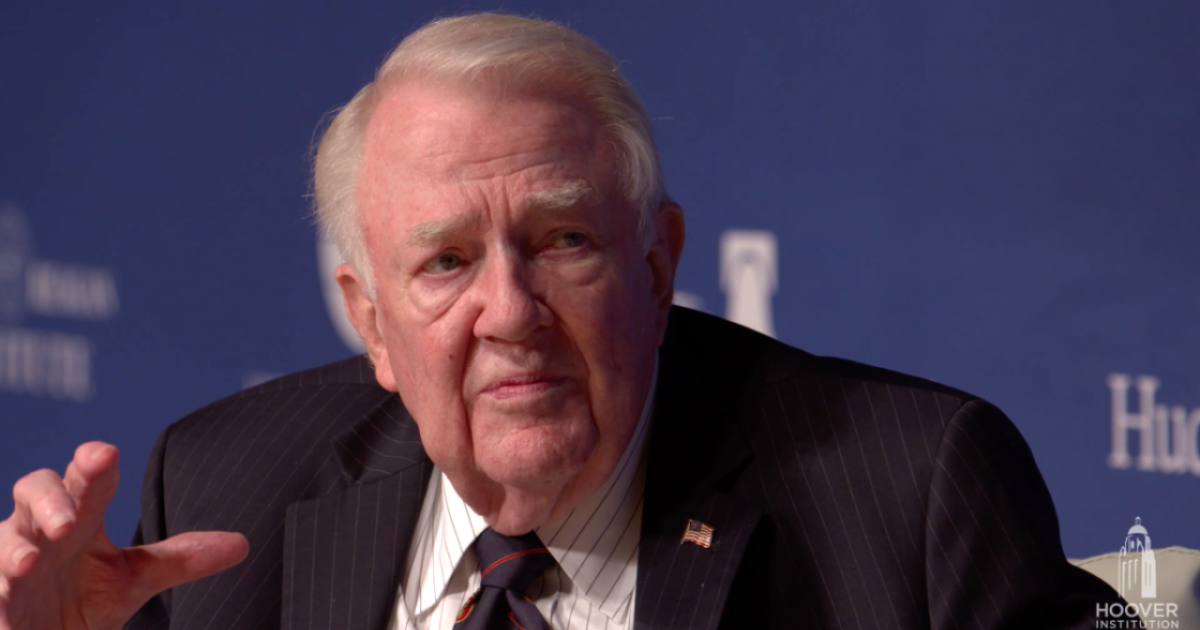
Did President Reagan and Pope John Paul II have a secret alliance or simply an aligned foreign policy strategy that helped end the Cold War? Former attorney general to President Reagan Edwin Meese III answers these questions and more in this episode of Uncommon Knowledge.
Edwin Meese III discusses how Reagan’s experience with communist factions attempting to infiltrate Hollywood’s unions while he was an actor made him uniquely suitable for handling the Cold War as president. He understood Stalinism’s techniques for spreading propaganda and had already spent several years defeating communism in Hollywood long before it was asked of him as president.
Religion in particular was anathema to Stalinism. Reagan’s personal faith as a Protestant and Pope John Paul II’s and the president’s mutual admiration and respect enabled the two world leaders to form a cooperative geopolitical relationship. According to Meese, Reagan and John Paul II had similar goals in ending the oppressive influence of the Soviet regime in Eastern Europe—Poland in particular, as the pope’s native country. The two leaders were able to coordinate their efforts to put increasing political, economic, and information pressure on the Soviet Union and general secretary Mikhail Gorbachev, which in the end helped bring about the collapse of the Soviet Union.
Meese stresses the importance of understanding history for younger generations, particularly the history of the Cold War and the oppressive influence of communism during that time. It was important to end the Soviet regime’s hold behind the Iron Curtain and free the captive nations.
Related Resources