

Published August 18, 2022

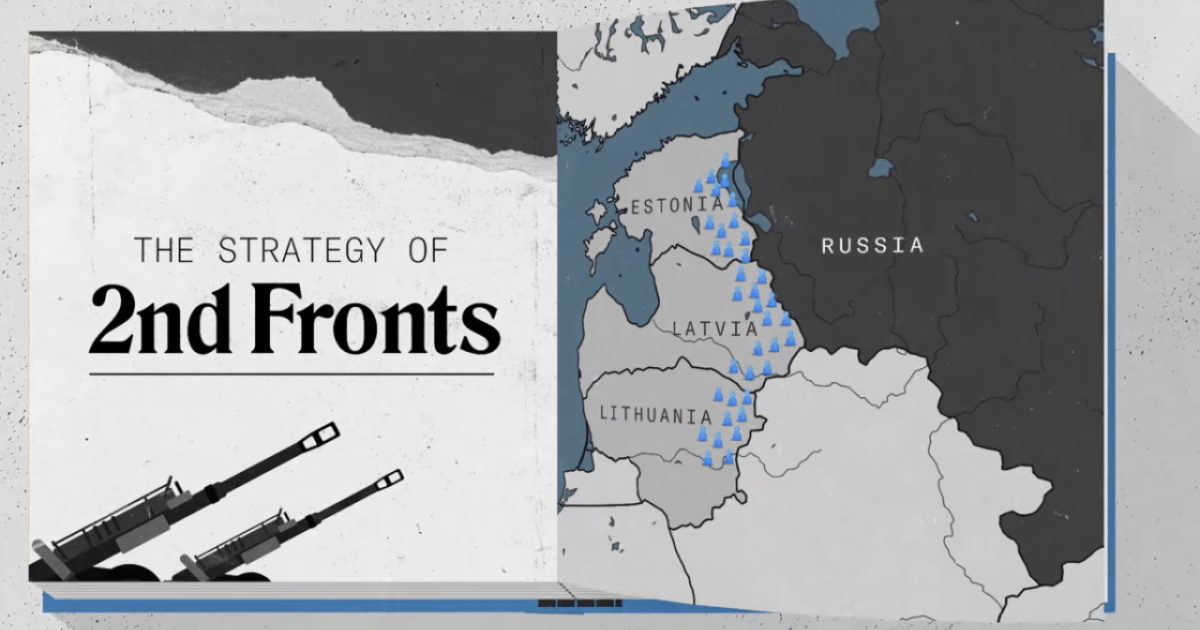
Russia’s invasion of Ukraine has led NATO to increase its resources along the Russian border. This strategy of presenting Russia with a possible second front dilutes its strength by forcing it to commit more assets outside of Ukraine. Second fronts are a common military strategy to deter or defeat adversaries by dissipating an enemy’s strength.

Discussion Questions:

  1. Do you think second fronts are an escalation or deterrent for war?
  2. How do you think China or Russia would respond to America creating second fronts?

Additional Resources:

  • Read “Opening Up Second Fronts in Great Power Conflict,” by Russell Berman and Misha Auslin via National InterestAvailable here.
  • Read “Passivity Is the Enemy of Security,” by Richard Epstein. Available here.
  • Read “Unpacking Putin’s War in Ukraine,” a Policy Insights edition on PolicyEd. Available here.

Cast

Russell A. Berman

Russell A. Berman

Michael Auslin

Michael Auslin

In response to Russia’s invasion of Ukraine, NATO military leadership and member countries announced plans to ready forces on NATO’s eastern European borders.

NATO clearly wants to build up defenses against a potential Russian attack, but there may also be another motivation – namely, the strategy of “second fronts.”

A second front forces the aggressor nation to have troops in two places at once. It dilutes their resources and fighting power in both places, which diminishes their ability to keep fighting.

Historically, this has been a successful tactic in helping to end major conflicts.

During World War II, Germany was defeated in part because it couldn’t withstand the Allied forces’ invasion of Normandy, while also trying to defend against the advances of the Red Army in the East. At the same time, Imperial Japan was forced to fight against the Chinese on the Asian continent and the Americans on the islands in the Pacific. 

Napoleonic France similarly succumbed to the combination of campaigns by Britain and Russia, as well as from local uprisings in Spain and elsewhere.

In the present, placing NATO troops and armament as a second front on Russia’s border would force Russia to make a decision: either leave its border less defended, or allocate more troops and weaponry there at the cost of degrading its ability to continue attacking Ukraine.

There are also global strategic reasons to plan for second fronts in potential future conflicts. As mainland China continues to consider a possible invasion of Taiwan to force a reunification, the United States must be prepared to apply pressure to China’s vulnerable areas near the Indian border or on the militarized islands in the South China Sea. These second fronts would serve as a serious deterrent against China’s potential invasion of Taiwan.

Second-front strategies run the risk of direct confrontations between superpowers. This risk, though, can be mitigated through reliance on allies as proxies to avoid direct confrontations with adversaries like Russia or China.

Planning and executing a second-front strategy would require intense strategy and coordination internally, sophisticated diplomacy with our potential partners, and a full commitment of US military capabilities.

But as history suggests, building the potential for second fronts is an effective deterrent to preventing and winning wars.

Related

Podcasts

Amidst “A World Of Generational Change”: 9/11’s Lessons And Legacy

The 9/11 attacks on the US were 25 years ago this week and, while there hasn’t been a second such shock, questions remain as to the Free World’s preparedness, whether a divided America can rediscover unity, and the strength of international alliances. Phillip Zelikow, the Hoover Institution’s Botha-Chan senior fellow and executive director of the 9/11 Commission, discusses lessons learned from the attack.

September 11, 2026 • 0 Min Listen

Articles

Twenty-Five Years After 9/11: A Call To Serve

For many Americans, 9/11 changed us in profound ways. The images of planes being flown into buildings, of desperate people jumping from the Twin Towers are seared into our memory. Few can understand the hatred that led nineteen hijackers to intentionally take thousands of lives.

September 8, 2026

Podcasts

25 Years After 9/11: Are We Safer?

Hoover Institution fellow Philip Zelikow explores whether America is truly safer today than on 9/11, how terrorist threats have evolved from centralized sanctuaries to online radicalization, and why conflicts in Gaza and Iran may not drive terrorism the way many assume.

September 2, 2026