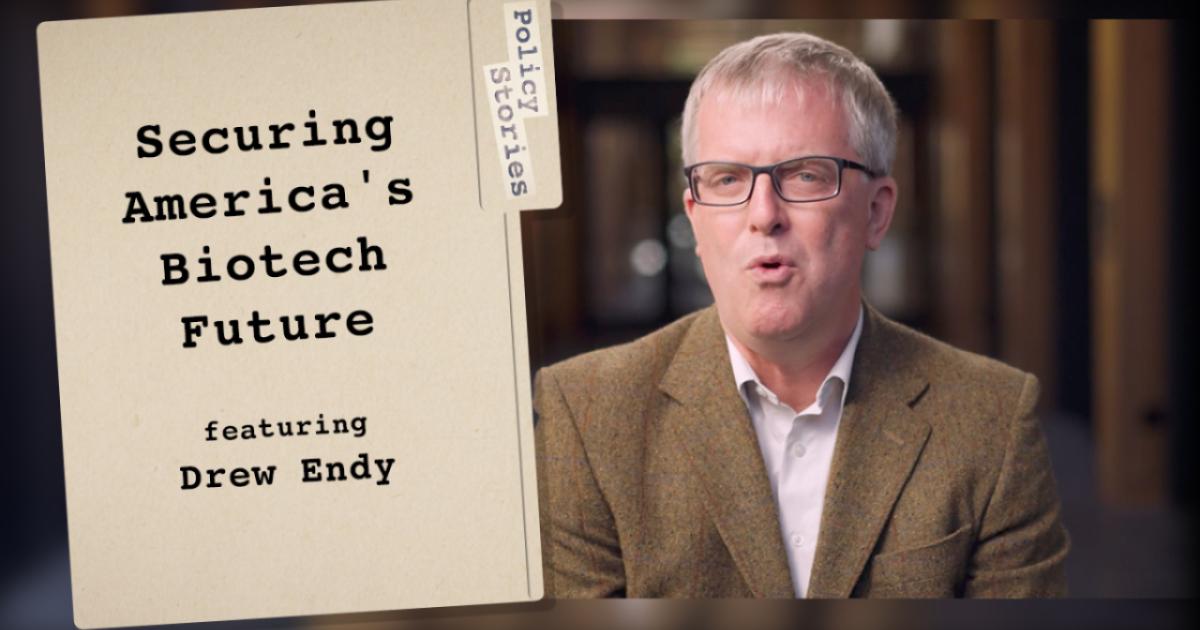
Securing America’s Biotech Future

Published December 1, 2025

Biology is rapidly becoming a general-purpose technology with far-reaching consequences for economic competitiveness and national security, placing the United States at a pivotal moment. While China advances with an all-of-nation strategy and world-class facilities, America risks forfeiting its longstanding leadership without decisive action. Three imperatives define the path forward: foundational investments in biotechnology infrastructure and standards, securing biology through biological intelligence and modern biodefense capabilities, and expanding nationwide access to biotech education, tools, and capital. Acting at scale will determine whether the next century of biotechnology strengthens American prosperity, security, and freedom.

Check out more from Drew Endy:

  • Read "Securing Our Nation’s Biotic Future: Ten Investments to Make Today" by Drew Endy here.
  • Read "Biosecurity Really: A Strategy for Victory" by Drew Endy here.
  • Watch "The ethics of science: How do we balance progress with safety?", a podcast with Drew Endy here.

Visit Drew Endy's profile here.

__________

The opinions expressed in this video are those of the authors and do not necessarily reflect the opinions of the Hoover Institution or Stanford University.

© 2025 by the Board of Trustees of Leland Stanford Junior University.
Cast

Drew Endy

Drew Endy

Related

Articles

Data Center Siting And Community Opposition

Where data centers locate to fuel the growth of artificial intelligence (AI) is of burgeoning political importance with economic and environmental implications. We highlight local factors associated with siting and opposition.

November 3, 2026

Event

Money and Power: Historical Lessons for Stablecoins and U.S Dollar Dominance

The Hoover Institution Economic Policy Working Group hosted “Money and Power: Historical Lessons for Stablecoins and U.S Dollar Dominance” with Michael D. Bordo, the Duncan Stewart Distinguished Visiting Fellow at the Hoover Institution.

April 23, 2026

Articles

We Just Created More Than 1,000 Synthetic Controls To Study California's $20 Fast Food Minimum Wage

Synthetic control methods hold the promise of identifying a credible counterfactual by closely reproducing pretreatment outcome paths. Their reliability, however, depends in part on how effectively they constrain researchers’ less-visible degrees of freedom. We explore these methods’ sensitivity by constructing 1440 plausibly defensible specifications to estimate the employment effect of California’s $20 fast-food minimum wage. While over 96 percent of the estimated employment effects are negative, the range is vast, illustrating that synthetic control methods are sensitive to specification choice.

October 30, 2026