Articles
A Golden State Of Housing Shortages
California wants more homes and less carbon. Its most powerful environmental statute often delivers the opposite of both.
November 16, 2026
Published January 19, 2026
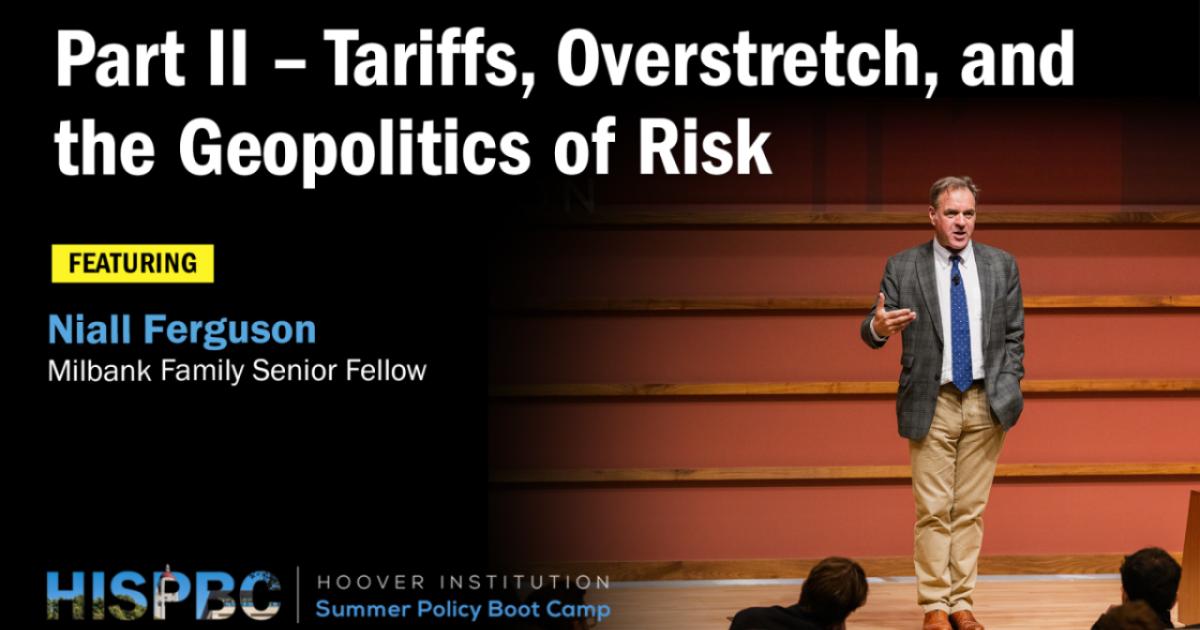
America’s renewed turn toward tariffs seeks to restore industrial strength and reduce trade imbalances after decades of globalization. Yet efforts to rebuild domestic production bring risk of slower growth, supply-chain friction, and higher costs that ripple through a tightly connected world economy. Across the Pacific, China’s expanding industrial capacity and coordination with Russia, Iran, and North Korea signal a more consolidated counterweight to U.S. influence. The central question is whether protectionist policies can secure long-term resilience without repeating the fiscal and strategic overextension that once undermined previous great powers. Recorded on August 14, 2025.
Check out more from Sir Niall Ferguson:
Learn more about Sir Niall Ferguson here.
__________
The opinions expressed in this video are those of the authors and do not necessarily reflect the opinions of the Hoover Institution or Stanford University.
© 2026 by the Board of Trustees of Leland Stanford Junior University.
Articles
California wants more homes and less carbon. Its most powerful environmental statute often delivers the opposite of both.
November 16, 2026
Articles
I had the privilege of attending the Fed’s AI (or SI) task force conference, “Reading the signals: How will SI reshape the economy?” at the San Francisco Fed. The conference was live-streamed at that link, so I won’t do too much summary.
November 16, 2026
Essays
Can America's venture-backed defense sector scale? Tracking Department of War contract obligations to roughly eight hundred startups between 2015 and 2026, the authors go beyond three often studied industry leaders—SpaceX, Anduril, and Palantir—to ask: Can the hundreds of smaller firms cross from research dollars into procurement programs?
November 17, 2026