
series_item_video
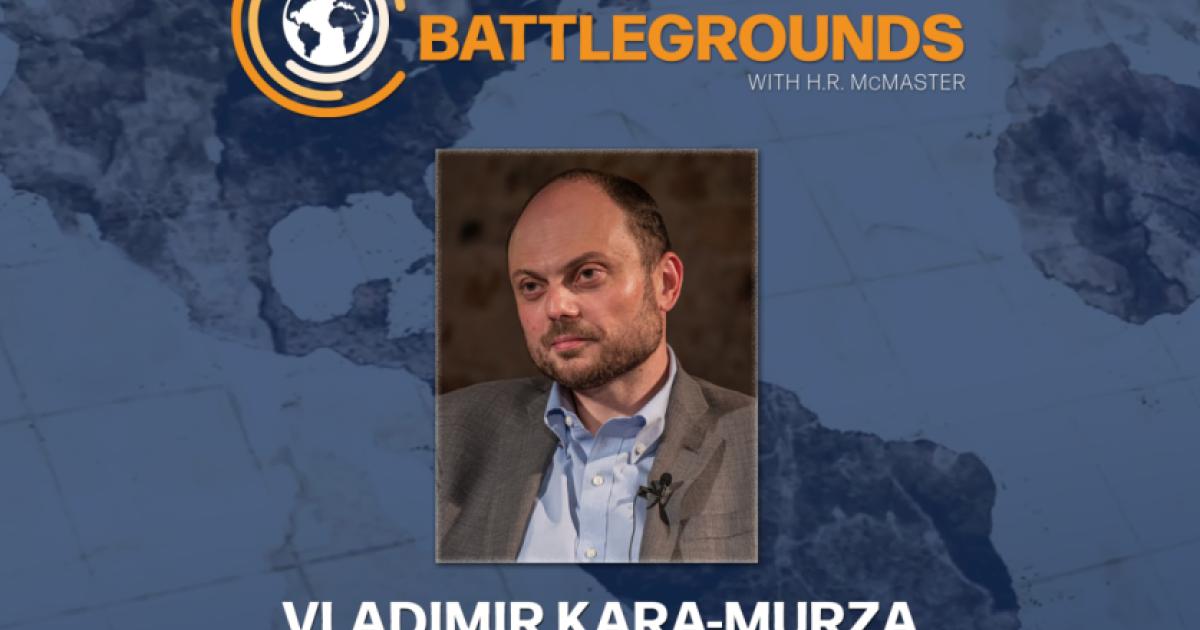
Join Russian opposition leader, historian, and journalist Vladimir Kara-Murza and Hoover Senior Fellow H.R. McMaster as they discuss the state of the war in Ukraine, the prospects and perils facing Russia's opposition, the shifting currents of Russian domestic politics, the effort to organize the Russian diaspora into a coherent political force, and prospects for a post-Putin Russia.
Reflecting on his experience as a political prisoner in Russia, Kara-Murza discusses the challenges facing Russia’s democratic opposition, the difficulty of measuring public opinion under authoritarian rule, and the West’s repeated efforts to accommodate Putin’s regime. He also considers how Western governments can support Russian civil society through targeted sanctions and access to independent information, and what a democratic future for Russia could mean for European security and lasting peace.
ABOUT THE GUEST SPEAKER
Vladimir Kara-Murza is a Russian opposition leader, historian, and journalist whose career has placed him at the center of the struggle over Russia's political future for two decades. A protégé of the murdered democratic leader Boris Nemtsov, Kara-Murza served as deputy leader of the People's Freedom Party in 2012 and helped shape the Magnitsky Act framework, which transformed targeted human-rights sanctions into a global instrument now used by the United States, the United Kingdom, the European Union, Canada, and Australia. He survived two poisonings, one in 2015 and one in 2017, attributed to Russian security services. Then in 2022, Russian authorities arrested him for publicly condemning the Russian invasion of Ukraine. Contrived charges resulted in a twenty-five-year prison sentence in a maximum security prison in Siberia, which is the longest sentence imposed on a political prisoner since the fall of the Soviet Union. He was released in 2024 as part of the largest East-West prisoner exchange since the Cold War. The same year, Kara-Murza won the Pulitzer Prize for commentary written and published in the Washington Post from his prison cell. He now sits on the newly formed Platform for Dialogue with Russian Democratic Forces run by the Parliamentary Assembly of the Council of Europe.
RELATED SOURCES
- Website for writing to Russian political prisoners
- OSCE PA report on the Nemtsov case
- Bellingcat investigation into Vladimir’s two poisonings
- Russian Discontent Made Visible via Freedom Frequency
Related
Essays
Indo-Pacific Maritime Security Cooperation
This essay explores Southeast Asian perspectives on Quad-driven maritime security cooperation in the Indo-Pacific. Through expert analyses from Indonesia, Singapore, and Vietnam, it evaluates regional perceptions of Quad initiatives based on three primary variables: initiative leadership, the character of the activity, and geographic location. It emphasizes the importance of balancing distinct national interests with Association of Southeast Asian Nations (ASEAN) alignment.
October 13, 2026
Videos
H.R. McMaster On Trump's Iran War Ahead Of The Midterms, Murphy's Claims About US Base Access
Hoover Institution fellow H.R. McMaster discusses the state of the Iran war ahead of the midterms.
October 10, 2026