











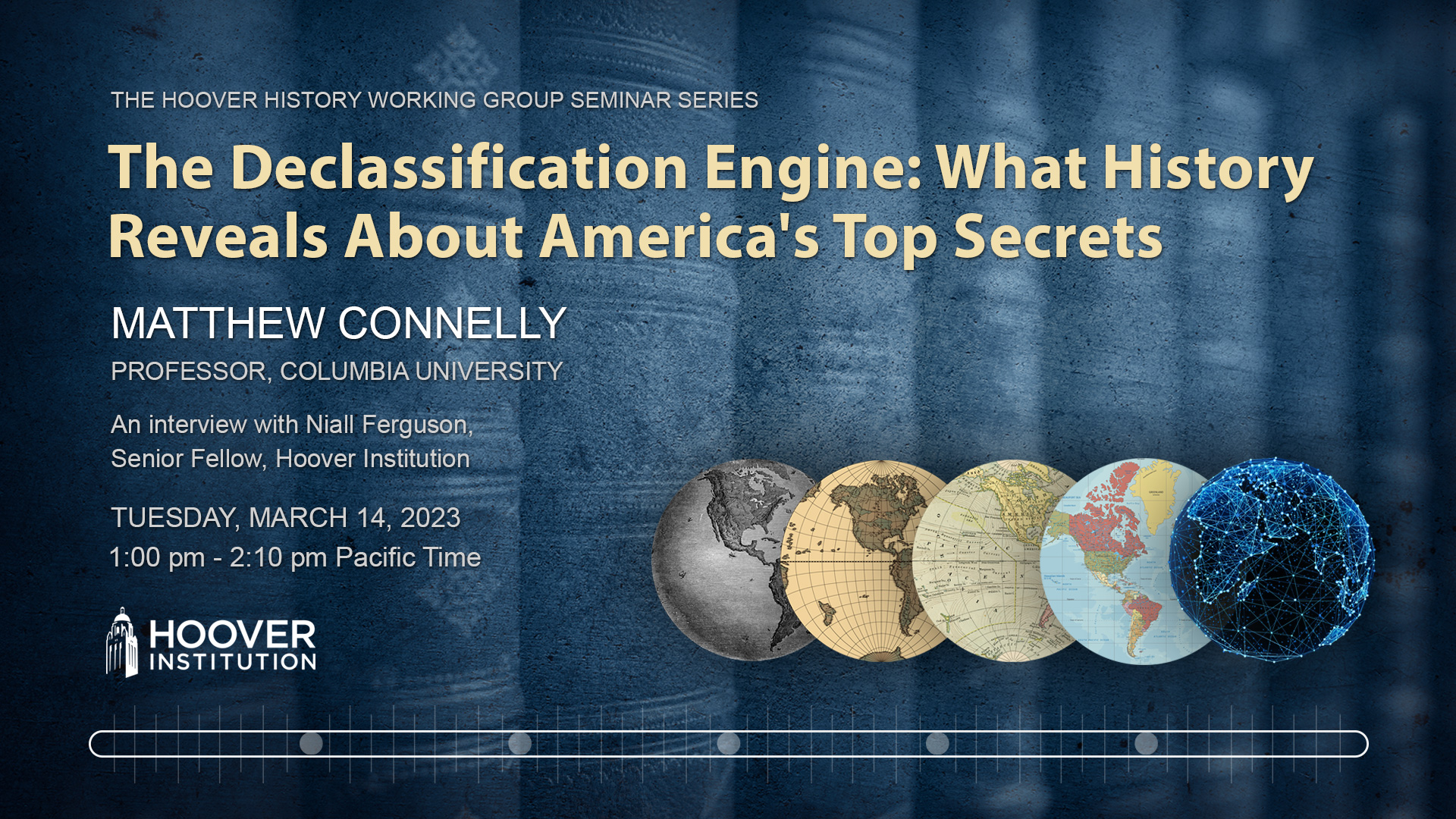
The Declassification Engine: What History Reveals About America's Top Secrets
Before World War II, transparent government was a proud tradition in the United States. In all but the most serious of circumstances, classification, covert operations, and spying were considered deeply un-American. But after the war, the power to decide what could be kept secret proved too tempting to give up. Since then, we have radically departed from that open tradition.
Using the latest techniques in data science, Matthew Connelly analyzes a vast trove of state secrets to unearth not only what the government really does not want us to know but also why they don’t want us to know it. Culling this research and carefully examining a series of pivotal moments in recent history, from Pearl Harbor to drone warfare, Connelly sheds light on the drivers of state secrecy—especially incompetence and criminality—and how rampant overclassification makes it impossible to protect truly vital information.
ABOUT THE SPEAKER
Matthew Connelly is a professor of international and global history at Columbia. He is co-director of the Institute for Social and Economic Research and Policy, and principal investigator of History Lab, an NSF-funded project to apply data science to the problem of preserving the public record and accelerating its release.
He is the author of A Diplomatic Revolution: Algeria's Fight for Independence and the Origins of the Post-Cold War Era, which won five prizes, and of Fatal Misconception: The Struggle to Control World Population, an Economist and Financial Times book of the year. He is also a commentator on international affairs for The Atlantic, The New York Times, The Washington Post, Le Monde, and has hosted documentaries for BBC Radio.
ABOUT THE TALK
Before World War II, transparent government was a proud tradition in the United States. In all but the most serious of circumstances, classification, covert operations, and spying were considered deeply un-American. But after the war, the power to decide what could be kept secret proved too tempting to give up. Since then, we have radically departed from that open tradition.
Using the latest techniques in data science, Matthew Connelly analyzes a vast trove of state secrets to unearth not only what the government really does not want us to know but also why they don’t want us to know it. Culling this research and carefully examining a series of pivotal moments in recent history, from Pearl Harbor to drone warfare, Connelly sheds light on the drivers of state secrecy—especially incompetence and criminality—and how rampant overclassification makes it impossible to protect truly vital information.