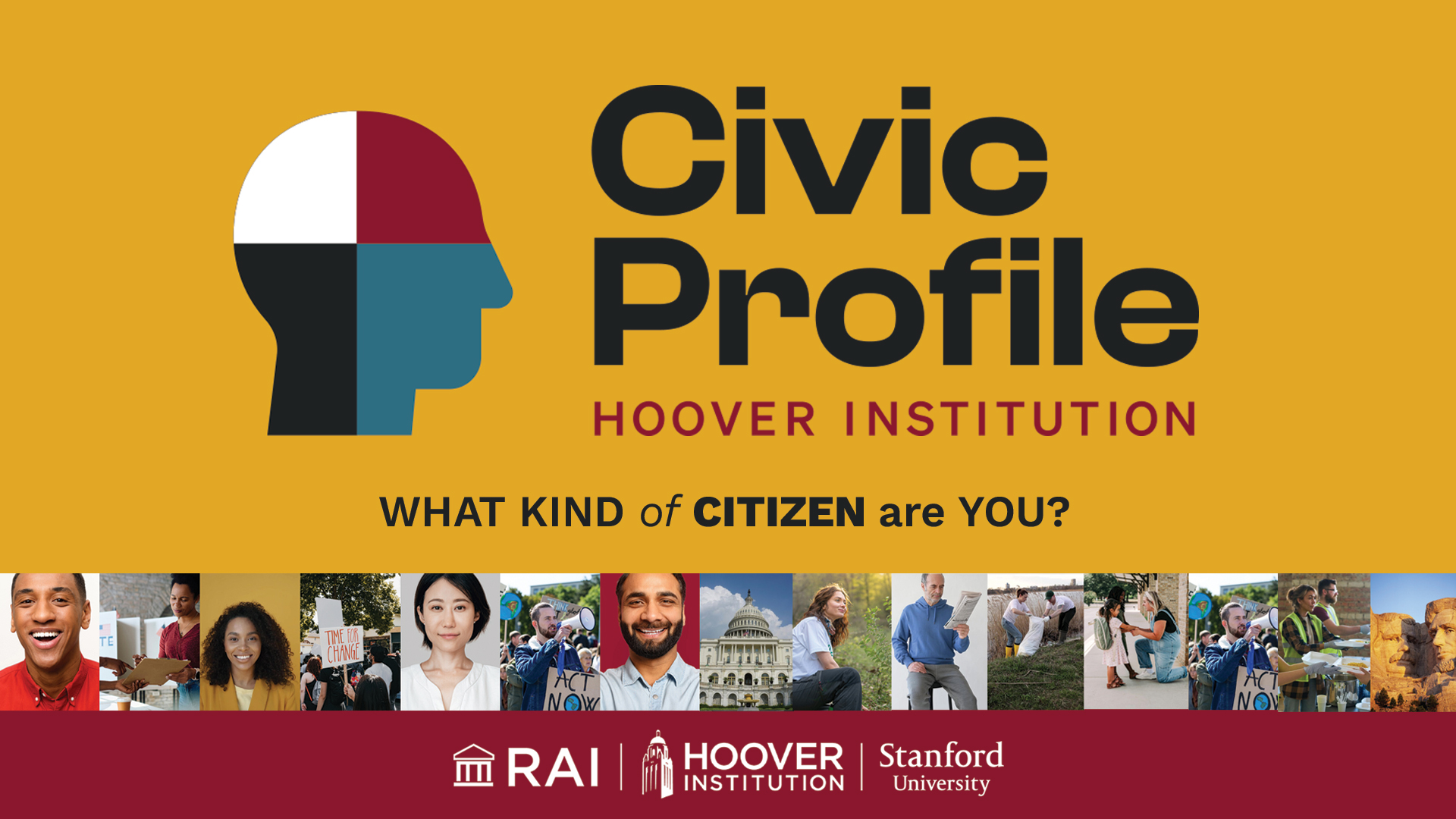
Do you know your civic identity? Do your students and your colleagues know theirs? Our webinar introduced the Civic Profile—a groundbreaking educational and research tool that's redefining how Americans understand their role in democracy. Akin to a “civics Meyers-Briggs,” the Civic Profile is an interactive quiz that holistically measures users’ civic identities across three dimensions: values, knowledge, and engagement. It doesn’t assign grades or pass judgment; rather, the Civic Profile is designed to help Americans understand that democracy requires diverse voices, choices, and actions.
Developed by the Hoover Institution's Center for Revitalizing American Institutions (RAI) and the Working Group on Civics and American Citizenship, the Civic Profile is arriving at a critical moment as our nation approaches its 250th anniversary amid rising partisan division and declining public trust. Webinar attendees hear from early adopters, get an exclusive look at the Civic Profile and how it works, and learn what the research reveals about civic identity in America today.
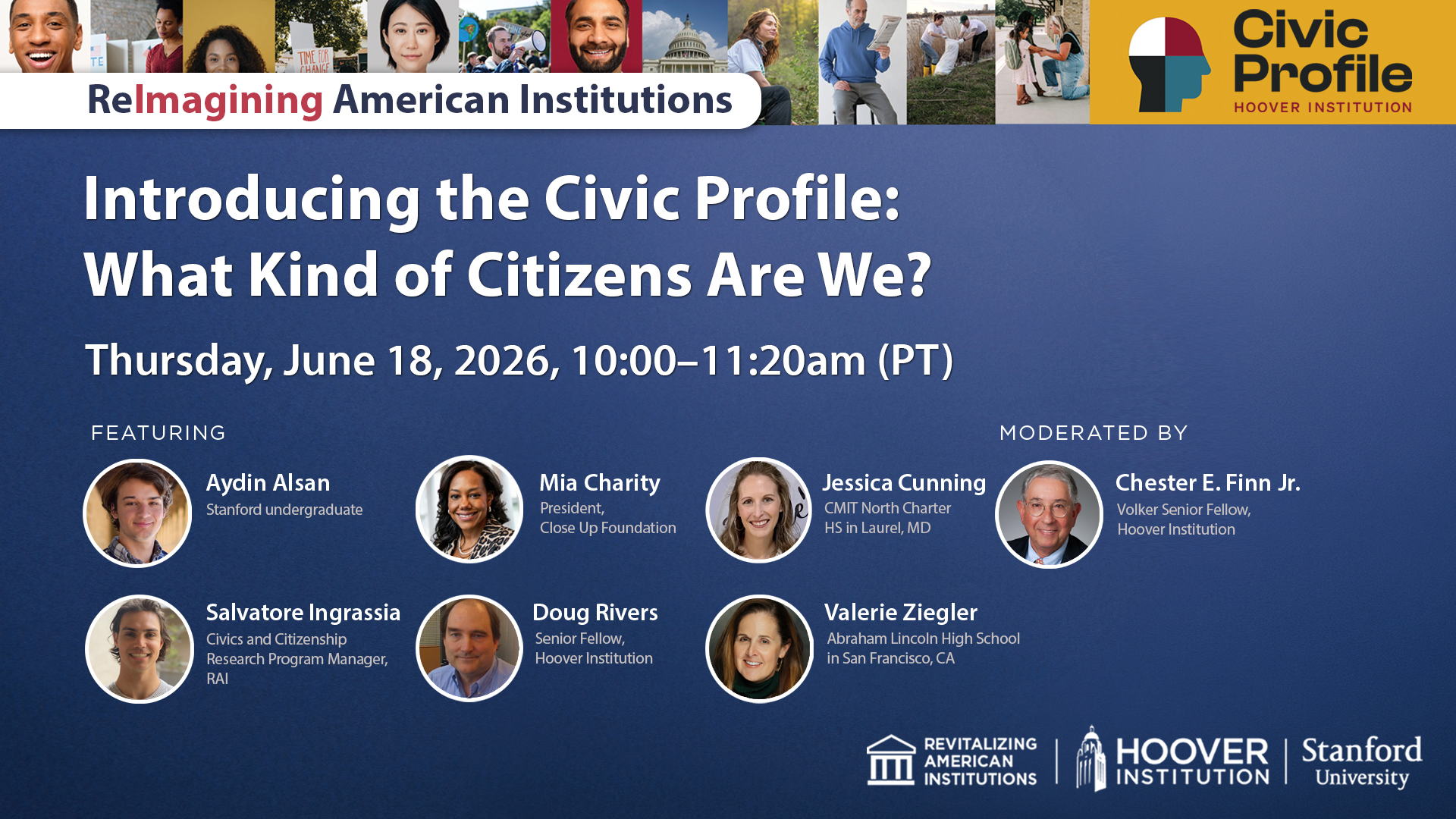
- Welcome and thank you for joining us for today's webinar hosted by the Hoover Institutions Center for Revitalizing American Institutions, also known as RAI. My name is Tom Schnabel. I serve as the executive director of RAI and I'll, I'll be the host for the today's session. Before we begin, let's review a few housekeeping items, but following brief opening remarks. Today's session will consist of a 50 minute discussion followed by about 20 minutes of q and a. To submit a question, please use the q and a feature located at the bottom of your zoom screen. While we might not have time to answer all the questions, we'll do our best to respond to as many as possible. And also a recording of this webinar will be available on the RII events page over the at the Hoover website. Within about three or four days, the Center for Revitalizing American Institutions was established to study the reasons behind the crisis and trust facing American institutions to analyze how they're operating in practice and consider policy recommendations to rebuild, trust and increase their effectiveness. REI operates as the Hoover Institution's first ever center and is a testament to one of our founding principles, ideas, advancing Freedom. Earlier this year we launched the Civic profile, an educational and research tool developed by the Hoover Institution Center for revitalizing American institutions, and specifically the working group on civics and American citizenship designed to help individuals better understand their civic identity across the dimensions of values, knowledge, and engagement. The civic profile offers a framework for exploring the many ways that Americans participate in democratic life. Today's webinar provides an opportunity to take a deeper dive into the civic profile and the research behind it. We'll examine what we've learned since the launch, hear from some early adopters, explore emerging insights about this, about civic identity in America, and share some future directions for the tool it gives me. Great pleasure to introduce today's moderator, Chester Finn, also known as Checker. Checker, is the Volker Senior Fellow at the Hoover Institution and President Emeritus of the Thomas b Fordham Institute at Hoover. He chairs the working group on civics and American citizenship within the center. We're especially honored to welcome a remarkable lineup of panelists for this session. Iden Sen, Mia Charity, Jessica Cunning, Salvatore Gracia, Doug Rivers, and Valerie Sigler. Iden Sen is a first year student at Stanford studying math and computer science. He serves as a FRO service liaison, helping members of his dorm community with civic engagement and service opportunities. MIA Charity is president of the Closeup Foundation, a nonprofit nonpartisan organization that has served more a million students and educators since 1971. Equipping young people with the knowledge and skills of active citizenship. Jessica Cunning, a nationally board certified social studies teacher chairs the social studies department at Chesapeake Math and IT Academy North High School in Laurel, Maryland. She's also taught classes in US history and in government and politics since 2010 and has been an AP government and politics reader for the college board since 2018. Salvatore Gracia is the research program manager at the Center for Revitalizing American Institutions where he focuses on civic education and democratic citizenship. Doug Rivers is a senior fellow here at Hoover Institution and a professor of political science at Stanford University. He's also the chief scientist at U gov PLCA global polling firm. And last but not least, we're pleased to welcome Valerie Sigler, a social studies educator at Abraham Lincoln High School in San Francisco, founder of the Green Academy Program, and a nationally recognized leader in civic education and historical education whose work has been featured in the New York Times. More complete bios of our speaker. Our speakers are available on the webinar webpage. Thanks to everybody for joining us today. I'm gonna hand it off to checker to get today's conversation started. Thank you, Tom. Thank you panelists. Thank you. Audience participants, this is important opportunity for a civic profile, which you can find online and when you have an opportunity@civicprofile.org, and you're gonna learn a lot more about it in a few minutes from Salvato who's gonna walk us through it. This is in many respects, the first public outing for civic profile. We've had the opportunity over the last few months to share it with some conferences and some organizations and we've, we've, we've enlisted and recruited some very enthusiastic organizations to join as partners in advancing civic profile. But what this basically is, and it's been under development for a couple of years, is to our knowledge, the first ever online self-assessment of what kind of citizen am I able to be taken by anybody in the world actually? And, and this runup to the 250th anniversary of the Declaration of America's birthday, if you will, we wanted at Hoover and through the working group on civics and American citizenship to create a lasting, usable vehicle that it enables people to call attention to their own citizenship, to, in effect check their own citizenship against a national sample. With Doug River's help and u Gov's help, we've been able to, and we will continue to do national sampling of the same questions, and that enables us to help people when they get feedback on their 15 minute participation in civic profile enables us to give people feedback that compares them with the national, with the country as a whole. This takes about 15 minutes to take and it's a, a, a very useful, we hope, mechanism for raising self-awareness about citizenship. And as we develop it further, it is a valuable tool for leaders of organizations, teachers, as you're about to hear leaders of organizations, as you're gonna hear from Mia, and individuals and classmates, as you're gonna hear from iden to gauge not only themselves, but also groups that they're part of or that they're teaching. And future developments are gonna make it even more useful actually in, in, in that context. So we think this is a durable, nonpartisan, non-ideological and non-judgmental, let me add mechanism for getting feedback on one's own citizenship across the three domains that, that Tom mentioned. One's values, one's knowledge, and one's participation in a variety of civic and citizenship related activities. So it's a a great pleasure to launch this conversation with this terrific panel. And I'm going to ask Salvato, who's been doing a whole lot of the heavy lifting on this project for, for the past year, year plus, to share his screen if he can get rid of the bay of the, of the Golden Gate Bridge for a few minutes and walk us through how it works. Sure. Thanks Checker. So as, as you and Tom mentioned, civic profile measures three components of one specific identity, values, engagement, and knowledge. So here's, here's the homepage gives a brief overview of what the tool is, a brief overview of those three components, some lovely images of Americans enthusiastically engaging in civic life. From there, you're prompted to start the quiz. So when a user signs up to to start to quiz, they can either take it as an individual or they can create or join a cohort. So as you alluded to, one of the major functions of the civic profile is not just that you get insight into your own civic identity, but you can look at yourself compared to a group. I've done this with my, with my family. We imagine people will use this as a, a classroom instrument. You can also create one so that members of your family or classroom can, can join the cohort later when they take it. So the quiz itself takes about 10 to 15 minutes. Once you are finished with it, you get this results page that goes in depth on your civic identity or what we call your civic profile. So initially what you get are sort of just a summary of your results. So some top line feedback from each of the three sections. So you can see your, your top three civic values, mine are equality, community and constructive patriotism. You also get scores on each of the three engagement styles that we measure, which I'll go into depth a little bit more later. And then you can also see what percentage of the knowledge questions that you got, correct. So if you scroll down, you can get a little bit more in depth information about each of the three sections. So here you can see your, your scores for each of these values. Now the way that we calculate scores is based on the national sample that we collected in December. So each of these scores, for example, I got 68% on community. That's not to say I got 68% of the questions correct 'cause there aren't really correct answers in the value section. But it's to say that based on our national sample, I scored about the same or higher than 68% of our national sample. If you click any of these values, you can get quick definitions on what they are so that people have a little bit of context for what it is that they're, they're seeing as their results. For more detailed definitions as well as the framework that we use, you can pivot over to the resources, or sorry, the yes, the resources section, click on values. One thing that I'd like to point out for the engagement section is that the feedback we give is not necessarily just one's, one's results on like particular activities, although we, we do ask about particular activities. We thought it would be more interesting to present someone's scores in terms of their engagement style. So the reason we, we, we tried to put forward this typology of three different types of civic engagements is one, to show people that there might be different types of civic engagement that they're more inclined toward. And the second is to present a, a pluralistic framework of civic engagement, which says there's no right way to engage as a citizen. There's multiple valid ways and we need everyone to, to contribute their part. Similar story with the values we, we measure values not as something that's, you know, some are good and some are bad. Basically to say that these are all values that we care about. To some extent the way we differ is in how we prioritize those values. So briefly I'll just go through what these three engagement styles are. The first is institutional actors. So these are people who are more inclined to engage in civic life through formal institutions. So these are things like voting, supporting a campaign, following the news. This is really engagement in the political system as such. The second is community builders. The way I like to describe is like this is kind of like my mom, like she doesn't really follow politics that closely. She's not very engaged in government, but she's the most active citizen that I know. She's always volunteering with the PTA, donating blood, things of that nature. So community builders are really people who engage in civic life through nonpolitical ways. So a lot of volunteerism and community engagement. The third category is change advocates. So this is more activist forms of civic engagement. So this would be something like protesting, signing petitions, contributing to some sort of advocacy campaign. The knowledge section measures. Basically we, we assign 10 questions randomly from the naturalization test. So with your feedback you can see the percent you got correct, if you get any incorrect, you can see which questions you got incorrect. And then as I mentioned earlier, the cohort section lets you compare your results to your cohort. So I believe I'm actually in Valerie's government class. That's the cohort that I've joined. So I won't steal her thunder by going too, too in depth into the results. But basically the yellow bar is my score and the gray bar is the group score. So you can see how I compare to this group of 17 year olds in San Francisco. So I'm a little less individualistic than they are. I'm a little more community oriented. The cohort function also lets you compare your group to the national average. So here you can see my score. And then this middle bar is the national average pivoting. Now over to the research section. So as I mentioned, we collected national data in December. So one arm of this project is as a public educational tool. The other is to provide a sense of longitudinal data on American civic life. So if you go to the research tab, you can dig into the findings from, from December from our first installment of this ongoing research project. And what it allows you to do is select the demographic of interest as well as the outcome variable of interest. So here I've selected individualism and community and we're looking at this demographic by political ideology. So the very, the dark blue bar is people who rank themselves as very liberal. The dark red is very conservative and as you can see, people are more conservative or more inclined to score highly on individualism and the opposite's true for community. I also particularly like the radar view. I think this is an interesting way of seeing the sort of assembly of values that each group has and comparing them to each other. Similar story with the engagement section. So here I have, I'm pulling up education in each of the three engagement styles. So as you can see, education's positively correlated with each of the three engagement styles that we, that we measure. And with that, I will turn it back over to you checker. Thank you very much. You incidentally, from your own, your own data don't appear to be quite comparable to anything at all. But, and I and I am going to require tutoring in how to handle the radar view myself because I'm obviously too old for this kind of technology. But I will look forward to learning more about it. But I want to turn to Doug because Doug and u gov are among the serious scholars and distinguished polling survey research organizations that have been looking at citizenship related issues forever, as far as I know. And, and I'd like to know what you've learned about, I'm gonna call it the need for something like civic profile based on what you learned over the years about the state of citizenship in America. And I got a couple more questions for you, but if you don't mind start with that one please. Yeah, so we do lots of interviewing of citizens, but this is unusual for the kind of work we do. I do a weekly poll for the Economist, which I was writing this morning and we asked people, you know, do you think we should end the war in Iran now or keep going? We asked people how they're gonna vote here we're asking people about things that aren't typical of surveys, they're basic values, fairly abstract and purposely detached from, you know, the election and what you think about the particular issues of the day. People are not in used to, you know, being asked about majority rule versus minority rights or federalism or equality and liberty, you know, so, you know, the interesting thing here for me was that people seem to instinctively understand that these are hard issues, that there are trade-offs that their competing values. And what you see is people seem to, you know, take a fairly nuanced view of the questions that we ask them. You know, our goal is to figure out how the people who come to the website compare to the world at large. You know, 'cause the people coming will be different from those that you get in the representative sample. But I would say one striking thing is at the end of the survey we ask people about the experience and to rate the survey. 'cause we ask a lot of surveys and we know what people like and don't like. And this survey scored exceptionally well. 52% of the people rated it excellent and 39% very good. That's really high by the standards of the polling that we do. And only 1% said it was poor. So I think we're doing well at this point. Thanks very much. The, we're accumulating a vast amount of data. We've obviously, you gov administered several versions of this in the development process and we're gonna continue trying to do this at least once a year with a national sample. What's the, what do you see as the sort of the, the research she side to the potential of all this data besides giving people feedback on themselves? Yeah, so there's a big debate among political scientists of the sort of conceptions that people use to think about politics. And you know, what we observe today is that you can predict most of their kind of voting and what they will come down on the issues that are in the news based on partisanship and that polarization, you know, dominates everything that happens in daily politics. What I found striking here is that, you know, people have values that are more nuanced than partisan polarization. And so I think that's probably the most exciting part of this research. Well we look forward to continuing to work with you of course at at at hoover and Stanford, but also with U gov because this is a partnership that's making the civic profile multiply useful, I think to the, to the world, not just to the individuals who take part in it, but a very valuable to them as well as to the larger, larger community. I wanna turn to Mia, who was one of, because her large important national nonprofit organization was one of the first to step up and say we'd like to partner with Hoover and Civic profile and I'd like you please to explain how closeup is and intends to use this instrument in the, in the coming months. Thank you Checker. I would just say, you know, when we first started talking to Tom about the profile, one of the first things that stuck out to us was the values piece. We very much root a lot of our work in thinking and looking at what are the values and tensions that drive our decisions and, and our thoughts about the issues that we all care about. And so some of that piece really brought it into focus 'cause we like to take some of that political, political tension out of these conversations and we know that teachers need tools for the classroom to have a starting point to have conversations with students. So we were really excited to be able to partner on this and create some, a few lesson plans to make it accessible to teachers. We also serve about 17,000 students a year on closeup programs. And so we had the opportunity to administer the profile recently to about a hundred students of a, a national collection and representatives, not a representative sample, but a, a national sample of students and the takeaways were for them on the values, civic openness and, and change. Were the main drivers of that. But we really just want there to be more conversations in the classroom. We think this is a good entry point tool to be for educators to be able to do that. Fantastic. And, and now speaking of the classroom for which we thank you for the introduction, Jessica, you've been using the civic profile. You're one of the early pilot users in a classroom with your 10th grade advanced placement civics course. Tell us what you did and what you learned from the experience. Yeah, so I had the opportunity to attend a PD for a closeup last year on civil discourse and incorporating that into the class with my 10th grade kids. And so in the springtime when this became available for us to use, they were redeveloping some of the lessons to tie more directly into the values aspect of the civic profile. So I had my 10th graders in the spring go ahead and take that test and they were able to do it individually, but then they joined the cohort so I could see their scores and like we saw, it's really cool because the kids can compare it themselves and how they stand to their classmates. But then when I jumped in and did it as well, you could see how age really plays a difference in some of these factors. And they're like, whoa, why, why are you so different than the rest of us when we're so close together? So it kind of got into some of those topics about, you know, how our values might change as we experience more life experiences. And it was really kind of cool to hear the kids talk about, well I wonder do, our parents would do. And so a couple of them got online and they said they had their parents go through and they talked about, again, experience, you know, were their parents born in the United States or were they immigrated from a different country and how that might change their take on some of these. But Closeup did a really good job with one of their civil discourse lessons. They actually had it tied to their values and tensions and so they took all the values that you guys have on the civic profile and I made them into like little flashcards and I made those purple and then I gave some green flashcards that had real life scenarios in it and the kids had to go through and just walking around here in the different groups, talk about which value does this match up to? And they all had to agree and they will place it together. And then they'd have another one, well wait, hold on, this one's more of this one. And it kind of showed them that some of these values are really close, but depending on the scenario, it could change which value is gonna be the higher ranking. And I think it really helped the kids understand exactly why we have some of these issues within our society, whether it be within their friend groups, within their families, or just what they're hearing on the news to disconnect from where they are to something else happening. It gave them that real life hands-on like, oh, this is real, this is why. And it was cool seeing, you know, the discussions that were going on. I mean, they just opened up a whole bunch of stuff that you don't think about as a teacher until you start putting it on in the kids' hands. Thank you. Using it as a discussion starter and as a kind of supplement to what teachers would otherwise ordinarily be doing and giving and giving students feedback on themselves and treating the feedback on themselves anonymously, such that nobody else sees the individual's score on anything. They see their own, but the leader of the cohort sees the diversity, the range, if you will, of, of, of results in that group, be it a classroom or an organization. These are some pretty neat features I think built into it. And you just gave a very good example and the the next version we developed that we are developing is gonna make it even more useful for teachers. But let's hear from another teacher, Mallory, and I believe you've got a few, a few slides to share on your screen, but tell us how you've been using it Here, a little bit about it myself. So as Tom mentioned, I am a AP US government and politics teacher in San Francisco. I had the chance to learn about this at the Civic Learning Conference in Philadelphia. And right away I thought, oh, this is something that I wanna do in part for two reasons because I am teaching a PUS politics and government Unit four is all about political socialization and students need to get this understanding of political socialization and where we get our, our ideas from and how you know, our lives and that the circumstances and places that we live can can influence that. So that was my first piece. And then the second piece is that I am actively working to bring the seal of civic engagement to S-F-U-S-D. We have that in California and we don't have it in our school district. And so to me this was the perfect way. So I actually did it with two different classes and well, Jessica's teaching 10th grade, I actually have 12th grade and my students are in career technical education programs. And what was really interesting to me is that I have two different cohorts, one that is in our, our business sector, their entrepreneurship program, and the other is in an environmental cohort and, and career pathway. And you can see even within students in the same school that the, the results were slightly different. And so that was really interesting to me just to see how different it was just within this little pocket of our school. So the way that I did this is I had the students take the quiz and I started with that and then before they had any discussion, before they talked to anybody, I had them just sort of look at the results and share something that surprised them. And here's some sort of quotes, I won't read these to you and I saw it in the, in the chat that this will be shared, but it was interesting to see how, how surprised they were by some of their results after students individually reflected then what I had them do, we projected the cohort for point of reference Salvatore is in the business program. His results were entered into my business class and then I had them think about the, the data for our cohort. And again, it was really interesting to see the difference just between the environmental career pathway program and the entrepreneurship, just particularly in the amount of engagement in the community that those students had just by virtue of being an environmental program and doing a lot of volunteering and a lot of workout side of the classroom. And then lastly, I think I asked the question sort of open-ended, what do you think the data can tell us? Because again, that ties to the unit four and a PUS politics. So this was my first time using it and I'm really excited for what this can do specifically for AP politics teachers, I in the past have used the political spectrum quizzes, doesn't give us a lot to discuss, right? It just sort of puts you on the spectrum. Some of the questions are so nuanced and kids would have all of these questions and this one felt just more realistic and more useful to discussion in the classroom. So I'm excited to see where we can use it going forward as well. That's really neat. I I did a very quick eyeballing of the, the student reactions that you asked for right after they saw the results. And I noticed that some of them with values, some of them dealt with engagement and some of them dealt with knowledge. Somebody commented, they were surprised that they had forgotten the name of the chief justice, for example. Somebody else was surprised by how many organization, how many engagement organizations they themselves were involved with. Yeah. And that was really different between that environmental science group and then the business group because those that, you know, have been doing environmental work for three years in high school have tons of engagement in the community and the others didn't. So that was really interesting to me too, to see how that also framed their view of themselves and how they, they sort of fit into those categories. Jesse, let me come back to you for a second on that, on that point, did, did, were your students surprised by their own results as, as well as discussion of the group's results? They were. So my kids are a lot younger. They weren't able to do a lot of the involvement in the community, but they are really big when it comes to getting service learning hours. And so they're thinking about how they could kind of switch up what they do to kind of get more involvement in the community. And so relying on just that one community that they usually reach out to. But yeah, they were really kind of okay. It was April and I got really started when they forgot the Supreme Court justice, but just so you know, my kids did too, so we're all kind of in the same boat, but they were so mad they got to the point where like, I knew this stuff and then it was like, put on the spot and they're like, it's changed as it goes through. So it was, it was cool to see their, like I said, the things they thought were cool. So both of you right now, the the, the technology of civic profile is a snapshot in time and one of the things we're hoping to develop, planning to develop in the next version and will enable sort of before and after scores results to be compared. Would that, so for example, at the beginning of a course or a segment or a week or an hour and people could do it twice basically and see if there's, if there's a difference, would that be beneficial to you as teachers to have that feature? I think it'd be really cool to give them to the beginning of the year and then right after the AP exam to kind of see that the more knowledge they have, the more they understand and how that can impact. So showing like the growth not only in their knowledge, but also how it changed their personality. I think it would be a really cool thing not only for us as educators to see, but also for the kids to realize how impactful these can be To the change in, to see the change in themself. Absolutely. And you know, part of the AP government class is that the last thing that they complete is a civic engagement project. And so, you know, by nature of taking this class, you should be more civically involved. And so it would be really fascinating to see as a result of taking this course. How has your civic engagement changed and just in, I'm only have a semester, so just in those quick four months, how much has that changed? I think it'd be fabulous. M mia are you hearing the, the kinds of uses and potential that you were, are hoping and intending? Absolutely. We're, we're really excited about the opportunity to do the pre and post because I think it really does prove to the students and even in themselves in a short amount of time, it's okay, right, for you to evolve and change your thinking. And I think having a measurement that maybe points that out to them is helpful in how they think about our institutions and, and how they apply that to all of the things and issues that they care about. So I think that utility will be a good benchmark for them to, to reflect and think about, you know, I thought this was a really big priority to get involved, but my score's not showing that I, I I'm getting involved as much as I want to, so maybe I should go do some more of those, those hours or, or go into the community a bit more. So just a self-check on yourself too. Like, I thought I was out in the community, but maybe I should be doing a little bit more. So I, I think it's wonderful. I think it's a great tool. I'm excited about all the new elements that will help make it digestible for teachers and show growth for students. I appreciate your emphasizing the sort of self-awareness aspect of this. 'cause one of the things that we, we, we, we wanted to do, especially during this semi quincentennial year of the declaration is to consciousness raise people, focusing, thinking more about their own citizenship, both their engagement but also their knowledge and, and, and how they stack up on these various values, which are, which are as, as Doug said, very nuanced for many people. They're not opposite poles of things so much as they're, how much of you as an individualist on which issues and how much of you as community minded and on which issues and people can harbor both thoughts at the same time and be both kinds of people in different ways. Iden, you're, you're nodding in agreement and you, you, I know you used this during your, your first year at Stanford with your peers. Tell us how you, how you used it and what you learned from it. Yeah, so I first encountered the tool actually in the class that Tom taught. And In this class and in this class we took the test and we looked at our results for our cohort and what we ended up finding, or what our immediate first thought was, was something that we kind of all knew inherently. And that was this idea that you're just talking about, that we aren't limited to a single value or characteristic. And I actually think that's one of the main utilities of this tool is actually the fact that it helps kind of challenge that mindset. It makes us realize that, you know, there are multiple values and characteristics to each individual. I will also say this isn't true for just the value section either. A lot of the students that I worked with remarked to me that in the engagement section they found that, well, I thought I could work just through institutions by being involved in politics in kind of a more traditional sense. They realized that they could actually get involved at the community level as well. And that also counted as a form of civic engagement. And I think a lot of students didn't realize that coming in. The most prominent piece of feedback though that I heard from students is something we've actually just touched on, which is this idea that a lot of students use the tool more as a benchmark in the sense that a lot of the conversations I had with the students that I worked with in the cohorts that I had were, I'm not involved in X whether that be voting or volunteering or something like that, but I want to be, a lot of students expressed the desire to get more engaged civically, but they didn't exactly know how. And actually there were a couple of students who said that the civic profile through the questions about volunteering and voting actually gave them a clear action plan for how to get more involved civically, which I found really encouraging as well. And perhaps even more interesting, I tried this on three different cohorts. One was just a general group of freshmen at Stanford, another was a group who were in the same service liaison program that I am in. So they're focused on public service and a lot of them are already involved in civic engagement. And the final group was individuals who had self-reported no civic engagement in the past and across all three groups, I received the same comments that people wanted to be engaged and actually came up with ways to be engaged if they were already engaged in something related to civics, they found additional ways that they can get involved. Maybe they had voted already, but they wanted to volunteer and if they weren't engaged at all, they spoke a lot about the importance of becoming more engaged civically. And overall, I'd say, I guess the feedback was very positive from the students. I mean, this is something Mr. Rivers was just talking about, but I heard really no negative comments whatsoever. The only thing actually that students mentioned was that they wish that they could go back after graduation and see how their values had changed, but it seems like that tool is exactly what's being added. So I'm very glad to hear that. But yeah, that's mainly the insights we had from my cohorts. Let me, let me just underscore that we're talking here about college students. Most people when they think about civics education and the use of something like this in education are thinking K 12. And often they're just thinking about high school civics courses. These are college students that IDEN is talking about. And we are really excited about the potential use of this instrument in not just in college courses, which there are fortunately a mounting number of civics type courses in more and more colleges, which we need as a country I think, but also student organizations for example, and other other ways in which college students gather together besides classrooms. And I think you're, you're talking about those as well as the, the, the classroom use. So you got three more years of college unless you speed up. What are you gonna do with it next year in the coming year? I think I'm part of a couple clubs. One is Stanford and Government, which is a club that specifically focuses on ways for students to get involved in government related tasks and work perhaps in government in the future. And I think it would be very interesting to help them. They have a specific branch that focuses on voter engagement and things like that called Stanford votes. I think it would be very interesting to employ that tool there my sophomore year because I'm a part of that branch to see, you know, generally or maybe do a survey of the entire Stanford population to see how people are getting engaged, things like that, using that organization. I think that's something I would be excited to do. Terrific, thank you for that. We're gonna move to questions from participants around the country or perhaps world very soon. But before we do that, I want to go back to Salvato and the Golden Gate Bridge and ask him to outline what's in the works for civic profile under development and in our plans. Yeah, so leading up to the next academic year, we've got a couple of plans. The main thing, you know, as we've socialized this tool around various civics orgs and teachers, the main feedback we've gotten is that they'd like to see a version that's specifically dedicated for educators or uses in a group context. So at the moment we've got the cohort feature which allows you to, you know, compare yourself to a group and the group to the national average. What we're developing, what we're we're calling the 2.0 version is going to be a little bit more in depth. So a teacher, for example, can create, you know, become an account administrator and create a a group profile and track changes over time. So the idea being they could distribute a code to all of their students, have them take it at the beginning of a class, take it again at the end of the class. And from the teacher's point of view, you can actually see the changes over time within one profile. We're also hoping to make it modular so that teachers can adapt it to their specific teaching goals. So for example, if there are particular values that are not necessarily of interest in the context of an AP gov class, teachers could remove those for the knowledge section. If they don't want 10 random questions from the naturalization test, they can select questions from the naturalization tests that are specifically aligned with their, their teaching goals as well. And then we also want to include other, you know, important civic outcomes, skills and dispositions that you want to see improve over the course of, you know, a a class. So this would include things like political efficacy, the sense that you can make a change or tolerance for disagreement, for example. Beyond that, we are also hoping to really hone in on the research side of this project moving forward. So now that the tool's been out, we've gotten some feedback about the survey design we're hoping to implement, implement some changes that'll make it a, a genuinely useful tool for both the public and and researchers. So over the summer we're refining our, our survey batteries that we have right now improving their validity. We're also entertaining the idea of adding additional values to measure. So for example, we've pretty much, as soon as we launched the tool, we've thought to ourselves, how do we not have a value on free expression, for example? So we're receiving feedback about what else we might measure. The idea would be to launch both the educator version and our next national sample in early August. On the research front, in addition to just measuring national samples of adults, we also want to measure high school students. So this will involve tailoring some of the engagement questions more towards students. For example, most high school students can't vote. They're probably not donating a whole lot of money to charity, but there are forms of engagements that we would want to measure, for example, involvement in student government. Terrific. It's a lot of work incidentally, and there's a a lot of activity on this front and as you can see, we're not sitting still. We're gonna move in this webinar toward questions. We've got a couple of them already. Let me, let me say to everybody watching that, if you've got a question for anyone on the panel or the panel, generally there is a q and a button at the top of a screen. There should be. And that's the place to ask your question. And Tom is watching them as they come in and passing 'em along to me to, to throw at the panel. So let me encourage people with questions to write 'em down and throw them at Tom and he'll throw them at me and we'll see how many we can, we can deal with in the remaining time. But we've got one, let me start with from Annie who's, who writes, we find first generation teens and others who have been marginalized are unlikely to respond to civic opportunities given their exclusion historically until they are invited in by a trusting pers trusted person. How does this tool address the differing starting points in the us? I am going to throw that I think to Mia and our two teachers on the assumption that they are trusted persons in their respective environments. How, how can this benefit people who often feel excluded and, and, and don't tend to wanna participate in civic related things? Is this, is this a, is this gonna be of use in that regard? Anyone? Mia, Jessica, I'll, I'll start and just, I'll just start and it, I think it opens the opportunity because maybe they are things that you're not thinking about, just like we talked about and you know, what, making a judgment or a gauge on whether you need to get more involved or thinking that you are more involved than you actually are. If you don't know that those are opportunities exist, maybe this helps prompt you thinking about the ways to engage. I do think what Annie's saying in terms of an, a trusted person from the community making a real difference to, to make you to take that leap, but just the awareness also of what those opportunities could look like for engagement when you're thinking, okay, for immigrant families, right? Like, this maybe doesn't apply to me. Well yes it does. You, you can be a active community member, an active citizen in your community without voting, just like we're saying for young people. So I think that prompting of the idea that you could be doing more in community to be a good citizen is, is a useful starting point. Okay, Thank you. And as a teacher, I think one of the best parts about it right now is the fact that it is kind of anonymous. While we do see all the results as part of the cohort, I don't know what each individual student answered to get to that bar that shows the cohort together. So I think it's kind of a cool way for the kids who might not realize how involved they are to not feel the pressure of having to impress everybody else because at the end of the day, they have to be on their screen to see the results and all that everyone else sees is the individual versus everybody else. So it kind of gives them that assurance of like, oh, I don't wanna be embarrassed by not having done x, Y, Z because it's not calling them out. So it's, it's safe in that sense, yeah, to participate, you learn about yourself, but you don't embarra risk embarrassing yourself in front of anybody else. And then nine times outta 10 they realize that they're more similar to most of the classmates than what they thought. So that trust kind of gets built in like, okay, I'm not behind or I'm not, you know, behind everybody else. I'll just add that it also, you know, it facilitates the discussion that Jessica was talking about. And so in my classroom when we were having those discussions or in in students in their, in their small groups and tables, they were specifically discussing about ways to become engaged and one student said, I don't really do anything. And someone said, aren't you working the election in June? And they hadn't even put that together as civic engagement, the fact that they could work that election. They thought, I'm just getting paid, but they didn't see this like sort of correlation. So also having those discussions can tie those into, tie those ideas together. And again, if we were to start this in the beginning of the semester and revisit, you know, there is the potential to see that those opportunities and students connecting those ideas of civic engagement. The, let me, let me pause and to Tom suggested that we pause on this for a second on the, an anonymity issue, data privacy is of concern to a lot of people in this country and should be, and it's legally protected as well in a variety of ways, particularly for students. Salvatore, let me throw this back to you. As we, as we, how are we, how are we ensuring that individual's data remains private? Yeah, so I mean on the current tool, our team does not have access to anyone's results. So the, the data is stored locally in the individual user's browser. So I can't on the backend go in and see who scores what on their values or engagement section or more embarrassingly the knowledge section in the upcoming educator version educator will, will enable data storage that educators can do pre and post, but all of the data will be de-identified from individuals. So as with the current version of the tool, a teacher can see the cohort and see those distributions, but they won't be able to know this is, you know, Johnny's values, they'll just see the group at large. Doug, you probably aren't expecting this question, but I, you, you and u gov must have a lot of experience with anxiety about data privacy. What, what council can you offer to reassure people who might have anxieties on this front? As you know, one of the things we go through at Stanford and all our research is A IRB internal review board that insists that data be anonymized. So we don't have access to any personal identifying information. You go when it collects data from people has a privacy agreement that allows them to give us the data but not the actual names and addresses and emails and things like that, that would allow us to connect the data back to individuals. And we're gonna ensure that that works on the, especially as we move into a high school centric version of, of this instrument and the additional concerns that certainly federal law has about student student education, data privacy. Thank you. I'm gonna, Valerie, your students are not AP classes, are they? All of them? The ones you've been using this with? Both classes are AP classes. Okay. But I will say, so it's a little bit different because that's just everyone gets into the ap, they didn't actually self-select to, It's a, it's an automatic open enrollment ap. Yeah, exactly. So it is a, I would say probably a more diverse group of AP students than the traditional AP gov classes. Yeah. And then other AP classes at our school. Just for point of reference, I did see that comment in the chat. Yeah, Cal was, was asking does anybody have any, any examples with the general high school population as opposed to a AP courses classes? Mia do you We don't have it yet, but as Tom mentioned at the beginning, we're doing a national deliberation with 401st time voters and that will be an a national representative sample. So we will have a good mix of public private charter schools where we, and we're planning to administer the civic profile with Tom. And so we'll, we'll be able to parse out some of that information and, and share that with you. Okay, great. Because this is intended for, this is not intended to be an an a leader exclusive instrument and indeed many of the organizations that we've been talking to, like, like yours have talked about the variety of populations that, that, that they participate with and potentially can use this with Jessica. I dunno how AP works at your school, but in terms of who, who, who, who enters it, do you have a relatively diverse population of students in these group, in these classes? So the AP one, no, but I did actually have my non-AP 10th grade class take this. And it was interesting to see that they're very similar. I think just because the region and the age group you might see a little bit higher when it came to some of the engagement and the knowledge part than the regular courses I was teaching at the time. But when it came to this big values, I think because they are so unique that it doesn't really matter the level of education that they were in. It was just a life experience that played a, a big role in their decision making Not so different. That's really interesting. That's really interesting. I want to go back to a, a original question from Annie actually, which was the, the potential use of this tool as part of a pipeline of getting people interested in careers in civics related work. Do is anybody on the panel looking at UI and also also see this as a a, a kind of a apprenticeship or recruitment device or training device or educational device that might cause individuals to wanna devote some larger part of their next phase of their life to work in this realm? I think it's really, we haven't thought about this one. Yeah, I think going back to what we were talking about earlier with kind of the civic profile as a measuring tool and as a way to look at our own engagement scores and see where we're lacking, I think that can also be true about looking potentially at careers like in the long term. It doesn't necessarily have to be just about voting or volunteering, but also what you do in the future. Maybe you can see kind of that, you know, maybe before you thought, oh, if I do something related to the community, I'm not very involved in civic engagement. Well perhaps the tool can bring to mind the fact that that is, if you're working in the community and doing something along those lines or if you're working in sort of more an institutional space, you can see that working in that space is also related to civic engagement as well. So I think especially with the engagement section, the tool does a good job kind of forcing us to think about what we are doing and what our future is, especially for students and pushing us in that sort of direction. I think Salva I'm gonna ask you, I don't know if you can do this on your screen, but I'm sure you can do it from your, from your head. The engagement with the tool gives people an amazing array of different kinds of engagement organizations and activities. Can you help people get some sense of the range of what we're calling engagement when we in, in the, in the, in the items they can check off as they do or don't participate in? Yeah, so unfortunately for me to share my screen on that, I'd have to dig through the entire survey, which I don't think anyone's trying to watch right now. Okay. But to, yeah, basically we, we tried to take a pretty capacious understanding of civic engagement. So we're asking questions that are beyond simply like, do you vote, do you follow the news? So some of the questions involve, you know, really hardcore forms of engagement like volunteering for a political campaign. You see that at a much higher threshold of, of political engagement. But there's also things like being, you know, an active member of your church, something that falls within our community builders typology. On the activism front, we have things from protesting, you know, graffiti or making lifestyle choices based on your political values. So for example, veganism, if someone, you know, chooses what to eat and what not to eat based on their political or civic values, we view that as, you know, a form of expressing your, your civic values and you know, making your contribution to society. For Valerie and Jessica and me in particular, Tom's passed along a real, a real hot potato of a question. He says, civic educators often experienced pressure given our highly poli polarized environment. Does the tool present, does using the tool present challenges in that realm or does it help navigate the challenges? We, we keep reading that, that civics educators, for example, feel muzzled or muted or, or just scared to bring up topics because of the environment outside the school or sometimes inside the school. Is this tool gonna be helpful in navigating those issues? I think it's incredibly helpful because I think the values themselves, I think a lot of people in this polarized environment, you're Republican or you're a Democrat and that's the lane that you're in and there's not a lot of gray area in, in being in one of those buckets, right? And so I think what the, the value section in particular does is show you that there is a lot of nuance in the choices we make on various issues that may not fall in the same bucket as you think on another issue. So I think it helps you think about those particular issues in a more evolved way than just I'm, I'm this or that. And it's, it's this benign this, this choice that you have to make to put yourself in one bucket or another. And this allows you to think about what are the things that influence you to make a judgment on a particular issue. And what I like is the fact that the civil discourse that closeup went through and created lessons for, to align with this is it's already set out for me. So it's already nonpartisan, it's not gonna lean one way or the other way. So as a teacher, I felt comfortable looking at the activity, you know, planning it out and then doing it with the kids without having that fear of, oh no, so gonna come in my room and start questioning me on these because I knew that the background had been done and the research to make sure this was going to be a way to where I didn't have to worry about, you know, second guessing, is this gonna be something that a parent's gonna complain about or admins gonna come in and question why am I doing this way? 'cause it was on the values, not necessarily on a political topic itself. Let's, let's, let's underscore that closeup provided you with suggested lesson plans that relate to this, that made you not have to come up with worry about these issues. You didn't have to develop your own, is I guess what I'm saying. Yeah, the fear of, oh no, I used the wrong term or this scenario was not taken the way that I thought it was gonna be taken. Like it was already done for me and I felt confident by going over it that it was something that the kids could understand without any kind of, you know, concerns. So Valerie, I'd be, I'd be troubled myself personally by trying to teach civics in San Francisco. The, did does this tool help you navigate the potential trap doors? I mean, again, I mentioned this before, but you know, for the AP government class and really for any government class, you know, one of the units is all about political i ideologies and beliefs. And we're talking about how you feel about individualism and free enterprise and limited government and your socialization. So it really backs up these, and we're not saying this is how you should feel about these topics. We're just saying here they are. Where does this come from? And so there were really interesting conversations among students that I think Jessica mentioned as well, you know, among students that were first generation immigrants, second generation immigrants living in an urban city as you mentioned, right? You know, these things are individual, but we also could have these really broad conversations. So I, there was no fear for me at all of this. And I think that, you know, just the, the idea that it's not capturing your data, it's not putting things out there, it's yours versus the community made it really simple and really easy. I haven't had a chance to use the closeup lesson plans, but I'm really excited that those are out there. Anytime you provide something to educators, they're more likely to use it. And so I think that that's gonna be a great tool to, to package these together. Thank you. One last note for you, checker. Yeah. The, the other nice thing is that it's something that, you know, I think Valerie or or Jessica mentioned it, they, some of the students went home and talked to their parents about the results. And so it's something that you can give the link to the parents too and say like, let's see where you score mom and dad. So I think that takes demystifies some of, you know, what the conversations are about when the parent can, you know, also maybe be directly involved. It's completely transparent. Anybody can see for themself what's in it. Yeah. And, and not feel like somebody is engaged in some conspiracy to brainwash their kid or something. Okay. Salvato, besides classroom use for this tool, which we've been focused on for the last few minutes, I, I, my impression is that our, already our list of partner organizations implies other kinds of entities and other kinds of uses for this tool. As you go down the dozen or 15 or 20, I've forgotten how many partner organizations, and I'm imagining other, other uses outside of, certainly we had fun at the Hoover organization, administ inviting everybody at Hoover to take the civic profile and then look at the cohort results so people could see how they, how they compare with the, with their colleagues, basically. I can imagine a, a rotary club or a other civic organization or even a, a, a scout troop or a, or an athletic team or, I mean, help me with this. What are the, what are the range of possibilities of the kinds of organizations and use cases or a tool like this besides classroom use? Yeah, so the, the functionality that we have and are trying to improve on dedicated toward educational use cases is also useful for, for other types of organizations that you alluded to, right? So we've had a number of our partners say like, oh, we administered this to our employees and we were really surprised to find that we were so, you know, deviated from the, the national average. One of the funny things is Tom's been showing, showing this tool off at a bunch of civics education, you know, conferences over the last couple of months, and pretty much everywhere he goes, everyone's like, why, why am I scoring so high on engagement? Why is our group so high on engagement? And there's, you know, it's the self-selection, right? He's at a, a civic education conference. So it's useful in all sorts of organizational contexts. We have a couple of museums that want to implement the tool that are, you know, during the 250th anniversary, you know, want to incorporate more of a civic component to, to their programming. Beyond that, as you mentioned, you know, families, friend groups, it's, it's just kind of a fun thing to take the same way that the political compass test is, you know, I mean, one of the things we, we haven't touched on quite as much, but outside of the organizational use case, we really do want people to take this for fun on social media, right? There's a, a component of the results screen that lets you share it to your LinkedIn, to your Instagram to compare with your friends. And then finally, I'll just, you know, remind that one of the purposes of this project more broadly is the research component. So a lot of the organizations we're partnering are suggesting additional covariates we might include in our national data sets, so that researchers can draw, you know, more, more nuanced conclusions about civic identity beyond simply, you know, measuring values, knowledge, and engagement. Nice. Thank you. One of our participants, participant's name pre is asking what are some political values that kids should follow? Should they continue? Should they consider protesting in public? Can they talk to their president or senator? I wanna, I invite everybody who would like to, to comment, but let me underscore that we're not doing shoulds within the civic profile. We are, and we're not doing judgements. We are hoping that when one sees one's own score or results or one's group's results, one might be inclined to alter one's behavior in some respects, but that's gotta be self-motivated. We're not telling you you're a bad citizen, we're not telling you that you've got lousy values. We're not telling you that you, that you are a, a stay at home non participant. We're letting the data speak for itself here, but certainly the self-awareness should contribute in this regard to awakening people to things they could do. The, but I'd, I'd welcome any, any additional thoughts in this regard? The political values that kids should follow? We certainly itemizing a bunch of values that they ought to consider, that they ought to think about and, and, and, and think what they think about. Yeah, so I can, I can hop in in here. So activities like protesting and contacting your representative, these are activities that, that are measured in the tool. And again, like as checker was alluding to, they're kind of pipes toward different engagement styles, right? So protesting would be more of the change advocates, you know, other forms of engagements will slot you differently. But basically we just wanna see engagement go up, right? We're not, we're agnostic as to the type of engagement that an individual is most inclined to. We just want to see people become more engaged. Similar with the values. You know, we, we are not saying that any particular set of values are the ones that should be prioritized necessarily, but in the data that we collect, there are a couple that we would like to see go up, right? It's not in the public tool, but we collect data, for example, on democratic norms. Like ideally we would see over time people are more inclined to rank that more highly as a value. Can you, while you're, while you've got the microphone so to speak, can you answer a very practical question from Mackel, which is how you create a cohort with this tool? I think there's just a button that you push when you, when you, when you sign into it, but I see iden nodding in agreement. It's easy, isn't it? Yeah. Let me, let me share my screen again really quickly. So when you go to start your quiz, basically you can, you just select, join a cohort. If you already have a cohort code that someone else has created, you just input it right there. Otherwise, Like, like a teacher giving you a cohort code? Exactly, yeah. Okay. Otherwise, if you are the teacher and you want to create a cohort, you can title your cohort, create a code, put in your email if you're so inclined. Otherwise, if you forget to enter your cohort code at the beginning, you can enter it on the back end When you get your results, You can enter it even after you've done it. Yes, exactly. You don't have to do it before you do it. You don't have to do it before you engage with the quiz. Okay, good. The Cal, Cal a few minutes ago posed a really provocative question that I think we should ponder for a few minutes and we're, we're getting close to our end here, so let me encourage others in the, in the audience to send any last questions to, to in the, through the q and a pretty soon, Cal asked whether the data might be used to support criticisms of liberal progressive indoctrination. In other words, are the data emerging from the civic profile gonna be used for other people's political ideological purposes or, or arguments pers pro work on actually for that matter, the, I mean, obviously we're gonna have national data that can be mined in a thousand different ways. Doug, you I'm sure run into these kinds of issues before with people worried about survey data being used for nefarious purposes. What do you, what do you say to people raising those kinds of kind concerns? So I've had my surveys quoted by three of the last presidents, sometimes misquoted. So there's not a lot you can do about that. People are gonna make us something, what they will, we just try to ensure that the research that we're doing is unbiased. That we take into account all possible perspectives so we don't assume something in a question that someone might disagree with. I view it as a success when people on all different directions. I think you've been unfair to them. You know, we think that is a sign that we've actually been fair to everyone, that they can't tell what direction something's coming from. We've worked really hard on the phrasing of the questions. There's no doubt about that. And they've gone through multiple, many drafts and many eyes have scrutinize them. I think we've also been somewhat surprised by how, how many questions don't divide in our results on partisan or, or ideological lines. Actually more on individual lines. The, you'll see some patterns on some, some questions, but certainly not on knowledge questions, not on participation questions, and not on some of the values questions. It's really interesting that way. The, but people are gonna use data for what? For whatever they want to use data for when they're making their arguments on any, any issue that suits them. I think, do we have further questions? I'm getting one from Tom. A chip related question. Can someone get access to our data? Is is his question? Certainly the national survey data is already accessible via our, our our civic profile.org website, right? Salvato? Yes. So people can navigate the data through that dashboard that I, I showed moving forward, once we collect our next national sample, we will put that data online. So if people want to peruse it, do any research with it, it'll be there for, for them to use. But let me underscore once again that nobody's individual data is gonna be accessible to anybody. And, and as Doug said a little while ago, this is a Stanford, this whole project is occurring under the ages of Stanford University, which has all sorts of privacy protections and, and institutional review board approvals and so forth in data that it's responsible for and research done with that data. So I think we're gonna be, I think the safeguards are in place and gonna remain in place for accessing anybody's personal data and the national data everybody has access to already. I think we are drawing near the end of this terrific opportunity to, and I'm going to throw the microphone as it were, back to Tom, who's going to, I imagine animate his face again and give us some, some closing remarks on behalf of the center on revitalizing American institutions, welcome back Tom. Thanks for having me back. Yeah, I, I, let me just say, I'm so thankful to have all of the, the panelists here. I think Iden was mentioning this or I, I'm not sure we talked much about the future of the civic profile, but Salvato and Doug and Checker are all working on, some other people are all working on the next, so what we're calling version 2.0, which we'll have specifically because of the feedback we've gotten from educators like Jessica and Valerie and Mia, who said, Hey, it'd be really helpful to have like a pre and post version of this, so the next iteration will will, we'll cover that. Okay. Let me then close that out and say thank you again to the panelists. If you're, and, and to the people who provided some questions, I, I wanna say, if you're part of an organization that's interested in using or helping spread the word or shaping the future of the civic profile, feel free to use the link that we're gonna put in the chat to sign up and let us know of your interest. The, this is going to be the last of the webinars for the Center for Revitalizing American Institutions series. That was the 2 20 25 26 academic year series. We'll post the video soon. REI is gonna relaunch this webinar series on October 7th at 10:00 AM Pacific with a conversation we're gonna have about the impact of mid decade redistricting. And I wanna close with a challenge to everybody. If you're joining this webinar live, sometime between now and July 4th, that's a little bit more than two weeks, I want you to consider creating a civic profile cohort and sharing it with a group friends, family. It could be a book club, it could be your church, any other group, and then have a conversation with people about those results. We really want to kind of spark a conversation about what kind of citizens we are as we celebrate the 250th. And if you're watching this sometime after this semi centennial, I'll give you a bit longer runway, let's say about 12 years. Let's try to have you do this sometime between now and when we celebrate the 250th anniversary of when the Constitution was ratified, which will happen in June 21st, 2038. Again, thanks for joining everybody. Have a wonderful rest of your day.
ABOUT THE SPEAKERS
Aydin Alsan is a first year student at Stanford University studying mathematics and computer science. He serves as a frosh service liaison, helping connect members of his dormitory community with civic engagement and service opportunities. Alsan is also a committee member for Stanford Votes, a nonpartisan organization that promotes voter registration, turnout, and civic education. He works on numerous political organizing initiatives across campus and is passionate about strengthening civic participation among young people.
Mia Charity is president of the Close Up Foundation, a nonprofit, nonpartisan organization that has served more than one million students and educators since 1971, equipping young people with the knowledge and skills of active citizenship.Charity leads Close Up during a period of growth and evolution, expanding its work as a comprehensive civic education organization to include experiential student programming in Washington, DC, and in communities nationwide, professional development for educators, curriculum design and consulting, and the creation of classroom resources. Under her leadership, Close Up has broadened its national reach, strengthened strategic partnerships, and expanded access to authentic civic learning opportunities for students from diverse communities and perspectives.
Jessica Cunning, a National Board-certified teacher in social studies, chairs the Social Studies Department at Chesapeake Math & IT Academy North High School in Laurel, Maryland. She has taught classes in US history and in government and politics since 2010 and has been an AP government and politics reader for the College Board since 2018. In addition, she sponsors Rho Kappa, the National Social Studies Honor Society.
Salvatore Ingrassia is the research program manager at the Center for Revitalizing American Institutions, where he focuses on civic education and democratic citizenship. He earned his MA from the University of Chicago, where his graduate research examined the role of antiestablishment attitudes in shaping contemporary American politics. He received a BA in political science from UCLA.
Douglas Rivers is a senior fellow at the Hoover Institution and a professor of political science at Stanford University. He is also the Chief Scientist at YouGov PLC, a global polling firm.
Valerie Ziegler received a BS in business from Indiana University and a master’s degree in education technology from the University of San Francisco. She teaches social studies and career technical education courses at Abraham Lincoln High School in the San Francisco Unified School District. She has served as the chair of the Social Studies Department and is the founder and coordinator of the Green Academy CTE program (energy, environment, and utilities sector), a three-year program serving students interested in careers in the green economy. Ziegler spends summers taking part in professional development, having visited schools and teachers in Colombia, Germany, Japan, Finland, Singapore, and across the US. She served as a fellow to the House of Representatives and attended the Federal Trials and Great Debates in US History Summer Institute through the American Bar Association and the Federal Judicial Center. Ziegler works with the Digital Inquiry Group to develop and test curriculum for the Reading Like a Historian, Beyond the Bubble and Civil Online Reasoning programs. Her work was recently featured in The New York Times.
ABOUT THE MODERATOR:
Chester E. Finn, Jr., is the Volker Senior Fellow (adjunct) at the Hoover Institution and president emeritus of the Thomas B. Fordham Institute. At Hoover, he chairs the Working Group on Civics and American Citizenship within the Center for Revitalizing American Institutions. He previously led Hoover’s Task Force on K–12 Education and now participates in the Hoover Education Success Initiative as much of his career has focused on reforming primary and secondary schooling in the United States. That included serving as a member of the Maryland State Board of Education and Maryland's Commission on Innovation and Excellence in Education as well as assistant US secretary of education and chair of the National Assessment Governing Board.