







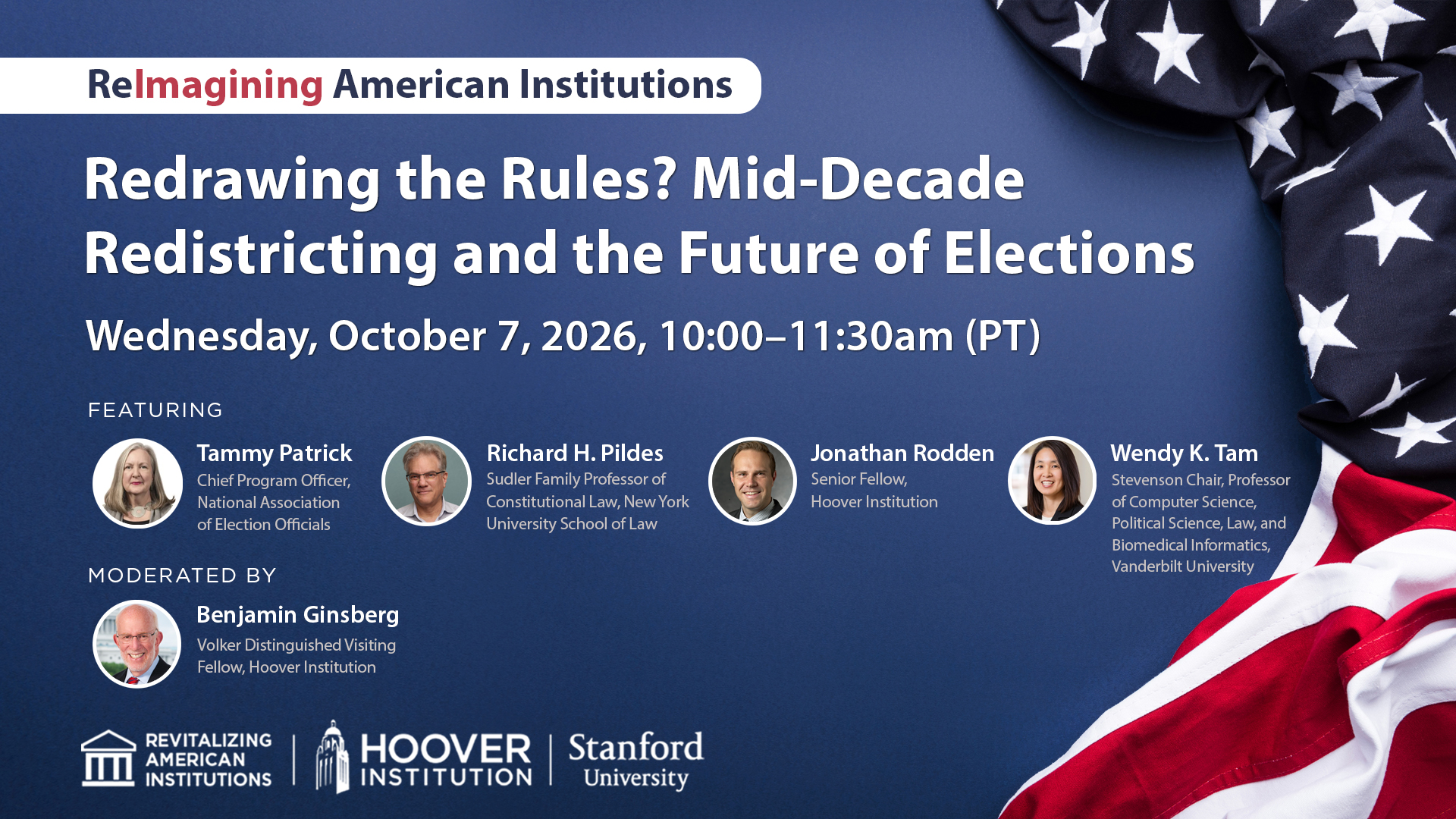
Redistricting is traditionally conducted once every ten years following the census, but in recent years some states have pursued efforts to redraw electoral maps in the middle of the decade. Supporters argue that mid-decade redistricting can correct flawed maps, respond to legal challenges, or better reflect population changes. Critics contend that it can be used as a partisan tool to entrench political power, reduce electoral competition, and undermine public confidence in democratic institutions.
This webinar will examine the legal, political, and democratic implications of mid-decade redistricting. What authority do states have to redraw maps outside the traditional redistricting cycle? How common is the practice, and what motivates elected officials to pursue it? Will we see more redistricting in the remaining years of this decade? How might mid-decade redistricting affect representation, electoral outcomes, and public trust in elections? And what are the broader implications for democratic norms and institutional legitimacy?
Join leading scholars and practitioners for a timely discussion of one of the most consequential—and contested—issues shaping the future of American elections.
ABOUT THE SPEAKERS
Tammy Patrick has been working in election administration since 2003, most recently as the senior advisor to the Elections Program at Democracy Fund. Focusing on modern elections, Patrick works to foster a voter-centric elections system and supports election officials across the country. In 2013, she was selected by President Obama to serve as a commissioner on the Presidential Commission on Election Administration, which led to a position at the Bipartisan Policy Center to further the work of the PCEA. Prior to that, she was the federal compliance officer for the Maricopa County Elections Department in Phoenix for eleven years.
Richard H. Pildes is one of the country’s leading experts on legal issues concerning the democratic process and the structure of American government. He was a law clerk to Justice Thurgood Marshall at the Supreme Court and served on President Biden’s Commission on the Supreme Court of the United States. He is a member of the American Academy of Arts and Sciences and the American Law Institute and received recognition as a Guggenheim Fellow and Carnegie Scholar. He is coauthor of the casebook The Law of Democracy: Legal Structure of the Political Process (Foundation Press, 2022) and has written on election reform, voting rights, effective government, presidential powers, and comparative perspectives on democracy.
Jonathan Rodden is a senior fellow at the Hoover Institution and a professor of political science at Stanford University. His research focuses on the comparative political economy of institutions, fiscal decentralization, and political geography. He is the author of multiple articles and two books, including Why Cities Lose: The Deep Roots of the Urban-Rural Political Divide (Basic Books, 2019). Rodden also advises international organizations like the World Bank and International Monetary Fund on fiscal decentralization and is currently writing on electoral districting and political geography.
Wendy K. Tam is professor and Stevenson Chair of Political Science, Computer Science, Law, and Biomedical Informatics at Vanderbilt University, an affiliate at the National Center for Supercomputing Applications, professor emerita at the University of Illinois Urbana-Champaign, and professional researcher in the School of Medicine at the University of California, San Francisco. She has been a fellow of the John Simon Guggenheim Memorial Foundation, the Society for Political Methodology, and the Center for Advanced Study in the Behavioral Sciences (Stanford); a visiting fellow at the Hoover Institution: and an IEEE senior member.
Moderator:
Ben Ginsberg is the Volker Distinguished Visiting Fellow at the Hoover Institution and a nationally known political law advocate representing participants in the political process. His clients have included political parties, political campaigns, candidates, members of Congress and state legislatures, governors, corporations, trade associations, political action committees (PACs), vendors, donors, and individuals. He represented four of the last six Republican presidential nominees.