







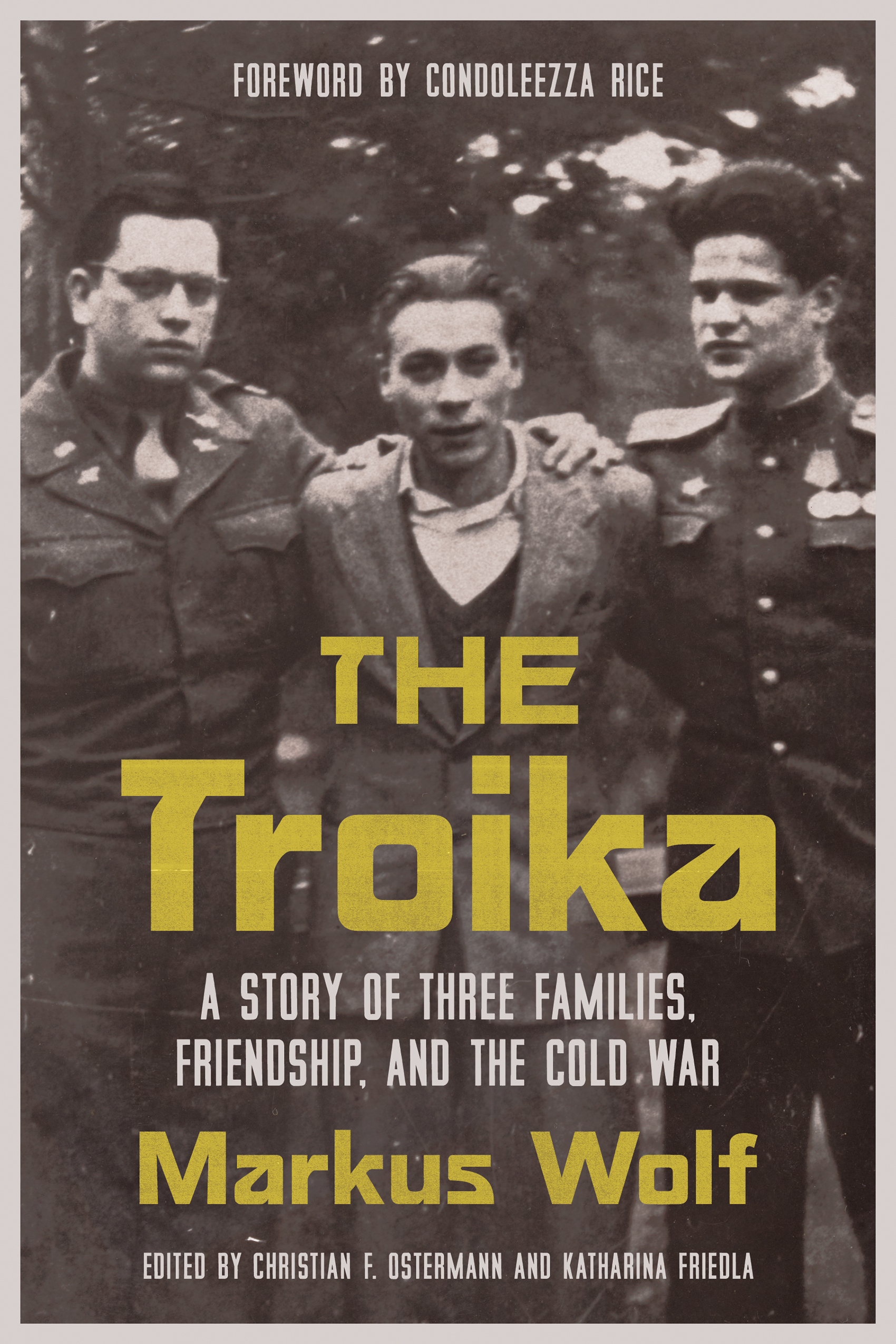
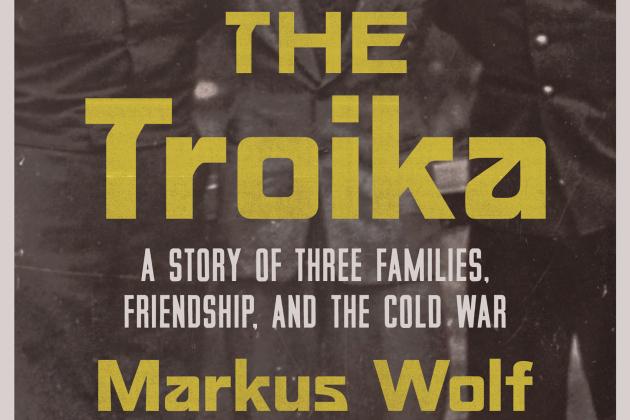
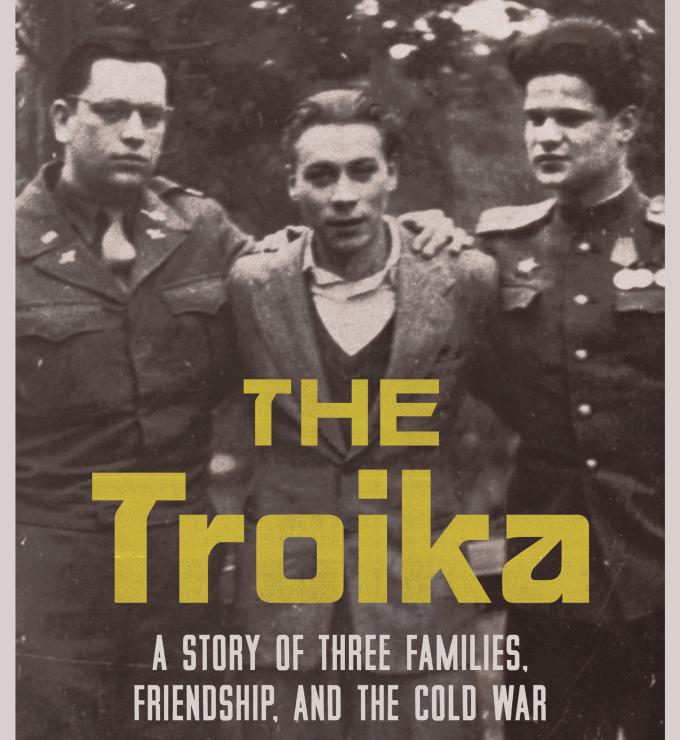
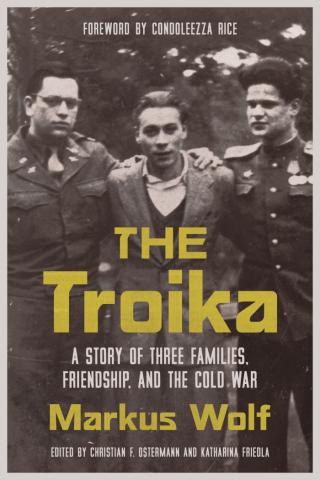
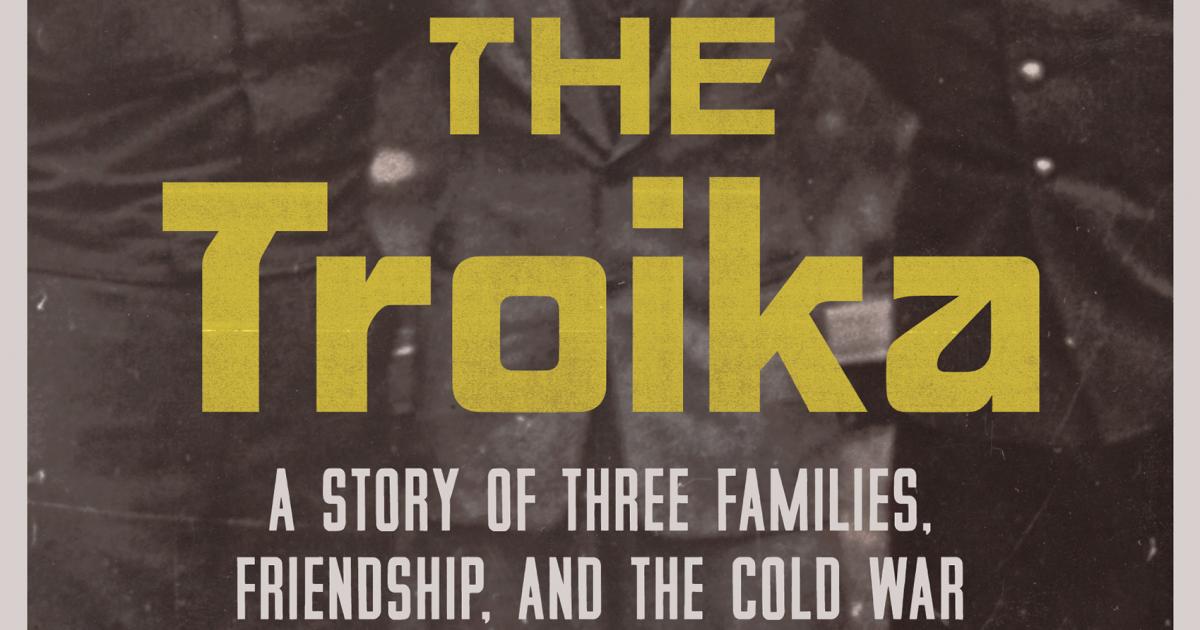
This excerpt is drawn from the introduction to The Troika: A Story of Three Families, Friendship, and the Cold War (Hoover Institution Press, 2026), by Markus Wolf, edited by Christian F. Ostermann and Katharina Friedla and translated by Sabine Berendse, with Paul Clements. The Hoover Institution Library & Archives holds the collection of Markus Wolf, who headed the foreign intelligence department of East Germany’s Ministry for State Security. Click here to buy a copy.
Shortly before 7 p.m. on March 9, 1989, Markus Wolf (1923–2006), the retired chief of East Germany’s foreign intelligence service (known by its German acronym, HVA, for Hauptverwaltung Aufklärung) arrived at the Friedrichsfelde Palace in East Berlin’s Tierpark. The neoclassical building that had escaped the widespread destruction of Berlin during World War II was to be the setting for the public launch of Wolf’s book The Troika. The thunderstorm of flashes awaiting Wolf was the beginning of a new phase in his career, that of author and public persona, dramatically different from decades of toiling in the shadows of the cloak-and-dagger world of espionage.
Earlier that day, the West German TV station ARD had taped an hourlong interview with him. Now, in the spotlights of the cameras of the other major TV station, ZDF, he faced “tough questions” by a reporter and then held a public reading of his book. The once-secretive master spy became an overnight celebrity: “It was like in the movie theater,” he noted in his diary, with what would become a familiar mixture of conceit and self-effacement, “the arrival of the great star” that felt “somehow entirely unreal.”
The publication of Wolf’s Die Troika: Geschichte eines nichtgedrehten Films (“The story of a film that was not produced”) was indeed a small sensation in divided Germany at the time of its release in March 1989: “the phantom gives a reading,” as one prominent West German daily headlined its coverage. As Wolf himself admitted, the public attention was largely due to his reputation as a secretive spymaster. During the Cold War, Wolf had led the foreign intelligence organization for the Ministry for State Security (MfS, colloquially referred to as the “Stasi”). At its peak, this organization fielded some 4,600 full-time operators aided by some ten thousand “unofficial collaborators.” Some 1,500 of Wolf’s agents had penetrated deeply into the political, economic, and sociocultural fabric of West Germany. Western intelligence services had failed to obtain a true photo of Wolf, dubbed “the man without a face,” until just a decade earlier, almost thirty years after Wolf had first risen to lead one of the most effective, and certainly one of the most notorious, espionage services of the Cold War. West German intelligence had famously leaked the photo to the prominent West German weekly Der Spiegel, which in March 1979 splashed it across its cover.
Written by the East German intelligence establishment’s “éminence grise,” The Troika also stood out for its then-stunning acknowledgment of the horrors of the Stalinist purges and terror of the mid-1930s. However cautious and incomplete this reckoning was, it helped overcome an important taboo upon which the German Democratic Republic (GDR) had been built.
The Great Terror of 1937–38 unleashed by Soviet dictator Joseph V. Stalin had led to the arrest of some 1.5 million people. Hundreds of thousands of Soviet citizens and foreigners were executed or perished in the Gulag’s labor camps. In the course of the “German Operation” launched in July 1937 by the People’s Commissariat for Internal Affairs of the Soviet Union, or NKVD, some 70 percent of the German section of the Moscow-based Communist International (Comintern) had been arrested. Many were killed; hundreds vanished within the Gulag system. The arrests had touched virtually every family among the German political émigrés who had escaped Nazi persecution by coming to the Soviet Union. It was a deeply traumatic experience—one whose memory those who survived brought with them when they returned to Germany after the end of the war.
Yet, until 1989, these émigrés, some of whom rose to leadership positions in the GDR, were forced to abide by a code of silence about what they had experienced. The repression of knowledge and memory of the Great Terror became, as Andreas Petersen has argued, a part of the schizophrenic mental foundation of the new East Germany.
In its break with the official taboo in East Germany about Stalin’s crimes, The Troika was a step in the direction of giving voice to the repressed but never forgotten memory. In that, it also aligned with the glasnost (opening) process taking place in the Soviet Union under Mikhail Gorbachev—a process strenuously resisted by East Germany’s hard-line leader Erich Honecker, secretary general of the Socialist Unity Party of Germany (known by its German acronym, SED). Honecker, like many others in the party-state elite, considered any discussion of the Stalinist crimes detrimental to the cause of socialism, undermining the antifascist foundation of the GDR and delegitimizing SED rule.
A story at a human level
The Troika tells the poignant and gripping story of three childhood friends coming of age in Moscow in the mid-1930s. The main protagonists are Markus Wolf’s younger brother Konrad, whose family had fled to the Soviet Union to escape Nazi persecution; Lothar Wloch, the son of German communists long involved in Soviet espionage; and Victor Fischer, born to Markoosha and Louis Fischer, the latter a well-known and Soviet-friendly American journalist. The boys formed an inseparable threesome in the streets around Moscow’s Old Arbat neighborhood. By the mid-1930s, the lives of the Troika and their families unfolded in the shadow of the Stalinist terror enveloping the country and its community of German émigrés.
With the onset of World War II, the paths of the three Troika protagonists diverged: Lothar returned to Nazi Germany and Victor to the United States, leaving Konrad behind. The three fought on different fronts in the war—Lothar serving in the German Luftwaffe, Victor in the US Army, and Konrad in the Red Army. Miraculously, all three survived the war. At war’s end, the three found themselves on opposing sides of the emerging Cold War fault lines: Konrad in East Germany, Lothar in what would become West Berlin, and Victor in the US.
During the tumultuous year of 1989, the publication of The Troika was just one moment in a torrent of unprecedented and extraordinary events. The media sensation surrounding Wolf’s book was soon overshadowed by the worsening crisis in East Germany and the revolutionary changes that would climax in the fall of the Berlin Wall in November 1989. Still, The Troika played a role in the “endgame” of the socialist system in East Germany.
Wolf’s conscious choice of an empathetic narrative style reinforced the book’s effect in opening space for discussion of sensitive subjects. With its sympathetic, non-polemical portrayal of the American and West Berlin protagonists that eschewed the class-struggle overtones prevalent in publications by regime insiders, The Troika also looked past the friend-foe orthodoxy that undergirded the SED’s media and cultural policies. For parts of the communist party membership and the intelligentsia, for the West German and international media, but also in his own mind, The Troika’s author became a beacon of hope for reform in East Germany.
Subhed
The accolades Wolf received for The Troika contributed to his decision to take part in a large demonstration planned for November 4, 1989, on East Berlin’s central Alexanderplatz. In the foreword to his book Im eigenem Auftrag (On My Own Behalf), published in 1991, Wolf related, contrary to views expressed earlier, that he had believed he was “on the side of the rebels of these last years.” But here the Troika author’s past, his thirty-year-plus career as a leading State Security officer, caught up with him.
In his speech, he referred directly to The Troika and spoke out “for openly speaking the truth, for civil courage, and for dealing with each other in a humane way, even with those who think differently.” But he also rejected a general indictment of Ministry for State Security employees, at which point his voice was drowned out by sharp whistling and prolonged jeers.
As Wolf stepped down from the flatbed truck that served as a makeshift speaker’s platform, someone said to him: “You went from Stasi general to bearer of hope, and now you’re going back to being a Stasi general.” Wolf retrospectively stated: “The man was probably right.”
The Troika was an inflection point in Wolf’s life. With his literary debut, he stepped out of the shadows into the limelight. He went on to write several other books, but arguably none matched The Troika in importance and impact. After seeking refuge in the Soviet Union in 1990, he gave himself up for arrest by the authorities of the now-united Germany the following year. In the ensuing decade, he was tried twice for his activities in the service of the MfS. All the while Wolf, through autobiographical writings and frequent appearances on television talk shows, inserted himself into the national debate over the country’s divided and communist past.
His sober and at times even self-critical, if never fully candid, reflections drew admirers and detractors (and lots of conspiracy theorists). His storied, if incomplete, family past evoked sympathy and critical counternarratives. His principled attitude and his continued commitment to the socialist idea commanded loyalty or respect by some and struck others as hypocritical. His self-assured and urbane manner inspired admiration but also provoked outrage, right up to his death in 2006.
The Troika reflected the controversy that surrounded its author. For some, it was a courageous step by a representative of the SED system in the direction of reckoning more “honestly” with the past than the Communist Party had hitherto permitted. For others, it was a half-hearted effort to come clean on some of the most tragic chapters in the party’s history—a reservation aggravated by the persona of the messenger whose Stasi background seemed to undercut the message.
More than three and a half decades later, this debate has lost little of its fervor. The Troika continues to challenge its readers. It is a document of a transformative moment in twentieth-century German and European history that raises important questions for the twenty-first.
Click here for information about the Hoover Institution Library & Archives’ collection of the papers of Markus Wolf.

