







- Middle East
- Security & Defense
- US Foreign Policy
- International Affairs
- Determining America's Role in the World
The views expressed in this article are the author’s alone and do not represent those of any part of the U.S. Government.
The closure of the Strait of Hormuz during Operation Epic Fury exposed the fragility of the Middle East’s strategic geography. For decades, the region’s commercial order was maritime. This order was politically flexible. It relied on oil tankers and cargo ships, which could easily change destinations, routes, flags, insurers, and escorts. That also meant alliances could be changed easily.
Prior to the war, the region was already considering terrestrial alternatives to the maritime order of the past few decades. The Gulf states hoped that pipelines, railways, and overland corridors would allow them to bypass the strait to export their natural resources and better secure their economic power. However, there had been no rush to develop these alternatives because sea routes have historically been cheaper and guaranteed by U.S. naval power. Epic Fury showed that the Strait of Hormuz, and with it the maritime order, can no longer be taken for granted. Therefore, it accelerated the search for terrestrial alternatives.
A new terrestrial order would rely on infrastructure that creates binding links between states and thus shape the region for the foreseeable future. Unlike ships, pipelines and railroads cannot easily change course. They do not simply move goods. They create the security obligations and diplomatic alignments that accompany economic interdependence. The previous maritime order allowed states to be promiscuous. A new terrestrial order will create Catholic marriages that are not easily undone.
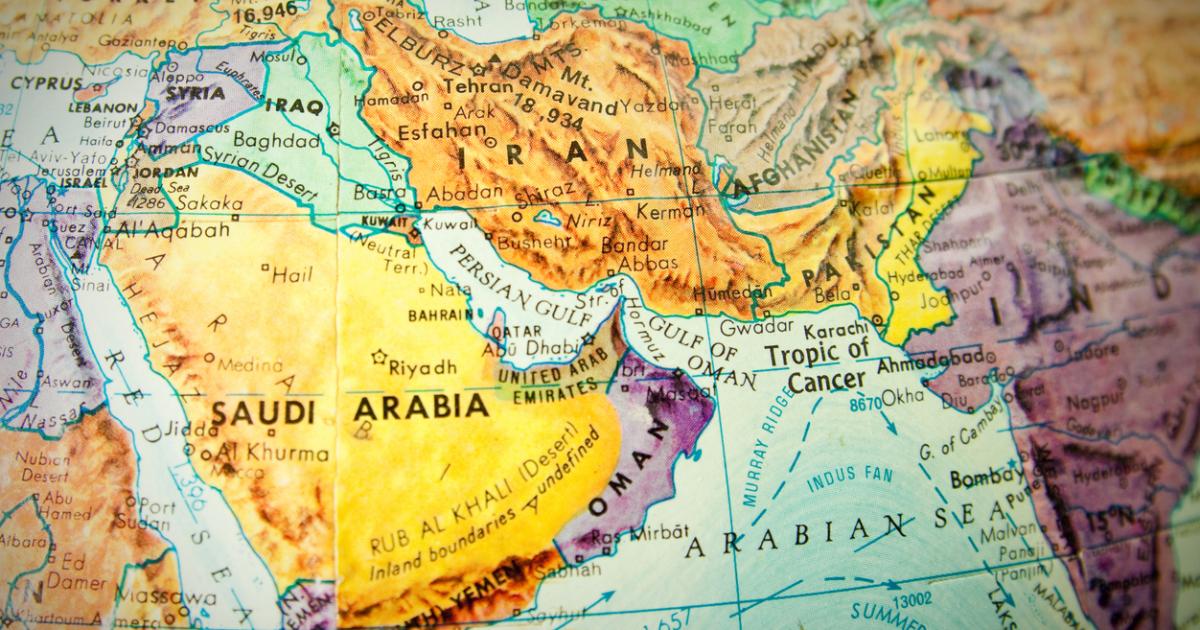
The fallout from Epic Fury is therefore likely to be geostrategic. It is pushing Middle Eastern states toward cementing new and more binding relationships than the region has seen recently. However, which states will link together and how is still an open question. Two competing options were emerging prior to the war, but there is now a high incentive to choose. One runs through Israel and would consolidate an American-backed order running through India, the Gulf, Israel, Cyprus and Greece, and through them to Europe. The other runs from the Gulf through Syria and Turkey to Europe, potentially organizing a rival coalition of nominal American partners whose interests often diverge from Washington’s most reliable regional allies.
The first map is the India-Middle East-Europe Economic Corridor, or IMEC. It was announced before the war and envisioned a network of ports, railways, energy links, digital cables, and logistics nodes connecting India to the Gulf and then onward to Europe through Saudi Arabia, Jordan, Israel, and the Mediterranean. It was meant to cement Saudi-Israeli normalization, allowing goods, energy, and data to pass through an American-aligned architecture in which Israel became the Gulf’s Mediterranean gateway. Importantly, it would bypass vulnerable maritime routes such as Bab al-Mandab and the Suez Canal. There was still a lot of work needed to turn IMEC into a reality. It required upgraded ports, rail links, integrated grids, and subsea cables. And, of course, Saudi-Israeli normalization has yet to be realized. Without some resolution of the wars in Gaza and Iran, and without a politically viable path for Arab states to engage Israel, there can be no serious IMEC.
Before Epic Fury, IMEC looked ambitious but fragile. After Epic Fury and the closure of Hormuz, its strategic rationale became stronger even as its politics became harder. The war showed that maritime chokepoints could be closed or made too expensive to use normally. It therefore strengthened the logic of overland routes. But it also made an arrangement with Israel a more politically divisive issue. The very route that would best consolidate a pro-Western order is also the route most likely to inflame Arab domestic politics.
As such, a second option has been gaining traction. Rather than moving westward through Israel and the port of Haifa, the alternative route runs north through Jordan, Syria, and Turkey. Turkey and Saudi Arabia have discussed a railway linking the two countries through Jordan and Syria, a project Turkish officials have explicitly connected to the disruption of Hormuz during the Iran war. Such a route could eventually carry goods, oil, natural gas, and passengers between Saudi Arabia, Turkey, Jordan, Syria, and Europe, with other Gulf states potentially joining later.
This plan offers a path that avoids Israel but with the same strategic objective of getting Gulf trade and energy to Europe without relying on Hormuz. It would make Turkey the Gulf’s northern gateway. It would rehabilitate Syria as a transit state, and it would give Saudi Arabia and Qatar an alternative to dependence on Israel. Thus, it would help solidify a geostrategic bloc consisting of Turkey, Syria, Saudi Arabia, Qatar, and probably Pakistan, which often aligns with these states politically.
The Syria-Turkey map would not create an openly anti-American bloc. Turkey is a NATO ally. Qatar hosts major American military facilities. Saudi Arabia remains a central U.S. security partner. Pakistan has long-standing defense ties with Washington. Yet none of these states is a consistently reliable American partner. Several of these states rely on anti-American or anti-Western rhetoric to bolster domestic legitimacy. In Turkey, anti-Western rhetoric and support for Islamist movements has served the Erdoğan government’s domestic political needs, helping it discredit opponents and consolidate its support base. Qatar has used state-backed media and diplomatic patronage to amplify currents deeply hostile to Washington’s preferred regional order. Doha has repeatedly hedged between the United States, Islamist movements, Iran, and its Gulf neighbors. In Pakistan, anti-Americanism and support for extremist groups has long figured in constrained U.S. policy and remains a tool that political actors can mobilize to frame themselves against American power. Pakistan thus adds military weight, Islamic legitimacy, and a nuclear shadow to a political constellation already skeptical of American preferences. A corridor that empowers these states would therefore do more than diversify trade routes. It would create a system of states that often define their legitimacy against the United States, Israel, or the West, and it would be a bloc whose domestic politics and regional ambitions make them unreliable partners for achieving American interests.
That is not a regional order the United States should want. A Middle East whose infrastructure runs through Israel, the UAE, India, and Europe would strengthen a pro-Western order and embed America’s most reliable partners in the region’s economic future. A Middle East whose infrastructure runs through Syria and Turkey would empower a more transactional and less dependable coalition inside the nominally American camp. It would make Israel easier to bypass, reduce the UAE’s geoeconomic centrality, and give Turkey, Qatar, and a rehabilitated Syria greater leverage over the region’s east-west flows.
The UAE’s position is especially important. Abu Dhabi has been one of Washington’s most capable Arab partners and one of the strongest supporters of the Abraham Accords. It also has the region’s most advanced export infrastructure outside Hormuz through Fujairah. Yet that same capacity gives Abu Dhabi an interest in ensuring that post-Hormuz connectivity does not simply shift northward toward Turkey and Syria.
The UAE cannot shape the emerging order alone. Washington will need to mediate between Abu Dhabi and Riyadh if IMEC is to become more than a diplomatic pipe dream. The Saudi-UAE relationship has always mixed cooperation and rivalry, but recently it has become increasingly rocky. Their competition has played out in Yemen, logistics, investment, oil policy, Sudan, and regional influence. The two states often share broad interests, but they increasingly compete over who will define the Gulf’s economic future. A post-Hormuz order organized around IMEC cannot be built if Riyadh and Abu Dhabi are pulling in opposite directions. So, if Washington wants an Israel-centered, India-Gulf-Europe corridor to compete with a Syria-Turkey alternative, it will have to keep Riyadh and Abu Dhabi aligned enough to cooperate.
Israel is the other political variable. Israeli elections now loom over the corridor question. A new Israeli government could create possibilities that are currently blocked. For IMEC to become politically viable, Israel will need to show that it can move toward some form of accommodation with the Palestinians, however difficult that may be politically. Saudi Arabia has been moving away from normalization with Israel. Riyadh cannot openly anchor a corridor through Israel while appearing to abandon the Palestinian issue altogether.
Washington should use the coming Israeli political transition, whatever its outcome, to test whether a renewed regional bargain is possible. It should be ready with a serious diplomatic package if a more favorable coalition emerges. The contours of that package are already well-known: Saudi normalization, Israeli regional integration, Gulf investment, Gaza reconstruction, a credible Palestinian political horizon, and American security assurances.
The United States probably does not need to solve the Israeli-Palestinian conflict before advancing IMEC, but it would almost certainly need enough movement toward accommodation to give Saudi Arabia and other Arab states political cover for an Israel-centered corridor. None of this would be easy, but without it, the Israel-centered map will remain strategically attractive and politically inaccessible.
Supporting IMEC does not require Washington to oppose every northern corridor. A stable Syria connected to regional infrastructure is preferable to a collapsed Syria dominated by Iran or jihadist networks. Turkey will remain an important, if difficult, NATO ally. Saudi Arabia and Qatar will continue to hedge, and the United States cannot simply wish that away. But Washington should understand the hierarchy of its interests. A Syria-Turkey corridor may be commercially useful, but it should not become the main organizing map of the post-Hormuz Middle East. If it does, the infrastructure built in the name of resilience may empower precisely those partners least likely to support American strategy in a crisis.
Epic Fury did not merely close the Strait of Hormuz. It may push the region to transition from a flexible maritime Middle East to a new Middle East order defined by binding terrestrial infrastructure. If IMEC succeeds, the region’s connective tissue will reinforce a pro-Western alignment linking India, the Gulf, Israel, and Europe. If the Syria-Turkey alternative gains momentum, American partners may build a rival map that empowers a looser, less reliable coalition that will often find itself at odds with U.S interests. The battle after Epic Fury is therefore not only over airspace or sea lanes. It is over the map of the next regional order. This order will likely be more binding and have more long-term implications than anything the region has witnessed recently. Washington should choose its map before others choose it for them.

