







- State & Local
- California
- California Decides
Ordinarily, a column at this time of the year—the California state budget has long been settled, but plenty of legislation is still in the pipeline—might take advantage of the relative lull in Sacramento to look ahead to November and the question of who will be the Golden State’s next governor.
But that can wait—at least, until there’s drama to report.
Or so the data in this recent survey by the Public Policy Institute of California suggest.
That poll’s headline finding: a lopsided race for governor in which former state attorney general Xavier Becerra, a Democrat, leads the Republican Steve Hilton, a former Fox News commentator, by 25 points despite Hilton finishing less than 4 points behind Becerra in last month’s statewide primary.
How to explain the enormous gulf between the two?
Let’s do the math.
While Becerra received 28 percent of the primary vote to Hilton’s 24.6 percent back in June, the top six Democrats on California’s primary ballot received a collective 60.5 percent to only 35.6 percent for the six leading Republican vote-getters. Round up those two numbers: et voilà, it’s a 61 percent-36 percent split.
Time will tell if Becerra can stay in the neighborhood of 60 percent, which is something of a sweet spot of late in California gubernatorial contests. Gavin Newsom received 61.9 percent in 2018’s open race and 59.2 percent while securing a second term (61.9 percent of Californians also voting against recalling Newsom from office in November 2021).
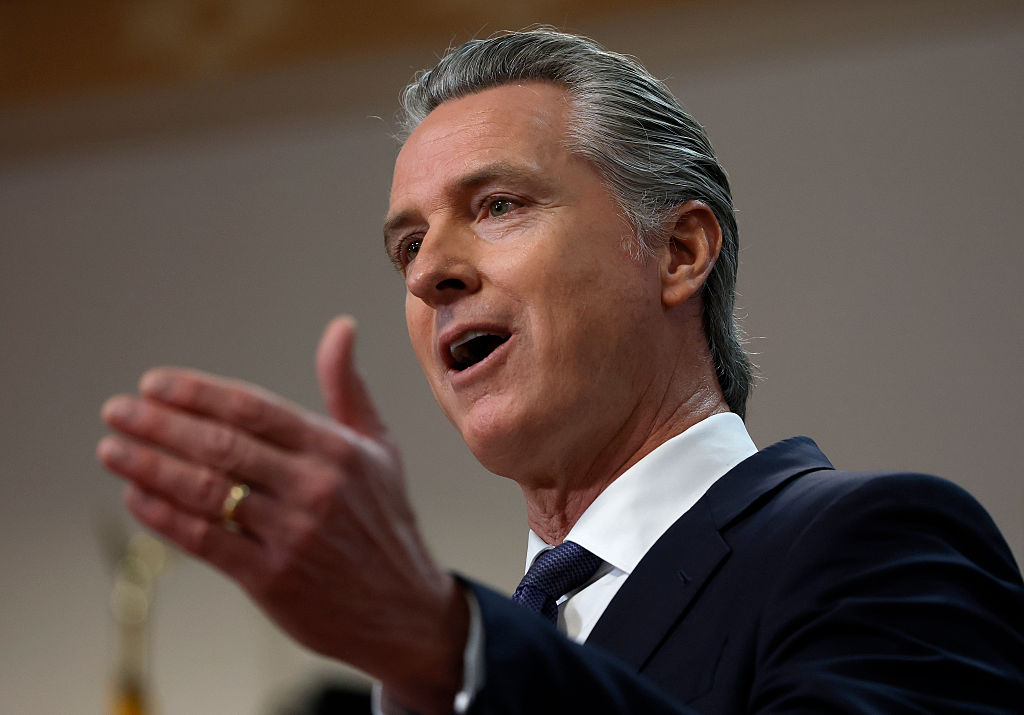
Let’s turn to Newsom now, as he’s doing something rare for California governors at this point in their tenure: pivoting for a presidential run.
What Newsom is doing isn’t a first for his peer class: Ronald Reagan sought the presidency less than a year after leaving the governor’s office in January 1975, though he waited eleven months.
But Reagan was consistent as a presidential contender—that is, consistently anti-government and anti-establishment. Or so he underscored in his announcement speech:
Today it is difficult to find leaders who are independent of the forces that have brought us our problems: the Congress, the bureaucracy, the lobbyist, big business, and big labor.
If America is to survive and go forward, this must change. It will only change when the American people vote for a leadership that listens to them, relies on them and seeks to return government to them. We need a government that is confident not of what it can do, but of what the people can do.
That’s the kind of deep-rooted, philosophical underpinning missing from Newsom’s presidential preamble, which seems a study in shapeshifting.
For Newsom, that’s meant being arguably the loudest Trump critic in the Democratic herd (last week, he questioned President Trump’s mental fitness and invoked the Twenty-Fifth Amendment, which maybe wasn’t the smartest move given his past coddling of a declining Joe Biden), as well as engaging in straw-man arguments with Big Oil, gun owners, the Constitution, and, when court rulings don’t go his way, the odd federal judge who disagrees with the governor.
But lately, it seems Newsom’s greatest challenge in trying to earn his party’s presidential nomination might be whether he can talk his way past competing narratives.
Will Newsom run for president as the no-nonsense governor who, for example, recently signed a reform to California’s Subsequent Injuries Benefits Trust Fund—a vestige of World War Two meant to help disabled veterans that instead has become something of a slush fund for dubious claim-seekers (the Orange County Register noting that a California Highway Patrol officer received over $200,000 for the likes of asthma, sleep apnea, seborrheic dermatitis, and erectile dysfunction)?
Or, speaking of dysfunction, can Newsom escape the image of an overseer of a shady government that cuts ethical corners? That includes a controversy over government deals that circumvented the state’s contracting process—one of the more odious examples of abusing the rules being a $6.2 million no-bid diaper deal benefiting a nonprofit with ties to his wife, Jennifer Newsom (the tax activities of the first partner’s own nonprofits reportedly the subject of a federal investigation).
How else is the House of Newsom divided?
Two years ago, California’s governor vetoed an “AI safety bill” holding tech companies liable for damage caused by AI models. That veto came only a few months after Newsom heartily defended California’s burgeoning AI sector: “I don’t want to cede this space to other states or other countries,” said the governor. “If we overregulate, if we overindulge, if we chase the shiny object, we could put ourselves in a perilous position.”
But the 2026 version of Governor Newsom is not exactly an AI BFF—the governor in recently weeks calling for a “national public equity fund that takes a major stake in the new economy.” While Newsom didn’t offer details on what the cost would be to AI entrepreneurs, he made clear his target audience: “Part of this fund could provide a real transition for the laid-off factory worker in Ohio or the twenty-five-year-old coder in San Francisco who sent out a thousand résumés and got zero callbacks. This could include significant severance and portable benefits while we support them through the transition and into new jobs with programs like enhanced employment insurance.”
Speaking of friends and frenemies, that leads us to a third case of “Gavin vs. Gavin”: wealth taxes.
In this corner: Governor Newsom, steadfast opponent of November’s Proposition 40, a labor union’s attempt to impose a one-time 5 percent tax on the assets of all Californians with a minimum of ten-figure wealth.
And in the other corner: Governor Newsom, champion of a national “billionaires tax” which in fact would kick in for all Americans with a net worth above $100 million (not that it will see the light of day anytime soon, but California Representative Juan Vargas favors a “Donald J. Trump wealth tax” that would take away one-seventh of the net worth for all American with at least $10 million in holdings).
The list of Newsom conflicts regarding his party’s hobbyhorses goes on. For years he’s fashioned himself a champion of California’s economically strapped Central Valley. But does rural redevelopment in the Golden State include AI data centers (New York Governor Kathy Hochul, a Democrat, having just signed an executive order imposing a temporary moratorium on large data center projects)?
And there’s the question of Israel.
Earlier this year, Newsom likened the Jewish state to “sort of an apartheid state.” But it wasn’t long before he softened those words (said while the governor was a guest on a progressive podcast ironically titled “Gavin Newsom Is Finally Comfortable with Himself”). Said Newsom: “I revere the state of Israel. I’m proud to support the state of Israel.”
So what does of this bode for Newsom’s presidential prospects?
On the one hand, some political wagering sites have California’s governor as the betting favorite for the Democratic nod in 2028 (Polymarket has him ahead of Representative Alexandria Ocasio-Cortez and other big-name Democrats). A recent survey has Newsom a distant second in a Democratic field led by former vice president Kamala Harris—with Harris, by the way, looking at a possible precedent (Thomas Jefferson being the only case of an incumbent vice president who lost a presidential election, then came back four years later and prevailed).
But one thing polls don’t consider: a candidate’s ability to have it both ways. In other words, is Gavin Newsom, an inveterate fan of the San Francisco Giants, an artful dodger who can talk his way past journalists likely to pounce on his inconsistencies?
Students of American politics might recall Bill Clinton possessing such a skill. In 1992, the then-governor of Arkansas tried to straddle the line over pot-smoking: “I’ve never broken a state law. But when I was in England, I experimented with marijuana a time or two, and I didn’t like it. I didn’t inhale it and never tried it again.” (Johnny Carson’s response: “That’s the trouble with the Democrats. Even when they do something wrong, they don’t do it right.”)
However, a dozen years later, former senator John Kerry showed he was hardly Clintonian in the same game of presidential straddling.
Appearing at a campaign event in West Virginia, Kerry was asked why he had voted against an $87 billion supplemental appropriation for military operations in Afghanistan and Iraq. Kerry’s reply, which would dog him for the rest of the 2004 campaign: “I actually did vote for the $87 billion before I voted against it.”
Fast-forward to the general election and this ad released by the rival Bush campaign featuring a windsurfing Kerry moving back and forth across the screen while a narrator lists multiple policy shifts, with these closing words: “John Kerry. Whichever way the wind blows.”
The good news for Newsom: as far as we know, he doesn’t wind-surf.
But can a presidential campaign based on which way the wind blows stay out of troubled waters?

