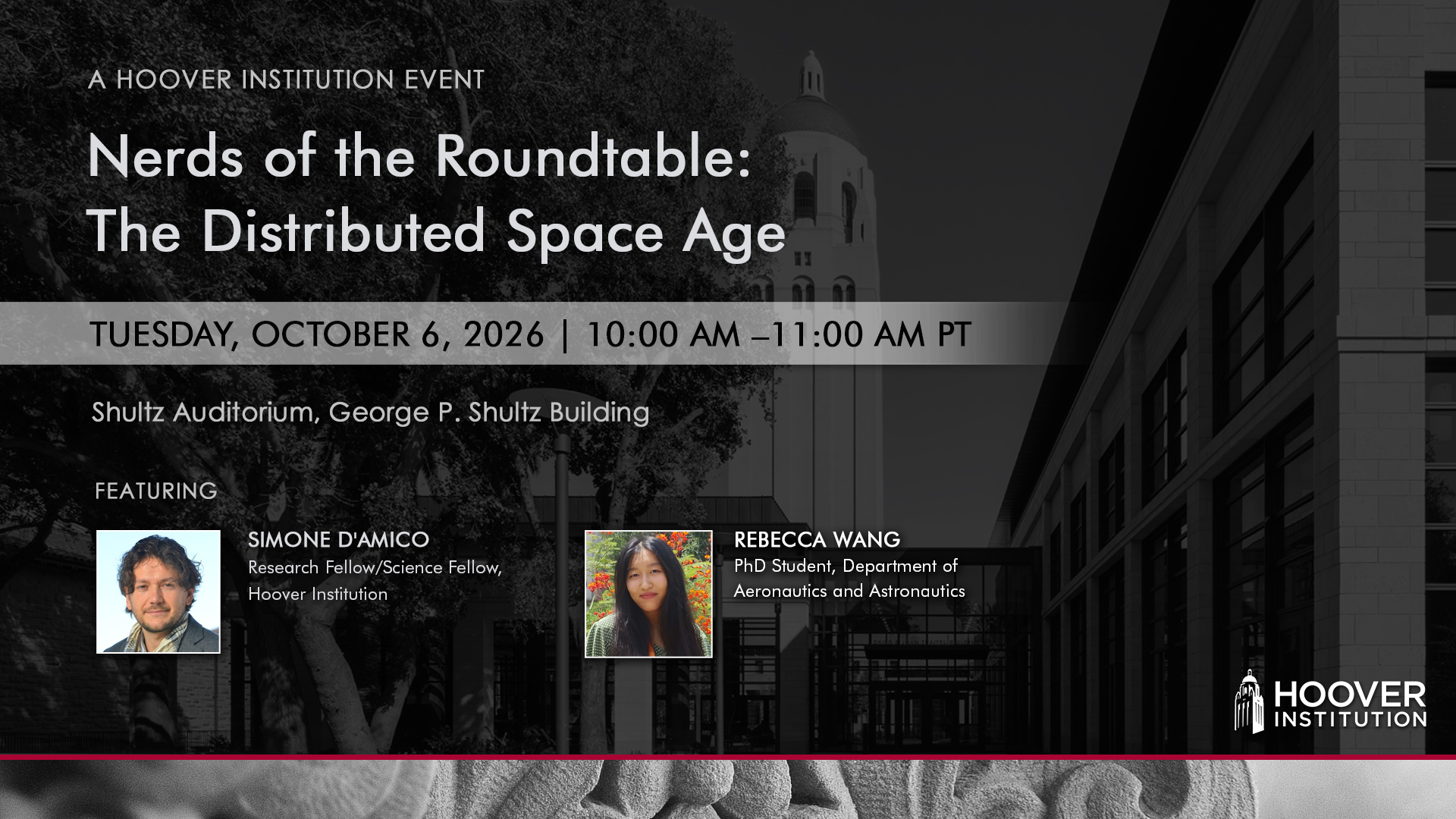
In this episode of Nerds of the Roundtable, Hoover Science Fellow Simone D’Amico discusses the technologies that are ushering in a new era of space exploration. He explains how autonomous satellites, distributed spacecraft systems, and artificial intelligence are transforming space operations and examines the growing challenges of orbital debris, collision avoidance, and space sustainability. D’Amico also reflects on his career in academic research, entrepreneurship, and the intersection of engineering and space policy. The conversation concludes with advice for the next generation of scientists and engineers on the importance of mastering fundamental principles of mathematics, physics, and engineering before broadening out into the study of more complex systems.
ABOUT THE SPEAKER
Simone D’Amico, science fellow at the Hoover Institution, is associate professor of aeronautics and astronautics, the W. M. Keck Faculty Scholar in the School of Engineering, and professor of geophysics (by courtesy) at Stanford University. He is the founding director of the Stanford Space Rendezvous Laboratory, codirector of the Center for Aerospace Autonomy Research (CAESAR), and director of the undergraduate program in aerospace engineering at Stanford.
Dr. D’Amico has more than two decades of experience in research and development of autonomous spacecraft and distributed space systems, including multiagent architectures. He developed the distributed guidance, navigation, and control systems of several such missions and is currently the institutional principal investigator of three autonomous satellite swarms funded by NASA and the National Science Foundation