Today, Eugene Volokh and Orin Kerr discuss Flock surveillance cameras and the Fourth Amendment; leading scholars of military history come together at Hoover to discuss conflicts and deterrence challenges in Iran, Ukraine, China, and beyond; and just in time for Halloween, Michael Boskin identifies five “tricks” that find their way into debates over policy.
Law and Policy
Do you have a right to privacy on public roads? In the latest episode of Free Speech Unmuted, Senior Fellows Eugene Volokh and Orin Kerr discuss Flock cameras, the networked license plate readers fueling nationwide debate over police surveillance. Volokh and Kerr, both distinguished professors of law, analyze how the Fourth Amendment (which protects against “unreasonable searches and seizures”) applies to tracking people’s movements. They also consider whether police should need a warrant to search camera databases, and how to balance the investigative benefits of technologies like Flock with the potential for abuse. The scholars close with a discussion of what we still don’t know about these tools’ effectiveness in protecting public safety. Watch or listen here.
Military History
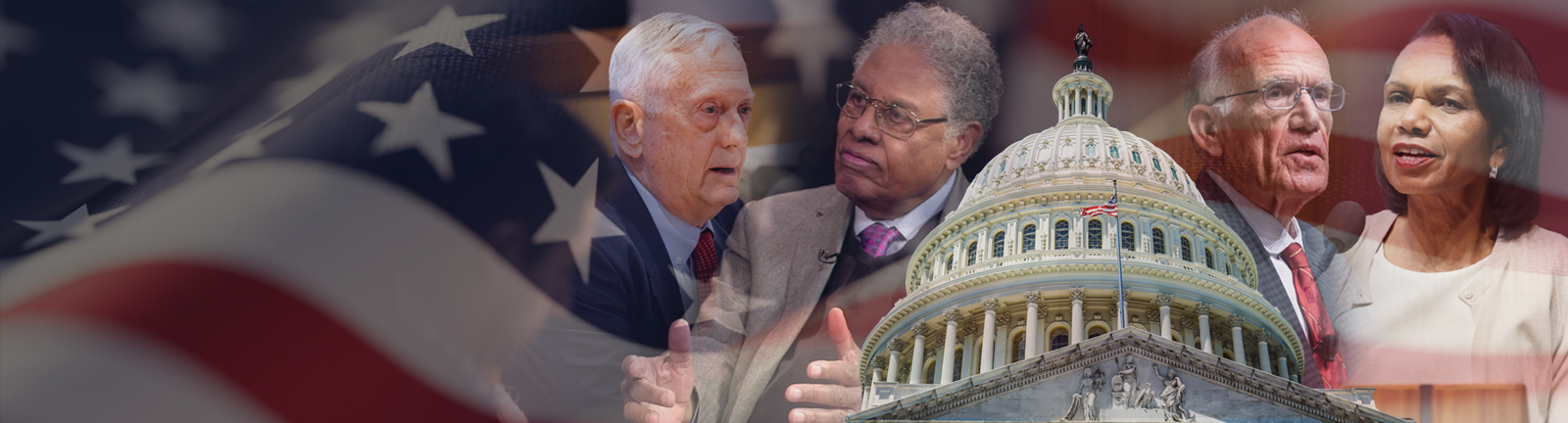
On October 9, scholars affiliated with Hoover’s Military History in Contemporary Conflict Working Group explored a number of pressing issues the US defense establishment must confront to guarantee security for future generations. The workshop focused on current conflicts in Ukraine, Iran, and elsewhere in the Middle East, and the tactical and strategic lessons that US military officials and policymakers can learn from these wars. Participants also considered how battlefield transformations wrought by new technologies, such as drones and AI, might change the character of war, if not its fundamental nature; as well as the military challenge presented by fiscal constraints across the West. Senior Fellow Victor Davis Hanson, chair of the group, noted, “Often contemporary conflict is so embedded in current politics, controversies, and emotion that we can forget that violent struggles of the past can offer considerable guidance about how these wars of today follow historical trends, especially how they originate, how they evolve, and how they end—given that human nature is constant across time and space.” Read more here.
Policy & Politics
“It is easy to demand more taxes, spending, and regulation for a category that is popular, for example, education or the environment,” writes Senior Fellow Michael J. Boskin about the “tyranny of the popular category.” This is the first of “five frequently used tricks to garner support” for policy proposals he examines in an essay for Freedom Frequency. The second, “presentness bias,” describes a tendency to ignore the cost and benefit mix in the long run, to focus “almost entirely on immediate outcomes.” Boskin goes on to discuss three other “popular forms of policy distortion,” before concluding with a reminder of the stakes of getting government action right. “A successful society needs a government that does its appropriate functions well and is adequately funded,” the economist writes. “But when the government—federal, state, or local—tries to solve every alleged problem, it becomes too unwieldy, too expensive, and too distracted from its legitimate core functions to do them even adequately.” Read more here.
California Decides
If approved by California voters next week, Proposition 2 would enlarge the state’s constitutional savings account, the Budget Stabilization Account, better known as the rainy-day fund. This fund has existed since 2014, and it is fed by automatic deposits each year. Today, the state must keep making deposits until the rainy-day fund reaches 10 percent of general fund tax revenues. Once it hits that ceiling, extra money that would have gone into savings is instead spent on infrastructure. Proposition 2 raises the ceiling to 20 percent, so the state can keep saving until the fund is roughly twice as large as it can be under current law. A central trade-off voters should consider is the fact that saving is not free; every dollar the constitution steers into the reserve or toward extra debt payments is a dollar not available this year for schools, healthcare, childcare, or tax relief. At the same time, a larger reserve would give the state a bigger cushion against volatility in California tax receipts (tied to market fluctuations), reducing the depth of cuts or the pressure for new taxes in an economic downturn. Read more here.
Revitalizing History
Senior Fellow Niall Ferguson was honored by America Abroad Media at its annual award gala earlier this month for his life’s work illuminating the role of history in explaining how the modern world came to be. Former diplomat Elliott Abrams presented Ferguson with his award at the 13th annual America Abroad Media Awards Dinner in Washington, DC, on October 19, “for his extraordinary contributions to our understanding of history, politics, and the forces shaping our world.” Ferguson told attendees at the dinner: “There’s something rotten in the state of history education around the world today. The toxic quality of what I call ‘anti-history’ on social media is only making matters worse, and artificial intelligence is increasingly being used to amplify historical falsehoods, not least Holocaust denial. That’s why high-quality, factual films about the past are so important. It means a great deal to me and my colleagues at Chimerica Media [Ferguson’s production company] to be honored in this way for our efforts." Read more here.








Related Commentary