



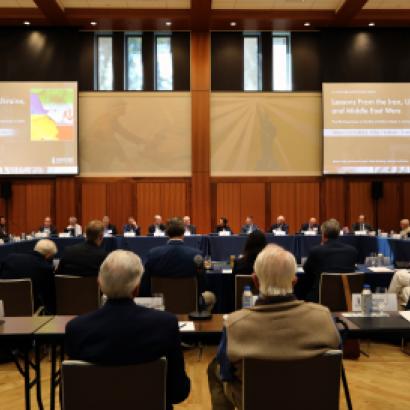
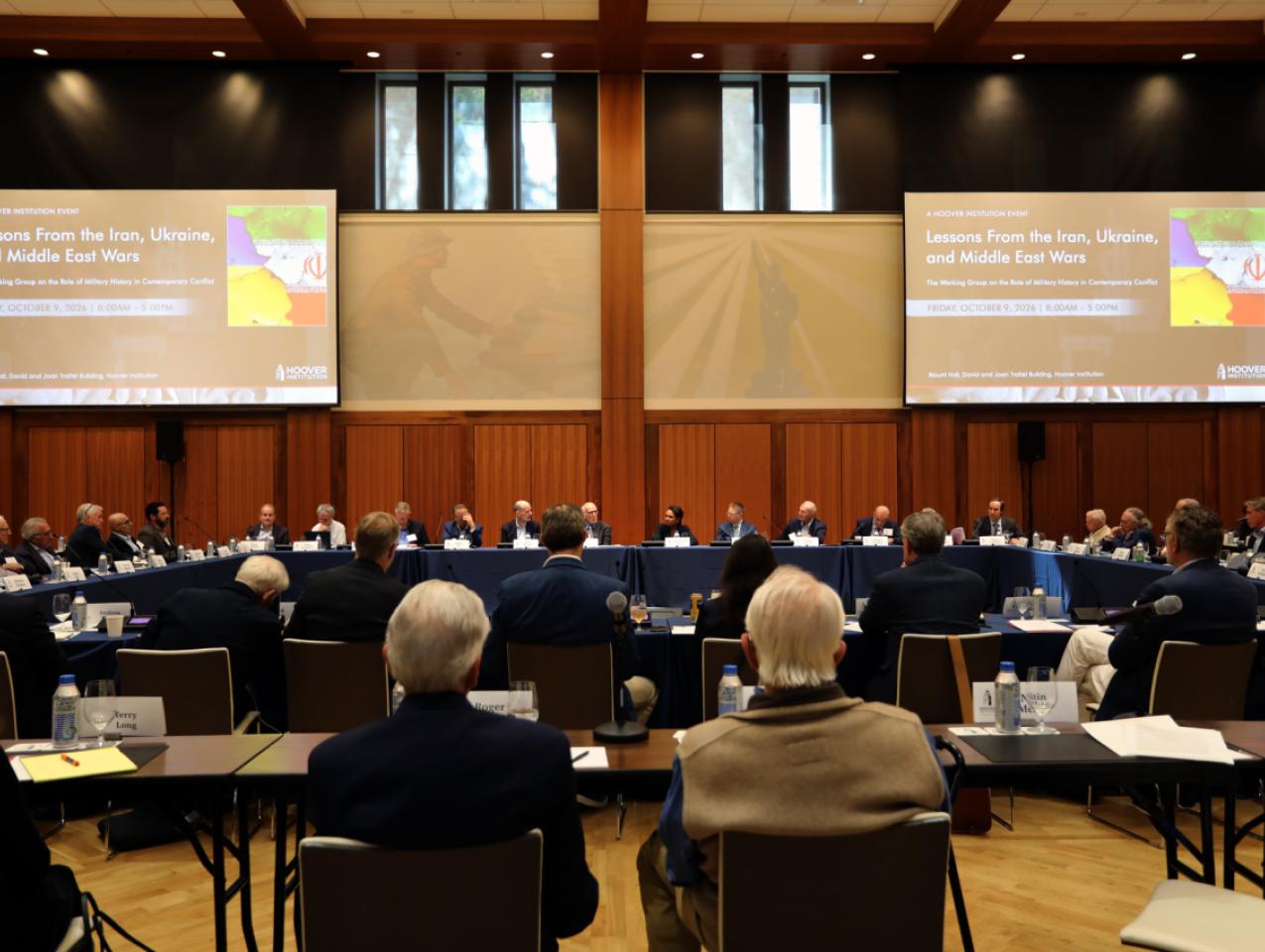
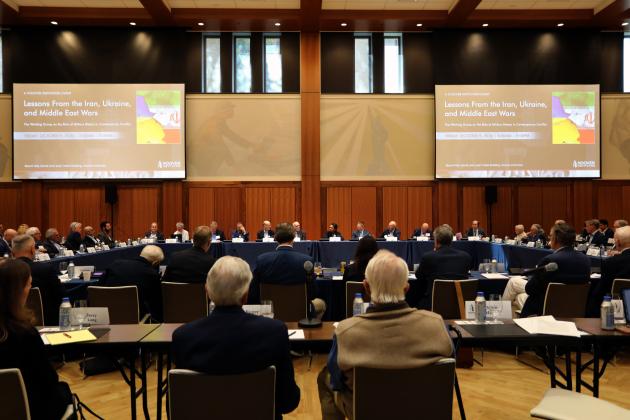
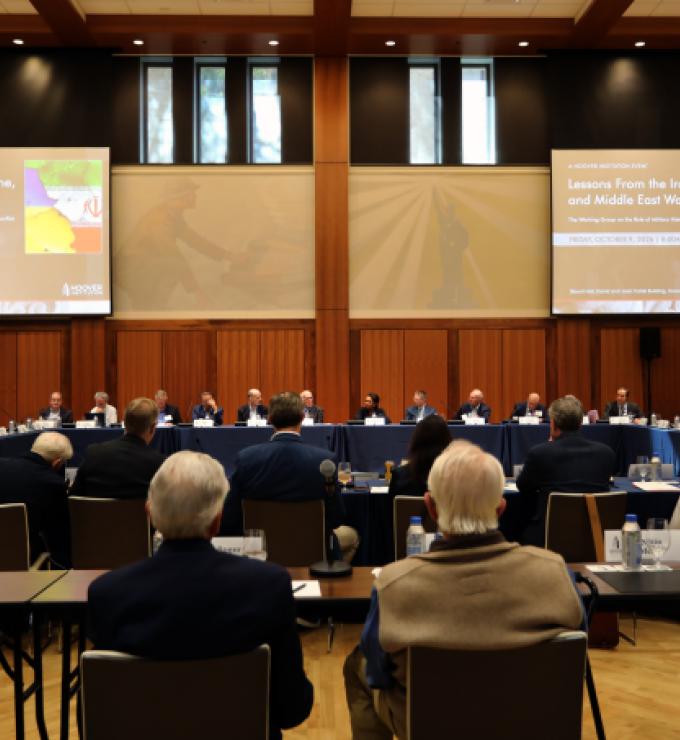

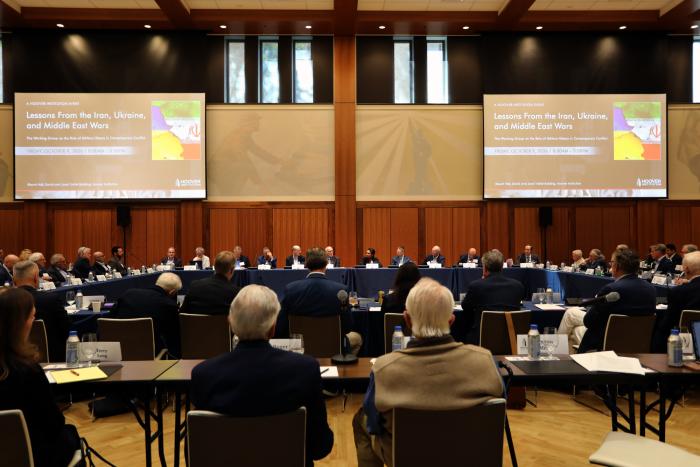
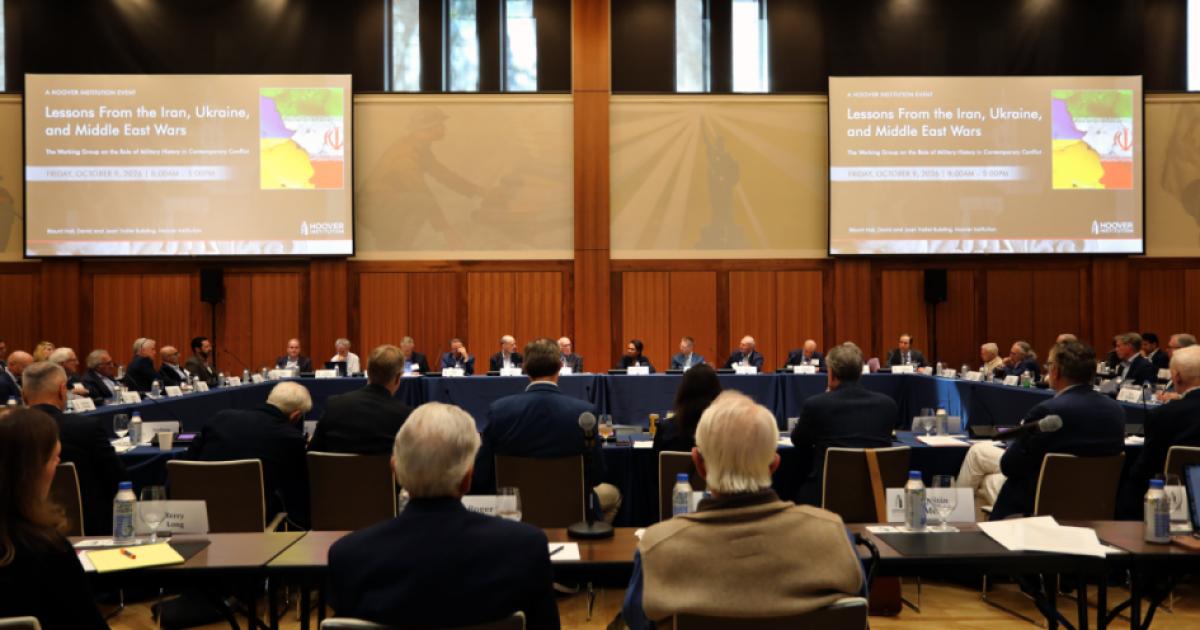
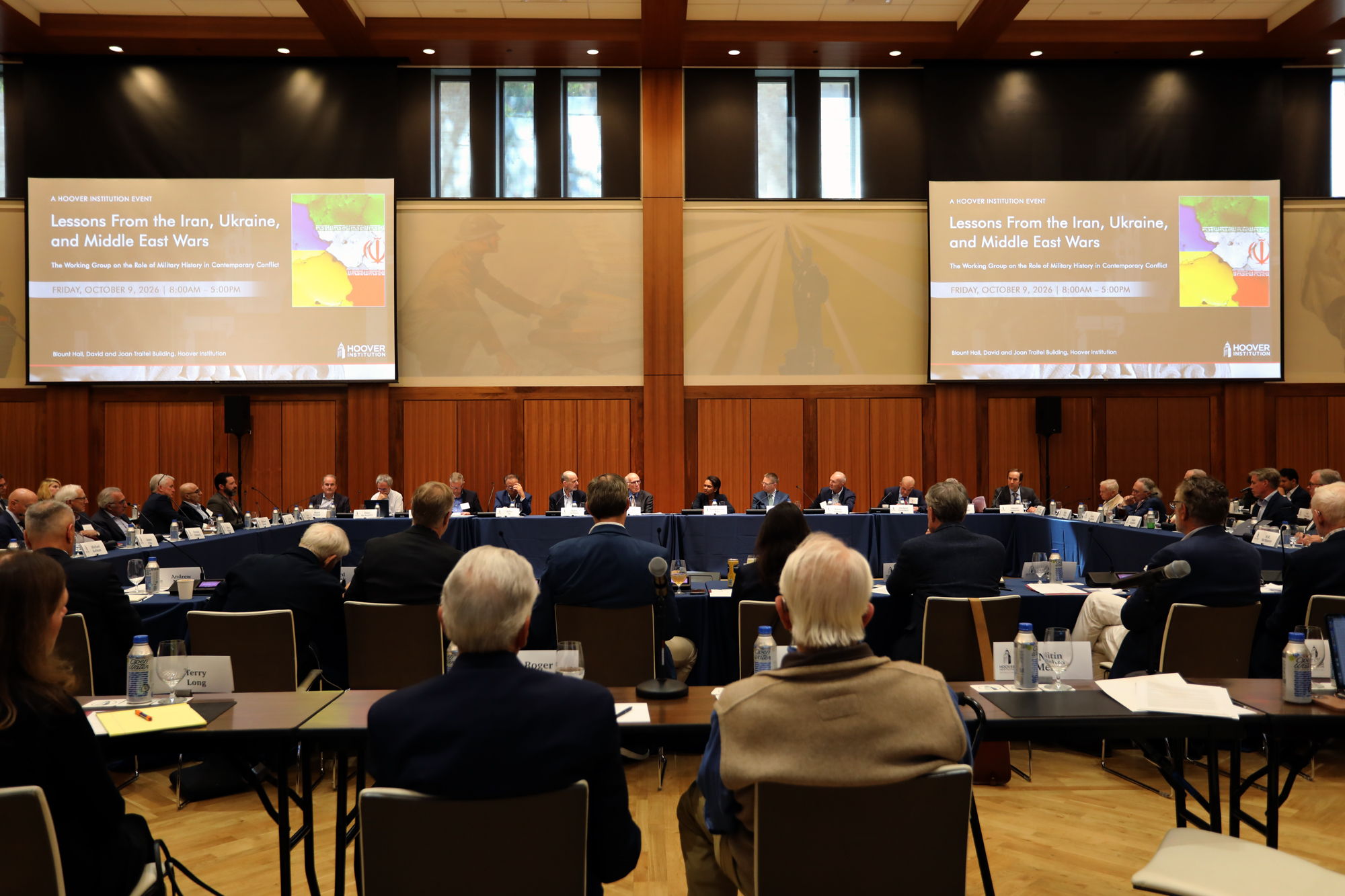
Hoover Institution (Stanford, CA)—With conflict still raging in Ukraine, and a yet-to-be-concluded conflict that holds two major oil chokepoints hostage possibly restarting at any moment, scholars gathered at the Hoover Institution to ask whether the US military is doing enough to meet new challenges.
On October 9, 2026, scholars affiliated with the institution’s Military History in Contemporary Conflict Working Group explored a number of pressing changes the US defense establishment must confront to guarantee security for future generations. The workshop centered around the conflicts being waged in Ukraine, the Middle East, and Iran, and the tactical and strategic lessons that US military officials and policymakers can learn from these wars.
Senior Fellow Victor Davis Hanson, chair of the group, noted, “Often contemporary conflict is so embedded in current politics, controversies, and emotion that we can forget that violent struggles of the past can offer considerable guidance about how these wars of today follow historical trends, especially how they originate, how they evolve, and how they end—given that human nature is constant across time and space.”
Themes discussed included what the fight around the Strait of Hormuz and Bab-el Mandeb will mean for future conflict, how the nature of fighting continues to rapidly evolve on the frontlines in eastern Ukraine, as well as how new spending and innovation priorities at the Pentagon are clicking into high gear, with the aim of introducing autonomous weapons, building space capabilities, and bolstering the impact of each person in uniform via new technology.
“Thinking about what we have learned from the past is really quite apt as we face these current wars,” said Hoover Institution Director Condoleezza Rice, adding modern thinkers in the realm of war need to prepare for the introduction of advanced technology like AI and quantum [?] technology onto the battlefield.
“We need to prepare for the fact that the modern battlefield will in fact incorporate the extraordinary transformational technologies we are experiencing now.”
Strategic Chokepoints
In the workshop’s first session, Distinguished Visiting Fellow Adm. James O. Ellis Jr. spoke about how the threat of land-based drones, anti-ship missiles, and even crude sea mines, in the context of the war between the United States, Iran, and Israel, has changed the dynamic of seaborne warfare.
Now, relatively inexpensive and easily concealable weapons like Iran’s Shahed one-way attack drone, or the Noor cruise missile, can deny access to a body of water for tankers and expensive Arleigh Burke–class US guided-missile destroyers alike.
This dynamic has played out before. During the Six-Day War, Soviet-made anti-ship missiles allowed the Egyptians to sink an Israeli frigate and remain relatively concealed.
Six years later, during the Yom Kippur War, Israeli corvettes and missile boats employed countermeasures they developed after the previous conflict to overcome a hail of missiles fired at them by the Syrians.
In the current Iran conflict, Ellis said, the quick, easy countermeasure to Iran’s cheap and plentiful weapons platforms has not yet emerged.
There Is No More Safe Area
Moving the conversation to land, Senior Fellow H.R. McMaster spoke of how the saturation of small explosive drones over battlefields in Ukraine has changed the way commanders have to maneuver and maintain their forces.
He said combat experience has taught that troops must operate as if they are always in visual range of their enemy, constantly taking countermeasures and employing concealment.
The battle area is much deeper than in conflicts past, he said, with the concept of a safe “rear” area fading from reality.
Speakers with direct knowledge of the conflict in Ukraine said AI’s use for targeting and maneuvering is still not profound or widespread, but combatants have an incentive to figure out how to use AI to pilot the thousands of small explosive-laden drones they fling at each other each day. Currently, both Russia and Ukraine divert thousands of personnel away from combat formations to operate these drones.
Whatever the future holds, the participants in the conversation agreed that the United States and all other war-fighting states must find a reliable, sustainable way to defeat these drones.
Post-Heroic Warfare and an American Understanding of Attritional War
Moving from a tactical picture to a strategic one, Hoover Military History Working Group contributor Edward Luttwak and Hoover National Security Visiting Fellow Nadia Schadlow examined why military strength and advanced technology do not necessarily produce victory.
Luttwak argued that Western societies’ declining tolerance for military casualties increasingly limits what their forces can accomplish.
Calling this the “rise of post-heroic warfare,” he linked this reluctance partly to falling birth rates and smaller families. He contrasted it with Israel’s willingness to accept heavy losses when national survival appears at stake.
Technology cannot overcome an unwillingness to act, Luttwak said. Efforts to protect troops can encourage reliance on costly long-range weapons and prevent commanders from using available forces effectively. He cited restrictions on American ground forces and Marines confronting Iranian interference with Persian Gulf shipping. The central question, he argued, is whether leaders and citizens will accept the costs of using military power.
Schadlow focused on prolonged conflicts that wear down forces, supplies, and political resolve. Economic size alone does not determine a country’s ability to replace troops and equipment, she argued. Rapid innovation also offers no assured path to victory because opponents can quickly counter new weapons and methods.
She argued that unclear political goals compound these problems. Promising to support Ukraine “for as long as it takes,” as NATO did in 2022 and 2023, did not define a desired outcome. She urged US planners to consider how to sustain military production, prevent prolonged wars, and exploit weaknesses in an opponent’s broader system rather than simply destroy its forces.
On Iran
Assessing the current situation between the US and Iran, Research Fellow Abbas Milani and Reuel Marc Gerecht, senior fellow at the Foundation for the Defense of Democracies, spoke about the internal politics of the Iranian regime, and where the conflict could go.
As it stands, the US Navy continues to block seaborne Iranian oil exports, Iran continues to strike Gulf shipping with drones, missiles, and mines, and the Houthis in Yemen threaten the airspace and oil infrastructure of Saudi Arabia.
Milani said the US military underestimated how much money the Iranian regime had spent on offensive weapons. This year, the military has been hardening and burying military installations, making them nearly impervious to aerial bombardment.
He said the United States also continues to underestimate the lengths the Islamic Revolutionary Guard Corps (IRGC) will go to preserve its own existence, and conversely how weak it believes US resolve is.
Gerecht spoke about the prospect that the US naval blockade of Iranian oil exports will result in regime capitulation. The chance of that happening, he said, is low.
He said it was imperative that the United States does not end the conflict at a point where the Iranian regime can impose tolls on ships passing through the Strait of Hormuz.
Modernizing the US Military
Owen West, a former Marine and futures trader now tasked with leading the Pentagon’s Project Agincourt, spoke about the enormous challenge of expanding the production and adoption of autonomous weapons systems into the US military.
While this work is ongoing, West pointed out other factors now straining the ability of the Pentagon to project power around the globe.
For starters, the average enlisted soldier in America today earns 30-40 percent more in real terms than a soldier did at the start of the First Gulf War in 1991. Fielding tens of thousands of troops in a war zone simply costs more than ever before.
Compounding that, the cost of merely maintaining the current Navy—let alone expanding it—will cost tens of billions in the next few years, and the bill for the strain imposed on soldiers during the Global War on Terror campaigns—health care, mental health, and disability payments—is starting to grow.
A New Era of Targeted Assassinations?
Hoover Military History Working Group contributor Seth Cropsey suggested a provocative theory to round out the day of presentations. What if the advances made in satellite reconnaissance and airborne surveillance today leads to a dramatic increase in the frequency and accuracy of targeted assassination attempts?
Will some powers use this new ability as a tool of policy? He suggested this phenomenon raises the chance of strategic surprise during a future major war.
Learn more about the Military History in Contemporary Conflict Working Group here.