



Key Focus Areas
Addressing the challenges our country faces by articulating free market principles in the key focus areas studied by Hoover fellows.
Explore all topics
- Socialism and the Fate of American Freedom
- Economic and Security Commons
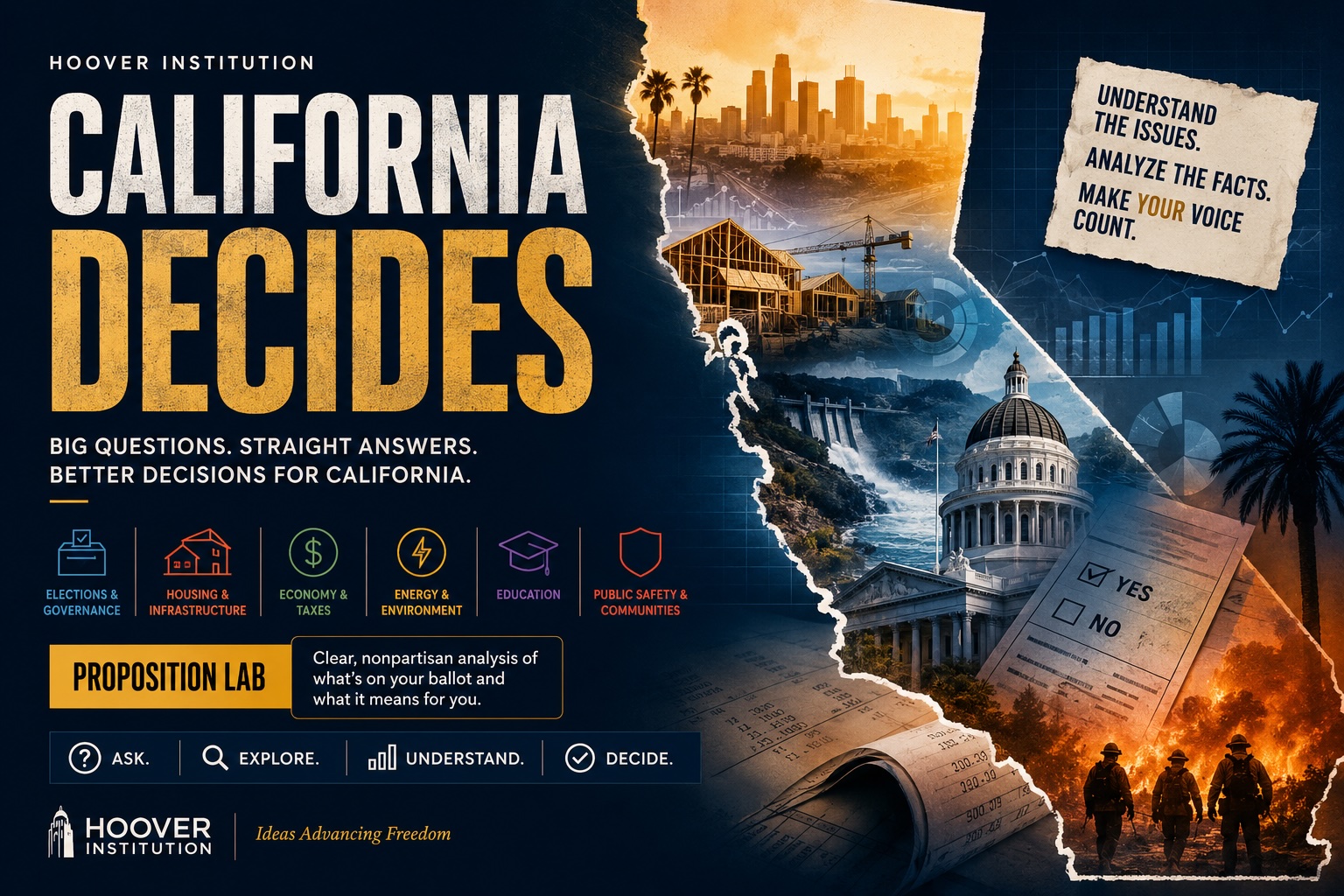
- California Decides
- China & Strategic Competition
- Revitalizing American Institutions
- American Leadership in the World
- Technology, AI & Innovation
- America's Economic Future
- History as a Guide to the Present
- Talent, Opportunity & American Competitiveness
- Empowering State and Local Governance


overview
The challenges our country faces require us to be provocative and wide-ranging in our thinking. The Hoover fellowship has a specific focus on the key areas of focus that seek to address the pressing needs faced by policy makers at all levels of government, from state and local leaders to national and international leaders.
America's Economic Future
Hoover examines the policies and economic forces that shape America's prosperity, competitiveness, and long-term growth. Through research on fiscal and monetary policy, trade, markets, and economic opportunity, our scholars advance ideas to strengthen America's economic foundations and sustain its global leadership.

"When free markets provide incentives for people to smartly organize their labor, resources, and capital, the whole of society will become more prosperous. What should actually grate against our sense of justice is inequality of access and opportunity.”
American Leadership in the World
Hoover examines America's role in an increasingly complex and contested global landscape, drawing on expertise in foreign policy, national security, diplomacy, and military affairs. Our scholars advance strategic insights to strengthen American leadership, protect national interests, deter conflict, and promote a more secure and peaceful world.

"Democracies don’t employ child soldiers. They don’t harbor terrorists as a matter of state policy. They don’t invade their neighbors. If you’re realistic about authoritarians, they do all of those things. And, by the way, they don’t have the one important shock absorber that democracies have. People can’t change their circumstances peacefully. And so when an autocracy fails, you get an explosion."[JM2]
- Condoleezza Rice
History as a Guide to the Present
Hoover draws on historical scholarship, the experiences of past leaders, and the extraordinary collections of its Library & Archives to illuminate the challenges facing America today. By examining the decisions, successes, and failures of the past, our scholars provide perspective that informs better policy, strengthens leadership, and helps navigate an uncertain future.

“One of the features that distinguishes Hoover from other think tanks is that it not only sits at a leading university, but it also has a Library & Archive containing the world’s most important collections of modern history. The truth can be told from our more than six thousand collections that largely cover the history of the twentieth century. The Hoover Institution has great historians who explore big questions.
- Condoleezza Rice
Empowering State and Local Governance
Significant policy making doesn’t just take place in the domain of the federal government. The Hoover Institution is committed to the idea that policy research should focus on solutions at the state and local level, where governments are best positioned to improve educational outcomes, stimulate economic growth, spur innovation, and respond to other needs of its citizens. To accomplish this goal of empowering states and localities across America, the Hoover Institution partners with a diverse range of state agencies and lawmakers. The aim of these collaborations is to produce data-driven policy recommendations on key issues such as economic development, public sector pensions, energy policy, tax and fiscal policy, and many others.

“Hoover fellows conduct data-driven research and deliver recommendations to our extensive network of policymakers and other stakeholders in states and cities across the nation with the goal of helping ordinary Americans improve their lives and achieve prosperity.”[JM3]
- Condoleezza Rice
“In a democracy, discerning public opinion is crucial to designing policies that respect the will of voters, advance freedom, and enhance citizens’ security and prosperity.”[JM4]
- Condoleezza Rice
China & Strategic Competition
Hoover examines China's growing economic, technological, military, and geopolitical influence and its implications for the United States and the international order. Our scholars provide research and strategic perspectives to inform American policy, strengthen national competitiveness, and navigate the challenges of US–China relations.

“America’s strategic advantage is its strong network of friends and allies. China only has clients.”
- Condoleezza Rice
Technology, AI & Innovation
Hoover explores how emerging technologies are transforming economies, national security, governance, and society. Drawing on expertise across technology, science, economics, and public policy, our scholars advance ideas that strengthen American innovation and technological leadership while safeguarding freedom and opportunity.

“We sit in the Silicon Valley surrounded by technology and innovation. …People tend to take for granted that technology is good. In fact, technology is neutral. However, it can be applied for good or evil, in the manner in which it affects institutions and people's lives. Human beings have been historically a lot better at the knowledge part than the wisdom part. The same splitting of the atom that allowed us to turn on the lights of civil nuclear power or administer medical isotopes, also gave us the atom bomb.”[JM8]
- Condoleezza Rice
Revitalizing American Institutions
From its founding, America has developed an array of institutions to preserve and advance our nation’s liberty and prosperity. Yet today, many citizens have lost confidence in those institutions, challenging their legitimacy and compromising their missions. In an objective, non-partisan spirit, the Center for Revitalizing American Institutions (RAI) will draw on the Hoover Institution’s scholarship, government experience, and convening power to study the reasons behind the crisis in trust facing American institutions, analyze how they are operating in practice, and consider policy recommendations to rebuild trust and increase their effectiveness.
“The American system of government is not perfect, because the founders were imperfect men. However, it’s delivered freedom to more people than any other form of government devised in human history. It is a remarkable story. The institutions are not just worth preserving, they are worth fighting for and upholding to bring about progress.”
- Condoleezza Rice