



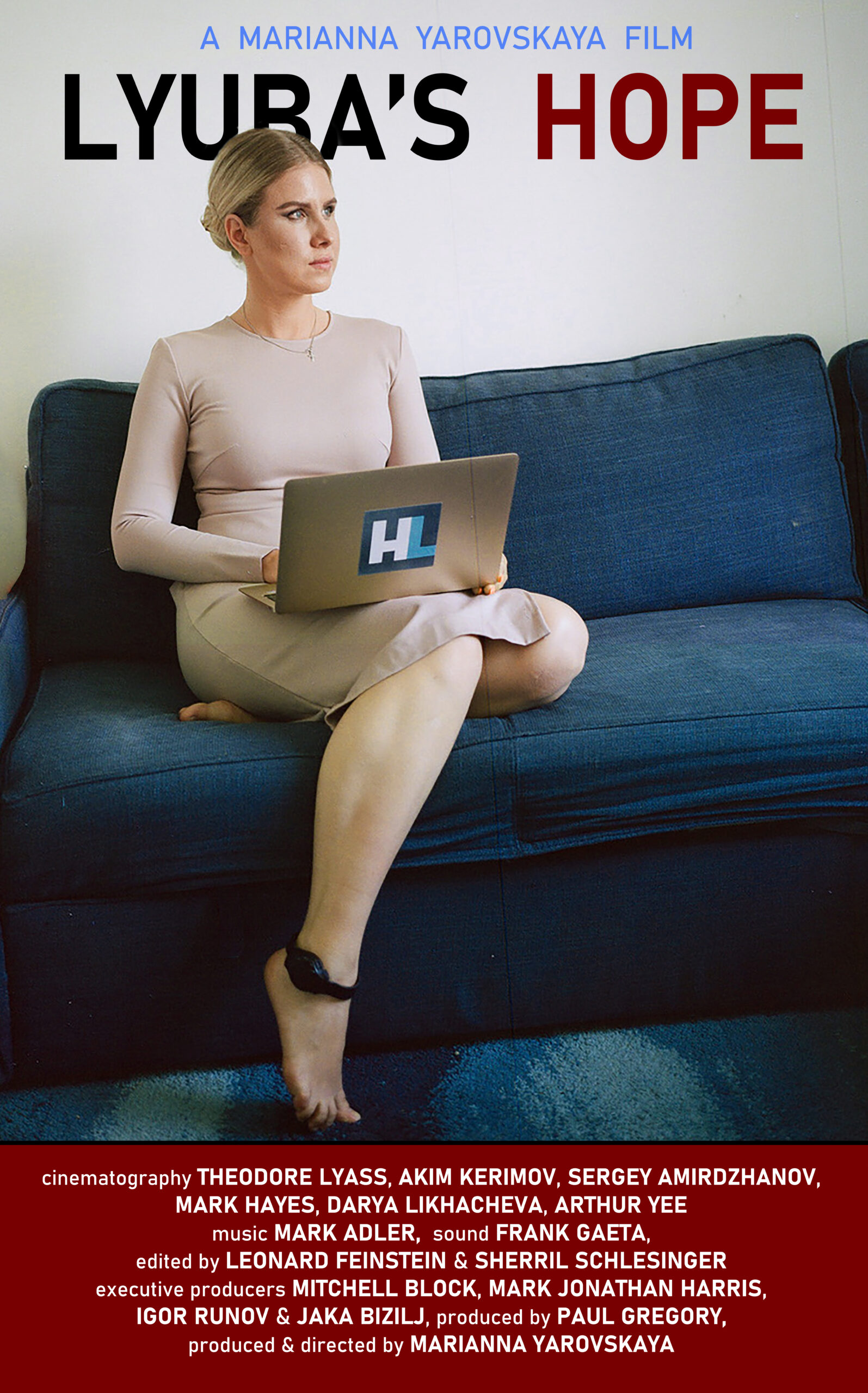
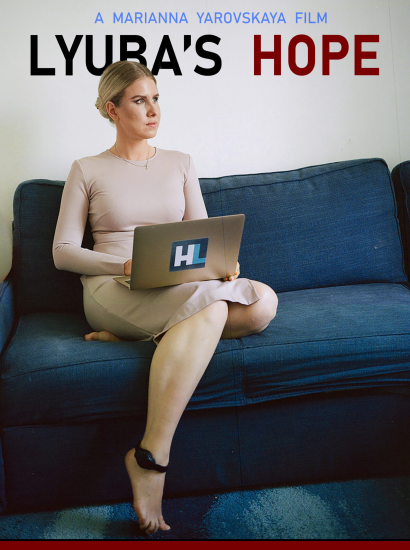
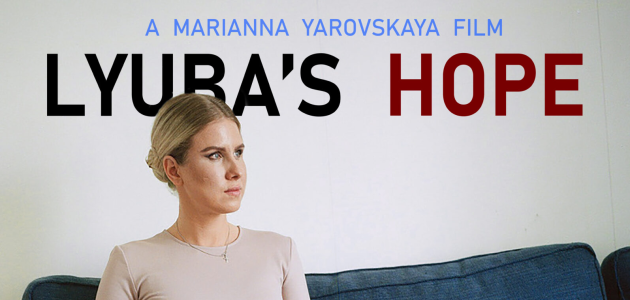
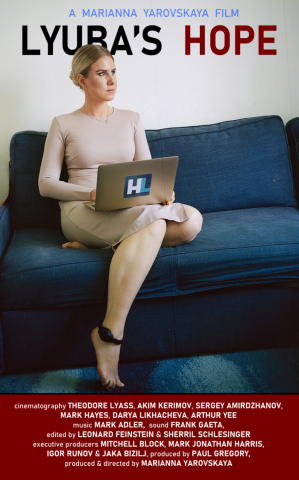
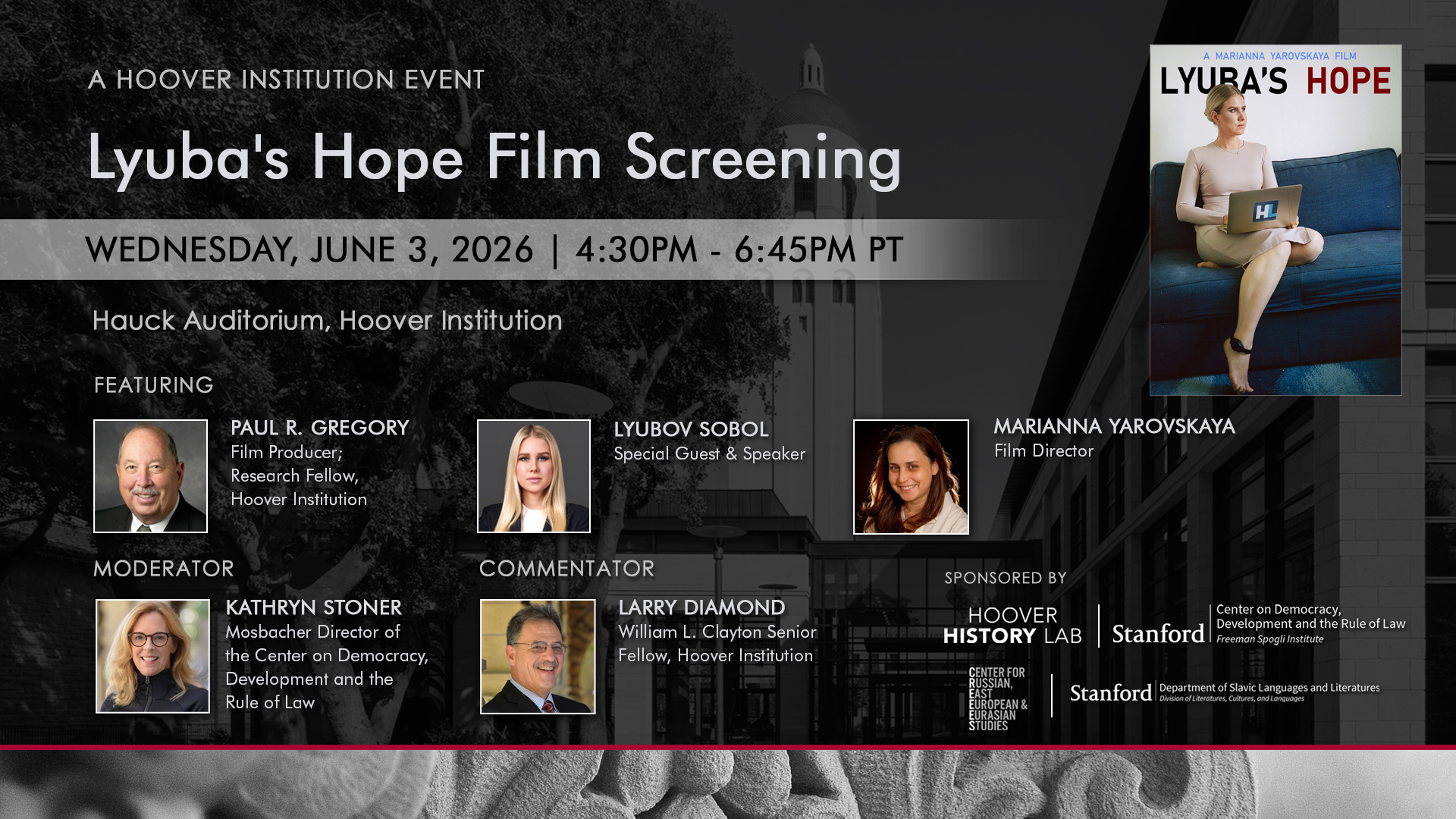
The Hoover Institution held an extraordinary screening Lyuba's Hope on Wednesday, June 3, 2026 from 4:30 p.m. to 6:45 p.m. PT in the Hauck Auditorium, Hoover Institution.
Lyuba’s Hope follows Lyubov Sobol, Russian anti-war opposition politician and anti-corruption figure, who has endured repeated arrests, hunger strikes, aborted political campaigns, attempted poisoning, and exile in her pursuit of a democratic post-Putin Russia.
As head of Alexei Navalny’s Anti-Corruption Foundation, Sobol advanced pathbreaking investigations including that of “Putin’s cook” Prigozhin. In 2026, Lyuba was among the fifteen Russian opposition figures admitted to the European Parliament PACE program.
Lyuba joined us in person for the screening of Lyuba’s Hope along with noted Russian-American director Marianna Yarovskaya and Paul Gregory, Hoover Research Fellow and producer. The discussion was moderated by Kathryn Stoner, Mosbacher Director of the Center on Democracy, Development and the Rule of Law and Satre Family Senior Fellow at the Freeman Spogli Institute for International Studies.
Gregory and Yarovskaya’s previous film collaboration, Women of the Gulag, was shortlisted for an Academy Award in 2018.
This event is sponsored by the Hoover History Lab, in partnership with the Center on Democracy, Development and the Rule of Law, the Center for Russian, East European and Eurasian Studies, and the Department of Slavic Languages and Literatures.
- I want to welcome you here to the showing of VUS Hope. My name is Paul Gregory. I'm a Hoover Research fellow and a producer of VUS Hope. The film has been directed by the distinguished Russian American filmmaker, Mariana Yaro, from whom you'll hear later. The showing will last about an hour and 20 minutes. We followed by a discussion with Luba svo, Mariana Ya, Larry Diamond and I, I can't recall whether I listed Luba, but she will of course be there. The discussion will be moderated by Catherine Stoner, who is the Mosbacher director of International of, excuse me, of Center on Democracy Development and Rule of Law, and a senior fellow at Freeman Spokey Institute. We are pleased to have a distinguished list of sponsors, Hoover History Lab, crease, Slavic studies, and the Center for Russian and East European Studies Center on Democracy Development and Law. As Paul said earlier in introducing the film, my name's Catherine Stoner. I'm the Mosbacher director of the Center on Democracy Development and the Rule of Law, and a senior fellow and political scientist working on contemporary Russia here at Stanford. And I wanted to welcome Yuba back to Stanford. She was actually a fellow here at our center a couple of years ago, so it's great to have you back on campus. And I should also mention that maybe a year and a half ago we had Vladimir Muza right on this very stage too. So, so I will tell you how the rest of the evening goes here. We have about 45 minutes and we will talk as a group for 20 to 25 minutes ideally, and then we'll take some questions from the audience. And I believe there will be roving microphones. So I will remind you again of this before you start asking your question. I want to introduce our panel, and I don't think I need to introduce Yuba Uba Sobo, I want now want to chant to your name, Lu Bo Sobo. So I, so I won't, we'll get to her in in just a moment. I will introduce though Maria, who is a Russian American documentary filmmaker who made the film with Paul Gregory. Mariana began winning awards for her work in 1998. Since 2000. She's worked for Discovery Channel, national Geographic History Channel, NASA Ames Research Center, and Greenpeace as a producer and senior film editor. Her film Holy Warriors, which is a study of soldiers who found religion, has played in 35 countries worldwide and won numerous awards. And I should also mention, I could keep on going here with, with all of the awards. She's, she's won, but I shouldn't really mention. She's the producer of the 2019 Academy Award, shortlisted documentary film, women of the Gulag, which is based on the book of our very own Paul Gregory here, women of the Gulag Stories of Five Remarkable Lives. So welcome, Mariana, we're very happy to have you back and, and thank you so much for showing this wonderful film and for making it you. And finally, at the far end, there is my very good friend and colleague, Larry Diamond, and I'll resist the temptation of calling you the dean of democracy. I guess I just did. Larry is no stranger, probably to most of you in the room. He's the William Clayton senior fellow here at the Hoover Institution and the Mosbacher Senior Fellow in global democracy at the Freeman Bogley Institute and actually at our center on Democracy Development in the rule of law. He's also a bas University fellow and undergraduate education at Stanford. Professor of Political Science by courtesy and sociology. Larry is, I said jokingly at the beginning, the Dean of democracy, but he really is the Lord of Liberty. He, of course, has probably the most recognized scholar in the world, among the most recognized scholars in the world on the subject of democracy and global democracy. He has research, obviously works on global trends affecting freedom in democracy in the US and and around the world. Catherine, stop. I'm sitting right next to the goddess of, of Liberty. I, I say nothing else should, I'm not gonna, I'm not gonna chart start chanting Larry Diamond, but he has so many books and accolades that if I list them all, just like with Mariana and, and Newba had a full movie, we wouldn't have time for the rest of our program. So let me just start by asking a few questions of, of Mariana and Lubo and then getting some perspective from, from Larry Mariana I'll with, with you in, in making this film. I, I couldn't help but notice that it really took four years to, to make it, 'cause Uff was here in 2022, I guess, and it just started shortly after that. Why, why so long to, to make it, did it have anything to do with growing political repression on opposition activists on you as a filmmaker by Putin regime? First of all, I wanted to, of course, to thank everybody for watching this. You are one of the first audiences who actually watches the film. And I must disappoint myself even to say that even this film is not quite a hundred percent complete because what you're hearing, the music and the end is still temporary music and there's no color correction, there's no sound mix. And there are a couple of things that we might change. Very small things, and I know which ones. So this is still a little bit of a work in progress. It's still not, of course, like with every film, 99% of it is, is funding and money. And like with women of the Gula, it took us forever to do it. It took Paul one year to write the book and it took me seven years to make the film with this one. When I met Luba, I said, would you like to make a film together? It was on Paul's suggestion. And she said, yes, if it'll take a couple of hours, I'll be happy. And I said, well, maybe, maybe a couple of days. And so then four years later, but we're in the home stretch and we hope to bring this film to the public very soon. You know, I actually found in my inbox, my mailbox early correspondence, I'm not sure why I was included, probably because Yuba was at our center with you talking about getting footage from tv, rain to insert in, in the film. So I, so I know you really had to, It's an interesting archives is how I make my living, you know, archives for, for cinema. I've worked on maybe a hundred films, feature films, documentary and fiction, doing archives. But on this film, archival work was very difficult because a lot of archives were destroyed, right? Luba, a lot of, a lot of the hard drives that Navalny Alive had was expropriated and Erased. She fled just with her cell phone. So we really had to collect bit by bit everything to recreate the story because it started with us in two 2022. And so we had to kind of build the backstory and then go from there, Incredible feat and, and also having to gather it from different sources that way it must have been taken a lot of, of time and effort. Can you, can you tell us just before I I move over and, and talk to Luba a little bit more, how hard it is to make a film like this, which is really important to a lot of people, and to remind people around the world that Russia is not Putin and, and Russians are not Putin. How hard is it in, in an atmosphere of funding cuts and, and the like? Mm, I I would say that to me it came pretty naturally because I, I was born and raised in Moscow. I worked as a journalist for Channel one and a couple of huge TV programs when I was a teenager. I worked for the first family radio station, echo Moscow. I worked for basically news when they were still democratic. And then in the nineties I went to study cinema. And so I observed what happened to the country over the years, how, you know, this happened. And I think Women of the Glock was a preparation for that because I looked into history. If you don't work on your history, then you are bound to commit the same mistakes. And then I think this was a natural film that came next after Women of the Gulag, what do we do? What, what is happening presently? And I found that the Lubo was a very, was the right subject, and I thought I'll make a small short movie. And then we realized that there is much more to the story and we're just stuck with it. Well, let's, let's move to the woman herself for a moment, Ben, and again, welcome, welcome back to Stanford. I, I knew a lot about you obviously before, and I knew, knew you before watching the film, but watching the film and seeing so much of your life presented in in 80 minutes really reminded me of how incredibly resilient you are. The definition of, of resilience and also having a child through all of this is, is just incredible. I wanna, I wanna ask you, I guess most in, in a lot of questions, but one is, can you explain to the group a little bit more about how you got involved and attached to Alex Navalny? And then I want to talk a little bit about the effect of his death on you. First of all, thanks for having me here and I'm a huge fan of your work and Larry's work, so I'm very like, happy to be here and it's honor for me to be subject of Mariana's work she told just now. So I became a first member of Alexander Val team in 2011. It was before he tried to be a mayor of Moscow. He was not like a well-known politician that time. He was considered like a blogger on the internet. But I saw a huge potential in his work. He was a anti-corruption lure those days. And I saw his work on internet. I followed him on a blog in live journal. He public published his ideas, thoughts for everyday basis and I followed him there and I saw that, yes, his idea, his ideas, like I can share these ideas, I can, I wanna join his team. And when he published a post that he's want, want to find the people in his team, he wants, likes to start some public project against corruption, I applied and I was, my application was accepted. So it was a public, it was opportunity for all people, but I was the first one. So I'm happy that I had this privilege to work with him maybe in political way a little bit from scratch because after I joined his team and became a member of his team, we established anti-corruption foundation, we started different project. He and me, we participated in political campaigns, we started do a lot of stuff. But when I joined his team, it was 2011 and like, it was like the experiment Yeah. In political way because there were no political campaign before us. And it, it was Alexander Naval who started the huge C mass protest on the streets after do my elections. So yes, I was, I was witness of this process and I was a member and organizers of a lot of process products in Moscow. And Navan was my mentor and coach Yeah. In this way. Yeah. He, he of course mentions you in Patriot, his, his prosti published biography or autobiography. So we saw a little bit of, of about your, of your reaction to hi his death, which in some ways was unexpected, but in other ways unsurprising. Where were you when you, when you heard about it and and what was your initial reaction to it? First of all, of course it was shocked and it was very difficult days, those days for me personally to understand this fact that he's not longer with us. And I was here in the United States and at that time, before he was moderate in prison in Russia, there were huge discussions on publicly about exchange or political prisoners. And a one was top priority for the exchange. So me and my colleagues, ex-colleagues, coworkers, we expected that maybe there is a possibility. It's slight, but anyway, it's a possibility. But he could join us abroad. But, but Putin had another plan for Iz Yeah. To make sure that he couldn't go abroad and be effective as an opposition leader. Yeah, right. I mean, it's a real kick for a political opposition when one of its main leaders, perhaps one of the more recognizable leaders, so the Russian opposition is, is taken away essentially. How, how do you maintain your sort of optimism that you can change things in, in Russia? I was really struck in the film, one of the young women says, who's working for Nova? We will overcome Putin and happily live our lives. And you talk about the, the beautiful future of the Russian Federation as, as did Alex himself. How, how can you, how do you maintain that hope, especially now? I mean there were, it, it seems as though, and, and Putin has just cracked down more and more on the space for political protest, any kind of activity against him. Thank you for this question. In 2021, I was forced to leave my country. But before that, my whole life I lived in, in Russia, I traveled a lot, I work in different region with different people. And so my hope and my belief is based on, I think that my knowing Russian people, and I know that Russian people are struggling for democracy and to live in a normal country. They don't want to live with the war. They don't want, like they ordinary people who want, who want live in a normal country with working laws, with judges like independent judges. We independent medias without any blocking and shutdowns on internet, just peaceful, normal life. And a lot of people was forced to live our country as well. But there are a lot of people who now live in, in, in Russia nowadays, and we, it's, it's difficult to organize a mass protest like it was before right now because repressions are very tough. But we have a little bit of connections. I have a lot of volunteers from my campaign, which are living in, in Russia even now. I have a lot of friends in different regions and I know that the protests have a huge potential and people don't give up, Right? We know there's some latent sort of possibility of, of people getting just disgusted enough to do something. Larry, I wanna turn to you and ask you specifically about this question in a a comparative context. What, under what circumstances are opposition politicians in exile effective in weakening an autocratic regime? And, and what do you think is, is likely to weaken a personalistic autocracy like Putin's in Russia? Well, the first thing I want to do before I answer your question is pay tribute to the star of the film, Luba for your remarkable courage and, and, and resilience and, and faith. You know, I I also have gotten to know a bit Vladimir Karaza. I actually was probably one of a thousand people who begged him not to return to Russia, where he met with that second and nearly fatal poisoning. And I, I often reflect, I I don't think I could summon that courage. I'm pretty certain I couldn't. And I think very few Americans understand what it's like to face that kind of overwhelming power, murderous power and intimidation. And really, you know, we're, we're took, it's talking pretty close to the pure human incarnation of evil. When, when we talk about Vladimir Putin, it's very daunting to stand up to that and particularly to stand up to that over such an extended period of time. We didn't talk about the murder of Boris Nsov, but then Navalny and, and so many others. And it is incredibly reaffirming and inspiring not only to see the film, but to see you here and looking so well and being so vibrant and, and so a resolute and then to Mariana really, my, my deep and profound admiration for your making this film and to Paul for the role you played in it. This is really, I think, a remarkable film. It just turns out by coincidence that I, I only saw the winner of the Academy Award for best documentary. I think it's called Mr. Nobody Against Putin. Yeah, Mr. Nobody Against Mr. Putin. Say again, Mr. Nobody Against Mr. Putin. Yeah. Which I highly recommend to everyone as well. We showed it here at Stanford fall, in fact, Only just a couple weeks ago. And that won the Academy Award for best documentary. And I think this is even better. So I hope that you will get the final version done in time and into the theaters so it can be considered for the, the following years award celebration. You know, you never know, it's very important to advocate, to campaign, to raise consciousness because you just never know when history's gonna turn. And we, we have instances of people who were in exile and trying to raise consciousness, working with much less visibility than, than you have generated. And things changed. Kim Dej was a, a, a scholar, I think at Harvard at one point in, in exile. And he, he went back when the military was forced to by student protests to yield and stand way. And he eventually became the president of the Republic of Korea. And I think that it's also very important to stress at this moment when American foreign policy is, if I can put it candidly, just so shamefully wrong on Ukraine, on Russia, on democracy around the world, and when, you know, it's Europe that's leading on these issues, that the last time when we were as unfaithful to our own founding principles around the world as we are right now, it was the Congress that stood up and began to change American foreign policy in the mid 1970s. And then paved the way for a succession of American presidents, first Carter, then Reagan, George W. Bush and so on, to manifest very different American foreign policies on democracy and human rights and so on. And for Reagan to say, Mr. Gorbachev, tear down this wall, and so on and so forth. So I think you shouldn't underestimate the impact you can potentially have in changing American foreign policy. And I would also say, again, by way of tribute to both of you, to Mariana and to Luba, that when it's just an abstract story of, you know, an amorphous democratic opposition and fear and resistance and so on, it's hard for people elsewhere in the United States or anywhere really to fully understand and identify with it when you personalize it through the life of one person. And we can see the arc of this over what you endured, what you risked, and you know, here you are relentless And the sacrifice, The, the impact. I, I think we shouldn't underestimate the impact of the story, the life, the example of one person through which we see a national story. Yep, yep. And there Right, exactly. And also the courage and you yeah, the courage. I, I wanna turn to the audience and I believe there are roving microphones. Yes. Are there roving microphones? Hi, I can you hear you Mary? Okay. Yes, I can I take this movie as an introduction? So my question is, how do you see the future Russian future moving from this moment? Great question. I think that's for you, Luba From this moment or tomorrow, I don't see anything good for Russia, but after tomorrow, I think that we can became a normal country. We miss this chance, not me personally because I was a child in a kindergarten, but people in Russia, we missed this chance in nineties. And some reforms was done, but it was not enough. I think that the main problem was that about people on the top level, they thought more about their wealth, about their pockets and not about institutions to establish institutions which could help establish democracy on a long, for a long distance. So we know these problems, we know we, and I think that our generation of politicians are human right activists, independent journalists, we will have a chance in future and we shouldn't miss it. So I'm looking in the future with hope. Great, thank you. There's another question up front here. Thank you for your, for your presentation. My question is, is to anybody in, in the podium that, that can answer this, but in general, what has been your experience with political activism when you're no longer in Russia, how does that actually affect the effectiveness of activism when the activist has left the country and the methods that are available to you? How do they get altered? Yeah, maybe you buff, you could take that first and then Larry, you can talk about that perhaps too. It's very difficult to be a politician or affect national politics from abroad. That's why return to Russia, that's why we return to Russia as well. So we have some limits of our actions. It's very difficult to call, people talk, to take now to the streets because you are abroad and you are in a safe place. Pretty the safe because I was poisoned in Europe. But anyway, they are not, yeah, we are not in the same position. So you action is limited. But anyway, rational position in like, which I, which I mean not only politicians, but human rights activists, feminist activists, L-G-B-T-Q, activists, eco Ec in ecological projects and, and Memorial for example. And other people, independent journalists. We are all now in exile, but we have a huge audience and our supporters inside Russia. For me personally, I have popular social media platforms like YouTube and Instagram and even TikTok. They're officially blocked in Russia. But anyways, I have millions of views on my platforms every month. And there are more than 100 very popular YouTube channels among Russian speaking audience. And in common we have dozens of millions of views per, per month. And I think that it's a great achievement of Russian opposition, that we have this huge channel of communication with people who are now still in Russia because every platform like YouTube, Facebook, Twitter, Instagram, they blocked it in Russia, official Putin, Putin's official. But people inside Russia, they know how to use VPay. And even like all the older generation of people, they are switching from one VPN to another one. They like, I dunno why, I dunno how, but they like taught to use these tools. And so, and for example, in a practical way, I can give you only, for example, one example because we are out of time. It's, it's very difficult for Putin right now to start new wave of mobilization inside Russia. And it's, I think that it's a rational position who told Russian people what is going on in real life in Ukraine in the war at that, it's not a special operation. That's Israel war. We told about massacre and butcher for me, I, I got a fifth criminal case which was open against me before I told about butcher on my YouTube channel. I was accused of spreading misinformation about Russian army. But so how people in Russia know about what is going on in, in real life in, in Russia, in regions of Russia, outside Russia, in Ukraine, be because we are doing our job from exile. Because every media inside Russia, radio channels, TV channels, newspapers, even regional and local newspapers, they're under officials control governors or kremlins control. And so it's like we have an impact that it's, it's difficult for Putin to start new wave of mobilization because Russian people know what what it like could affect on their lives. Right. It you, just to clarify mobilization is is not, it's kind of the draft, it's close to the draft. Yeah. Very unpopular for, for obvious reasons. Larry, do you wanna make any comment about Well, I, I really just wanna, what Lu Luba said from her own experience and strategy is what I would most emphasize from a comparative standpoint. The one thing that can I think be effectively done from the outside is to pierce the monopoly of information and the propaganda of the authoritarian regime. And to give people the truth. This is why I think one of the biggest mistakes the United States has made in quite some time is to try to close down the voice of America and radio free Europe, radio Liberty and so on. The, the person who was appointed as director, our friend Micah Ovitz, is fighting a very brave battle in this regard. But people need to hear the truth and that's one instrument for, for doing so. But when it's coming from their own people and, and people whose stories they know and respect and trust, it's even more powerful. One of the lines in the movie that actually most resonated with me, it's really one of my favorite lines, is when you say in one of your broadcasts or appeals, get out your VPN and, and you know, get ready to access the internet to circumvent state, state internet censorship and control. And we're in a cat and mouse game in, in terms of access, the authoritarian regimes are getting more skillful, but we're also developing new tools as well. And leaders from these countries in the in exile, but with close communication with people on the ground have I think an authenticity that is unmatched and an ability to inspire people to be truth tellers. And again, to wait for an opportunity when things change. This war is going very badly for Putin. I I really think things are, are going to change. Yeah. On, on that note, I think it also gives people hope inside the country, right? To know that, that the, there, there are still people alive. Some it, it, it you're more effective outside right now than, than you would be inside of course because you would be in jail or unfortunately I didn't have any chance to be in Russia and, and free. So I had only in 2021 when I only returned to Russia, I have only two options to be in prison for a long, long, long time. We don't know. Like endless time, I suppose so because as I know only five criminal cases was were open against me, but maybe I don't know about other cases. And you might have poisoned or Yeah, so, or abroad. So I did, I had only two options. Right, exactly. Yeah. Any I think Mariana wanted, Oh yeah, Mariana, go ahead. I wanted to add about impact, I think as far as filmmakers go, or artists, I heard them a famous poet who was featured here for two seconds who was poisoned also. There was a poisoning attempt, said that the difference in immigration between a hundred years ago and now is, is that back then only, you know, the very talented people left and geniuses remained in the, in the country when it was a revolution of 1917 and now it's the opposite. Geniuses left, you know, and talented, some talented people remained in the country. So by geniuses I I mean some great theater directors, great filmmakers. I just got back from Khan International Film Festival where I watched the premier of this movie called The Mini Tower by Andres VAs of, please remember the, the title it'll Get the Academy Award that just got the Grand Prix in Khan. It's one of, it's the first major strongest ever movie about the war and mobilization that was made by the Russian director with all the Russian actors, but somebody who lives outside, outside Russia. So by doing something outside Russia on the Russian subject in Russian language, we are certain that Russian people will watch it sonar later. Of course, you know, I'm not the caliber of please, please watch Mear and then what comes out. So I think that we make a difference that way, but our goal as art is to make it emotionally and artistically powerful. And that's, that's my task. And, and when, and just to pick up on, on that and when, and Larry's remark, when, when the moment comes, nobody lives forever, even though Vladimir Putin is, is apparently trying all kinds of technology to, to live forever when the moment comes having a strong diaspora population but is in touch with what's going on in the country is, is incredibly valuable. And of course you raised Lenin, Lenin was living in exile until 1917, not that he's a good example, but he is an example of the efficacy of of opposition in exile. Are there any other Yes, over here? Yes. Hello, I'm GRE visiting from London. I have this question about transitional justice to you as a lawyer. So you know, other Russian opposition leaders like Serge Gray, gray of, you know, proposed, you know, some sort of structured steps, how to bring with the Russian society, you know, government forward, you know, given there are maybe maybe half a million, you know, power and military and you know, law, law enforcement people in Russia, you know, from secret service to FSB, to to, you know, military intelligence, et cetera, that are supporting the current regime. How would you imagine the steps for transitional justice, you know, to migrate the or or Russian, you know, society from existing point to, you know, maybe the society that you envision? So process of illustration? Yes. It's very difficult question and I I, I want to be briefly with my explanation, but I saw, like as you, as you saw in a movie, I, I had a huge experience even with actions and talking with security forces, policemen, prosecutors, and any kind of like security forces and others inside Russia. And I had a lot of talk with them privately and, and publicly because like we was kept in one facility for long hour a a lot of hours. And I'm not so sure that they are supporting this regime. I I think that they're not supporting this regime. They don't have braveness, they are not brave and they a lot of care about their, about money, about they are not high educated people. And they understood very clearly that it's only one way for them to earn some money just to be a policeman or some kind of like people from the system, but they are not seeing them in business or academia or other like paths. So, but they're not supported regime ideological. It's, it's about money. It's about, like, I was like you saw there like, I think they, you didn't mention, but I know one of a person from like other side of like from the regime and we had a a, a lot of hours of conversations because he was like my, not bodyguard, but like a person who was like with me from this regime shadowing you. It just no, no, no, the shadow. You, he was like officially my like, I dunno, assigned to you to follow you. Yeah, yes. Like person who should be with me just to control every my, every actions. So, and he told me like, oh, I will be retired, retired in five years and I will join you in the protest. And I told him, no, you will not. I'm I I'm sure that you will not, but yeah, no, no, no, take my world, like I I will join you in the streets, but I need my retirement and, and that's it. But I think that they understood very clearly what is going on inside the regime. So they don't have like pin glasses on them. They know it's from inside, but they don't have a braveness to speak out against the regime to do some actions to Left the decide. But I'm not sure that it's very big problem for them. It, it would be very, they would fight for this regime after Putin's death or something like this. So I'm not sure that it could be like this. And what would you do, do you see any, any process of, you know, illustration or punishment in the future as there have, you know, there has been this form of tradi transitional justice in other autocratic states, apartheid, obviously South Africa is one that is a criticism of the 1990s. I know that QA has, that there should have been some illustration process and punishment of of the people who headed the communist party in the security apparatus in the Soviet Union. Do you, do you agree that that was a mistake then and that there, when the moment comes there would or should be such a process after Putin Is discussable question about illustration, but I'm sure that people were criminals should be sentenced and should be accountable for the actions in the war in Ukraine. People who participated in repressions, judges, policemen and other people who, like we have a project inside rational position, it named black list. And there is a list of people from different, like parts of the regime from different departments, which we have documentation that they participated in repressions against a rational position and, and Russian people, for example, people who sentenced a Navalny to panel colony and other people. So they should be like, they should be accountable for their actions. But I'm, I'm not sure that we should like Yeah, yeah. I, I I'm not sure about this step. I think that we should establish new rules and the democracy, democratic institutions. We should not think about revenge. We should think about our future and how to become a normal country. How to help people with trauma, with a bad experience to be like a normal member in a, in new configuration. Right, right. Move forward, look to the future rather, rather than the past. Okay. Or maybe over here, Can you tell a little bit about your plans and maybe strategy, how in future you will fight with Putin and how we can help you in your fight? I mean, peoples who live Russia and live in another country. Yeah, Thank you for your support and I'm trying to do my best to use different tools and opportunities to fight against Putin's regime. It's, I have my own, as I mentioned before, platforms on internet and I produce a lot of video contacts for the Russian audience and explain what is going on. And I'm talking about the war in Ukraine and talking about Russian corruption system. And now as you seen in a movie, I am a member of the place platform for dialect with Russian democratic forces at pace. And it's very meaningful opportunity for me to speak with different politicians from 46 countries. We are, we are altogether for four times a year at the same place, at the same building. And you can and pace open doors for us for rational position to talk with parliamentarians from different countries. And I am, I'm using this opportunity like as I could for example, last session of the pace was in April and I had 15 events, mostly private meetings with different parliamentarians. And we discussed a lot disinformation campaigns of Putin because he's like now in Armenia, their elections, preliminary elections and then using votes and AI tools to spread disinformation. And so we have some in common rational position and people who are trying to like to fight against the put in disinformation and abroad we have some issues with communitarian reasons for Russian people, which are struggle to be legal immigrants in different countries because they can back come back to Russian. For me it's like high level, high level officials wish you could meet and discuss things in common in in general or particular different like points and questions as Catherine told before. It's very good point. And don't explain that rationale equals Putin. And for example, a lot of politicians abroad, they're focused on Putin and Kremlin and like top propagandas, like salvia simonian. But there are regions and like there is a life in the regions, there is some different propagandist. And for me for example, I made possible to include in a personal sanctions list propagandist and people who are supportive Putin and the war in Ukraine from different regions because nobody like focused on this matter. And I like made the least evidence quotes of the expressions of supporting the war in Ukraine in a table in included in a EU list of sanctions. So there are different types of work abroad form international audience and for Russian audience and, and trying to help people who now living in exile and don't have any documents. There are some very famous activists who are now can get visas or legal status and I'm like writing every day some recommendation letters to them. And I ask politicians directly to help some different people because now for example, in Finland there is a family which are, I I which are about to be reported to Russia, but they were very active in supporting Ukrainian refugee in Finland and they could be sentenced till death in Russian prison because of like yes, a stratus. So I'm helping them, yes, prison and I'm helping them like just to obtain legal status. Some, some work I wish I do public, but some, there are a lot of activities on publicly. Right. And, and I think also just keeping in the news, the fact that not everyone in Russia and Russians who have left Russia think Putin is, you know, great and that and that he, his regime can't eventually fall. Of course he will die at some point and he's appears very paranoid about that. So the work that you continue to do and other members of the Russian opposition and and Russians who have left I think is very important. It's also really important in informing Europeans and Americans. So we are already almost three minutes over time and I see Paul coming down this, the Slight refresh but are in this, Wow, that's a Very light What a wonderful surprise. We weren't told about that. That's terrific. I, I just wanna, again, thank you Mariana for making this wonderful film. Thank you Uba for all of the incredible work that you're doing and thank you Larry for giving us some perspective and thank you Paul. Gregory, Can I add towards Yes, sure. Can I add towards, yes. I, I also, I wanna thank you all for coming here and thank for organizers of this event and especially, especially thanks to Paul Gregory, which made this film possible. This idea of making this film came up to him here at Stanford four years ago. And yes, and Paul Gregory was the person who saved my life after poisoning. So thank you so much.