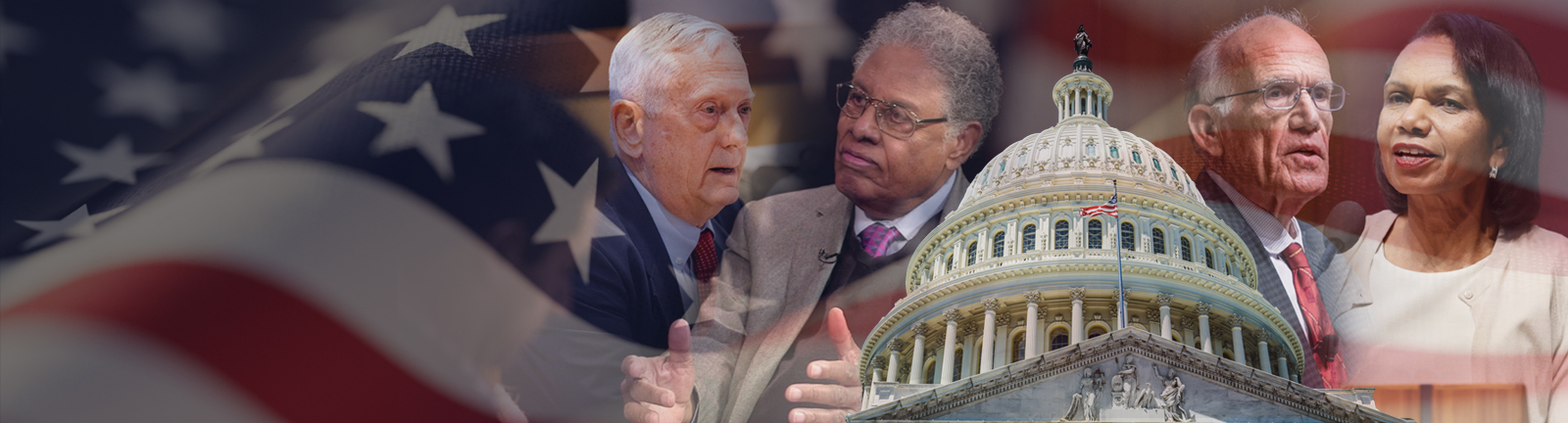
Today, Victor Davis Hanson offers a scenario for what may come next in the US war on Iran. C3 AI CEO Tom Siebel speaks to Condoleezza Rice in the latest episode of Only in America. And Hoover’s Veteran Fellowship Program marks five years of veteran initiatives to help US communities.
The War in Iran
At American Greatness, Senior Fellow Victor Davis Hanson writes about what he thinks will come next in the “bomb, talk, bomb” campaign between the US and Iran. “We may see another week or two of intensive strikes against Iran’s dual-use infrastructure. At some point, the United States may also seal Pickaxe Mountain and any other remaining sites suspected of storing or producing enriched uranium,” he writes. “The United States has already severed many of Iran’s rail and maritime links to China, Russia, and their allies. It can reopen the Strait of Hormuz by force and convert frozen Iranian assets into a maritime insurance fund to compensate any foreign tanker damaged by Iranian attacks.” If the US does this, Hanson believes American forces could “disengage” by mid-August. Read more here.
Only in America
Tom Siebel, founder and CEO of C3 AI, joins Condoleezza Rice for a wide-ranging conversation on innovation, resilience, and the enduring promise of the American experiment. Siebel recounts how his time as a history student at the University of Illinois shaped his entrepreneurial instincts as well as the calculated risks he took to launch one of Silicon Valley’s most influential enterprise software companies. He explains why America’s education system, commitment to liberty, and culture of opportunity remain the foundation of its success. Rice and Siebel explore the transformative potential of artificial intelligence, from increasing the efficiency of government services to democratizing lifesaving and productivity-enhancing practical knowledge. Siebel also discusses what two serious personal hardships—a harrowing elephant attack and the sudden loss of his vision—have taught him about resilience and reinvention. Watch their conversation here.
Empowering US Veterans
Condoleezza Rice, the 66th US secretary of state, and Robert Gates, the 22nd US secretary of defense, headlined a Hoover Institution gathering marking the fifth anniversary of the Hoover Veteran Fellowship Program, an annual yearlong program that helps veterans develop actionable projects benefiting their communities and the nation. On May 6–8, Hoover convened current and alumni veteran fellows for VFP at Five: Taking Point, a three-day celebration of the accomplishments and impact of the program’s first five cohorts. The anniversary gathering brought together 38 current and former fellows, representing nearly every participant since the program’s founding. Fellows presented their capstone projects and demonstrated their community impact during the George P. Shultz Distinguished in Service Expo in Hoover’s Stauffer Auditorium. Read more here.
Freedom Frequency
The world trading system is under great strain, even as most trade still takes place under multilateral disciplines. US unilateralism, China’s state-driven model, cross-border regulatory spillovers, digitalization, and the unfinished Doha development bargain have all weakened confidence in the World Trade Organization (WTO). Yet according to economist Ralph Ossa, the system’s core logic remains sound. Reciprocity, most-favored-nation treatment, and binding commitments help restrain discrimination, reduce uncertainty, and benefit economies of all sizes. The old WTO model cannot simply be restored, Ossa argues, but it can be selectively renewed. The way forward is to preserve the multilateral core, make open plurilateral agreements work inside the WTO framework, and rely on active stewardship by middle powers to keep cooperation moving. Read more here.
Space
On the latest episode of Matters of Policy & Politics, Simone D’Amico, a Hoover Institution science fellow and founder of Stanford’s Space Rendezvous Laboratory, discusses his recent report on space safety with Distinguished Policy Fellow Bill Whalen.
The Big Idea: Without new investments in communications technology and greater international cooperation, D’Amico says, lower Earth orbit may become too crowded for spacecraft, leading to satellite damage. Watch or listen here.








Related Commentary