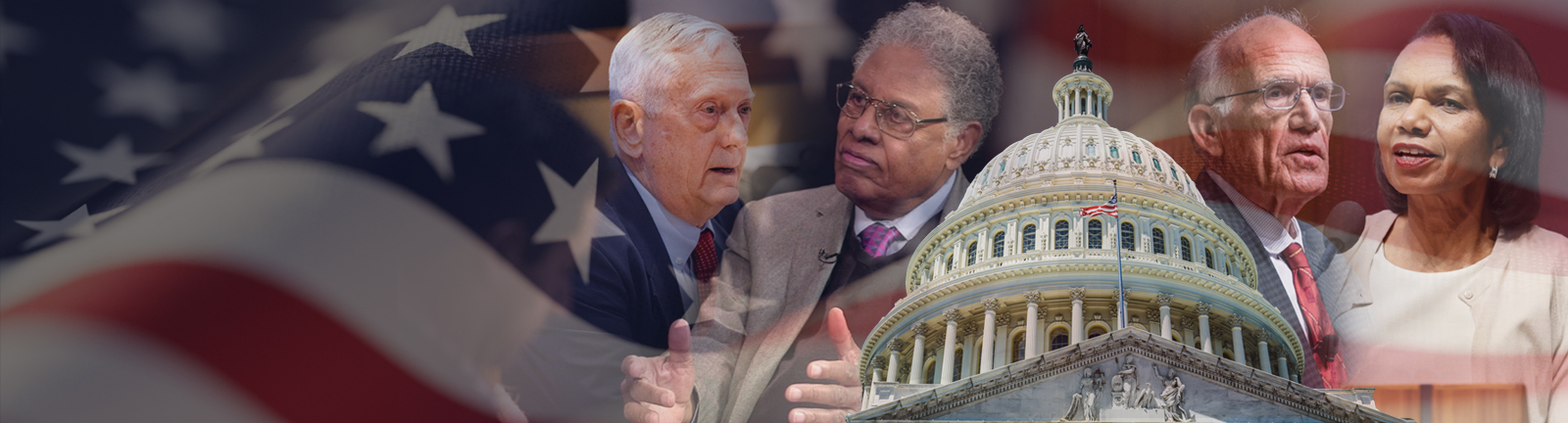
This Friday, Condoleezza Rice delivers a speech at the Pentagon commemorating the 25th anniversary of the September 11 attacks; Bill Whalen speaks with Philip Zelikow about the latter’s work leading the 9/11 Commission; and Michael McConnell examines how presidential emergency powers have expanded in the quarter century since the attacks.
Remembering 9/11
Hoover Institution Director Condoleezza Rice was national security advisor on September 11, 2001. She delivered a powerful speech this morning at the Pentagon’s commemoration of the 9/11 attacks. Rice mourns those who were lost that day, reflects on the heroism of the first responders, and praises the outpouring of support for victims from the American public in the aftermath of the attacks. As she notes, “Across the country, people gave blood, filled houses of worship to pray, took care of the vulnerable — the elderly and infirm — and comforted families of the fallen.” Rice recalls that America’s allies rallied to the nation’s defense, as “NATO for the first time in its history under Article 5 declared that an attack upon one was an attack upon all.” At the Pentagon, Rice says, those first on the scene “summoned a will and a spirit — a sense of obligation — that our military lives by every day. ‘I will stand between danger and my fellow citizens. I will leave no comrade behind. I will go; I will serve; I will do my duty.’” Watch the speech here.
What did the nation learn from the 9/11 attacks, and is the country better prepared to handle the threat of terrorism today?
The Big Idea: Senior Fellow Philip Zelikow joins Bill Whalen on Matters of Policy & Politics to discuss his work as executive director of the bipartisan 9/11 Commission, and to reflect on the changing nature of national security work today in the face of rapid technological innovations with the potential to empower violent actors as never before. The conversation also explores Zelikow’s role in launching Hoover’s ambitious Commons Initiative, which studies how the US can lead free societies to adapt and thrive in a changing world. Watch or listen here.
In an essay for City Journal, Senior Fellow Michael McConnell analyzes how the presidential emergency powers invoked in the wake of September 11, 2001, have led “to far-reaching changes to the national security apparatus, to domestic surveillance practices, to immigration and travel policies—and to a string of wars that seems never to end.” McConnell says that “for all the talk of his executive unilateralism, [President] Bush assumed his increased emergency powers the way the Constitution stipulates: by getting them through Congress.” But subsequent presidents have not similarly obtained congressional authorization for emergency declarations related to vaccination mandates, a pandemic-era eviction moratorium, or tariffs in response to trade deficits. The former federal judge writes, “The president’s ability to seize power by declaring emergencies has become a grave danger to our constitutional system of checks and balances.” The solution, McConnell concludes, is for Congress to amend the National Emergencies Act “to provide that emergencies cease after a year unless Congress passes a joint resolution affirmatively extending them.” Read more here.
Freedom Frequency
Hoover Fellow Jacquelyn Schneider conducted a nationwide project to collect the voices of the post-9/11 generation of military veterans. She found a wide range of experiences among this cohort of 4.4 million Americans. Some believed they served for good causes, at home and abroad, and benefited from a job and an education; others are uncertain about whether anything they did mattered. As she writes, some drifted toward extremist views; some succumbed to suicide. Others still are carrying burdens caused by the stresses of long deployments, separation from families, stressful work, and uncertain missions. Post-9/11 vets also remark that “thank you for your service” is sometimes the beginning and the end of civilians’ understanding of military life. This generation of service members has yet to resolve the complexity of its experiences, Schneider writes, but clearly it has the potential to do extraordinary things for America. Read more here.
Gun violence harms individuals, families, and the cities they live in, and long-running policy responses have done little to reduce it, Jens Ludwig writes at Freedom Frequency. Conventional explanations for gun violence (lack of economic opportunity, weak gun control, social “root causes”) spawn policies that largely don’t work, he argues. Building more prisons also appears to have diminishing returns. The usual hunt for “incentives” for murder is a false trail, because most violence erupts from in-the-moment decisions made during heated arguments, often fueled by misunderstandings and quick reactions that leave no time to think clearly, Ludwig notes. The good news: Research shows offenders can learn to recognize and avoid these visceral triggers—to deploy “slow thinking.” Other successful, low-cost tactics include using data to better allocate first responders and fostering vibrant communities full of “eyes on the street.” The hopeful result, Ludwig concludes, is a virtuous cycle that benefits schools, businesses, and neighborhoods. Read more here.








Related Commentary