





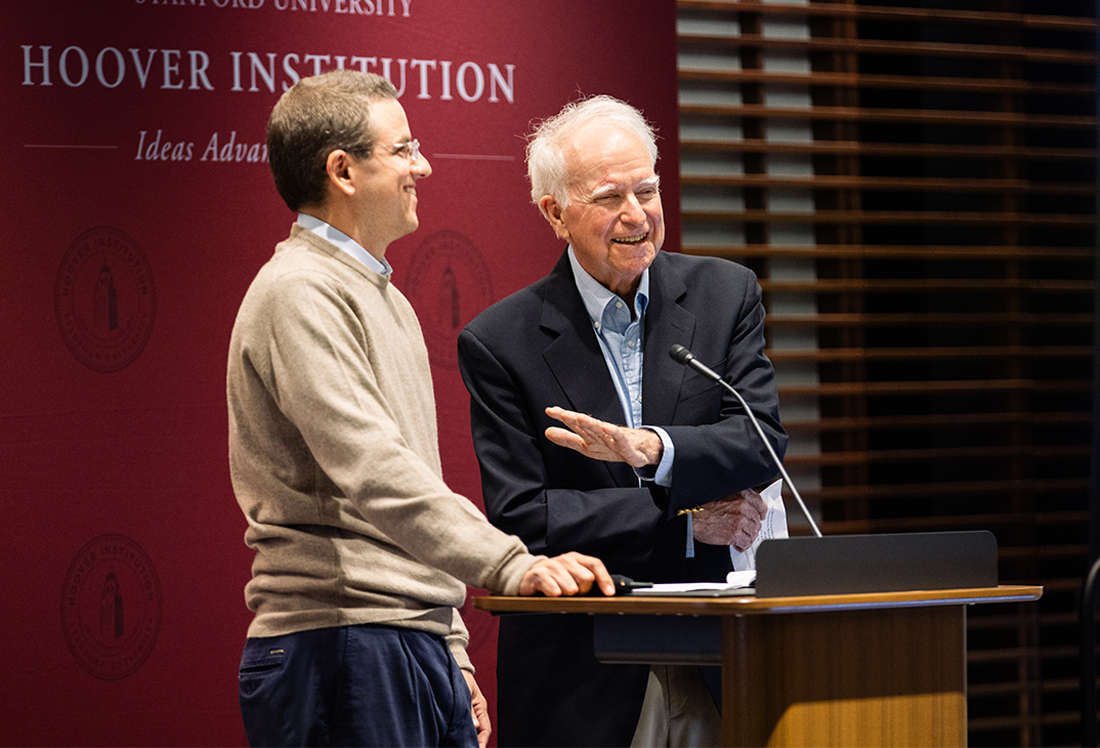
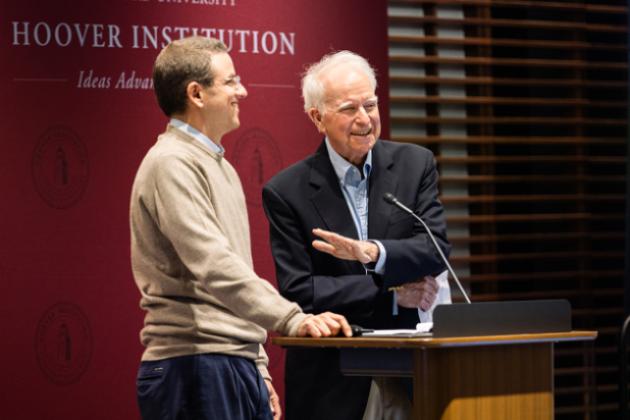
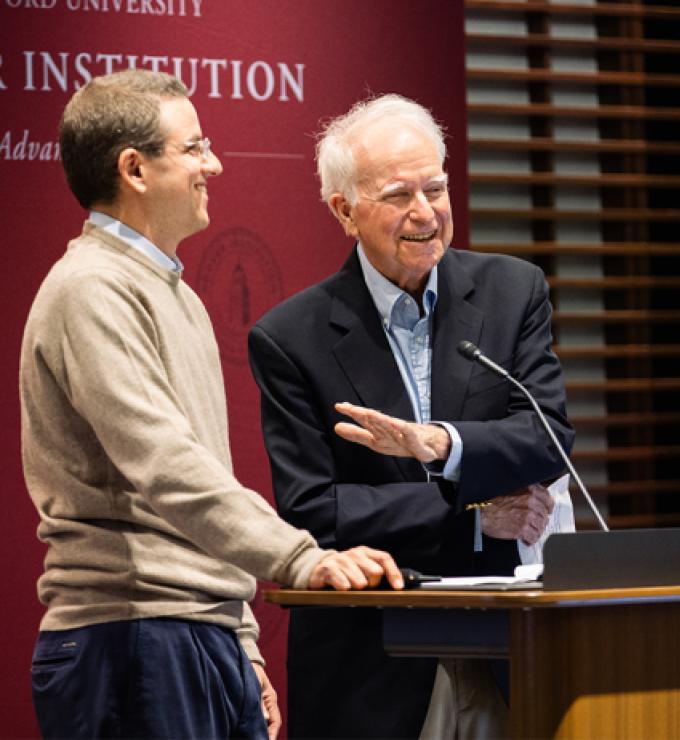
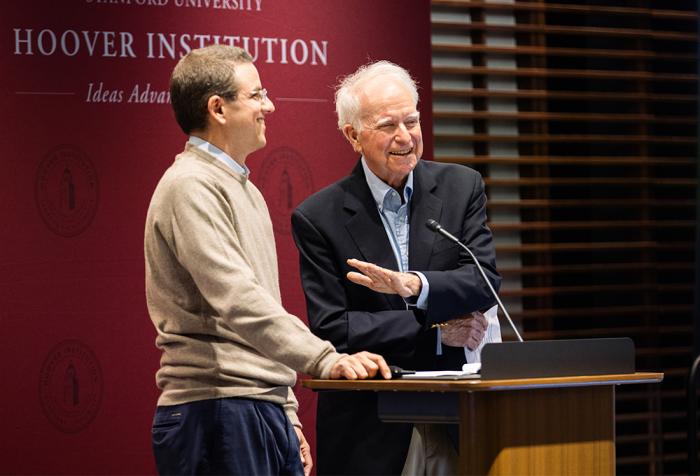
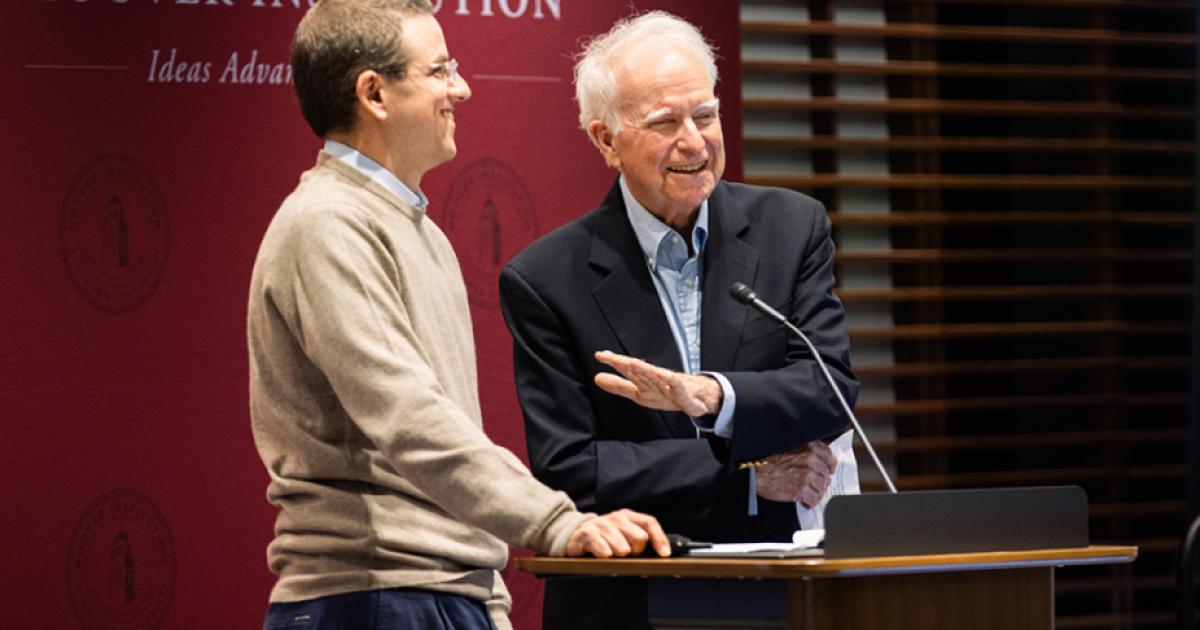
Robert E. Hall, the Robert and Carol McNeil Endowed Professor in Economics and Senior Fellow at the Hoover Institution, Emeritus, and emeritus professor of economics in the School of Humanities and Sciences, is the recipient of the 2026 Nobel Memorial Prize in Economic Sciences.
Hall was recognized with the Sveriges Riksbank Prize in Economic Sciences in Memory of Alfred Nobel for his contributions to the ”microeconomic foundations of macroeconomic stabilization,” alongside economist Michael Woodford, with whom he will share the approximately $1.2 million prize.
“Robert E. Hall and Michael Woodford are awarded this year’s prize in economic sciences for demonstrating how economic models could be reconstructed to revitalise stabilisation policy,” according to an announcement from the Nobel Committee. “Rather than basing the models on statistical links between macroeconomic variables, such as inflation, production and consumption, they chose to build them on a microeconomic foundation. This encompasses an understanding for how the total mass of individual households and businesses affect the economy through their actions.”
Robert E. Hall, 83, is a member of the National Academy of Sciences and a fellow of the American Academy of Arts and Sciences, the Econometric Society and the Society of Labor Economists. Hall is an applied economist with interests in technology, competition, employment issues, and economic policy. He is a frequent contributor to discussions of national economic policy, including monetary policy, fiscal policy, and competition policy. Hall's research focuses on levels of activity and stock market valuations in market economies and on the economics of high technology, particularly the Internet.
Bob Hall is one of the most distinguished economists of his generation, whose work has profoundly shaped our understanding of economic growth, employment, and the forces that drive the American economy,” said Hoover Institution Director Condoleezza Rice. “He has been instrumental in the way policy leaders think about the free market economy. This great honor is a well deserved recognition of a remarkable career, and we at Hoover are proud to call him a colleague.
“Bob Hall's creative and impactful work illuminates the connections between how households and firms behave and the outcomes of the economy as a whole, said Stanford President Jonathan Levin. “His insights have changed how governments and central banks respond to economic volatility. I’m thrilled that he has been honored with this year’s Nobel Prize in Economics.”
“Hall has made pioneering contributions to our understanding of household consumption, employment fluctuations, and market power,” said Debra Satz, the Vernon R. and Lysbeth Warren Anderson Dean of the School of Humanities and Sciences. “It is wonderful to see his lifetime of work in applied economics recognized by the Nobel committee.”
Along with Hoover colleague Alvin Rabushka, Hall is an active proponent of the flat tax. Their article in the Wall Street Journal in December 1981 was the starting point of an upsurge of interest in the flat tax. This led to their book, The Flat Tax. The pair was recognized in Money magazine's Money Hall of Fame for their contributions to financial innovation over the past twenty years.
Hall also serves as director of the research program on economic fluctuations and growth of the National Bureau of Economic Research, an interuniversity research organization. He is chairman of the bureau's Committee on Business Cycle Dating, which maintains the semiofficial chronology of the US business cycle.
Hall has advised a number of government agencies on national economic policy, including the Justice Department, the Treasury Department, and the Federal Reserve Board. He served on President-elect Ronald Reagan's Task Force on Inflation Policy and was a member of the National Presidential Advisory Committee on Productivity. He has testified on numerous occasions before congressional committees concerning national economic policy. He presented the Ely Lecture to the American Economic Association in 2001.
Before coming to Stanford, Hall was a professor of economics at the Massachusetts Institute of Technology and an assistant professor at the University of California at Berkeley.
Born in Palo Alto, California, he attended school in Palo Alto and Los Angeles, received his BA from the University of California at Berkeley and his PhD from the Massachusetts Institute of Technology. Hall is married to economist Susan Woodward and lives in Menlo Park, California.
For more information on Robert E. Hall visit: https://www.hoover.org/profiles/robert-e-hall.
For more information on the Hoover Institution, find us on Facebook, and X (formerly Twitter) is @HooverInst or visit Hoover.org.
Jeff Marschner
Director of Media Relations
202-760-3200