
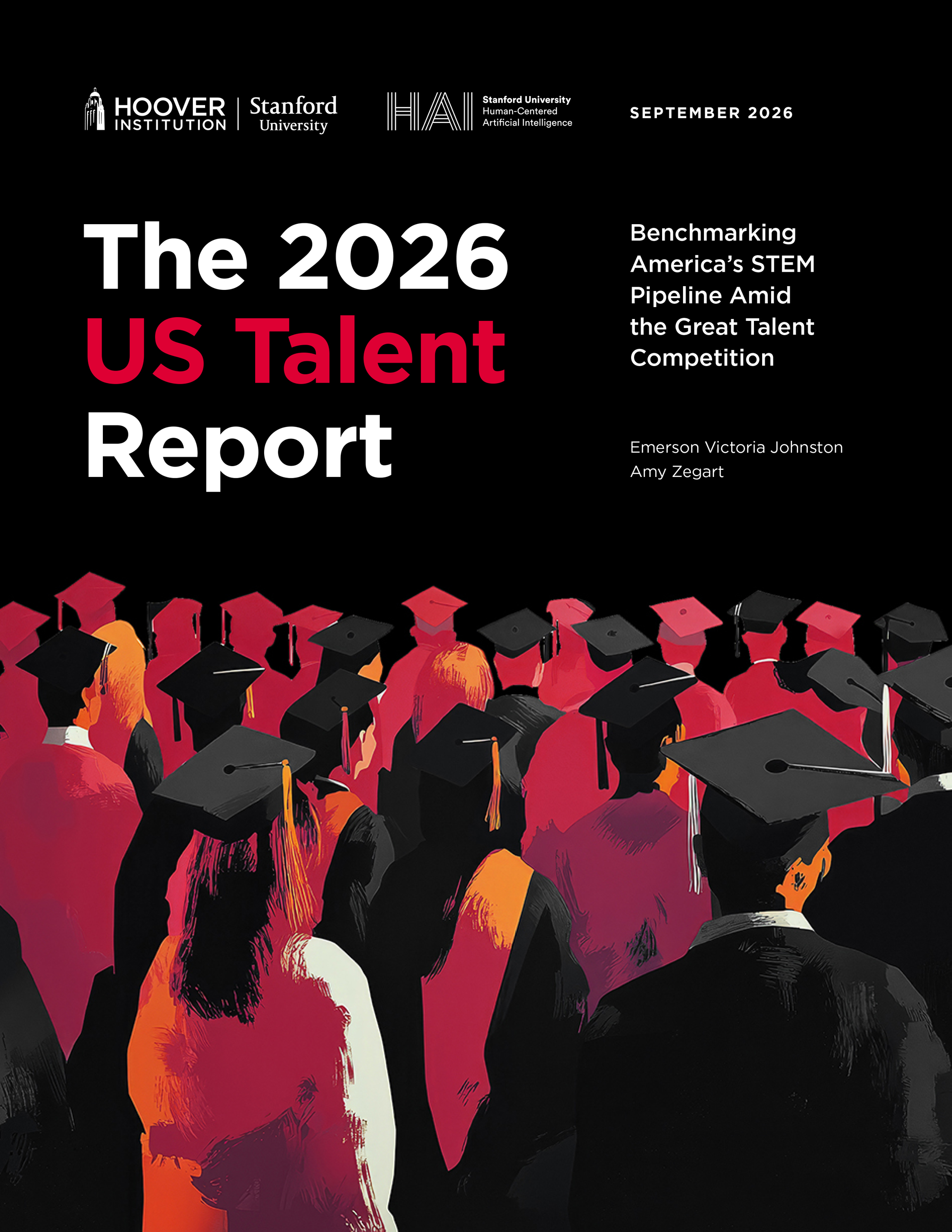
Hoover Institution and HAI (Stanford, CA) — America’s STEM education system output has more than doubled in the past 30 years, and it relies on a large number of foreign enrollees at the graduate and postgraduate level to fulfill the nation’s demand for high-skill talent in many of the nation’s most important technological fields.
That’s the main takeaway from a new joint report from Hoover's Tech Policy Accelerator and the Stanford Institute for Human-Centered Artificial Intelligence that examines the US-China technology competition through the educational choices made by the people wishing to join the US high-skilled tech workforce, both within the country and from abroad.
Using more than 30 years of data from federal surveys, international databases, research rankings, publication and patent records, visa filings, and company histories, authors Amy Zegart, senior fellow at the Hoover Institution and director of its Technology Policy Accelerator, and Hoover Research Assistant Emerson Johnston identified the education and career paths taken by hundreds of thousands of students, graduates, researchers, workers, and founders. The report’s findings point to a system with substantial advantages, but also considerable and growing vulnerabilities compared to America’s rivals.
“STEM talent has never been a more important source of national power,” said Zegart. “It comes from two pipelines—the students we educate at home and the talent we attract from abroad. Both are in serious trouble in the U.S. while they are growing stronger in China and other countries.”
America’s STEM higher education system now graduates just under 800,000 pupils every year, more than twice what it produced in 1995.
And while international students make up just 6.1 percent of total US higher-education enrollment, that share climbs significantly once the population is broken out by degree level and field. International students turn out to supply a large share of America’s advanced STEM graduates and are concentrated in many of the country’s most strategic fields, like computer science.
The report shows that America’s domestic pipeline supplies most undergraduates, but a much smaller share of advanced degree holders.
International students earn just 4 percent of awarded bachelor's degrees, but one-fifth of all master’s degrees and one-third of all research doctorates. In STEM fields, the gap grows wider, where they still earn just a small fraction of awarded bachelor's degrees, but 51.3 percent of master’s degrees and 38.7 percent of research doctorates.
As a result, international talent powers American research and industry after graduation. Foreign graduates make up majorities of postdoctoral researchers in several STEM fields. They work in STEM at higher rates than US-born peers with comparable degrees, and they founded or co-founded a large share of the nation’s leading AI firms.
Part of the reason for this is that although the US K–12 education system spends heavily it develops too little of its potential talent. Today, the United States ranks 34th in the world in mathematics, behind Slovenia, Poland, and Vietnam, despite per-pupil spending 48 percent above the OECD average. Of domestically educated students who enter college intending to major in STEM, only about four in ten finish a STEM degree.
But while students from India, China, and elsewhere continue to flock to America to complete their studies in STEM, current immigration policies create bottlenecks as they attempt to enter the workforce.
The report finds that while about 76 percent of new international PhDs report plans to remain in the United States, only 68 percent of STEM PhDs are in still in the country ten years later.
According to the report, the United States should not retain every graduate, and national-security screening and labor protections are important, but the system rations the granting of permanent residency through per-country ceilings enacted sixty years ago. Today, the rules make birthplace—not talent or employer demand—a major determinant of visa wait time.
Indian advanced-degree holders, for example, face waits exceeding twelve years, compared with roughly four to five years for many other nationalities. The United States makes the talent it relies on most wait the longest.
When it comes to publishing impactful research in STEM, America's research magnet remains formidable, but its edge is narrowing fast. Over the past decade, the US author share of top-cited emerging technology publications fell from 14 percent to 8 percent. In the same period, China’s share rose from 11 percent to 21 percent. Chinese companies and researchers now file roughly three times as many computer technology patents as those in the United States.
As a whole, the authors stress that the findings reveal a compounding risk. Weak domestic preparation increases reliance on international recruitment. Narrowing research advantages make international recruitment more competitive. Immigration bottlenecks and outdated policies make retention less certain. The United States still possesses enormous advantages, but none can safely be treated as enduring.
Read the full report here.
For more information, please contact Jeffrey Marschner, assistant director of media and government relations, at jmarsch@stanford.edu or 202-760-3200.