




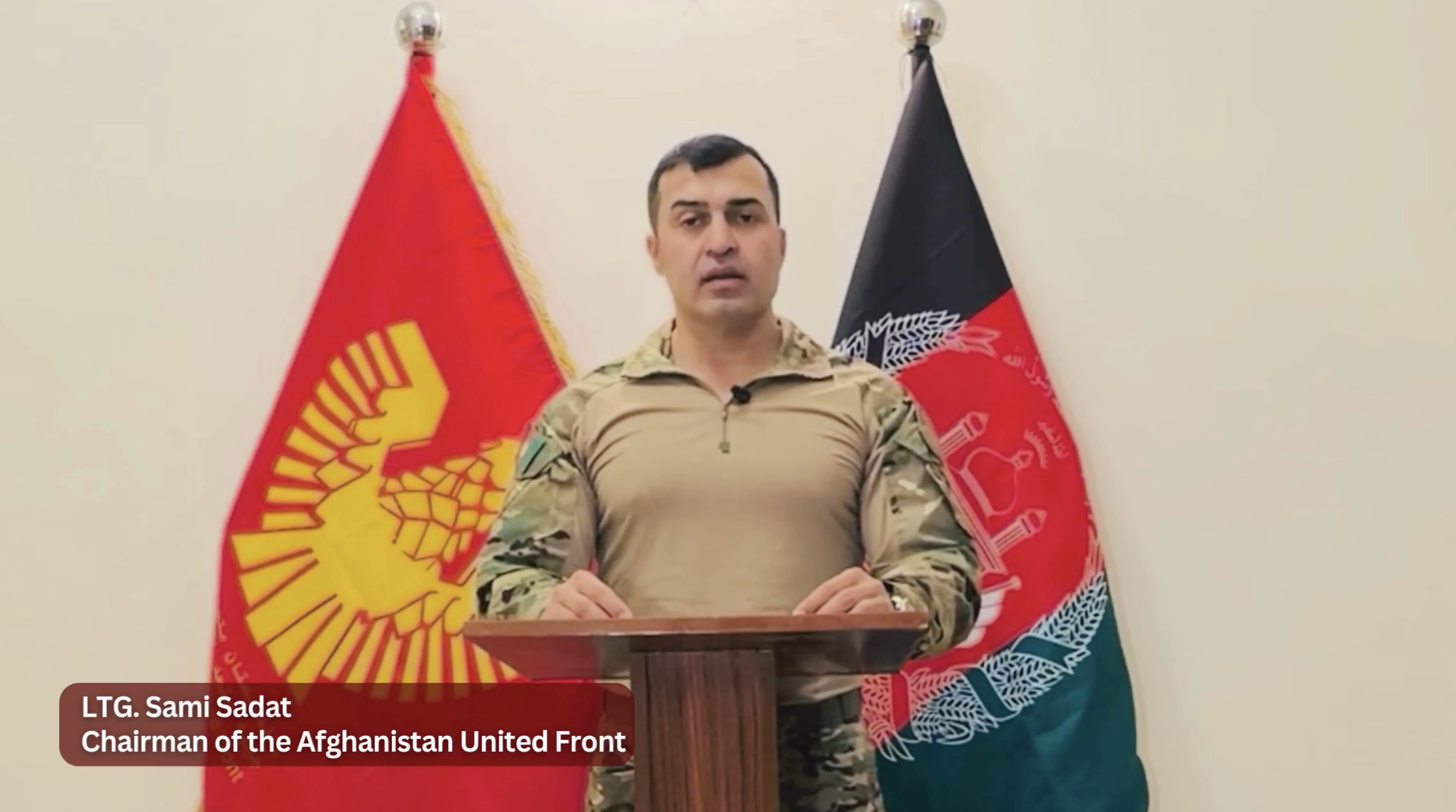
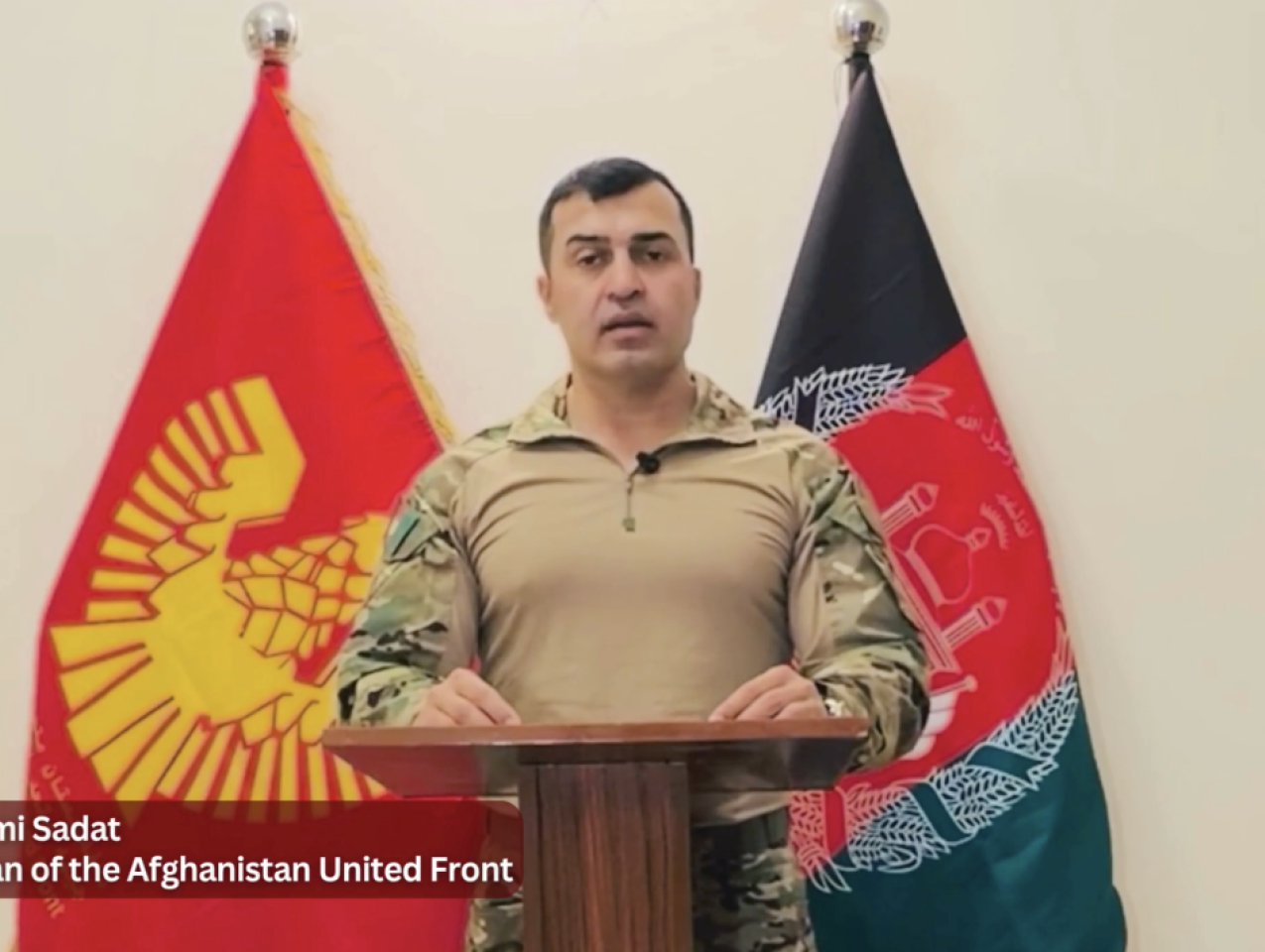
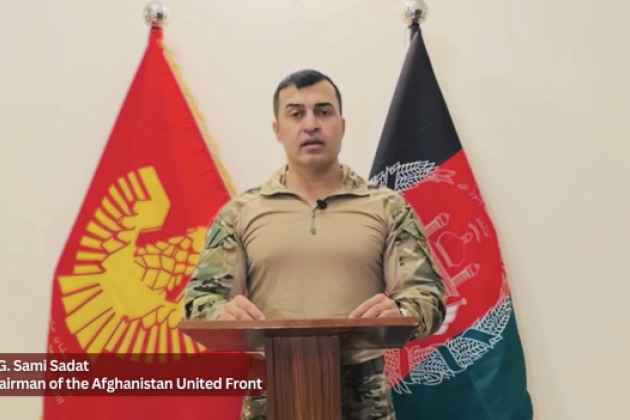
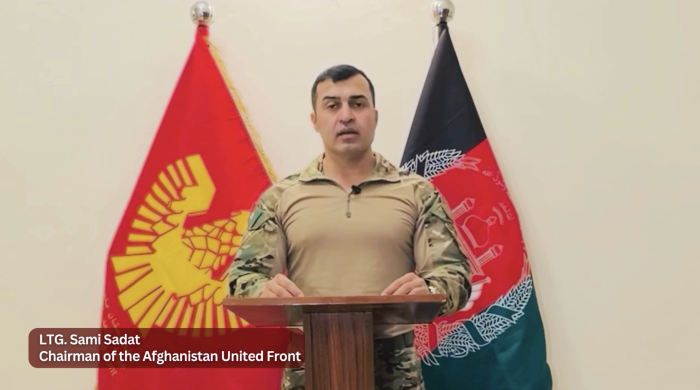
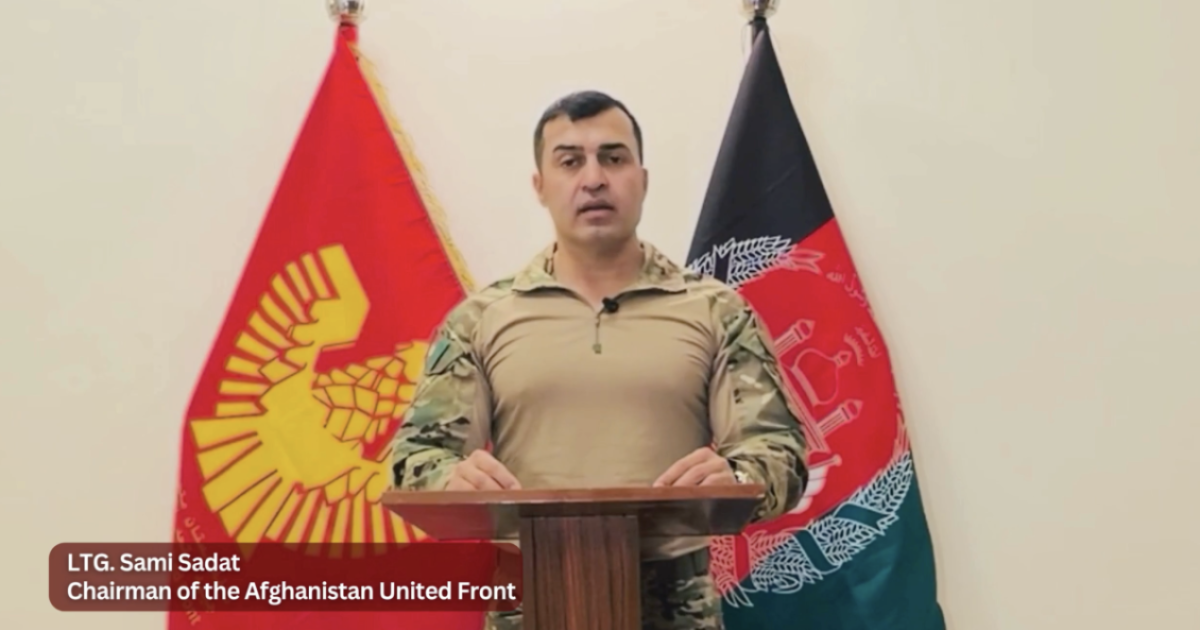
Hoover Institution (Stanford, CA) — August 15th marked five years since the fall of the Islamic Republic of Afghanistan. President Ashraf Ghani fled that afternoon, the Taliban entered Kabul that night, and the American evacuation began. But this anniversary is a live question rather than a settled one. Earlier this month, former Lieutenant General Sami Sadat appeared in the uniform of the Afghan National Army, beneath the tricolour flag of the former Islamic Republic of Afghanistan and announced a phased armed campaign against the Taliban under the banner of the Afghanistan United Front. He said negotiations had failed. He asked the international community for material support but made clear he did not want foreign troops.
Sadat has been building the front for nearly three years and is reportedly mobilizing operations first in Kandahar, in the Taliban's own heartland, and then in the north. On June 6, 2023, near the end of a three-hour interview for the Hoover Institution's Afghanistan Oral History Project, Sadat told me what he intended to do with his exile.
I'm trying to mobilize the new generation of Afghan leaders, military generals, intelligence, governors and civil society activists, politicians, both men and women of our generation, to go back and restore the [2004] Afghan Constitution with whatever means necessary. And I think war is a necessity, and the only way to get rid of the Taliban is war.
He also provided his reasons for thinking the Taliban are beatable. One was that they had lost the foreign sponsorship that made them possible, especially from Pakistan; he expected Iran to turn on them too, and it did not. On Pakistan he was right: the Taliban and Pakistan have been at open war since February, with strikes on Kabul, Kandahar and Paktia, and clashes closing the Torkham crossing since October 2025.
Sadat has made a choice in which no option was acceptable, and Afghans have been making that kind of choice for fifty years: not a hard choice with a difficult right answer, but a set of impossible choices, each of which abandons something you are bound to.
These three men have spent five years being judged, and so have many others in this archive. Setting their accounts beside one another allows a narrower question than blame does: what did each of them know that afternoon, and what did they choose to do with it?
The afternoon of August 15, 2021
Three men spent that afternoon within a few kilometers of one another in Kabul, deciding what to do about the end of the republic. Two of them found out it was ending, one from an aide knocking on his door, the other from a former minister calling out of Dubai. Both still had troops in the field. The third had spent the day arranging the departure. None of them could reach the others. Hamdullah Mohib, the national security adviser, later explained why.
The chain of command had broken because the real chain of command was the American chain of command, and since this broke, this other was on stilts, it just fell apart with it. And no one is able to make any decisions.
General Haibatullah Alizai, the chief of the army staff, had been awake for nights. He had promised himself he would never send his family away. Then a suicide attack and a car bomb made his house unsafe. Their plane to India took off at noon. In the early afternoon he prayed and lay down for the first time in days, and his aide knocked to say the president had escaped. His first reaction was to laugh.
He made it easy. Made it easy for us. Let's announce the martial law. The military government. And then we will see what happens. This is the path.
Across the city, just before two, Sadat was walking toward a helicopter at his own headquarters when Asadullah Khalid, the former defense minister, called him from Dubai to tell him the president had fled. He had been given responsibility for the security of the capital four days earlier, and had arrived from Lashkargah after four months of fighting, injured and barely able to walk. "I felt that the earth has moved beneath my feet," he said. "My mind was in the clouds, and it's like I couldn't believe it."
Sadat went back to his headquarters, declared martial law, and authorized air strikes on Taliban units entering the capital, an authority reserved by law to the head of state. His reasoning was exact: "Only the President could authorize an air strike on Kabul, on the enemy positions. So I say there is no President, and I am authorizing."
Mohib was inside the Arg, watching it empty.
Every time I left my office, I came back, there were less and less people in the office... And my assumption was, people are escaping. So just let them. It's fine. Let them live.
What he was weighing was not his own survival but a scenario he had spent the previous year researching, including interviews with people who had been present in 1996. Mohammad Najibullah, the last communist president, had stayed behind when his government fell in 1992, taken shelter in a UN compound in Kabul, and been hanged by the Taliban four years later. Najib didn't stay," Mohib said. "Najib couldn't get out. His escape plan failed, and I studied those escape plans quite thoroughly."
Then the president's pilot said something Mohib did not immediately grasp: there is fuel. Fuel is weight, and on a hot day a fully fuelled helicopter could not also lift everyone waiting to board. The airport was no longer an option either: the Americans held the towers and would not clear the pilots to fly. Nangarhar and Khost, the fallbacks, had fallen. What the pilot had was fuel enough for Termez, and shortcuts. None of it was a flight plan. It was a statement about who was now in control.
I can go along with their plan, or they will leave anyway. And Ghani will be stuck here, and who knows who will kill him first. But whoever kills him, it's not going to stop at Ghani. That news will spread, and then it will be the civil war scenario that we didn't want.
Looking into the pilot's eyes, he said, was the moment it resolved.
His calculation was that a president killed in Kabul would not save the city but detonate it.
It may be bad if there is a Taliban government. But it's still better than a full on civil war. That was my calculation then, you know, future me might say a war may have been better, and that we lost too much for that.
He grabbed Ghani, told him there was no time, and said no one else should know, because "the least number of people that know, the more the rate of survival." He also understood how each of the two possible deaths would be read. Killed in the palace, he said, some would count Ghani a martyr. "But on the way out, no one would. And the conspiracies it would create would last for a very long time."
The two hours to Termez, he said, were the longest of his life. He spent them expecting to be shot down, by the Americans, the Taliban or one of the warlords.
Still in Kabul, late that afternoon, Alizai and Sadat each went to the coalition headquarters to ask Rear Admiral Peter Vasely, the senior American commander in Kabul, for help. Alizai went in himself rather than take Sadat's word for it. Their accounts of the answer are nearly identical. Alizai's version:
He told me exactly, honestly, the same thing. Hey, there's no President left. There's no one left. Who are you going to fight for? There's no country.
Sadat's:
He turned to me and he said, I don't take orders from you. And, by the way, who are you? I don't know you anymore. You don't have a government. So I can't help you, sorry.
Alizai says he could not stop crying. "President left, politicians left, Americans are not supporting you. Your friends are not willing to stand with you. And I said, okay, we will fight to death." As he left, he says, the admiral called after him not to get killed for no reason.
Sadat walked away and told Alizai they would fight with what they had, then called the air force commander, General Fahim, to ready the bombers. A lot of the aircraft had already left for Uzbekistan and Tajikistan, Fahim told him. Squadron leaders were taking their squadrons and going, and he was no longer in charge of the air force.
Alizai told him and several other generals that he was going to the Darulaman front line to declare martial law on camera, and that anyone who wanted to come was welcome. They said they would go with him. "Sami said I want to drive," Alizai recalled. "And he took the wheel, and instead of turning left he turned right and he drove to the airport."
At the terminal the two men argued. Alizai pointed at a waiting C-17 sent by Asadullah Khalid, the same man who had called Sadat from Dubai that afternoon, and told him to take it.
You guys are safe. You can leave. I'm not gonna leave. I'm gonna fight to the last minute, even if it's one hour from now, I will fight and goodbye. Just go.
"You have kids," Sadat told him. "This is the time that we should stay in country," Alizai answered. "We should fight. We can keep Kabul. Our troops are fighting. How can I leave them?"
Then his aide took a call and reported that the troops at Darulaman had left the fight. "And it's the end," Alizai said.
The bombers had flown north. The troops at Darulaman had left the line. Each found out separately, within the hour, and each learned only his own half of it. There was nothing left answering either of them.
Sadat stayed four days and turned to the same work. "I called on all my guys," he said. "And then my job became to collect everyone and take them to safety." He said he wanted to fly back to Helmand and fight on from there, but the Americans refused his aircraft fuel because they knew where he was going. He left for the United Kingdom for medical treatment, too weak by then, he said, to keep fighting.
Alizai did not take the plane. Bismillah Khan and another general boarded it; Alizai refused, telling them he would rather the Taliban killed him on the airfield. Later that night he flew a C-130 into Kandahar in the dark to lift out 125 soldiers who had been left behind, landing back in Kabul at one in the morning. He stayed at the airport until the night of 25 August, keeping hundreds of commandos equipped and twice trying to reach Panjshir, where Ahmad Massoud had agreed to receive him.
We were defeated, but not here [pointing to his head]. It was a physical defeat for me. And still I was looking for opportunities.
What actually matters
Which returns us to this month. The rupture between the Taliban and Pakistan is real leverage, possibly the only leverage that will exist. It is also being paid for by civilians: since the fighting escalated last October, the United Nations has documented 499 Afghans killed and more than 1,200 wounded, most of them in airstrikes. The deadliest single incident was a strike on a drug rehabilitation centre in Kabul on March 19. To add another front to a war already killing civilians is to accept that some of the cost falls on people who did not choose it. To decline is to let the Taliban consolidate while waiting for a moment Afghan history has rarely offered.
There is a third cost, and it is the one Afghans raise most. For fifty years American money for Afghanistan has moved through Pakistan, a pattern that recurs throughout the HART archive interviews. Islamabad is at war with the Taliban over their shelter of the Tehrik-i-Taliban Pakistan, the movement's Pakistani counterpart, which has been waging its own insurgency against the Pakistani state. Pakistan still has Washington's ear, and an Afghan force in the field is the cheapest instrument available to it. Nothing has surfaced to indicate such an arrangement, and Sadat has directed his appeals to NATO. The archive complicates the suspicion further. When he was running covert operations across the Pakistani border, he told me, he wanted the relationship to run the other way.
I was actually in favor of supporting and arming the Pakistani Taliban against the Pakistani Government... I said, no, we have to show them that if you hurt me, I can hurt you too.
He shared that Pakistan had spent the republic's twenty years working through the Taliban to bring it down, "secretly trying to destroy our government, which ultimately they have done." Five years on, Islamabad is doing that work directly, against the regime it helped bring to power.
The reverse argument can be heard from Afghan men: that the Taliban bleeding Pakistan is the strongest position Afghanistan has held against Islamabad in decades, that no previous government managed it, and that it is worth leaving them in power to let it continue. It is a serious argument. It is also a calculation whose price is paid by people who are not the ones making it. Afghan girls have been out of secondary school for five years. Women have been barred from universities, from most paid work, and from most of public life.
Whatever Sadat chooses, something is lost that cannot be recovered. He is not the first Afghan to choose on those terms.
This is the argument of Impossible Choices, a new podcast series in production with the Hoover Institution and Stanford's Abbasi Program in Islamic Studies, drawn entirely from the The Hoover Afghanistan Research and Relief Team (HART) archive. Across fifteen episodes, in English and in Dari, it returns to the moments when Afghans faced decisions in which every option cost something irreplaceable: fight or flee, comply or resist, speak or stay silent. It is not an exercise in assigning blame. It is an attempt to understand how people reason when no good answer is available. The podcast will launch in late August 2026.
The HART Oral Histories archive holds more than 450 hours of interviews recorded between 2022 and 2025 with Afghans who built the republic and watched it fall: ministers, commanders and diplomats, and also teachers, judges, journalists and students whose names will not be familiar. The three interviews here are a few hours of it. The rest is at Hoover's digital collections and the launch event from April 2026 can be watched here.
Dr. Halima Kazem is a scholar and journalist who has reported on and researched Afghanistan since 1995. She recorded the interviews in the HART oral history archive and is associate director of Stanford's Program in Feminist, Gender, and Sexuality Studies.