





Almost five years following the American and Allied withdrawal in August 2021, the need to process, reflect on, and learn from the lessons after two decades of fighting and foreign policy in Afghanistan remains imperative.
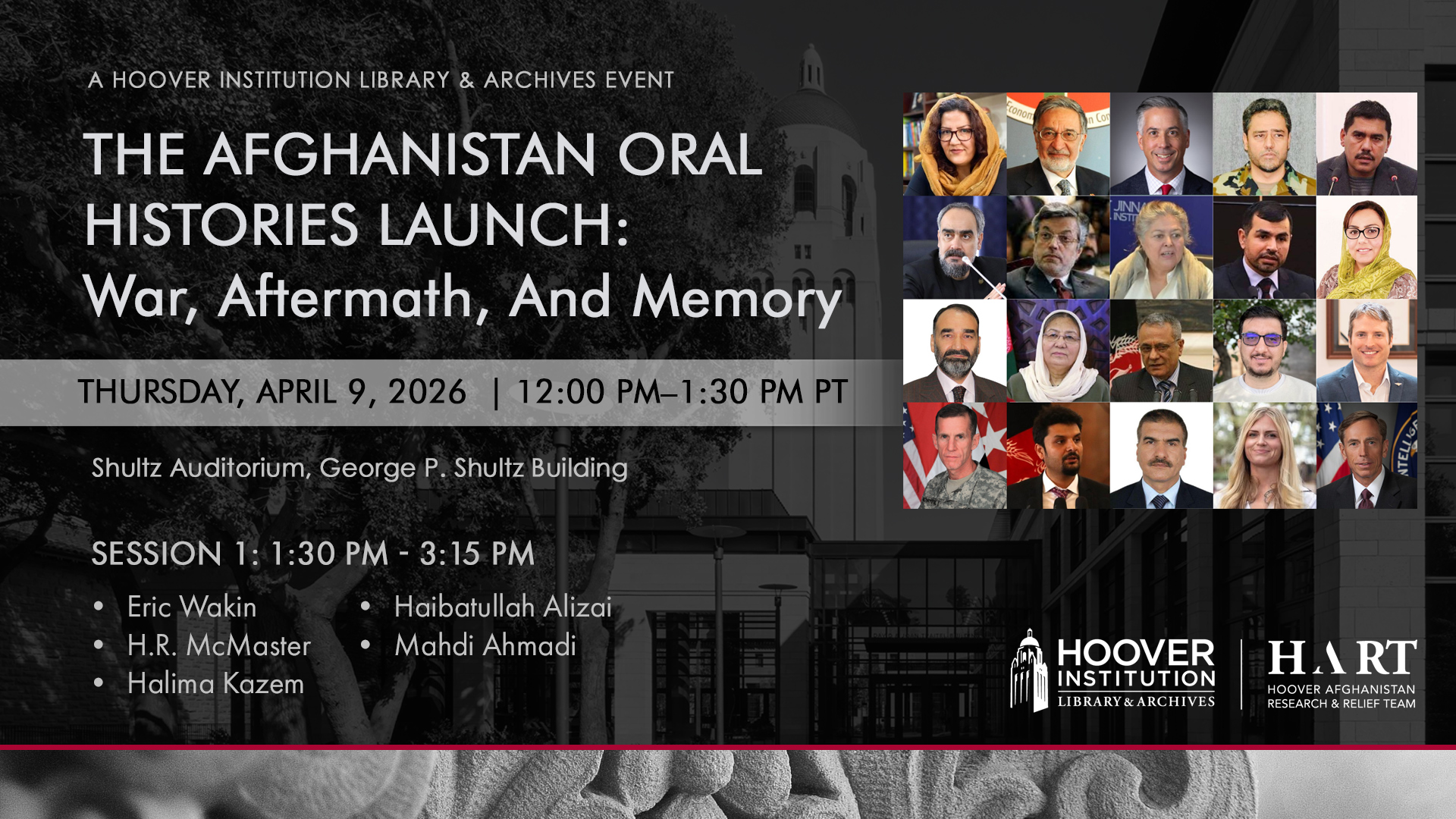
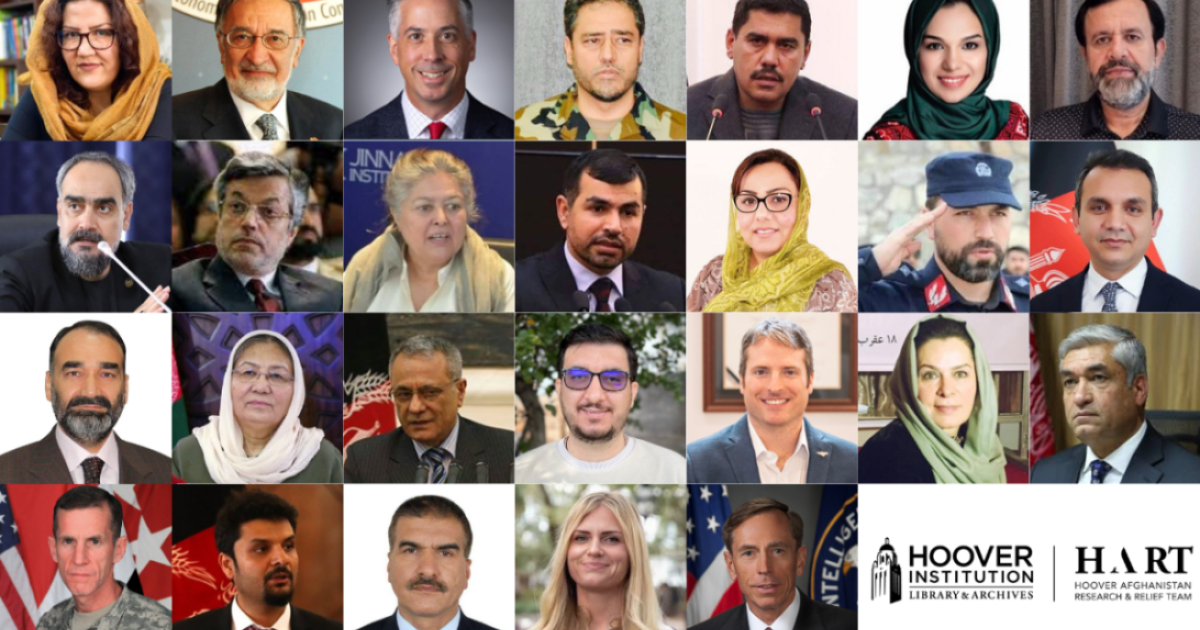
The Hoover Institution Library & Archives has partnered with the Hoover Afghanistan Relief Team to document the important stories of Afghans, Americans, and others who took part in and experienced the war and rebuilding efforts in Afghanistan by capturing the stories and experiences of Afghans fleeing the country after the US withdrawal, the Taliban regime takeover, and the collapse of the Afghan government.
This collection of 450 hours of interviews are now available in the Library & Archives' digital repository.
The Archives Uncovered event series highlights the Hoover Institution Library & Archives’ recently acquired, preserved, and described library and archival material by exploring their contents, building connections to researchers, and tracing the role of history.
AGENDA
All times Pacific Time
|
1:30 PM |
1:35 PM |
Introductory Remarks by Eric Wakin |
|
1:35 PM |
1:50 PM |
Video |
|
1:50 PM |
1:55 PM |
Opening Remarks by H.R. McMaster |
|
1:55 PM |
2:00 PM |
Opening Remarks by Halima Kazem |
|
2:00 PM |
3:15 PM |
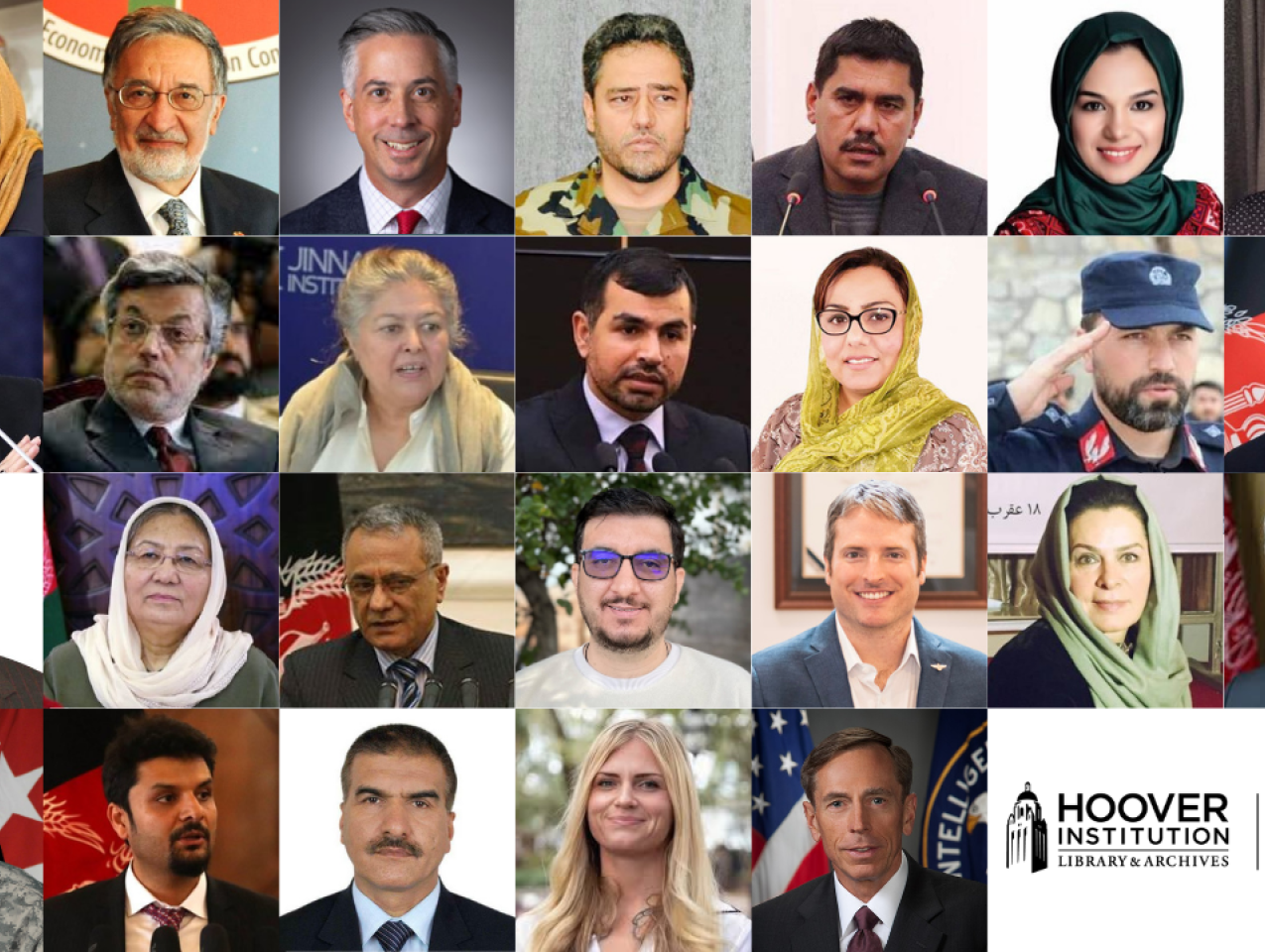
Panel featuring H.R. McMaster, Halima Kazem, Haibatullah Alizai, and Mahdi Ahmadi |
|
3:15 PM |
3:30 PM |
Coffee Break |
|
3:30 PM |
4:45 PM |
Panel featuring Halima Kazem, Jean Cannon, Farahnaz Forotan, and Mahnaz Akbari |
|
4:45 PM |
4:50 PM |
Concluding Remarks by Jean Cannon |
|
4:50 PM |
5:30 PM |
Reception |
ABOUT THE SPEAKERS
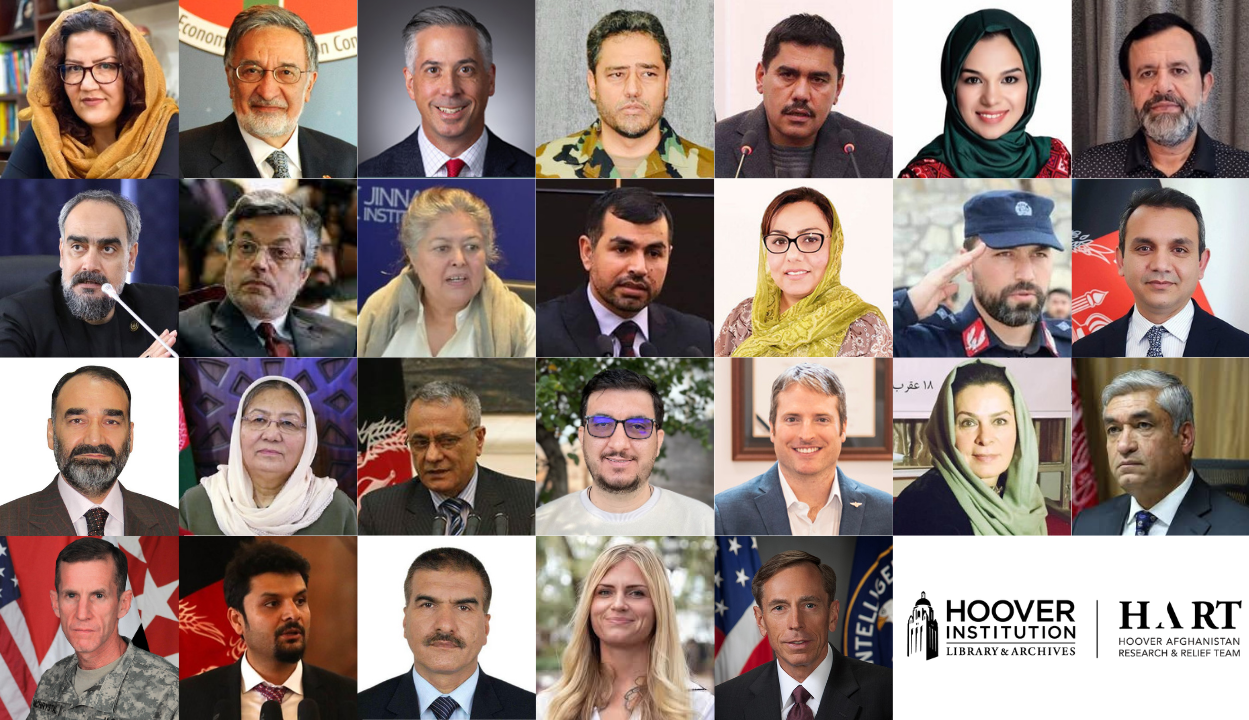
H.R. McMaster is the Fouad and Michelle Ajami Senior Fellow at the Hoover Institution. He is also the Bernard and Susan Liautaud Fellow at the Freeman Spogli Institute and lecturer at Stanford University’s Graduate School of Business. He was the twenty-fifth assistant to the president for National Security Affairs. McMaster served as a commissioned officer in the US Army for thirty-four years after graduation from West Point. He has commanded organizations in wartime including the Combined Joint Inter-Agency Task Force—Shafafiyat in Kabul, Afghanistan, from 2010 to 2012. He holds a PhD in military history from the University of North Carolina at Chapel Hill. He is author of Battlegrounds: The Fight to Defend the Free World, Dereliction of Duty: Lyndon Johnson, Robert McNamara, the Joint Chiefs of Staff, and the Lies that Led to Vietnam, and At War with Ourselves: My Tour of Duty in the Trump White House. He is host of the podcast Today’s Battlegrounds with H.R. McMaster.
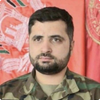
Lieutenant General Haibatullah Alizai is the last Chief of the Afghan Army and one of Afghanistan’s most senior military leaders of the past two decades. Over the course of his career, he held key leadership positions including Commander of the Afghan National Army Special Operations Command, Commander of the 209th Northern Army Corps, Director General of Military Operations at the Ministry of Defense, and Deputy Director of the Joint Special Operations Coordination Center (JSOCC). A graduate of the UK Defence Academy’s Advanced Command & Staff Course, he brings deep expertise in military strategy, special operations, and regional security, and offers valuable insight on Afghanistan’s future, security challenges, and regional dynamics.

Mahdi Ahmadi is a former Afghan Air Force Blackhawk pilot who served across multiple regions of Afghanistan, including Kabul, Mazar-e-Sharif, Kandahar, and Helmand. He received his training at the Afghanistan Air Force Academy and later completed advanced helicopter training on the S300 and MD530F in Slovakia, followed by UH-60 Black Hawk qualification. Over the course of his service, he conducted critical missions including air support, cargo transport, casualty evacuation (MEDEVAC), and the insertion of special forces into high-risk combat zones, often operating under demanding conditions such as high-altitude and nighttime environments in direct support of the Afghanistan National Defense Forces. Following the collapse of Afghanistan's republic government, he was evacuated to the United States and is currently pursuing a Master of Science in Artificial Intelligence in Business at Arizona State University.

Dr. Halima Kazem is the Associate Director of Stanford University’s Program in Feminist, Gender, Sexuality studies. She is collaborating with the Hoover Institution as an oral historian and building an oral history archive about the US Afghan war. Kazem’s work is deeply rooted in feminist methodologies and 26 years of working as a journalist, lecturer, human rights researcher, oral historian, and filmmaker. Her research intersects in the areas of gender, empire, human rights, and media with a focus on Afghanistan. Kazem’s forthcoming book, A Feminist History of Afghanistan: Resisting the Erasure of Women, unearths and narrates the little-told feminist history of women’s movements in Afghanistan. Halima has published more than 300 news features and produced dozens of video stories covering topics from women’s rights and constraints in Turkey, domestic violence in New Zealand, presidential elections in Afghanistan, and LGBTQ rights and immigration in the United States.

Mahnaz Akbari is a former commander of the first Female Tactical Platoon (FTP) in Afghanistan. From 2011 to 2021, Akbari served alongside Afghan and U.S. special forces, participating in missions that focused on intelligence gathering and ensuring cultural sensitivity during military operations. Together with other FTP members, she played an important role in supporting more than two thousand special operations missions across Afghanistan. Following the fall of Afghanistan, Mahnaz relocated to the United States and dedicated herself to advocating for the members of the FTPs. She has volunteered with Sisters of Service (SOS) and is now one of the founders of NXT Mission, an organization committed to supporting former FTP members and helping them transition to new opportunities. She is also involved with the Bamyan Foundation, which works to provide educational opportunities for women in Afghanistan who have been denied access to schooling.

Farahnaz Forotan is the founder and CEO of Kaaj Magazine and one of Afghanistan’s prominent journalists. Guided by the belief that “Women’s Voices Matter,” she has spent more than a decade in media leadership, using human-centered storytelling to amplify the voices of Afghan women and communities, telling the stories of people who were born in war, lived through it, and too often lost their lives in it. Forotan was the first female domestic journalist to conduct face-to-face interviews with Taliban prisoners and among the first women to travel alongside soldiers and journalists to cover the war in southern Afghanistan. She later became one of the few female journalists covering the U.S.–Taliban peace talks in Doha. After receiving threats on her life, she relocated to the United States in 2021, months before the Taliban’s return to power. Through Kaaj Magazine, she continues to document Afghanistan’s realities with a strong focus on women’s rights, human dignity, and social justice, while inspiring a new generation of journalists.

Jean M. Cannon is a research fellow and curator for North American Collections at the Hoover Institution Library & Archives at Stanford University, where she specializes in acquisitions, education, exhibitions, and scholarly publications. Prior to her current position, she was the Literary Collections Research Associate at the Harry Ransom Center, where she co-curated the 2014 exhibition The World at War, 1914-1918. She was also the curator of Hoover’s exhibitions, Weapon on the Wall: American Political Posters of WWI, Un-Presidented: Watergate and Power in America, and The Battalion Artist: A Sailor's Journey Through The South Seas. Cannon has also worked extensively in book publishing and advertising and as a freelance writer and editor. Cannon received a PhD in English Literature from the University of Texas at Austin, with a focus on WWI poetry and fiction, and holds a BA in English from Duke University.

Eric Wakin is a research fellow, the deputy director of the Hoover Institution, and the Everett and Jane Hauck Director of the Institution’s Library and Archives, overseeing their strategic direction and operations. Wakin is the author of Anthropology Goes to War: Professional Ethics and Counterinsurgency in Thailand. He has also coauthored a number of walking-tour books and travel guides. Before coming to Hoover, Wakin was the Herbert H. Lehman Curator for American History and the Curator of Manuscripts at the Rare Book & Manuscript Library at Columbia University, where he also taught courses in the History Department on public history, memory and narrative, archives and knowledge, and theory. Wakin received a BA in English literature from Columbia University; an MA in Southeast Asian studies and an MA in political science from the University of Michigan, where he was a FLAS Fellow; and a PhD in history from Columbia, where he was a Richard Hofstadter Fellow and a President’s Fellow.