




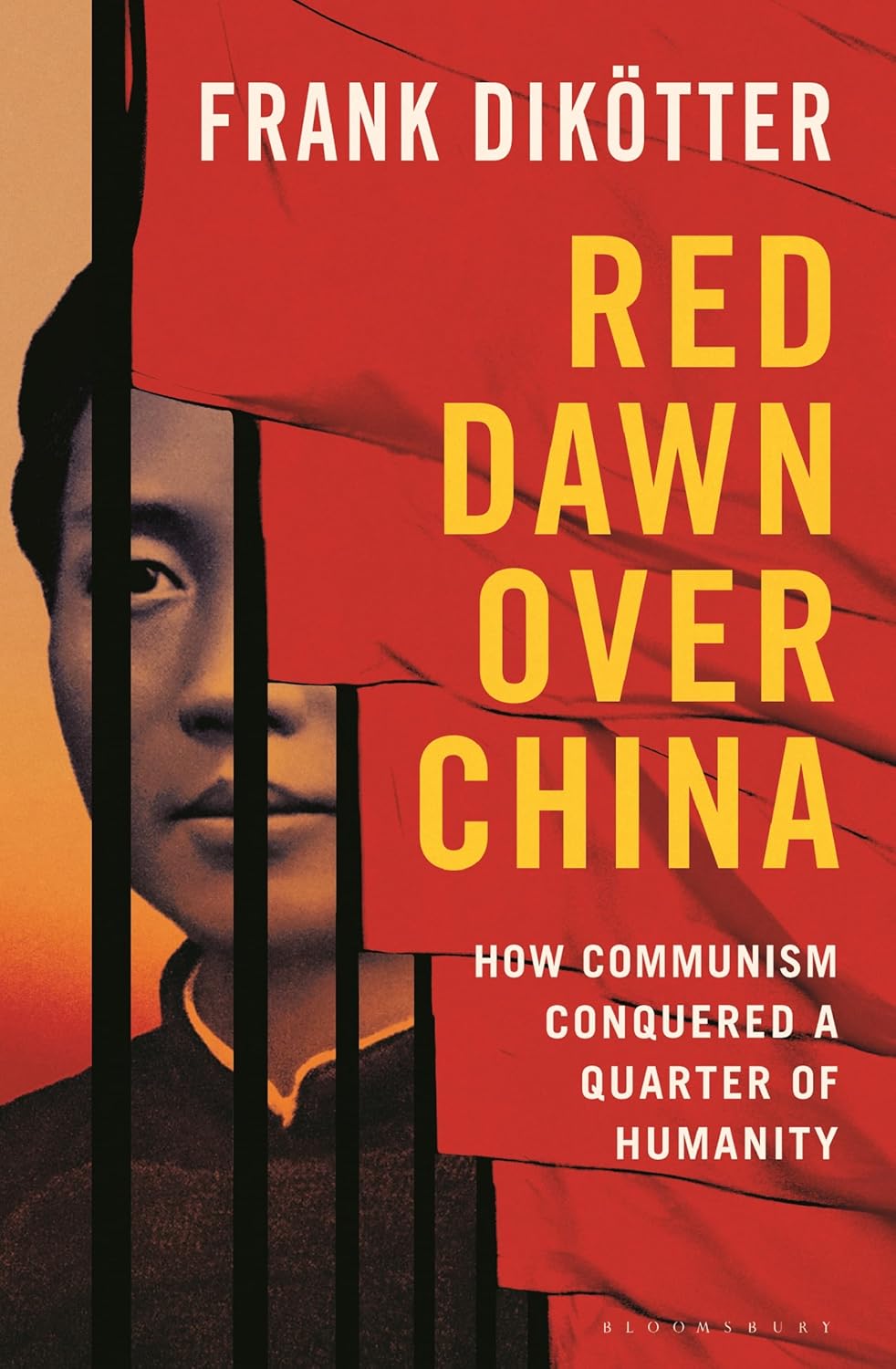
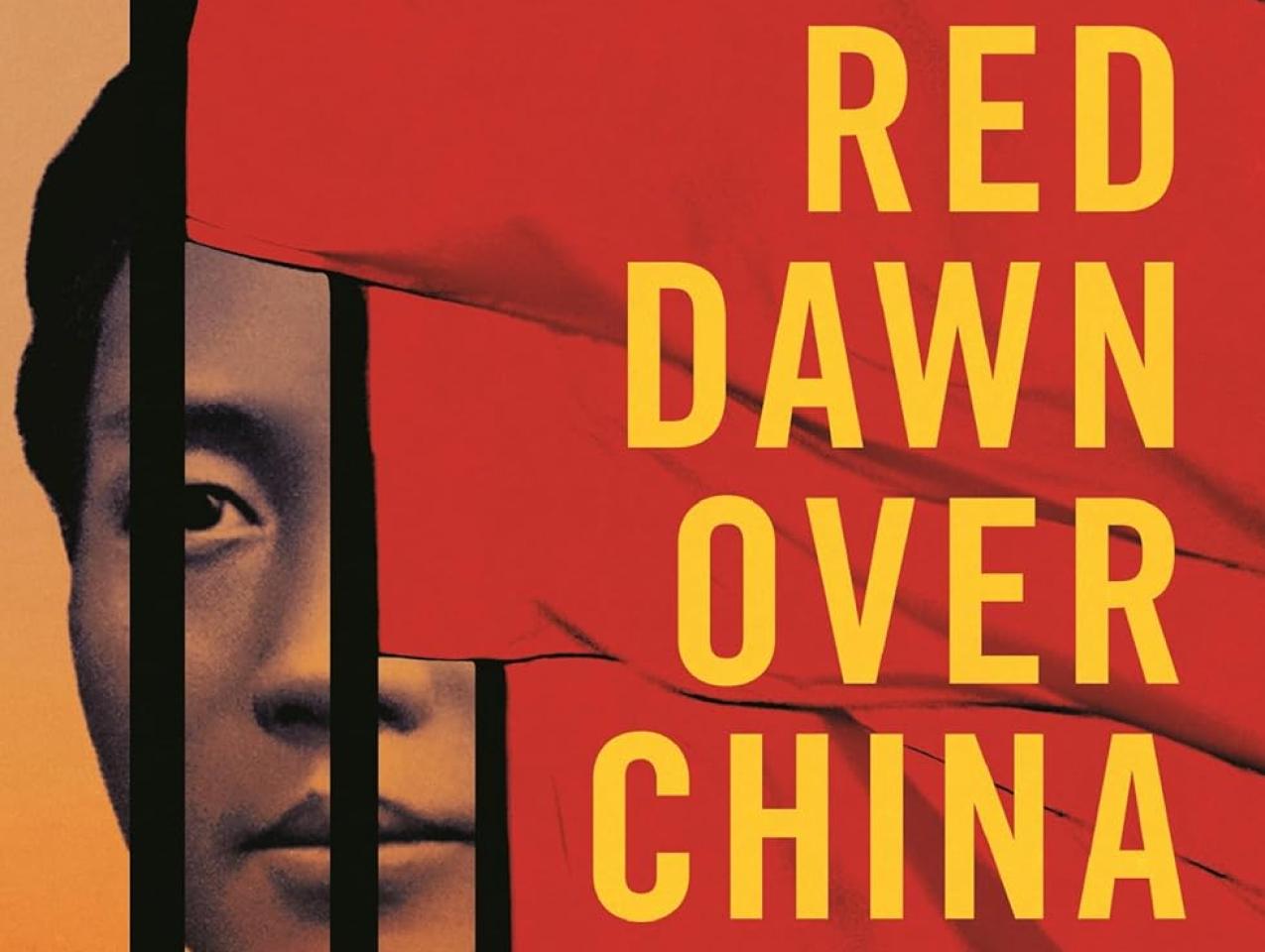
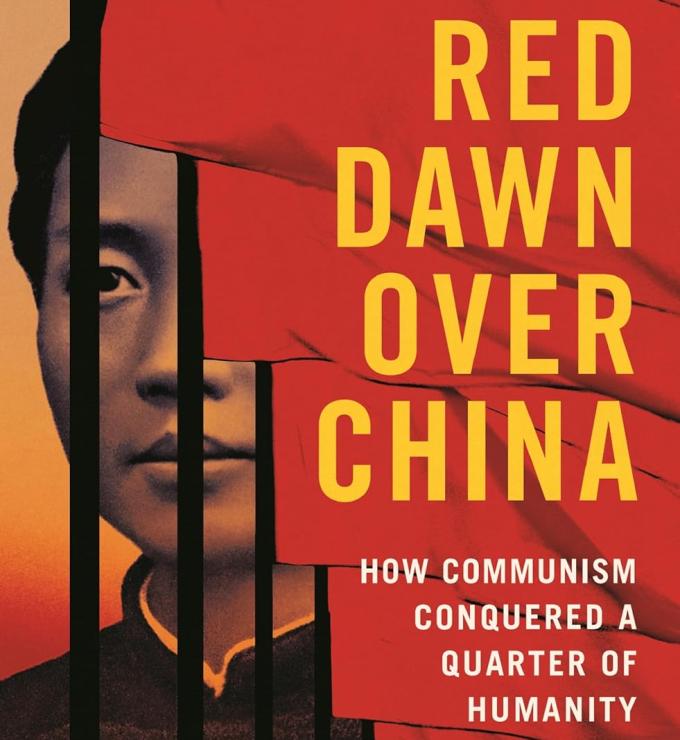
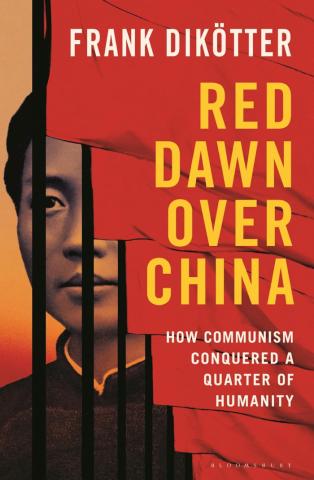
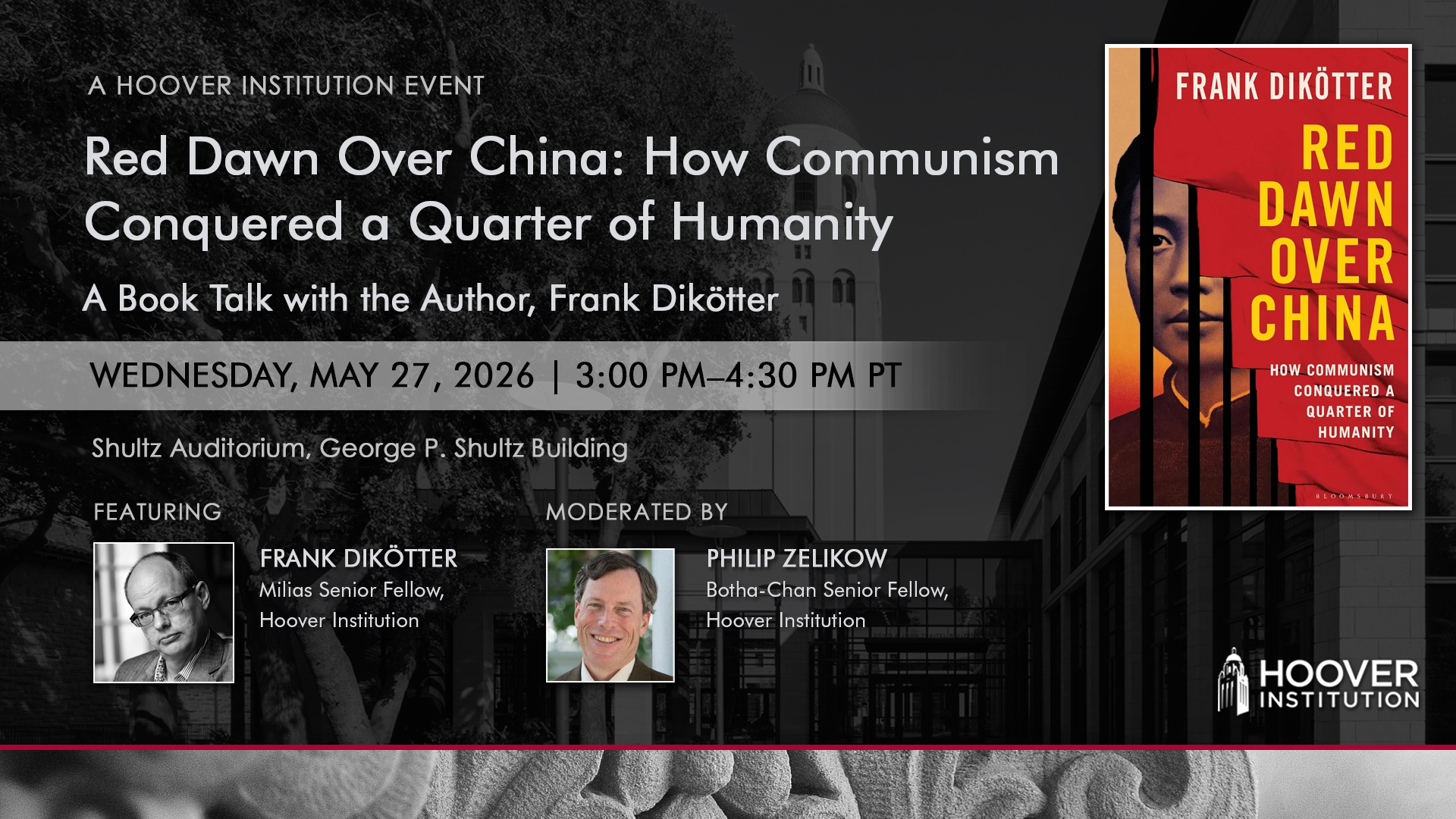
The Hoover Institution hosted Red Dawn Over China: How Communism Conquered a Quarter of Humanity, a book talk with the author, Frank Dikötter on Wednesday, May 27, 2026 from 3:00-4:30 pm PT in the Shultz Auditorium, George P. Shultz Building.
The history of modern China has long been portrayed as a tale of Communists fighting in the hills for freedom, gradually gaining popular support by taking land from the rich and giving it to the poor. Drawing on a wealth of archival evidence, Red Dawn Over China reveals how unlikely the Party's victory actually was, had it not been for financial and military support from the Soviet Union.
Established in 1921 under the direct guidance of Moscow, for the best part of a decade the Communist Party left a trail of destruction, besieging towns and plundering the countryside. When the Communists managed to hold territory, they reduced the villagers to a state of servitude, undermining belief in their cause as well as the local economy. By 1936 they had the same popular appeal as an obscure religious sect. A brutal war of occupation by Japan allowed them to survive far behind enemy lines. After Soviet troops invaded Manchuria in 1945 and provided more money and munitions, the Communists at long last prevailed through a pitiless war of attrition, driven by an unflinching will to conquer at all costs.
In this riveting tale told with great narrative verve, Frank Dikötter reveals how thirteen delegates gathered in a dusty room in 1921 ended up raising the red flag over the Forbidden City in 1949, forever altering the course of history for a quarter of humanity and shaping the world as we know it today.
- Welcome to the Hoover Institution. My name is Joseph Ledford. I'm a Hoover Fellow and the assistant director of the Hoover History Lab At the Hoover Institution, we have a robust slate of history programming and an all-star roster of historians, which includes our speaker today and the moderator. Everything I know about the Chinese Communist Party, I learned from Frank Deco's work and read Dawn Over China. How Communism conquered a quarter of humanity, is another fabulous entry into his bibliography. Frank is Theus senior fellow at the Hoover Institution and Chair, professor of Humanities at the University of Hong Kong. He is the most widely read living historian of modern China with books translated into more than 20 languages, if you wanna read it in German, Spanish, Mongolian, and has fundamentally changed the way historians think about China. Notably Frank is the author of The People's Trilogy, which includes Mals great famine, the tragedy of liberation, and the Cultural Revolution. And he is received numerous prestigious awards and grants. Moderating the conversation today is Philip Ziko. Philip is the both a Chan senior fellow here at the Hoover Institution for 25 years. Before that, he held a chaired professorship in history at the University of Virginia, where he also directed the Miller Center. And for seven years before that, he was an associate professor at Harvard University. Philip is the author of many works on critical episodes in world history and the challenges of policy design and state craft. His most recent book is The Road Less Traveled, the Secret Turning Point of The Great War 1916 to 1917. Ladies and gentlemen, please join me in welcoming Frank. So to start out, I just wanna frame the question that Frank's latest book is trying to answer because it's one of the most interesting questions about the entire history of the world. What you have is a story of a very small group of people who take absolute power over a large fraction of all of humanity. I was trying to reflect on is there any case in all of world history quite so extraordinary? When I was younger, I used to think that the, that the number one case of this kind was the Bolshevik Revolution that seized power and created the Soviet Union out of the Russian Empire. But actually on reflection, the Bolshevik movement and the Russian Social Democratic Party from which it grew was a, a substantial movement that had been around for a while and had a wide set of adherence and many factions and parties allied to the cause of socialist revolution. By comparison, by comparison, the Chinese Communist Party was quite small, narrowly based, and took charge of an even larger portion of humanity than was encompassed by the Russian Empire. Thus, really, world history offers no case. That presents a more challenging question of how such a tiny number of people gain such absolute power over so many. And this book attempts to address that question, and Frank's gonna tell us how. Thank You. Thank you very much. I'll go over the book in no more than 25 minutes, 30 at most. I'll set my clock. No, no one should be allowed to speak for too long, even on such a riveting topic. There we go. Ooh, these seconds go by very fast. So just to avoid any confusion, I am down there on the left. That one on the cover is Mao. So how did he manage to do that? Let me first start by how I got into this book. I went to Hong Kong to settle there in 2006, me and my wife. And the reason, one of the reasons besides the climate, which is lovely, and the people who are great, is proximity to archives in the People's Republic of China. For some 15 years, I crossed that border in and out weeks spent in archives in cities, provinces, central archives in Beijing, east West GaN, Gansu Province au Guango, just across the border by speed train within four hours of reach. I loved it. I wrote a trilogy of books on life on the Mao from 49 up till the Good Old Man's death in 1976, and a sequel that takes the story pretty much up till till today, CTP. The last trip I did before I started working on this one was in December, 2019. I was in Wen Jo. Now, you may not know this, but when Jo is actually very much connected to Whan, most people in, we Jo wanna send their children to a good school, will send them not to Shanghai up the coast, but inland to Wuhan. And I got to say that on the plane back to Hong Kong, I heard some people cough on that plane and it did sound rather alarming. Now, of course, a few months later, C so now what country closed down, can't go across the border, have to spend time in Hong Kong, can't really hike all day long. But I've been cut off from material. I like primary sources. I'm an evidence-based historian. What do I do? I thought, how about a prequel? How about looking at how 12 chaps in a room in Shanghai in 1921 managed to conquer what is a quarter of humanity by 1949? So that was a great topic, but what sources will I use? There's a huge diversity of material, but where's the bulk of it? So I shopped around a bit, found some volumes, which turned out to be part of a series of 300 books published between 1981 and 1989. Not sure what happened in 1989, could have been possibly those 200 tanks that went in there and crushed it, the population. But anyway, during those years, the Central Archives in Calibration with provincial archives published from 300 volumes with every scrap to to be found in any archive on the Communist Party of China. Now, these books at the time were published as for internal circulation for the eyes of party members only, not to be bought in bookshops, not to be read in libraries, but of course this is Hong Kong. All these volumes were smuggled across the ball. They're in the 1980s and nineties all along. So he, he was just a, a great source. I complimented that with Russian sources on the common town, five fat volumes in horrible Russian, but easy to download. And of course also material from the key great powers, the Brits and the French. Why? Because there were great powers and they knew a great deal about what was happening in the most remote regions of this country, the size of Europe. So what comes out of all that material? I can't honestly say I read all those 300 volumes. I had a bunch of students help me. Hong Kong students are great, and they too was somehow stuck with COVID. So we spent a lot of time going through it. What comes out of it is something which is actually not all that surprising. There are a great number of reports about party branches that don't exist. Members who don't pay their fees. Young men and young women more interested in dating each other than in reading the classics of Marxism Leninism, basically an organization which was rather disorganized. Not only that, but how, how many were there? Not a great many. About 12 in a room in 1921 who represent I think about 50 people. Wow, that's not a great deal. As you move forward to 1929 in a city like where some hundred thousand workers are alerted to the shift by steam whistles and electric sirens, there are a grand total of 25 party members. 25. Well, of course you might say, well, that's because they were repressed mercilessly by this fascist central government under Chiang Kai shack. Could be, could be. I doubt it. In fact, I would disagree. But even before the clam down in 1927 in a province like the size of France, there were no more than 2,800 communists. One in about 7,700 people in 1936. Fast forward by about 15 years, roughly 40,000 followers are to be found in this country of half a billion people. Now, I don't calculate all that well, but I think's roughly one for every 12,000 people or so. How about Europe? You could find more communists in any European country with the possible exception of Nazi Germany. Take, let's take a good old fascist regime like Portugal in 1934 under Salazar. Who Represses mercilessly about one in 250 or 280 people are a member of the Communist Party. Wow. She goes to Gansu province by 1941 in 25,000 people is the communist in China piss poor province, right for revolution? I would say if you trust the figures of the Common Town, common Town is the communist international setup in 1919 to promote worldwide revolution, including by violent means, we trust their inflated figures in 1941, in 1,700 people in China as a communist, pretty much the same number as the followers of the Communist Party in the United States of America. A country which I'm not an American, but in my opinion is not exactly a leader of the international communist movement. I may be wrong. So in a nutshell, no country or few countries are so un attuned to the ideology of communism was quite remarkable. But the Histography will tell you the exact opposite. This is not reflected anywhere. You can pick up a textbook, you can read more detailed studies. It's always about the fight between the communists and the nationalists. But that's positing an equivalence that doesn't exist. The communist in the 1930s, not to mention the twenties, are about the same side as some local religious S sect, a secret society, a local gang of bandits that are of course campaigns to suppress bandits. They've been going on from the Ching onwards, but the communists are not seen to be anyhow different. So this message, in fact, is also promoted by a book, written by a man called Edgar Snow was recruited precisely as in 1936. The Red Star of the Communist has is at its lowest, and he is a journalist, somewhat naive from Missouri, and published a book called Red Star Over China. You will notice that there is an echo in the title, and that book portrays the communists as great agrarian reformers more in tune with the spirit of the modern age fighting for freedom in the hills. That book is translated into 20 languages, makes Mao a household name, puts the communist on the map. Romantic story that has been repeated time and again until this day, a kind of David and Goliath story in which sympathy goes to the boy with the slick. That's the story we've heard endlessly to this very day in established history. So what, what really happened? If you look at all these sources, well, where should we begin? 19. 19, I'll go through it. Not year by year. There's a great deal of material. Also, quite frankly, there's an issue here with this entire period. In fact, that two one is something spotted by the Soviets who had a joke about it. They said, well, you know, the future if you're a Marxist is easy to predict, but the past keeps on changing. Well, there's a bit of a problem. Take for instance, the 1929 Sino Soviet War, massive confl conflagration, hundreds of thousands of troops fight between the Soviet Union, Stalin and Manchuria under Jin. So that book, a book was published on specifically that war, the 1920 nines of Soviet War, with the subtitle saying, the War, nobody knew. It appears that historians have just somehow skipped that war together until it was rediscovered by Michael Walker, author of this particular book. So you see, you see massive events somehow either disappear from view or reappear, and then there's another issue with this period. Oh, it is complicated there, endless battles and coalitions and alliances and shifting relationships between local, provincial, and central troops. Names of generals, commandant envoys shifting capitals. There's one damn thing after another. So to simplify it, I'll go through it at pace, so to speak. 1919, commandant Communist International sends Soviet envoys. They speak to a small number of intellectual figures in Shanghai and Beijing. They manage by 1921 to have roughly 50 people converted to the cause in this country. They squabble a great deal. They have to send another Commandant agent, a Dutch person, I'm not proud of it, called Hank sna lead. He's a good organizer. He managed to get 12 of them inside room. Still membership doesn't really grow all that much. The Commandant is also interested in another party called the Nationalist Party, established in 1912, a year after the collapse of the Ching Empire, which is organized by several military governors who very quickly fall out and throughout the 1910s, control and twenties, control different parts of the country with different shifting alliances. The nationalist party established under a different name in 1912, wishes to unite that country in a military expedition to be launched from Guang Jo Canton, just across the border from Hong Kong. Great stuff. Moscow is willing to provide man munitions money, but with a condition attached. The National Party must accept members of the communist inside their ranks. It is a beautiful illustration of the Trojan horse. By 1926, Moscow has sent about 600 military advisors all busy in guango organizing an army of a hundred thousand soldiers. They go on their march in 1926 to unite that country up north from Guangzhou. Inside the ranks are communist party members, and they incite mobs to attack anyone with any kind of wealth. Whether these are land owners or wealthy shopkeepers and also foreigners seen as agents of imperialism. They create such havoc that Chiang Kai-shek, head of the Nationalist party by land, decides to get rid of the communist and and the alliance imposed by Moscow, Stalin in particular. It's the end of a so-called united front. The Russians, by the way, are kicked out of the country by the end of 1927. From here onwards, the communists are on their own. What should they do? They follow a policy. What is the policy? It's a policy of red terror. It's not my, my terms their term ho. The idea is that by imposing a campaign of red terror, every single enemy must be eliminated. Now why? Why would you do that? Well, it's best captured by a saying, proposed by Maldon in January, 1930. It's a beautiful thing. The man's got a real gift for pity slogans. A single spark can set the prairie alike. A single spark can set the prairie alike. So that violence, revolutionary violence, is meant to be the spark that will unleash great revolutionary masses and lead to victory. Well, it doesn't quite work. The idea is if you eliminate kill off so-called class enemies, any obstacle in the way, the revolution will be eliminated. But it doesn't happen like that. So what you see is a sequence of attacks on towns in which government buildings are burnt down, number of class enemies executed, wealth confiscated, people ransomed until inevitably government troops arrive and the communists have to move on to greener pastures. This goes on for several years until the 1930 Stalin intervenes and says, you must seize and hold territory and not just, you know, roll through the countryside from one place to another. You must establish a revolutionary base. These are called Soviets. This they do in remote, mountainous regions. And here the communist encounter an issue, a problem. How do you implement land reform? How do you, how do you manage to take land from the rich and give it to the poor when everybody is poor? So the model is not a bad one. The sort of Robin hood model that comes of course from Russia 1861, the surfs are emancipated. 50 years later, they are still poor and live on massive aristocratic estates. So the Bolsheviks decide to take that land and give it to these poor surfs. But in these impoverished, mountainous areas and elsewhere throughout China, there is no land aristocracy. There are no barons, there are no squires, and nobody can take land from and distribute it to the poor. These people work very hard to eke out a living. So what happens is that the communist not being able to find so-called landlords attack, so-called rich peasants. Once they had been attacked, they attack so-called middle peasants. At that point, just about every villager realizes that these communists are after your grain and also after your man to be used as canon father. So some remarkable text describe what, what, what, what follows. One of these leaders describes how the peasants have become lazy. They no longer work well. The reason is quite clear. Everybody knows that anything you might produce over and above the strict minimum that you need to feed yourself and your family will be taken by the Communist Party. So communist rule very quickly leads to the improvisation of just about everyone in those regions. There's another problem. Communists tend to be a little bit paranoid. They see spies everywhere. There are purges, very violent ones. One that happens in 1930s, quite well known. The fu chain incident in which some two to 10,000 followers are massacred described as spies within the ranks. Some of the pos go against ordinary people. It's enough to speak out against exactions of the party to somehow merit severe punishment. So very rapidly, these soviets begin to implode. In the case of the chunky Soviet, the most famous one, from 31 to 34, of course, government troops arrive to encircle them. But ultimately what causes that collapse is just that people vote with their feet and they flee. So from 5.6 million population goes down by about 1.3 million and 20% of people leave the whole thing implodes as jungle Tao leader of another. Soviet in Hube put it rather, I think succinctly. He said, we squeezed the region like a lemon. I almost, it was squeezed they had to move on. 1934, the long march, which is in effect a very chaotic retreat. In fact, there are about three long marches. I won't go into the detail, but three groups of people undergo a very long march to find refuge up in a Lus plateau in Chancy province towards the North East. Why does it take so long? Because government troops cut off access to resources, send them into inhospitable terrain. In fact, practice a guerrilla warfare against the communist themselves in the hope that they will die of attrition. This is precisely what happens by 1936 when these three groups arrive independently in in Chancy province. There are about 40,000 of them left. I've mentioned Edgar Snow. He puts them back on the map. But the true savior, yet again is Uncle Joe Stalin. He comes up with a message, a pretty, I think, straightforward one. Japan has invaded all of Manchuria to the north of Beijing, the size of France and the United Kingdom combined. And Stalin says, you should collaborate with the central government, the nationalists to fight the Japanese. Ooh, or the Chinese Communist find it very difficult to do so. It takes a lot of convincing and badgering for Mao to finally accept that message and say that he's willing to unite with c Khe to fight the Japanese. Of course, the Japanese can smell a rat. They're afraid that the central government and the Chanka Shaq will lean towards the Soviet Union and start war in the summer of 1937. They do precisely what the communists would never have been able to do. They eliminate the central government from all the main cities along the coast. One might say that the communists only ever waged won battle from 1937 to 45 against the Communist in September, 1937. But that would be, I think, slightly unfair. They do fight. They fight the central government. They try to occupy terrain behind Japanese lines. They try to dish dislodge the nationalists, the central government. They thrive in distressed terrain and this is what they do. Acquiring a, a broader range of territory from 1940 onwards. Now, Mao said it very clearly, power comes from the barrel of a gun, but there's something else. Communists must make pledges and promises. And these come in the guise of a document called On the New Democracy published by in 1940. What is it? Well, lots of promises about how the communist will embrace just about anyone who is willing to fight against the Japanese. They promise a multi-party system. They promise freedoms of speech, they promise respect of private property. Of course, it's a fiction. One might argue every dictator by definition is, is a Democrat. Every dictatorship will promote democracy, will pretend to fight on behalf of the vast majority. But it's a fiction that works very well. Tens of thousands of young idealists students, teachers join Yan, the wartime capital of the Communist. Unfortunately, being paranoid now is somewhat suspicious. Launches a campaign from 1942 to 44 in which tens of thousands are interrogated, occasionally tortured, tortured thousands of them physically eliminated. In the meantime yen and is set up as a showcase of democracy with American journalists in particular arriving in 1944 and describing it as a small paradise on earth. The communist, they believe represent the future. Now here we are round about 1945 and still the communists do not represent a significant fraction of the population, maybe 30 counties under their control, out of about 2000 in this country, maybe 200 more controlled directly or indirectly. The forces are very uneven. What? What happens? Well, would you really ask why North Korea became communist? Would you really ponder the question as to how Germany could possibly be divided into two East Germany being communist? Was there something in the culture of East Germany that made them become communists as opposed to Western Germany? Call smart. It's the red army. The Red Army arrives, stops in Korea on the 38th parallel. A million of them also invade Manchuria in August, 1945. They too divide China into two. They take occupy all of Manchuria to the North Beijing. They prevent the allied forces from entering Manchuria. They prevent the central government from sending troops. But they welcome the communists. They welcome the communists. Not only that, but they armed them to the teeth with endless wagon loads of material arriving by rail and also by sea. Though very gradually, Manchuria becomes a sort of fortress with the countryside in the hands of the Communist Party and very, very feeble control of the cities along the railways. Something else happens. Very interesting and, but 25 minutes, we've got five minutes left. Something else happens. Very interesting. This country, as I said, the size of Europe is like Europe in rubble. Cities flattened during the second World war. The central government needs help. Instead of getting help, it gets nothing. It gets communist troops that sabotage every telegraph pole, every railway, every bit of society that functions is racked by the communist. The communist task could destroy. Central government's task is to build up very difficult to do not least when you get zero help from your allies. Okay, here we are in 1947. They're armed to the teeth they've been able to recruit through forced conscription mercilessly. 750,000 troops by the end of 1947. But it's not just the gun power comes under the barrel of the gun. It's also how you use that gun. What are you willing to do? How keen are you? How determined are you? Now these people are pretty determined. They wage not just the war of attrition, they wage what I would call unrestricted warfare. That means war regardless of any moral principles. You get telegrams, you can, you can read them in the archives in, in Taipei online, I should say reports about how the soldiers are sick and tired of having to fire bullets into unarmed villages where send their way in one wave after another. Most of all, the willingness to starve entire cities into surrender. We all know about Stalingrad and Leningrad, who's ever heard of Chung Chuan From May to October 48. Li Bal, the man in charge of the communist troops, surrounds Chung Tun and has a very clear instruction. He says, turn hun into a city of death. That's how he puts it. That's not my alarm. So soldiers, 40 minutes, 40 meters apart, trenches four meters deep, nobody can escape from Chung Hu. When the city finally falls, 160,000 people have died of disease or hunger. Ang long, a lieutenant in the People's Liberation army later who studies the whole thing, puts it in a very nice way. He says, Hiroshima took about nine seconds. Chung took five months, but the result is the same under 60,000 casualties. Once Chang Hun falls, clearly other cities are very unwilling to undergo the same fate. Beijing surrenders the commander, unwilling to see that seat of Chinese culture destroyed as Chun was. They're still massive battles going on. Not least the one in Hu Hu. But nonetheless, by the end of 1949, these cities popple like dominoes. In October 49, the red flag goes up over the forbidden city. A quote of humanity has become communist. And that's the end of my 30 minutes. Thank you. There are a few things to try to drill down on and then we can also take some questions from some people here. So rather than go through the whole story in another way, what I want to do is I want to sync Mineshafts into a few, in a couple of particular moments in time. Yes. At like that to unpack as kind of snapshots and turning points. The first one I want to pick is 1936. There's an episode. This is the Japanese have now moved out of Manchuria and into North China. Yep. But not yet fully into Beijing. That's it. They're on the outskirts of Beijing and they're deciding how do we, and how do we proceed with this war in China that Tokyo had kind of half authorized, but now they clearly have this puppet state that they've stood up in in Manchuria, but they don't really know where, what they want to do with China. And they're debating that. But they're drawn to, and what they want the Chinese to do is just quit fighting and accept the losses and sign a deal with the Japanese. That's what the Japanese want. Then there's this episode called the Ian incident. Yep. Which I'm gonna invite you to explain. And then, which is this astonishing story. And then the outcome of this shian incident is actually that creates the situation that will ignite the full on war between China and Japan. That in my judgment, is the war that delivers the mortal wound to the Chinese republic. The, that guts the Chinese republic to a degree from which it will really kind of never really be able to recover. And thus lends it the vulnerability to the story that you just described. But that sino, the full s of Japanese war is still just, is just in the future. Might not happen. Yep. And then we have 1936 in which there's this character of Chung Lin. Yep. The communist movement, which the, which you described. Yep. The Chinese Republic. Tell us what happened. The Russians, the Japanese, they don't like each other. They see China as a sort of terrain where they can create a buffer zone. They go to war in 19 0 4, 19 0 5. The Japanese win overwhelmingly, but are civil enough to hand all of Manchuria back to the Ching, which is great. But that rivalry will continue all along. All along. So when Japan invades Manchuria in September 31, the Soviet Union is not too pleased about it. There are hundreds of incidents along what is now a common border between Japan occupied Manchuria and the Soviet Union. Now, clearly from a Japanese point of view, who are the allies of the Soviet Union, the Communists. So as long as Chiang Kai-shek Khe can fight the communists, that's still acceptable. And the whole point for Chan Kashe is that by pretending to fight the communist, but allowing them to somehow meander through a whole series of provinces, which, which Cka Shak van occupies with central troops is to train his troops, but also to unify the country. In other words, CKA Shak spends a good 10 years using the Communist to train his troop. He can't train them openly against Japan and try to unite that country. Now he is in the Northeast in 1936 and he's telling two of his generals. One is the local general in charge of that province, Chancy. The other one is Jang, who comes from Anuria and took 160,000 of his soldiers all the way to Chancy province. He's been kicked out by the Japanese. These soldiers are keen to fight the Japanese. They're not keen to fight the communists, but this is what Chang Kashe wants. It's got one more battle. He can eliminate those communists. And then he is ready. He's been buying weapons from Germany. He's, he's got 750 airplanes. He's got a whole plan to fight back against Japan. But he needs that extra bit of time. He's been planning this very carefully. But Jun Young, the y the two generals are not keen. They don't wanna fight any Chinese. They don't wanna go and fight the Japanese right away. They kidnap John Kai Shak in December. How, how do they kidnap him? John Khak goes over to Ian to lecture them. He's a very stubborn man and also very unpleasant. He tends to lecture people a lot as generals don't always like it. He upsets a lot of people. They decide to send soldiers and basically, you know, grab them physically and put 'em under, under arrest until he agrees to fight the Japanese instead of the communist. Sohan Kai Shaq is smart enough to realize that Stalin will not like it. And Stalin being a very smart man, doesn't like it. He says, is this some sort of plot? Is this a Japanese engineered trick? 'cause of course it's a gift to Japan because it compels the, it compels Kersha and the central government to declare war against Japan, which means in invariably war with the Soviet Union. So it's not pleased at all and all the communists to make sure that Chi Khe is released as quickly as possible. He is released. So Stalin is telling his the communists Yes. To be sure Chiang Kai-shek is set free. Yes. The communists are dancing. They're very naive. They think this is great. We're going to hang the man Who's been chasing them for nearly 10 years and murdering their comrades. Yes. And instead Stalin tells him, no, you're sworn your mortal enemy. You want to be sure he's set free. Exactly. Because I need his help. This is provocation. But the Japanese don't buy Ithan. KeHE is released. He is released, he goes back to Naing. Every newspaper in that country cheers him. There's no sympathy for the communists. There's no sympathy for those two generals. No sympathy whatsoever. But the Japanese don't buy it. In, in January, 1937, you can see massive movement of troops in Ventura. They are preparing for war. Their biggest fear is that Naing, the central government, will lean towards the Soviet Union. And that's exactly the result of this kidnapping. So the result of this kidnapping of 1936 is that Japan, the sites to, to invade in the summer of 37. And it will deal a mortal wound of course to the central government as brutal war, as a, a rape of Xi, the cities and bomb flat is the most brutal war to date, to date, 1937. But many horrors will follow in Europe. But at that point in time, what the Japanese do is, is just utterly brutal, including the use of chemical warfare to get all the way to Wuhan. So that's, that's 19. That's, that's the result of 1936. So let's now flash forward, Sino-Japanese war has, has proceeded, Japan has now been defeated because America has joined the war, actually significantly joined the war in order to save China, though it thought that as part of the global struggle against totalitarianism, which is an interesting story. Yeah. But nine, it's the war's over Japan is defeated, but the central government now is, is trying to recover from the ruin nation. That that war has inflicted this mortal wound. And so now the other year I wanna drill down on is 1946. So here's the situation. War's Japan's defeated. You now have the, the Soviets have now occupied Manchuria. They're actually still large numbers of Japanese civilians and soldiers in Manchuria who need to be repatriated. Though many of them are being turned into slave laborers and doing other things to help the, the Soviets, the Chinese communists are being now muscled up armed, turned, given this man Manchuria as a sanctuary. And now the Americans enter the scene in a really big way because the Americans are now gonna try to patch up the Chinese Civil War, persuade China to make a deal with Mao and try to see if China can unite under a coalition government. They send the most prestigious American that they can find. George Marshall, the head of the army on a special mission to China to try to patch this up. And using some thousands of American advisors and, and troops left over from the Pacific War who were still helping out as a way to foster this. And Marshall spends about a year in 1946 trying to patch this up and also try to persuade Stalin to help him with this resolution and agree also to withdraw Soviet troops from Manchuria. The American plan ends up not working out. But tell me about a little bit, drill down with me into that year, and do you think there was ever a possible chance that the Marshall mission to China, that the American plan could possibly have worked or were, was, was this really a situation in which to borrow a phrase, Stalin held all the cards. If you want to understand 46, I mean, Stalin appears on about 69 pages in this book. If you want to understand what the Americans do, you have to go back to Stalin. What does Stalin do? Well, the city named after him, Stalin gr is the turning point in the second World war. It's 1943. So Stalin can see the, I think, what, what's he going to do with all these communist parties established by the common town. They must look natural when he's going to invade again Poland and all those other countries, those communist parties that he will prop up must look like they, they are somehow natural. So he abolishes the common town in 1943 with all these parties is on their own, nothing to do with us. He tells the American ambassador in Moscow that the Chinese communists really are margarine communists and nothing to do with international communism by grand reforms. The American sand, a vice president called Henry Wallace, he visits Siberia, including Mageddon, which is part of a massive gulag system. And he's very impressed. And when he meets c Kai Shak, he tells, you know, you really should do with your economy what the Soviet Soviets have done in Siberia. It's terrific and you should get a lot closer to the communists Sohan Kai Shak. Well, the Chanka Shak says, well, the communists, you know, they, they're very much supported by Moscow. So Henry Wallace says, no, no, the Commandant has been abolished in 1943. These are just the grand reformers. He insists on a coalition. And subsequently, 19 34, 44, 35 in particular, even before, you know, good old Marshall arrives, the United States insists on a coalition between the communists and the central government, in effect, doing what Stalin had pulled off in 1924 with the first united French, and again, in 1927 with the second, sorry, 19 30, 37 with the second United front. The quite extraordinary That was the, the, the, the coalition that he helped orchestrate Yes. To join against the Japanese. Yes. So the first one, he, he, he, he puts communist members inside the ranks of the nationalist party. That's actually 1924, not 21. And then 37 with the united front, again, engineered by Stalin. There's a coalition. So the Americans are not doing the same thing. Marshall arrives in January 46, 46. These two are fighting each other. Now we're in 46, imposes a truth the very day of the truth. Five regiments of communists attack a city in Manchuria along the coast were where the nationalists tried to disembark called Yol. In April 46, the Soviet Union withdrawals having plundered the whole place withdrawals from Manchuria. Immediately the central government sends troops goes on the pursuit of lie, Bal pushes the communist. They push, they push the communist all the way back to Hain and probably would've been able to kick them out of Manchuria across the border into Siberia had it not been again for the intervention of Marshall. This is April, 1946. Again, a truth is imposed then an arms embargo in September, 1946. That is also worthwhile noting that unlike other allies, the central government of China gets very little financial support. This is what they need to rebuild a country which is in ruins. So the man who will later come up with the Marshall Plan is the one who prevents the nationalist, the central government, which has to reconstruct a huge continent from fighting against the communist. That's the result. But the key point, Why is Marshall doing this bad thing? Marshall all along has an aid called Allian Gilliam. Alan Gilliam is rarely mentioned in the literature, but he says very clearly that man is raising his hand. Time that a says very clearly, the communists are the ones who attacked. Marshall responds by sending a letter to Truman saying the communist are nothing but disorganized bans. That he's got no clue of what he's talking about. The moment this truth is imposed in April, 1946, the communist in Manura start land reform. And land reform is really compelling. The local population to eliminate all power holders, which are then replaced by Communist party members. It, it's in effect a way of getting a grip on the countryside. And at that point they can extract as much grain as they wish, and of course also have compulsory conscription to bulk up their army. So that coalition, that that truth in April 46 is absolutely essential. Absolutely essential. I would say 47 is the sort of pivot year as a result. So 46 Marshalls imposing Marshall helps persuade the Soviets to leave Manchu. They would've left. In fact, it's almost the other way round, as in the central government wishes the Soviets to stay a bit longer because they find it very difficult to get their troops anywhere close to it. But yes, the Soviets do withdraw after a while Because in this is also the period in which Stalin has cut a deal with Chiang Kai-shek about the future of China. Yes. In 40, in 45, 46, Yes. Marshall thinks I'm, I'm persuading the Soviets to leave Manchuria. That's good. The Chang thinks I've gotta, I've gotta deal with the Soviets. So this, all this look looks good for Chang. So how is it that the communists are able to rescue the situation in 46 and and regain their strength that Marshalls getting the truce he wants, he's getting the Soviets to leave. Chang has made hi thinks he's made his deal with the Soviets too. And of course he's friendly with Marshall. Marshall. It's true. Doesn't have any money to really help Chang with the reconstruction of China. But why does this situation then turn out to be the godsend for the to, for the communists? The, the Soviets arrive in August 45 from almost the very day that the Occupy Manchuria communist troops start crossing the border into Manchuria. So Fallon has a very clever way of doing it. He says the communist party is not allowed in Manchuria, but local partisans are so lie Chen, others get clear instructions, go to Manchuria, change your name, call yourselves local partisans. So throughout from 40, from August 45 onwards, you get a huge sort of exodus from other parts of, of China towards Manchuria. Not only that, but partisans who had to flee Manchuria under the Japanese were recruited by the Soviet Union and trained and also enter Manchuria. So by 46 is already too late in words. The countryside In the hand six, when the Soviets leave, they've actually are leaving because they've already substantially accomplished their mission. The entire countryside is controlled by the communists. And Marshall can't reverse that 'cause he's 'cause Chiang Kai Shk can't reverse that. Shang Kai Shk doesn't have military power. He Does. He does. When do mean starts fighting his way up. Manchuria. The moment the Soviets withdrawn April 46, he could have prevailed and he did, he pushed the communist back all the way to to, to the Soviet border. So he could have, but Marshall intervened. Why did Marshall intervene? Because he's ideologically committed to a coalition. That's why. So he doesn't want the communist destroyed. 'cause he fears that that will then, that that defeat will then drive the communists out of the coalition and reignite the Civil war that he thinks he's tamping down and preventing. Yes, yes, yes. So he crushed the central government's best chance of getting rid of the communists in Manura. He, he crushed that and makes it even more difficult later on with the arms embargo in September 46. So let me just see if I understand your argument. Your argument then would be that the thing the all is not yet lost for the central government in 46. Absolutely. The, the central government, even despite the Soviet success in building up communists in Manchuria, the central government still has a a, a reasonable shot at driving them out of Manchuria. Yep. Despite that. But that the American imposed truth actually prevents the, the central government from completing that victory and allows the communists to Yes. Maintain their strength. Yes. And then begin turning the tide as the Americans abandoned their mission. Yes. Failing to get the coalition and also cut off aid to Shang Kai-shek. Yes. In 1947. Yes. To put it, to put it slightly differently, in 1946, Moscow and Washington intervened on behalf of the Communist Party. So the key turning points 19 47, 19 47 is the sort of balance of power becomes very frail. So there is actually a chance for the central government still to have won the Civil War. Yes, absolutely. And you don't think that the situation is irretrievably lost for the central government then until this plays out in 47? Yes. By the end of 47. In fact, Chiang Kai Shaxi very clearly does not want to go back into ura, but is general Counterman is old and tries to re-con all of it again. And is Defeated. Is defeated. It's too late. Alright, let's throw the floor open to some questions from the audience about this astonishing story. I think it's, it's fair to say that a, a major theme of of the book, which I I wanna be sure I'm, I'm summarizing correctly, is not really the victory of a mass movement or even the victory of a mass ideology. This is just a straight up power struggle of who's willing and able to use maximum violence. Yes. And, and win the battle. Yes. Who uses fortune and misfortune best and who is more determined? Alright, questions? So That's Larry Diamond back There, I believe. Oh, thanks. Thanks Philip. So as you, you know Frank, thank you. This is absolutely riveting. There was a debate in the United States about who lost China. So, and then there was a reaction and characterization of that red baiting, et cetera, et cetera. As you look back now, I, I mean it's kind of implicit in what you've said so far, but I wanna see if you can crystallize it. If we look back now from a historical lens with the insight of your analysis, is the question properly framed? Who lost China? How much responsibility does the US bear for its own naivete or miscalculations? And how would you answer the question? Well, let's say the Americans had a lot to do liberating planet earth. Right? It's not an not an easy thing. I including even the Netherlands. Including the Netherlands. Well, the British and Canadians helped with that too. That's true, That's true. But you got, you got to realize, you know, when they, when the American troops land in the Philippines, just the, the, the battle of Manila was, was horrendous. So this is early 45. So when Truman insists on the Soviet Union coming to their help in August 45, he doesn't know. Truman doesn't know he will have a, a bomb at his disposal later on in December of 45. So it's, it's not inexplicable that he tries, first of all to, to have a coalition between all those willing to fight nationalists and communists and also to arm with land lease material. The Red Army in Siberia. It's the land lease material that will allow a million soldiers, of course to, to march through Manchuria on their way to the 38th parallel in, in Korea. So all of that is quite understandable. But on the other hand, of course they didn't want to fight the communists, but they end up doing it anyway. They can't avoid them. That was a very interesting document in the, They didn't wanna fight the commun, you mean the Americans? The Americans didn't want to fight the communist, but they end up doing it in Korea. It was a very interesting document in, in the archives in, in Taipei, the historic, what is it? The institute, historic academia, ssa, there's the Synica and the historical. Anyway, it's a long time ago. This is one big American general. He visits Janka sha in 51, I believe. And he says, wow, you know, in Korea the United Nations is, is, is fighting the Chinese, but they just throw one wave of fighters against you after the other. It's impossible. So ang kai-shek looks at him. I, I imagine this, it doesn't say any tax that he's looking at him. The drunk guy Shaik looks at him and says, if you, you and the United Nations find it so difficult now what do you think I should have done in 48? And of course by 48, Europe has received the Marshall plan at 13 billion plus 12 billion that have been extended to Europe before 1948 for 45 to to 48, those 25 billion. Whereas the Republic of China received as an ally of one of the great four allies represented at the conference in, in Cairo. Right. Has received about a third of a million. At most even Japan receives more money, as Truman said, a third Of a billion you must A a third of a billion. A third of a billion. I mean, yes. 330 million at, at most. Well Truman has a, a nice way of putting it. He says, you know, helping the central government is like pouring sand down a rats hole. I'm not answering your question directly, but I think indirectly it's itself. So it, part of it then is that, which is ironic since a substantial reason America goes to war with Japan in 1941 is because it won't make a deal with the Japanese that will abandon China. And so in some to significant degree we go to war with Japan and save China and then won't commit the money at the end of the war that will help complete that salvation. Yes, yes. I mean that's a really complicated story that, you know, when I mentioned the 1929 Sono Soviet war, one of those great battles that the world has forgotten about. There's another one that takes part that takes place in August 39 and it's called the Han Battle by the Japanese and the, as the Russians say it, which is easy if you Dutch, lots of gut rules in there. But anyway, Stalin has purged Siberia. The moment Japan starts its war with, with China in 37, the Japanese thing, they're weak, we should attack. They do. So August 39, they meet with the ferocious response by tanks and they are determined. The defeat is such, they're determined never, ever to have to fight the Soviets again. So instead with the oil bomb, this Is the war. This is a small war between Japan and the Soviet Union. Yes. In 1939, This is August 39. This is in Mongolia, you know, close to Manchuria. So instead of going for the oil in Siberia, there's an oil embargo. They want to go for the oil in the, in Southeast Asia, malaria, the Dutch Indies as they're called. So if you want to do that, it means that you have to control the Pacific. If you want to control the Pacific, you must attack Pearl Harbor. Alright, another other question. Hi Mr. Coter. Should China decided to invade the Taiwan tomorrow or the historical lessons from this period that you can offer to the American policymaker as well as Taiwanese government? There's an awful lot about Taiwan. I don't think it will happen. I mean, look at, look at the Russians. Wow. They fight over a field with three trees for weeks on end. The attrition rate is huge and that should have been easy, right? This is just a, a nice plane. You should be able to send your tank straight, straight through. But the Taiwan Strait was about a hundred miles. Pretty, pretty rough sea. It's very difficult to do. But the key lesson is really unrestricted warfare. The term I used earlier on attrition is when several months ago there were thousands of boats, you know, surrounding Taiwan. That, that instills fear in me. Not the technology, but the use, the willingness to throw huge numbers at your enemy and overwhelm him. That that's a lesson to be learned there. What is, that's, what's the question? That was a little bit about the lessons. You, what lesson do you think Americans should take away from your, from this story about how they should view this Taiwan? Right. Well, Taiwan to the peace. So you've Been somewhat critical of American's historical role in the fate of China. It's mainland China. Hardly they should have armed Ukraine to the teeth and they should arm Taiwan to the teeth. That's the lesson, not just for Americans. Yes. Is that Rowena? Yeah. Yeah. Thank you Frank. I want two questions. One is historical, one is methodology about the CN incident. So when I taught the CN incident in, in class two things always came up. I forgot if you mentioned that in, in, in the chi geology. So one is the decision that Ian decided to go with Yang Hu Chang to to, to cap Chang Gaa. So because we always see December 12th, 1936 is a turning point. It's a major turning point because the, the KMT was so close to get rid of the C ccp, I mean settle the CCP. But it did not happen because of the CN incident. Right. We often wonder if the fact that John Ian's father John Jolin was actually attack and and die in the, in the bomb by the Ong army. It wa if it was collected to Ian's decision because he, he's, he's from Manchuria and then he really has this kind of deep, strong sentiments against the Japanese. That's why he decided to do that. And the second thing, I mean, before Gorbachev have all this classify cable, like it's, I think the first time that it was mentioned, it was the cable from Stalin that told Mao not to kill Chang Kai ep. Right. So that was from the, the, the cable from the declassified archive. So we, we have been wondering this whole time before that like why Mao would like to keep CH alive and then ch Kai wanted to keep Lan alive and then is kind of like eco. They are both, they are both kind of kind. But now we know that Mao got the cable from actually Stalin. Yes. But, but, but, but ch Kai decided to keep Lan for other reasons, right? Because his relationship with so, so, so, so, so, so many. So that's one thing that I really wonder if you you go into the details because the students were very interested in these two key points about if Zolin was not killed by the Japanese, if John John Zian would make that decision. And second is more methodology question. 'cause when I saw your title, I was thinking like finally a corrective for Red River over China. Right? So, and when Agar Snow collected all his data, he interviewed Mao extensively and all this other guys, and that's why he came up this book that shaped the public opinion of the time about the CCP, which was totally misleading. Of course, later we find out. So I'm just wondering, like, as a historian, like you have written all the books. So when we were at that time, I think he thought he was supporting the opposition, the dissident of this, the CCP people. And he gave voice, but somehow it was totally misleading for, for centuries. I mean for decades. So how, how, what can we do in under the circum? Because he gave voice to all these people who were not given a voice at that time. He believed he was doing the right thing, supporting the CCP against the kts, you know, authoritarian or authoritarian rule. So I wonder if you can share how you approach this as a historian Methodologically? Yes. Let's, the, the first one is, is pretty straightforward. I go into detail, I show that Mao not only got a telegram from Stalin, but withheld it for several days. So a very manipulative person then also went much further by, by instructing journal I to spread the myth that somehow the central government, in particular Hu Yin, the general wa, was actually about to, to, to bomb Ian in, in including taking the risk of killing Chiang Kai Shaq. So very manipulative person. But the point really is that Ang Young are had a great number of troops and also teachers who came from, from schools driven outta Manchuria, who very upset about the whole thing and, and lived on a very low allowance. So they're very discontent. They wanna go back home, they wanna go and fight the Japanese, they wanna go back home. So it's not just about, it's about its troops as well. And of needless to say, there's been great propaganda among the troops distributed by, as you can imagine, members of the Communist Party. So that's the CN incident. There's a, a terrific diary by TV song inside the Hoover archives, which goes through it in great detail. Very helpful indeed. But besides of course, all the released information from, from Russia and elsewhere as to the methodology, you mean Red Star over China, right? Yeah, I read it when I was a student. There's a lot of things I read and I don't know, I just didn't really believe it. It just sounded a bit too pretty. It sounded just a bit too implausible. You know, also if you have read a little bit about, about communists, it's hard to believe that somehow these chaps over the are incredibly different from the predecessors, the Bolsheviks. Also with hindsight, it's also pretty implausible the whole story. So it's basically a fairytale. What do you do to find out? I spent 20 years working on the Republican era before I started working on Post 49. I can tell you one thing, rarely did I come across anything that corroborated at Gosnell's story. So I guess just an intuition. But ultimately I would think if you can't access proper primary sources, better withhold You describe how the party goes from 12 people to so many soldiers that they overwhelm. And of course it takes a long time. There's, you know, so much that goes on. In what ways were so many people attracted, compelled, pushed? Why did they join It? It you have a whole spectrum there. There are young idealist students who track to Yan in 19 40, 41, seeing it as a, a sort of mecca where they can join the liberation and fight, you know, with the peasants to emancipate hundreds of millions great idealists. And then at the other extreme of that spectrum are your villagers who watch the troops approach. And then the choice is very simple. You either join the army or you get shot. There's land reform, which I mentioned starts immediately. The moment Marshall imp imposes a, a truce in, in in April 46, land reform is very interesting 'cause there's two ways of looking at at it. One is to think that the communists take the land and give it to the poor, and now the poor are willing to fight to defend what they have. But much more accurate would be to say that the poor are compelled by the party to physically eliminate a certain number of power holders. Could be a neighbor. The neighbor might have a pane of glass that indicates that he's very wealthy. And then the party, communist party members will tell them, you all have blood on your hands. If the central government returns to power, you'll get in trouble. So they do join the ranks, but most of the time from variety of documents, we have this sheer forced conscription. So it's the whole range from extreme idealism to thugs, to fellow travelers, to people who have really no choice but to follow orders. It's the whole, the whole spectrum. Yes. Up in Front. Yeah. Question, a question about Shang Kai-shek. I think the standard story that you learn in America was that he was an ineffectual leader and had great corruption, you know, up to, in including his wife's family. To what extent were his shortcomings a cause of the communist victory? I thought that true. But once you start reading chunks of his diary, once you start following this man, you realize he's a lot smarter than meets the eye. For instance, I'll give you one example. This is 1934, October, Mao and ab, about 70 80,000 of his followers gone along March. Leave the chunky Soviet. What does Chen do? He thinks very carefully. And he says, you, we should steer them into, steer them into a whole bunch of provinces over which we have very weak control. And then these provinces will come and ask for help, which is precisely what happens. So he, he uses that to impose a much greater sense of national unity on these southern provinces. The other thing he does is he thinks, what's the point in running behind very lightly equipped communist troops who move at night in extremely inhospitable terrain? When Gu Joe is horrible, rains a lot, very hot during the summer, so he doesn't, he orders his troops to, to cut off access to supplies, access to food, easy route. He sends them into increasingly inhospitable terrain. He dries, he sends the communists, he sends the communist into very inhospitable terrain in the hope that the rate of attrition will be enormous, which is exactly what happens. Of those 70, 80,000, about 6,000 arrive in Shanti a year later. And the other thing he does is that he's constantly trying to train his troops. He wants to unite his country and he wants to train his troops to fight the Japanese, which he cannot do openly. And he manages quite well. Now here is one man who doesn't like Chanka Shak, and his name is Joseph Stillwell, who takes overall command of the Burma, India, China Theater in 1944. But Stillwell is a military attache well before that, in the summer of 1936. He says there's a critical man, very critical. He says, never before as this country been united to such an extent without violence. That's, that's Joseph Stillwell in the summer of 1936, Praising Chiang Kai, Praising Chiang Kai Shak. So to Praising Chik, but to carry the, the questioner's. Very good question forward. The criticism would be that later on in the, as you get to the end of the war, the reestablishment of the central government, that the central government was too corrupt. Chiang Kai-shek too incompetent. And that Mao is then able to win the civil war because the, the central government was so rotten. This is actually the great story the Americans tell themselves as to why they hadn't let China down. We didn't let China down because the na, the central government was so rotten it could not be salvaged. It would, it was, it would've been a hopeless cause. And that's partly I think what the question is getting at. So could you comment on the, on that American argument about the later period, the period just before and during the last stage of the Civil War? Yeah. It, it all depends on which particular period you take. But one great argument is that the central government under Chan Khe, caused great inflation all the way till 1945. What could have bought you a peg in 1938 can get you a small bag of penis by 1945. Yeah, absolutely great inflation. But inflation is higher under the communist in Yan. In other words, the villagers in Yan under communist control has to sell more from 37 till 45 to free China for the same amount of money. So the inflation is higher under communist, which is hardly ever mentioned. How did the communist get by? It is the central government under Chan Kai-shek that actually funds the communist troops under the degree of the united front. They stop, of course, by 19 40, 41. So what happens in Yan are, first of all, greater taxes. Everybody becomes poor war bonds, everybody becomes even poor work around the clock. It becomes a slave labor camp. And in the end they find a solution with opium, which they start cultivating and selling. So which one is more corrupt? So let's talk about 45 onwards. Same story inflation. Of course there is a great amount of inflation. Of course there's a great amount of corruption. More less than what on the Franco of thought. I don't know. Of course they're corrupt. Doesn't mean they're ineffective. They're being sabotaged constantly. They're not being given any help. They have to run a country the size of a continent. Does Tan Khe make the mistake of going into Manchuria? No, he does not. He sends do you, do you mean in 1946, almost succeeding by the end of 47, he tells the general, don't do it. Do not go in there. It's too difficult. We can't do it. It's too late. Still, still we, Hong goes in there. So the, so in the 46 story, just be sure I'm understanding you. That's the offensive Chang does authorize and actually that offensive is on the verge of success when the On the verge of success make Him stop. Yep. In 47 where they do get overextended and defeated. That's not so much Chang Kai Shaks incompetence. No, that's his, that's his general in the field. Yes. Disobeying his orders that had urged him to be, to show restraint. Mm. But you got to, you got to remember, this is a huge country that has been at war, a violent war since 1937. It's very easy to just dismiss Chong, that's the wartime capital and later munching and describe it as some sort of, you know, corrupt government bound to fail. I think it's quite, quite, quite wrong. Not to say that there were choir boys. Yes. They were violent. Yes. They had the Secret service. Yes. They were very corrupt. More so than anyone else in that region. I'm not so sure. I'm not so sure at all. They tried and they tried hard. This has been a terrific conversation about a very important book. I think you can see that. And well, it's, it's an effort to synthesize an enormous literature and an epic story in between two covers. I feel that we've been privileged to share this time with you, and actually we can extend that privilege under more relaxed circumstances 'cause we're offering a reception outside. As we conclude, feel free to hang around, enjoy a drink and let's first of all, thank Frank, the cutter for his book and for his presentation.
FEATURING
Frank Dikötter lives in Palo Alto, California, where he is the Milias Senior Fellow at the Hoover Institution, Stanford University. He is also Chair Professor of Humanities at the University of Hong Kong. His books have changed the way historians view China, from the classic The Discourse of Race in Modern China to his award-winning People's Trilogy documenting the lives of ordinary people under Mao.
MODERATED BY
Philip Zelikow is the Botha-Chan Senior Fellow at Stanford University's Hoover Institution. For 25 years he held a chaired professorship in history at the University of Virginia, where he also directed the nation's leading research center on the American presidency. For seven years before that, he was an associate professor at Harvard University.
In his scholarship, Zelikow focuses on critical episodes in world history and the challenges of policy design and statecraft. His most recent book is The Road Less Traveled: The Secret Turning Point of the Great War, 1916-17 (2021).