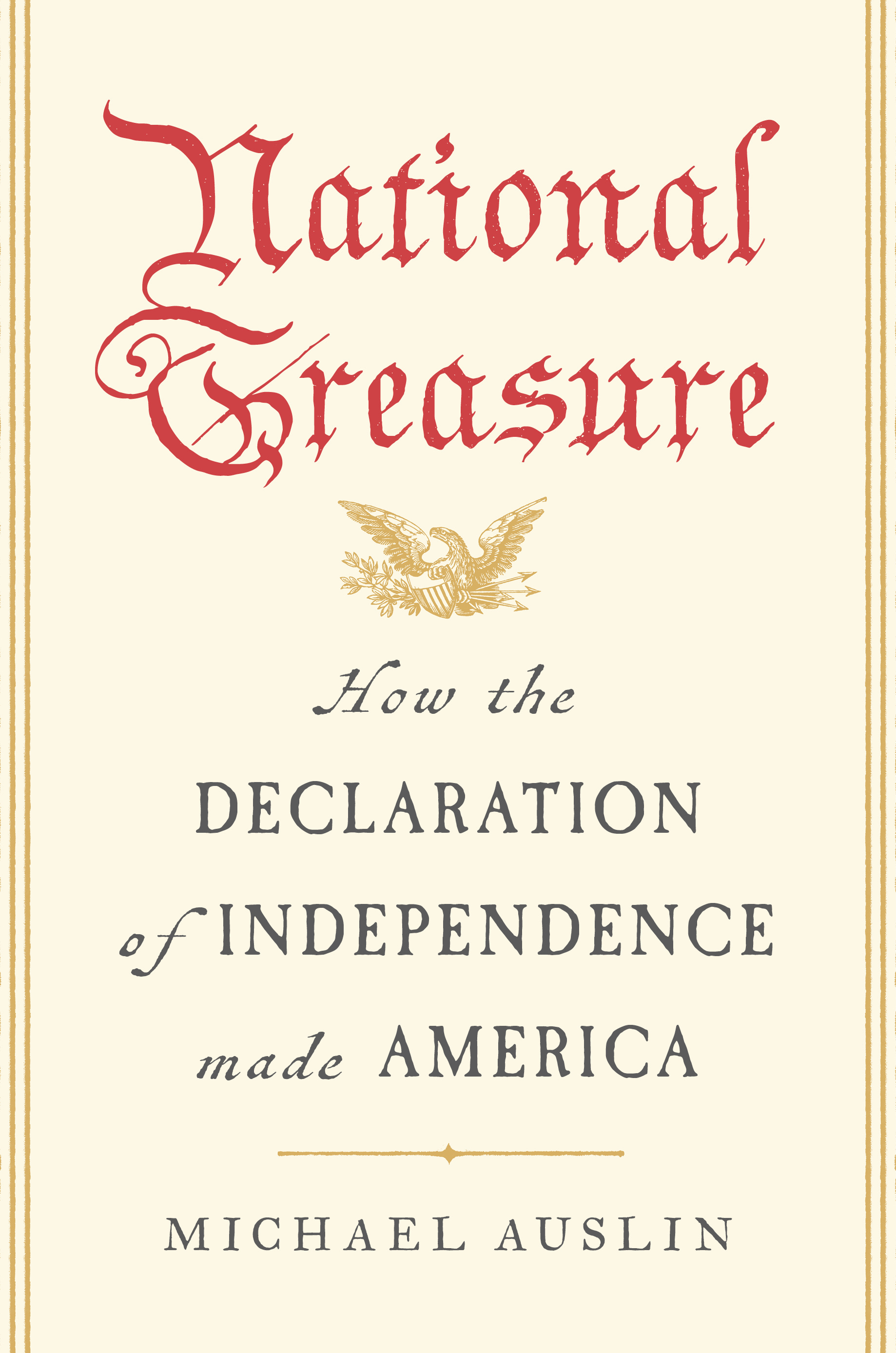
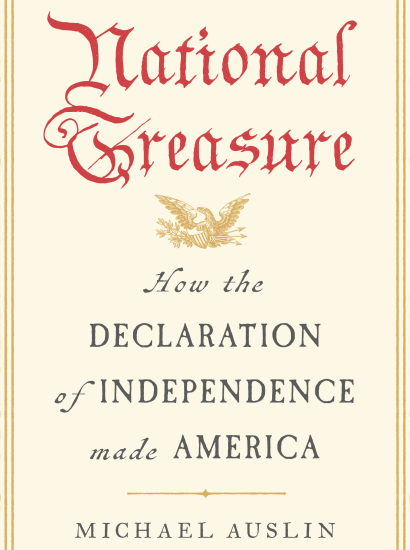
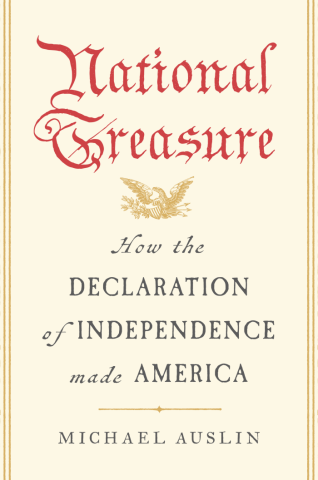
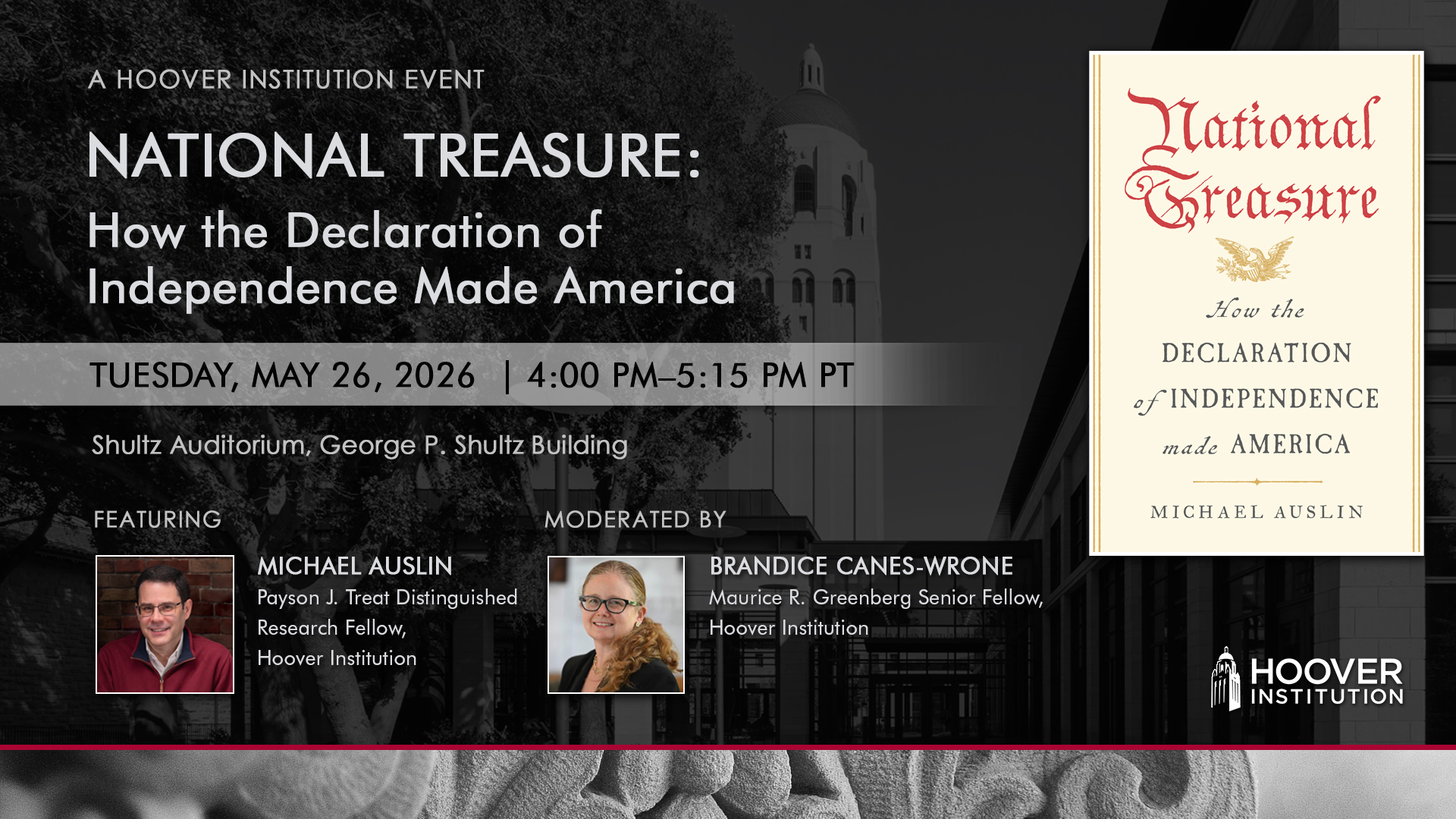

The Hoover's History Lab and Center for Revitalizing American Institutions held National Treasure: How the Declaration of Independence Made America, a special book launch with the author, Michael Auslin on Tuesday, May 26, 2026 from 4:00 - 5:15 p.m. PT.
The inspiring story of the Declaration of Independence —the first to take us from its drafting by Thomas Jefferson to today— charts the many lives of a document that captures the soul of America on the 250th anniversary of the country’s founding.
An award-winning historian, Michael Auslin takes us from the boarding house in Philadelphia where Jefferson put quill to paper to the Declaration’s covert signing and its long, harrowing, and ultimately hallowed afterlife. We follow the parchment as it is hauled out of a soon-to-be-burning Washington in 1814 and see it hidden in a dank cellar, posted in classrooms, printed on handkerchiefs, and used to sell insurance and bundle coal. Through it all, Jefferson’s words have inspired implausibly varied causes, from suffragists and civil rights leaders to groups waging war on the US government. As Jefferson had hoped, the principles enshrined in the Declaration became a beacon to the world. But what lessons should we take from it today? Can this statement of ideals in whose name the signers pledged their lives and sacred honor bring a disparate nation together? As we gather to celebrate the 250th anniversary of the founders’ bold experiment in democracy, Auslin reminds us that this enduring document was not just a call for freedom and equality but an eloquent statement of the principles that bind us together.
- Welcome to the Hoover Institution. My name is Joseph Ledford. I'm a Hoover fellow and the assistant director of the Hoover History Lab. Under the leadership of the director, Stephen Kotkin, the Hoover History Lab functions as a hub for research on consequential history and pursues a host of initiatives all aimed to bring the study of the past to bear on contemporary policy issues with over 40 fellows involved, ranging from the most senior distinguished historians in the nation. Like our speaker today, to the Rising Superstar next generation scholars of brilliant student fellows. We have the most phenomenal group in the world applying historical reasoning to policy challenges. Today we are proud to co-sponsor this book Launch for Michael Oslan with the Center for Revitalizing American Institutions, Hoover's, RAI was established to examine the causes of declining public trust in American institutions. Assess how these institutions are functioning in practice and develop policy recommendations to strengthen both their effectiveness and public legitimacy. As Hoover's first ever center, RAI reflects one of the institution's founding principles, ideas, advancing freedom, working in an objective non-partisan spirit, RAI draws on Hoover scholarship, government experience and convening power to study governing institutions at the federal, state, and local levels. The non-governmental institutions that sustain our democratic practice and the responsibilities of democratic citizenship, particularly through its commitments to public opinion, research and civic education. Together we have invited a historian that unites the mission of both HHL and RAI. Our speaker today is Michael Oslan. He is the Payson J Treat Distinguished research fellow here at the Hoover Institution. He was previously a professor of history at Yale University For many years, Michael has been a distinguished visiting scholar at the Library of Congress, John w Kluge Center, where he completed the book that you will hear about shortly, national Treasure, how the Declaration of Independence made America, the Royal Historical Society, elected him as a fellow in 2018. And he is the American Heritage Partners Fellow at the Society of Cincinnati's American Revolution Institute. And he's a senior fellow at the Foreign Policy Research Institute. Among his many, many honors is being named a Fulbright Scholar, a German Marshall Fund, Marshall Memorial Scholar, and a young global leader of the World Economic Forum. He's the author of four previous books, and notably, he writes a Substack, the Potoma packet of Washington, DC and American History, which I encourage you very much to read right after this event actually. And moderating the conversation today with Michael is the founding director of Hoover Center for Revitalizing American Institutions. Brandis Kanes Rome. In addition to directing REI, Brandis is the Maurice r Greenberg Senior Fellow here at the Hoover Institution, and a professor of political science at Stanford University. Ladies and gentlemen, please join me in welcoming Michael back from the swamp to Hoover.
- So, Michael, I I've already told you that I enjoyed this book just enormously and so let's get through as many questions as we can since there's a lot to dive into. So it's our 250th anniversary, as I'm sure everyone in this room knows of our founding and the Declaration of Independence. So very timely book, and it begins at the writing of the declaration. So the book gets into why founders such as Jefferson, Adams, Franklin, and others believed a written Declaration of Independence was needed, what it signified and why it was important to bring the document to the people, not just sticking George, but very importantly to the colonists. Can you say a bit about that?
- Sure. Well, first Brandis, thank you. Thank you for having me, Joseph. Thank you for having me. It's, it's great to be back. I don't think I've, I, I shouldn't say this publicly probably 'cause the bosses are listening, but I don't think I've been back at Hoover for about two years doing this book. But now it, it's great to be back and, and I can tell you from the DC perspective where I live, the work of RAI, the work of HHL is so vastly needed out there to, to give people perspective and understanding. And I really, I really appreciate, you know, being part of it. One quick caveat, I apologize if I cough or my wheeze or my voice gives out. The, the punishment for doing the book is the worst season of allergies I've ever had. So, as I've been on the road continuously since we launched earlier this month, it's, it's caught up with me. So I apologize for that. So, onto the questions, and I will try to do what I don't usually do, which is answer too long on all of them. The, the thing that interested me the most about the declaration is I, I, I came to it knowing very little to be, to be quite frank. And, and so it was a voyage of discovery the entire way through. And, and, and it turned out to be a voyage of discovery over nearly 250 years of American history. So there was a lot that it was a, you know, a bit of a rollercoaster and, and every different point was something that I, I, I either didn't know or didn't appreciate. One of them in the very beginning was that this, this totemic document that I first saw as I opened the book, you know, when I was a young, very young child visiting Washington DC and for those of you old enough, if you went to see it before they changed the rotunda in 2001 of the national archives, remember it was up on the back wall in the case, you know, with the eagle on top. It was like the 10 Commandments, which, which some people had problem with. We can talk about that. But so you think this was the moment, this was it. And what I discovered is that one of the reasons that they wrote it and printed it and disseminated it is because it really wasn't, it, what really was it was that we were losing the war and we needed aid, particularly from France and Spain, Dutch, whoever was gonna give us money and arms and the like. But you couldn't ask for that if all you wanted to do was become a part of Britain again, you could easily become a part of Britain. Again, to paraphrase Ronald Reagan, right? Lose surrender. So that, that would've been very easy. So you, you're declaring independence because it was a, it was a step, it was an instrumental step to getting what you needed to win this war. And so when they, June 11th, will Mark, I'm actually doing an event at the National Archives in DC I'm very excited about on June 11th, that marks the 250th anniversary of the day that the Committee of five was commissioned to draft what became the declaration. But there were two other committees that were commissioned that day too. One was to prepare a model treaty for relations with foreign nations, IE to get this aid. And the second was, of course, if you're gonna be an independent nation, you're gonna have to govern yourselves in some way, even 13 sovereign states. So a committee to form articles of Confederation. The point being that the declaration, it wasn't that it wasn't important, but it was a needed step. And we also think, and I I love this, I talk about a little bit in the book, you know, we have these heroic, and I think the images are very important. The myths are important. We have this heroic image of Jefferson struggling by candlelight to write the declaration and bring forth the greatest thoughts ever written, which in many ways they were, that's not the reality. Of course, Jefferson wrote it very quickly in the space of a, a week to 10 days. He was on four other committees at the same time. It's not like life stopped because the declaration had to be written. So this was an administrative task. It, it had to be put out to the people because the people had to know now what was going on, why they were fighting and, and, and losing, and that they, they needed to now choose sides because many of them were not supportive much later in life. John Adams said, you know, at the time of the, of independence, a third were in favor. A third, the loyalists were opposed. And in good American fashion, a third had no opinion whatsoever. Whatever happened, they were fine with it, right? So you needed to encourage, the loyalists encouraged the Patriots, you needed to sway the undecided and maybe convince some of the loyalists of whom there were tens and tens of thousands to come to come on board. And that's why this was written out. It was a huge compromise as I, as I talk about, and then printed up very quickly that night at the, the Shop of John, John Dunlap, maybe 200 copies or so, and sent out through the colonies so that people would hear about it and know what was going on. So to them, this was, you know, they didn't focus on the preamble, the things that we focus on today. If anything, they focused on the justification, the 27 charges against King George. That's what really got their, their ire up. But, but this was for Congress. This was one of dozens of things. It was doing. It wasn't like they stopped and bowed down to the document and, you know, said, we're gonna, we're gonna enshrine it. They didn't even think to engross it that, you know, write it in a big hand permanently on Parchment, what is today in the National Archives until weeks later. And they didn't start signing that, not on July 4th, but until sometime in August, August 2nd, probably. And that took weeks. So the, the myths we made about it, which were critical and important, and I think we should celebrate those also, there was a reality, this was the midst of a losing war. And there was a lot to do.
- And one thing you talk about, you know, we tend to, or at least I'll confess, I tended to learn in my K through 12 classes, you know, of the declaration a a bit in isolation and not in relationship to the other documents. I mean, how original did Jefferson think of the claims that were being made? That's something the book goes into.
- Oh, if I may, channel John Adams and, and Richard Henry Lee, not at all. And that was a fight much later in life. One, a judgment with which Jefferson himself concurred. And, and, and also, if I may say the only reason that, that they even got into this argument, IE who wrote the declaration, whose words and ideas were they was because by the, the second decade of the 19th century, the declaration was taking on a life that it did not have in the first decades. You know, 1776 on, look, it did its job on July 4th, 1776 and after, and of course, you know, the vote for Independence is July 2nd. That was the day John Adams thought would be the Great Dane, July 4th, somebody we don't know who decided to put at the top of the first printing by John Dunlap in Congress July 4th, 1776. So all of a sudden it becomes July 4th, whereas everyone, you know, John Adams and these other folks thought it would be July 2nd. But by the second part of the 19th century, after decades of neglect, decades, where people really quoted the declaration very, very little, they, they celebrated independence. But if you look back at the newspapers and, and the, the reminiscences of, of what Independence Day became very little on the declaration itself. Occasionally it would come up, but after the war of 1812, it becomes a much bigger thing, which we can talk about. And so they get into an argument, whose words were they? And Adam says, there was, there's nothing original in it, nothing that hadn't been hackneyed about for, for two years prior and was written in Boston. And, and of course George Mason's, Virginia Bill of Rights. And, and, and of course John Locke. And that was Richard Henry Lee's argument. It's basically a restatement of the second treatise. And this is done by letter, of course it's not in public. And Jefferson's replying to James Mass and he says, you know, they're right. It wasn't my job to come up with something new. If I had come up with something new, he doesn't say this, but if he had come up with something new, it would've been unfamiliar and people would've started arguing about that. He had to take what he called an expression of the American mind, things that the colonists had been saying in colonial assemblies in the pulpits, rabbel rousers like Sam Adams and Tom Payne in the streets, and the Pam Flers, and put it into a form that crystallized what Americans had been arguing about low this decade, decade plus. But the genius of his words, the genius of his phrasing, even as edited as it was, and well-edited by Congress as Pauline Mayer and, and others have written about, means that I think we can call it Jefferson's document. But it was something that into which he poured the soul of America as a much later scholar said,
- Thanks, thanks Misha. And I hope everyone will, excuse me. I'll sometimes say, Misha, which is what Michael often goes by. And he said, I'm allowed to do that. So you mentioned briefly in, in your remarks that, you know, it starts to kind of take off in the 18 hundreds, sort of goes from being a document that of course they're trying to publicize. And some of that story you could say, it's a very Hoover esque story in this part is about American business and business men as they are at the time trying to make money off of declaration memorabilia. Could you say a bit about how that contributes to Yeah. The culture of the declaration in, in American society?
- Sure. So the, the, the backstory is, I mean, it's not like these things were charted and people understood exactly what was happening. So they're, they're, you know, they're looking at it the way we would look at it today. But first, when you go to the National Archives and you look at the parchment, almost no Americans knew that existed in the first four decades of American history because it was a state paper, it was a property of Congress, it was rolled up, it was kept with the papers of Congress went where Congress went shoved into attics when Congress and, and then later the State Department was in temporary buildings. So it becomes, it becomes a, a, a, it's a state paper for Congress until 1789. And then when the federal government set up, it becomes the property of the Department of State. Ironically, the first Secretary of State is Thomas Jefferson. So he's now the custodian of his own creation. After the British Burn Washington and the Parchment declaration along with the constitution, journals of continental Congress and, and other important papers are in the nick of time saved, but less than 24 hours, they're saved from incineration because the State Department next to the White House goes up in flames with the White House. The story gets out and people start saying, that's great, it survived. And they say what survived? They didn't know there was this, this parchment. So the, the, the story comes out, you know, it's Dolly Madison saved it, which is of course a myth that's that's created later. It's actually a state department clerk. But it's, it's tied together with this resurgence of American patriotism that for the second time in a generation we've defeated the greatest empire on earth. We are a viable country. We're a going concern. You know, we, we, and what's beginning to happen in, in, you know, France, obviously 1789, but other nations following on the heels of this Latin America, different independence movements, the inspiration partly of our declaration, it begins to take on this new important life of its own. And in a wonderful marriage of civics and commerce, some Americans decide we can educate the people about this document. They knew what the document was, right? It had been printed newspapers, not that the declaration itself was, was unknown, but that there was this formal copy of it was un was largely unknown. And so they came up with artistic reproductions. They called them facsimiles. They really weren't, they traced the signatures very carefully. But if you look at the first couple of, of reproductions, the, the, the text is nothing like the text of, of the actual document, but these begin to be very popular sellers. And there's knockoffs and there's pirating. It's, it's this cutthroat American business world. And, but, but they, they advertise and do subscriptions for these saying, you know, put this on your wall. This is your, this is your birthright of freedom. They, they truly, I, I believe they truly meant it, but they also figured out a way to make money off of it, as did John Trumble, who comes up with this very famous scene in the Rotunda. It's in the paintings in the Rotunda. And the Ale Art Gallery paints two of them of the presentation of the declaration draft to Congress. It's not the voting, everyone thinks it's the voting, but, but you know, Jefferson's in the middle. 'cause it's Jefferson's idea to paint the portrait, of course. And, and, and this becomes same thing, sell subscriptions, cheap knockoffs, very high quality prints. It becomes, it, it becomes part of American political life in a way it hadn't before. I would argue and, and popular culture. And I think the real, if I would chart one transformative moment in, in the history of ideas around the declaration, it's July 4th, 1820 ones, 45th anniversary. The actual, original parchment is taken from the State Department carried to Congress. The galleries are opened. I have the vignette in the book. And John Quincy Adams, secretary of State, soon to be president, reads the parchment and then gives his famous, we go not abroad in mon in search of monsters to destroy speech. One of the most important speeches on foreign policy in American history. But the part that no one talks about is that he also, for the first time at least, that I, that I really discovered and, and I think the first time at such a high level, explicitly links the declaration to our constitutional order and, and, and does so in a public way to say, this is the font of of our ordered system of liberty. And, and that then begins to grow and takes off through the 19th centuries that you now have people thinking more and thinking ultimately as abolition is beginning to tick up the abolition movement, as women's rights movement is beginning to tick up, pe people are now looking back into the document and they're not focusing on the charges anymore. They're now focusing on what we call the preamble. They're focusing on the, the, the great statements that begin to change the world in ways that we today take for granted. But for them were, I would argue were were newer departures of interpreting what our founding document meant. It went from being a liberty document, in which when it was often referenced, it was our, our great Instrument of Liberty, for example, it would be called on July 4th to being what ultimately was apotheosized by Abraham Lincoln as our great equality document. And in many ways, that's how we've thought of it since.
- Yeah. Misha, building on that, I mean, the book does a nice job of going into the ways in which the declaration has been interpreted differently by various groups in across US history as you trace the history of the document itself. And so you have this juxtaposition between the dec declaration that actually ultimately is passed and then signed, as you know, later, and a clause that gets removed that Jefferson had wanted in about slavery. And then the document comes back in the Civil War with competing interpretations, right by Lincoln, by the Abolition movement and by Confederate. So maybe you could say a bit about both the earlier document, the clause that gets removed, that debate, and then its role in, in the Civil War and those interpretations.
- Yeah. As, as many scholars have, have looked at the, the, the drafting and then editing of the document is a fascinating process. Julian Boyd, the Princeton Scholar, spent good chunks of his career tracing this. Oh, and by the way, if you go to wa, and I hardly recommend it, if you go to Washington starting July 3rd, Jefferson's handwritten hand edited draft will be on display at the Library of Congress for the first time since the bicentennial. So first time in 50 years, I, I don't think it's been out since then. I asked and didn't get a good answer, but I don't think it's been publicly displayed so that we know what he wrote in part because he was so incensed at the edits that Congress did to his draft, that he wrote out other copies of his draft and sent it to different people. James Madison got a copy different, there's about six of them. And John Adams actually took a very early version of the draft and hand wrote his own copy of it. That's in the Massachusetts Historical Society. That's really important 'cause it's probably the, the, the closest to the er text what Jefferson originally wrote in which he then began changing. And this part of the fascination with the document, we don't know who made many of the changes. When you look at what Jefferson drafted and what we have today, nobody kept records. So for example, the, the entire two day debate in Congress, July 3rd and fourth, or really sort of second, once they voted independence, they went immediately went into the draft, all of the third and most likely finished it early up on the early on the fourth, no record of who said what the Committee of five did stuff to it. We don't know Jefferson annotated that draft later. We don't know how accurate he was. So one of the most important changes, now I'll get to your thing in just a sec, was in the very first line, when in the course of human events, it becomes necessary for a people, a people. Jefferson writes a people somebody, many like to think it was Franklin. And there's evidence to think it, it was, but somebody changes that to one people. I think that's a critical change. That's why I call this our great unity document. Because even though they were writing it as representatives of 13 sovereign states, the very first line they changed to one people. We may live in 13 different colonies soon to be states, but we are one people. And then there's all these other changes. Well, the two biggest ones of course, that were taken out by Congress. This we know were taken out by Congress. 'cause we have the draft that, basically the draft that Jefferson gave Congress one was a, an intemperate aum attack on the British people. And of course you had tens of thousands of loyalists. You had people looking down the line saying, you know, these will still be in some ways our brethren Jefferson wrote a very vicious attack on them that was taken out. And then the famous one is a condemnation of the slave trade, not slavery per se, but of the slave trade laying it at the door of King George ii. And of course, Jefferson had tried to get the slave trade banned in Virginia, felt that if you ended the trade, you would end slavery. And that, of course was taken out primarily at Southern. But I think there were northern mercantile interests, but southern agrarian interests, it was the first deal with the devil. And it was the first can kick down the road. But it was one of those compromises that were made and compromises that didn't lead to the sunder of the nascent union. Jefferson didn't walk out of Congress, you know, didn't say everyone should be recalled and replaced. You know, he, he, he accepted it un unhappily. So, but he accepted it. The, the question of this then phrase that gets picked up later, all men are created equal, which was in a particular 18th century context of English rights, but is still debated today. Why didn't they then just say, all Englishmen are created equal, or all property owning white Englishmen are created equal no Jefferson rights and Congress keeps all men are created equal. So does that mean women, does it mean blacks? Does it mean Indians? Who, who does it mean? And there's still debates over this that, that go on today. But as we move into the Civil War period, and for, you know, a, a good couple of decades before that, this is what abolitionists and, and ultimately Abraham Lincoln are fastening on this question of equality. And it's, it's not that the, if you wanna call it the hypocrisy of a statement proclaiming equality and proclaiming liberty while denying it to hundreds of thousands of slaves in America was unknown. Of course it was understood and known and lamented by people like Jefferson, by people like George Mason, by Richard Henry Lee and others, and abroad, you know, Samuel Johnson gives his famous quote on it, which I include in the book. But as we get into that 19th century period, it now becomes an argument over the illegitimacy of the system persisting this long. And that's really what Lincoln's ultimate argument is, is that decisions like the Kansas Nebraska Act of 1854, which Stephen Douglas interprets as well, that's popular sovereignty if you vote for slavery, slavery's, okay? 'cause that's consent of the governed and that's popular sovereignty plus the 1857 Dr. Scott Civil Supreme Court decision, which goes beyond the merits of the case to say that no blacks are not, not, are not only not citizens, they are property, you know, sort of in instantiating the idea of chat chattel slavery at the highest level to this, to Lincoln. These are deformation, unacceptable deformations of what the intent of the document was. And there are still historical debates, if you're familiar on the conservative side of things with the Claremont School and Harry Jaffa, his first book, A House divided very famous book, really argued that Lincoln completely reinterpreted the declaration, extraordinarily important book from from from that perspective, Lincoln reinterpreted what Jefferson was writing and reinterpreted the declaration for all time. His last book, A New Birth of Freedom, which was written almost half century later, recast that and said, no, that's what Jefferson meant. And Lincoln was simply carrying through the logical thread. So we're still debating what they meant to me as, as a, you know, sort of nuts and bolts historian. It's, it's, it's simply looking at this to say that by that time, this was the interpretation that was now breaking through all that encrustation. But that was one side. And very briefly, as you pointed out, there was another side, I was having a, I was telling a, a very well-known major media, former media figure when I was writing the book. We were at one of these Washington things. And, and so I said, oh, I'm writing a book on the Declaration of Independence. And he said, oh, that's great. He said, boy, the Confederates, they hated the declaration. And I said, not exactly they hated part of it, but they based their entire justification for secession on the consent of the governed. And they weren't wrong to do. So up until Lincoln, up until that moment, that was what really was understood as the most important part of the document. Consent of the government makes government legitimate. And if you don't have that, then government should be changed. And there were even northern newspapers, as I quote in the book, that accepted that argument up to the Civil War. They said the South has to do it peacefully, which there was the, the rub, right? 'cause Lincoln wouldn't allow that and it wasn't gonna happen peacefully, but even they accepted that the South isn't wrong to say it's consent of the governed. So if they don't consent, I guess they can go, right? We were at that moment of the most fundamental re-understanding of what this document meant. Is it union or is it sort of radical sovereignty? And through the war, Jefferson Davis, Alexander Stevens, and they even have differences between themselves as to whether the document is right to say all men are created equal, in which case we don't agree with that, or the document never meant to say all men are created equal. So we we will continue with our system. They're, they're fighting over these, these interpretations. And you know, again, from the, just the nuts and bolts historical perspective, if the South had won, we obviously, we don't know what would've happened in the long run, but that interpretation would have to some degree been justified by the fact of the historical fact of winning as it was that interpretation, the South's entire understanding of the document was refuted, bloodily and thoroughly. And I, I find it in some ways, you know, it's a tragedy. It is our greatest tragedy, of course, in our history, but it, it's a tragedy in that the, the, the south, you know, in Vir, I I live in Virginia now Virginia, you know, the, the cradle of the revolution in some ways. And the first presidents and the like, had to come to a completely different understanding of and acceptance of the document that had guided them in ways that we absolutely consider immoral and wrong, but we can't deny what their, I guess we call it today. The lived experience was that was the lived experience. And it was, it was profoundly, you know, cataclysmically shattered at that moment. And I think we can't, we can't dismiss what that meant in terms of, of the future of trying to reit the nation, which I ironically the declaration was used to do. So at the centennial, when I talk about the centennial and the like,
- Misha, in addition to tracing the intellectual history of the document, as, as you've just been describing here, your book also does this terrific job of tracing the actual history of the physical document and the Civil War plays into that. So some of the history is new, right? Due to recently dig digitized local newspapers and guide guidebooks to Washington DC I thought that was, you know, as a, you know, kind of nerdy scholar, a really interesting part of the book, and how how have some of those newly digitized documents potentially at least changed our thinking about what happened to the document during the Civil War.
- Yeah, thank you. So I, not that I want to give it all away, but I think we have copies anyway, so it's not like you won't read it now, you're gonna get copies on the outside. It, it's, I'm just trying to figure out how to phrase it, because when I was doing it, it was so fascinating to me and consuming. And then you step back and you're like, okay, this is a part of the story. But I do think it's an important part of the story. I started off this project because I stumbled on it at the National Archives doing something different. And when you start at the National Archives, you, you're focused on the physical parchment and it's survival and its con conservation and its preservation. And that's what the incredible conservationists and archivists do there. And, and they have their own histories of all of this. You know, the, the, the, you know, it was in the Library of Congress after the State Department. It was in the patent office before that. I'm gonna get to that then it was in the, the archives. And so they have all these histories and as you're reading it, they all with just, you know, how would you put it just without, without going into it or, or talking about it. And, and when you're learning something new, you know, not having spent my whole life doing it, when you're learning something new, things leap out at you maybe because you, you're not taking them for granted every single account official or otherwise, of the declaration states without reservation that the Declaration of Independence hung in the patent office from 1841 when Daniel Webster sent it there to 1876 when it was taken up to Philadelphia for the Centennial Exposition without, without any hesitation whatsoever, without any qualification. But now I'm doing the Civil War chapter, and if there's one thing you know of, you know, of the Civil War and certainly living there, it's that Washington was a frontline city, right? Virginia's across the river, across the river every day. Washington was a sympathizer city. It was filled with southern sympathizer. It was actually sandwiched between two slave owning southern states, one of which was forced to stay in the Union, Maryland, and one which not only seceded, but became the capital of the Confederacy. And you read the newspapers and there's one overwhelming feeling in the first months of the Civil War. And that is invasion is coming from the southern newspapers and northern newspapers, everyone expected invasion. So you've got a city where there's spies, saboteurs, sympathizers, they're expecting an invasion any day they're routed at bull run, which now the gates are open. And it just seemed to me it was odd that the most important document to Abraham Lincoln, the one that he himself said, he never had a political feeling that did not emanate from this document that he built his entire political philosophy around that he called the apple of gold around which the silver frame of the constitution was made to protect the apple would be left unguarded in a building that had been turned into a military hospital, which was ransacked by union troops while they were there using it as barracks during the totality of the Civil War. And no one had ever thought to even ask the question. Now if all you care about is the thoughts, which is very important, don't get me wrong, most of my colleagues have looked at the great thoughts, which are important, critically important. But if all you care about is the thoughts, you don't really focus on the parchment. But if you're a conservatory, you focus on the parchment. And that's what I was picking up from them. But even they had never asked the question, it just seems strange to me that in a city where just 50 years before, large parts of it had been burned to the ground, that they wouldn't have done something to protect the documents. So I started trying to find out what could have happened. Did they really leave it hanging on a wall through the greatest struggle? And one where the confederates actually did invade Maryland, Fort Stevens, and they were just a few miles from, from the White House. And this is where I changed, and I don't, I have to look in the book, I don't know if I gave as much acknowledgement as I should when I was trained back in the nineties, not a lot was digitized. So you had to go to the archives and I thought always that digitization, not AI that didn't exist, but digitization was a bit of a cheat. You know, you had to get in there and get dusty and get allergies and the like to look through the documents and they crumble and you get yelled at. But the digitization is extraordinary. So much is online now. Things that people have not looked at since they were probably printed that day. Obscure newspapers, as you said, periodicals accounts and the like, and you can find it all pretty easily. So I started digging through and lo and behold, I found evidence that I did, I called it maybe not a smoking gun, but evidence Sure. That just after Bull Run, because people are talking about the declaration there just before Bull Run and just after Bull Run, people are talking about the patent office and not mentioning the declaration, which seemed odd to me because for 20 years people had always talked about the declaration in the patent office, every account that something had to have happened. And sure enough, the evidence that I found said that it was secretly moved from the patent office right after Bull Run and brought back to the, what they called the executive square, the White House Complex, where the rebuilt State Department was and kept under guard there. And it doesn't change history, but it just seemed to me that it was odd that no one, I mean, how much has been written on the Civil War? Like I didn't read about Civil War forever. 'cause it's, it's a, you never get out of it if you go into it. Right? And no one had ever even thought to ask the question, despite all the histories of Washington, wonderful histories of Washington in the Civil War. And I was really happy to find evidence. But I think it is part of this bigger picture when you understand how much the declaration meant to Lincoln. And I guess it's good if an, if an author gets a little emotional at his own writing or I don't know what it says, but you know, Lincoln, on his way to Washington to his inauguration in February of 1861, it's, it's all in the book Stops at the, at Independence Hall, gives a speech. And he, that's where he says, I've never had an idea, a political idea that didn't emanate from the declaration. And then he says, near the end of his speech, he says, and I was about to say, I would rather be assassinated than surrender these principles. When you understand how important the declaration was to him, the idea that he's just gonna leave it unguarded, hanging on a wall in a military hospital, also used as a barracks when they know the city's filled with sympathizers and spies takes away to me from the glory of this document and, and how in, in a way human it, its life was. And I was just sort of happy to have found that and at least put forward for the readers this alternate explanation because it fits in so perfectly with Lincoln and, and what it meant to him and what he did, and ultimately what he did surrender his life for
- Isha. The book describes you and you just described a bit about the different homes that the Declaration has had over the years. The Parchman has had, we can't do every, we wanna get to questions. Yeah. We can't go through all the different homes. Yeah. But we do, it ends up in the archives Yes. Where you're gonna be giving a talk, as you mentioned. Yeah. Can't wait in a few. How, how does it end up in the archives? What are some of the protective measures
- Ooh.
- That are there in case Washington's attack today?
- I can't tell you 'cause I'll have to Okay. So very briefly, there's, there's one word the i I will just quickly say. So when Daniel sends it there in 1841 to the old patent office, that's the National Portrait Gallery today. So if you go to the National Portrait Gallery, go upstairs to the second gallery or second floor gallery, that's where it was in the sunshine, more or less. That's 1841. It does go up to Philadelphia. Think it goes back to the White House, goes back to the patent office, goes to Philadelphia in 1876, but then it goes to what is today the Eisenhower Executive Office building. That's in 1876, basically taken away from the public. 1921, it goes to the Library of Congress, 1952. It goes to the National Archives for, and the explanation for all of those moves is one word fire. At each stage, each new building was considered more fireproof and a better place to keep the document. And that's in each of the explanations. Daniel Webster writes it, there's a new fireproof building, the, the old patent office, which by the way, burns just a few months after the declaration is moved. Then it goes to, as I said, ultimately it goes to the State Department. When Charles Evans Hughes transfers it to the Library of Congress, it goes to state barn because that's the newest, biggest building, Eisenhower fireproof. Then when Charles Evans Hughes transferred in 1921, he says, the Library of Congress has more fireproof and then 1952, and there's a very particular type of fire. They're worried about atomic fire. And so it goes to the National archives because it is both a sturdier building. And of course in World War ii, it was taken outta the library. Another story that not as many people know, it was secretly taken out and rushed undercover of night under armed guard to Fort Knox because that was in the, it it was done, sorry, the day after Christmas, 19 41, 3 weeks after Pearl Harbor. And if you read the newspapers at the time, they're talking about these new giant Nazi bombers and the Nazis are gonna take over the Azores and if they take over the Azores, they're gonna be able to fly to Washington. And they had already done studies based on the blitz and what was happening in Europe, looking at how the bombs were falling in the like. And they said the Library of Congress and it was on an exterior wall, will not be able to survive. So they took it along with the Constitution of Magna Carta, which we were holding for the British brought it to Fort Knox, 1952, comes back in 19 44, 19 52. It's the fear of atomic war. So what do they do? Obviously the building's not gonna survive an atomic attack. And so if you're old enough, you may have seen the model. They build the famous mosler vault right underneath, and you can still see the model. They still have it. There's actually online stuff. I couldn't put it in the book, but you can actually see some online stuff every night. Because there, there one piece, if you remember the old way the declaration was here and the constitution was here. Not the whole constitution, it wasn't a big enough case. And every night the whole thing they were actually connected would drop down into this concrete vault with steel doors and close over it. And, and I find it a, a wonderful Cold War analogy. We're using this as, I call it the Cold War icon, freedom, you know, the antithesis of communism before that. The antithesis of, of, of, of fascism and totalitarianism. And yet we have to hide it every night. You know, it has to go down for safekeeping. The one thing I didn't find, by the way that I I, I asked everyone at the archives, they could find no record. I still wanna search, even though the book's out second edition was whether they lowered it into the vault during the Cuban Missile Crisis. I'll bet they did. But no one, there was no record of it done. And the other time they would've lowered in is the vault, of course would've been nine 11. But by then it was already gone. You know, because you had all those reports of a fourth plane coming into Washington, they don't know where it's coming. I'm positive. And by the way, it's interesting, the archivist has that authority. It doesn't have to ask the president or anyone else, he or she gets to hit the button, but it was already in College Park, Maryland at Archives two because they were redoing it when they redid it. If you go today, and there's a picture in the book, the Declar, the Constitution is now in the middle, all four leaves in great shape. On the right is the Bill of Rights. And on the left almost looks a little forlorned to me, is the declaration. I've asked them to put flag stands next to them. I'm really gonna follow up. I, you know, gotta do something, draw attention to it. And there is a new vault system. They actually did tell me a, a little bit about it. So, but I, I can't say, but it is different from what it was. But it is still vaulted every night. And, and it's, you know, it is this interesting, you know, we, we think of it as immobile and we think of it as as, as, as, as you know, timeless and stationary. But it has had this life of adventure. And even every night it still goes into its vault.
- One final question before we open it up to all of you and your great questions. So how do you think the document shapes our culture today on our 250th anniversary? And what would you like Americans to think about in terms of the declaration on this important anniversary?
- A very RAI question. I think it's important at one level, it's just a simple historian saying, you know, this book, the reason I wrote the book, honestly, I wanted to read this book. And it didn't exist. It doesn't mean there hasn't been lots of great stuff written about the declaration. There has been, but there was no soup to nuts, A to Z history, a complete history of the declaration from 1776 to the 21st century. Nor one that, pardon me, combined the, you know, I talk about three declarations, the relic that we've been talking about, the symbol, the ideas that we talked about, and the, the cultural object. No one really combined to a sort of complete American engagement with the document. And that's why I wrote the book. So on the one hand, I just want people to read it to at least when I was growing up and you put those crinkly copies on your wall, and I actually found the company that discovered that process that's in the book. That is, you know, it, it, it is our patrimony. And we've been doing things like that, putting it on the wall for 200 years since those first reproductions came out. And so I just want people to know the whole history and in a way, to fall in love with it again, the, maybe the way we did as kids or as certainly as I did as a kid. That's number one. Number two, to dispel the myths. Not to, not to, not to erase them, but to dispel them, to put them into a context of what really was going on and why the myths are important. I like the myths. I think people's need myths, you know, in some ways, but you also have to understand what the reality is. So that's one reason. And then as, as I try to describe it, if there is a new, you know, sort of theoretical aspect, I wouldn't call it theoretical, but you know, as I said, you know, the, the two great claims are, it's a, it's a liberty claim and inequality claim within the document and how those have been exercised and developed. We talked about it in our history, I believe over it, an umbrella is a unity claim. I talked a little bit about that. The one people, it's also why Jefferson wrote, we hold these truths to be self-evident. Not me, not the congress, we, the American people. He was helping call into being hold these truths to be self-evident and why the founders pledge to each other, their lives, their fortunes and their sacred honor. Not to the new country, not to the the states that they were representing, but to each other. It is, I believe, our great unity document. I believe it can be read that way. And I believe they were thinking clearly of it in that way along with all the other things that they were thinking about liberty and equality and charges and the like. And I'd like Americans to read it that way. I, I, I think, you know, we talk a lot about civic friendship these days. You know, it's an ancient concept. It goes back to Aristotle. We talk about why, why, you know, are politicians at each other's throats. Why can't we have Ronald Reagan and Tip O'Neill having a beer after work? Why are we calling for, you know, maximum warfare, calling people traitors or all sorts of things going on. We have all of this happening. The founders truly idealistic, but realistic men, ambitious vain, brilliant acerbic. And you know, I think they, they didn't expect us necessarily to love each other, but I think they understood we couldn't hate each other and survive as a nation. And I think they wrote their document in that way when a third of Americans were loyalists and were opposed to this. I'd like us to reread it as a unity document. Doesn't mean equality and liberty aren't important. What appeals to me today in my lifetime is that it's a unity document. It always has been in some ways. And that's what I hope people read it as and understand that our terrible times and our great times, we've had to go through it. 'cause we're all here together. And if people think you can go through it somehow not together, then we will simply relive our terrible times.
- Thanks so much for sharing these important thoughts about this. As I said, terrific book. So we wanna give, yeah. So I've had my crack at questions and we wanna give the rest of the time to you. Yes. In the back.
- Thank you so much. As an internalized American, I love the presentation and I gave up my former Spanish citizenship, so I'm really happy about this thing. So question for you. What are your thoughts about the King of Britain? So the descendant of the guy, this document was addressed to, given a address to Congress and nobody kind of opposing among the representatives of the general people in the sense that, have we lost the sense that this document was about an independence of a certain country? And even though we serve the culture, you know, having the king giving a speech in the Congress is kind of a weird thing.
- Oh, you mean King Charles?
- Yes.
- I think, you know, it's, it's an, I think it's great. It's an ironic thing in some ways certainly would be to them, you know, I mean, no, Charles, let's, let's be clear. George the third would've loved to have spoken before Congress. 'cause that means he would've won and he would've called them all there before executing them. So he would've loved to speak before Congress. I think it's great that, you know, he was the first king to speak before Congress and you know, that, that, but I think in some ways that goes to that, that forward vision where there were people saying, you know, and if, you know, you had obviously Alexander Hamilton, and this is in the early Republic period, in the Federalist period, looking towards Britain as a trading partner. And certainly once the French Revolution turned south, which, you know, Jefferson was a big prop. He was in France when the revolution broke out. Big proponent of the revolution initially. But you know, as it as it goes south, you know, Britain starts to look better. You know, and it took us a very long time to work through, you know, all of that through the, through all of the 18th and 19th centuries, even up until really the, the beginning of the 20th century. You know, what's interesting is the document never mentions parliament, even though about up until the war, it was really the king that was seen as the potential savior of the colonies from the depredations of parliament. The, the, the, we, even, even after Lexington Concord sent what was called the Olive Branch petition to the king. But he not only ignored it, he never, apparently never read it. And as my colleague here at Hoover, Andrew Roberts writes in his fantastic biography of George ii and in which Andrew takes the opportunity to once again go through each of the charges to show how they were illegitimate, except for a couple which I, which I love writes a George almost certainly never read it and never referenced it. He does talk about the rebellion in parliament, but he doesn't talk about the, doesn't talk about the, the document, though there were lots of other responses to the document. So I I I think it's a great thing. I mean, queen Elizabeth, I opened up my bicentennial chapter with Queen Elizabeth's visit in 1976, master stroke of diplomacy on the part of the British. And I didn't, I actually didn't put it in, you know, there's so much that I wanted to put in and sometimes you forget and sometimes it just doesn't seem to fit. So again, second edition or director's cut, there's a lot more I wanna put in there. 1951, right before she becomes Queen Princess Elizabeth visits America, she visits Washington. And there is a picture of her standing in the Library of Congress before the declaration in its shrine. And you know, this was what her fourth grandfather, great-grandfather called treason. You know, it went from treason in 1776 to, in 1918, Winston Churchill calls it the third great title deed, title deed, on which the liberties of the English speaking world rests Magna Carta and the British Bill of Rights in 1689. And our declaration. So there's an, you know, from that perspective, that international relations perspective and, and, and Anglo-American relations perspective, it has a fascinating life from treason to title deed. And so the fact that she came to our bicentennial, you would've thought she might be the last person to visit in some ways. You know, she came to the bicentennial and, and King Charles came, came this year a little earlier, but, you know, went to, went to Fort Royal in, in Virginia, you know, it was colonial focus. So yeah. Other questions? I know there were some other ones up here.
- So I was taught by a sequence of aging Jesuits in college, and
- Me too,
- One of them, Cornelius Buckley, a historian, you may have heard of him. He had a takeaway that stuck with me for all these years. And that was that the Declaration of Independence and the American Revolution was the perfect counterpoint to the French Revolution and the chaos that ensued. And that in many ways, according to Father, it still percolates through world politics, particularly in the West. I'm wondering if you have a comment on that.
- Yeah, I mean, obviously they didn't foresee the French Revolution, so it was really sort of, the French made their revolution, the perfect counterpoint to ours. And that's been written about a lot and probably decade, at least a decade ago, obviously a decade ago, decade and a half. Gertrude Himmel Farber wrote a nice book called The Roads to Modernity, I think it was. And she looked at the, the, the French, British and American Enlightenments. And clearly ours was, you know, a variant of, mostly a variant of the British Enlightenment. And, you know, that was a much, it was a much more moderate enlightenment. The Scottish Enlightenment, you know, Locke and others. It was a much more moderate enlightenment in which the rights of the individual, because of English, common law and, and, you know, the Bill of Rights in 1689, Magna Carta even played a, played a significant role. I also think there, there is a role, and that was clearly played by the Bible and the boundaries that Bible puts on the Bible puts on human action. And this was remarked upon by Calvin Coolidge in his very famous, well, i I I hope it's famous and certainly outstanding speech in 1926, a hundred years ago on our, on our sesquicentennial. And if you haven't read it, please go read it. You can find it online, where he, he said, you know, of course there's, you know, we, we were founded on a proposition. We were founded on the idea of, of, you know, these new ideas of, of equality. But he says, this comes out of our religious tradition. And, and he's quoting people like John Wise, who had around the year 1700 basically said, all men are created equal. He's doing it within a church context, but he's talking about all men are created equal and with rights to life, liberty property and so on. And I, and I think in some ways that biblical understanding, you know, what, what sometimes called ordered liberty or ordered freedom sets boundaries on human behavior. And those are boundaries that in some ways, the French Revolution sought to erase year zero and start completely anew. That's where, you know, Thomas Payne in his, we want to start, you know, it's in, it's, it's in our hands to start the world anew, or the exact phrasing in common sense is probably the most radical expression during the revolution. And there's still debates over that, you know, how radical was our revolution? Or was it a moderate revolution or a temperate revolution? Can a revolution be temperate? And in some ways, you know, there's certainly an argument that the, the, the leaders did not see themselves as revolutionaries. They thought they saw themselves as conservator, conservatories of the rights as Englishmen that they had, that they had exercised in their colonies on this continent for n on a hundred and 160 years or so, 150 plus years, by the time of 1776 that the king in parliament, in what they called a great conspiracy, we're trying to take away from them. They were not year zero people. They were, this is our inheritance, what they called their constitutions. They're unwritten constitutions of self-government. And so, you know, Jefferson, when he's in France and he's talking with Lafayette, who is there as a, as a bit of a bridge between the nobles and the people and the king. And he's, and he's partly, he's, he's very involved. It's not only him, but writing the declaration of the rights of man and the citizen, which Jefferson doesn't like. He thinks it goes too far. You know, it's funny, I think it's, I think it's Dumas Malone, his great biographer who says in America, Jefferson was seen as a radical. And in Europe he was seen as a conservative, not radical enough because of where France was going. Which, you know, sort of probably puts him right, probably right where he wanted to be. And, and that as the revolution in, it's certainly in the terror phase and, and the responses. And then by the time you're in Napoleon, it showed what happens when this spins out of control and why it didn't with ours, of course, by then, you know, we have, we have the constitution, we have these guards, we have these today we call 'em guardrails. I don't think they ever used the term guardrails back then. Right. But guardrails and, and we had, you know, some level of experience in negotiating among parties. We have the Federalist, we have these writings on faction and writings on separation of powers. And of course some of that's coming from France and Montesquieu, but divisions, you know, within government and balances and checks and the like. So I think that, you know, it's not that we were ever in danger of those successes necessarily, but certainly by the time you get to it, pardon me, in France, you know, I, I I would say, and this is, this was, you know, not something I was looking at directly, but that the, the sanguinary excesses of the French Revolution only reaffirmed the, the, if I can put it this way, the temperateness of, of our revolution. And, and of course that's also being, it's changing and being reinterpreted and being criticized, you know, the anti-Federalists are criticizing that what's happening at the Constitutional convention is a betrayal of 1776, that you are going to, you're going to create the type of central government that they were, in essence, fighting against one that can become a despotism. So yes, ma'am. Several. Yeah, sir, sorry.
- In your studies, did you gain insights of what the founding fathers were like and whether is there more wisdom in those in our founding fathers, or was it just a collection of people that made things happen? I mean, I'm curious on that.
- I think they couldn't have made things happen without wisdom or just a ton of luck. Yeah. I mean, you know, people have focused so much on them and, you know, I, I looked a, a, a fair amount at Jefferson during this process, to be honest. The one that that strikes me the most is, is, is largely absent from the book. 'cause he wasn't directly involved with the declaration is Washington and his moderation and his prudence. He really strikes me as, and it's probably just, you know, a reflection of my own sense of, of of, of, you know, how I'd like to be or how things should be. The, the more, you know, often derided, you know, he's, he's not the intellect of a Madison or a Jefferson, a polymath like Jefferson or, or a a, you know, a a an Adams. And yet his oddly un erring stability, you know, even, even as he was a very passionate man, clearly, and you read his letters and he's a little bit whiny in a lot of the letters. You notice that as you read them, struck me as, as extraordinary. I, I didn't, I didn't really come away as like a massive Jefferson fan. It wasn't that I wasn't, you know, not, not against him in any way, but I wasn't like, sort of swept away. And it's really interesting Jefferson historiography, it's not something I know very well, but, you know, lauded and forgotten and lauded and forgotten, and today semi canceled. It's really an interesting history. And, you know, I've just picked up, I haven't read it yet, but who wrote J Jefferson, the American Mind? Who was it? I I'm just forgetting. Meryl Peterson. Yeah, I think it's, it's, I think it's Meryl Peterson. Yeah, yeah. You know, in, in, in, so Jefferson I think is, is probably pretty well due for a, you know, another turn of the wheel given where things have gone lately. But I think it's probably just 'cause I don't understand him as well and, and his polymathic, you know, experience in life. But all of them, you know, I mean, they really were, I wish I could understand Adam's better and his, his, his constitutional acumen and his writings, George Mason, you know, very forgotten. John Dickinson very forgotten. Of course. He didn't sign it, you know, compromise in, in, in a very noble way of, of, again, not, not denigrating or delegitimizing the Congress, but saying on that critical July 2nd, I shall not show up. I and Robert Morris of Pennsylvania shall not show up. Which allows Ben Franklin and the remaining Pennsylvania delegation to vote in favor of the declaration and help ensure along with South Carolina and Caesar Rodney's famous and heroic thunder and lightning ride, thunder and rain, I think it is thunder and rain ride, that it's a unanimous vote for independence. They knew independence would pass. They wanted it to be unanimous for many reasons, many tactical reasons. And they compromised, many compromised. Right? Then South Carolina was against it on July 1st, they were against it and they said, you know what? Give us another day. They were gonna vote on July 1st. They give us another day for the sake of unanimity. We might come along. And they did John Dickinson at that point to that moment, maybe one of the most famous men in America, letters from a Pennsylvania farmer, absent himself, doesn't de-legitimize Congress, doesn't call for it to be replaced. And then he goes home and enlist in the army from the moment of our birth com is evident. It's not that it was always there, it's not that there wasn't partisanship and viciousness, but at moments of great peril, many understood the importance of compromise or you couldn't go forward. And in that most tragic of moments when we couldn't compromise, that's a scar we still deal with today, 160 years after the event. So we
- Probably have time for one, maybe two more questions.
- Definitely wanna get Jack if we can, although I'm scared of the question, I just want everyone to understand, so if I punt, you'll know why.
- Yeah. So Bishop, I'm a, I'm a little surprised about your comment about Jefferson as a biographical figure. It seems to me he dominant, and you haven't been a practitioner in the founder Chic movement myself, I think Jefferson dominates the field and, and, and has done so for a long time. And I think it's for a whole variety of reasons. Some of them I think are tied to the, the subject of your book, but it's also because he is the, along with Franklin, he, I think he and Franklin were the two most cosmopolitan members of the revolutionary generation, but for a variety of reasons. I think, you know, Franklin is compelling in his own way. But you know, I think he's, Gordon Wood points out pretty well. Franklin is in some ways kind of an isolated figure. Maybe it's a function of age. Yeah. The function of fact. He spends so much time overseas and not back in the United States. Yeah. But they were, you know, they, they were so cosmopolitan that did, I've written a couple different places. If, if, if you started right Jefferson and fill in the blank, the number of blanks you could fill in would be quite substantial. Jefferson and wine, Jefferson Women, Jefferson and Food, Jefferson and Pasta, Jefferson and Cheese, Jefferson and architect, you know, and then all, then all, all, you know, all all the more substance subjects. So I think the question, you know, I don't, there, there may have been some, some gas, but you know, you can't, you know, Madison, you know, my guy Washington Dickinson is, has a rebirth because of, you know, what I call his, his warrior, his warrior pri you know, priest or Princess Jane Calvert is really single handedly, you know, revived Dickinson. Yeah. As, as, as, as the, as the compelling figure. So I think, you know, in a certain sense, the theme of the book is that, you know, Jefferson is the one we have to wrestle with. And this is really more of a comment than a question. So a beg politic, but Jefferson's the guy we have to wrestle with the most.
- Yeah.
- You know, we don't have to wrestle with Washington, we don't have to wrestle with Frank, we don't have to wrestle with, with Madison, yo know, Adam's just a bit of a pain because he's, he's kind of a Nik and, you know, in, in, you know, in, in his own way, Jefferson is just compelling. The declaration is at the heart of it, but it's not the only reason, if you wanna think about religious liberty, which seems to be at our table of public affairs along with Madison. 'cause the two were so closely allied on that issue that you, you really can't, you really can't distinguish them. So I think the declar, the declaration's at the heart of it, but it's only the beginning and the document, I think in many ways is as easily mistaken, as interpreted, correctly. I mean, in terms of, its, its, its, its its original purpose and so on. So I haven't really put a question except I am kind of pushing back on
- Yeah. I, I would actually, I I would say you are very much in tune with my editor who kept asking for more Jefferson when I thought it's over. And he, he actually does go through the first chapters up until his, his passing. And, and I did return to him a lot. I think what I, what I was saying, and, and it's separate from the book, and I, I completely, jack agree, how am I not gonna agree with, you know, what you said? But I was reading something where someone was talking about, and maybe it was, I can't remember now. I think it, it might have been, was it, was it Gary Wills writing that we haven't fully dealt with Jefferson yet, and he's, and he brings up Douglas Adairs book, which I think is 1940 something, you know, the, his dissertation. The, the, the, the leader. What now, I'm, I'm just blanking. There's so much in my head. The, the, the, the, the fame and and favorite the founding fathers Yes. Fame and the founding fathers. That's a, that's just a collection. That's it. Well, he says something there, I'll go back and look, but that, that up until that Jefferson, there was a period pre that, that Jefferson was ignored. And, and it just struck me that, because I thought like Jefferson was one of the titans and, and so it, it was only my understanding that maybe there have been more waves and certainly responding to, you know, what's, what's happened since, you know, the Hemmings controversy and, and, and other issues that have, have seen him taken down off a pedestal often. But I I, I do, I I do agree that within that context, and of course his longevity, the, the, the epistolatory, if that's the right pronunciation, the letters, you know, that, that, that express and explain so much more, including so much, pardon me, his allergies. So much of, of our understanding of what was happening at the time is from decades later. It's when he's writing these letters to Madison, or he and Adams are going back and forth, or he and Ru well, it's more, I think more Russian Adams, but Rush brings them together anyway, he's looking back and so these, these, these interpretations that he's giving. And, and so, so I agree with you and, and of course you have the entire period, which I talk about the Federalist versus Democratic Republicans in which, you know, Jefferson and Adams are held up as the competing titans because it's an interpretation of where we were going as a country, this new generation struggling with these questions. So it, it's, for me, the beginning of, of a, of, of a, you know, of a, of an attempt to understand it better. What I did was try to neck it down in terms of the book and his, you know, his unrelenting and undoubted, not just shadow, but you know, the, the basis of, of this declaration and, and everything that's flown, gone from it, and how we interpret it and understand it as they're still debating, which I, I, which I find fascinating. It is a living document and to me, a very human document. And, and that's why one of the reasons I wanted to write the book. So thank you.
- Thanks so much, Michael. This has been terrific. And
- Want to thank Joseph in the Hoover History Lab. He mentioned this was a great melding of REI and the Hoover History Lab missions. We're so glad, Misha, that you could be that bringing us together. And thank you all for joining us. Thank you.
FEATURING
Michael Auslin, PhD, is the Payson J. Treat Distinguished Research Fellow at the Hoover Institution, Stanford University. A historian by training, Auslin is the author of the forthcoming history National Treasure: How the Declaration of Independence Made America. He also writes The Patowmack Packet, a Substack on Washington, DC, and American history. His prior books include Asia’s New Geopolitics: Essays on Reshaping the Indo-Pacific and The End of the Asian Century: War, Stagnation, and the Risks to the World’s Most Dynamic Region. He has been a longtime contributor to The Wall Street Journal and his writing appears in other leading publications including the Financial Times, The Spectator, Law & Liberty, and Foreign Policy. He comments regularly for US and foreign print and broadcast media.
MODERATED BY

Brandice Canes-Wrone is the Maurice R. Greenberg Senior Fellow at the Hoover Institution, professor of political science at Stanford University, and the founding director of the Hoover Institution Center for Revitalizing American Institutions. She is also a member of the American Academy of Arts and Sciences and the American Academy of Sciences and Letters.