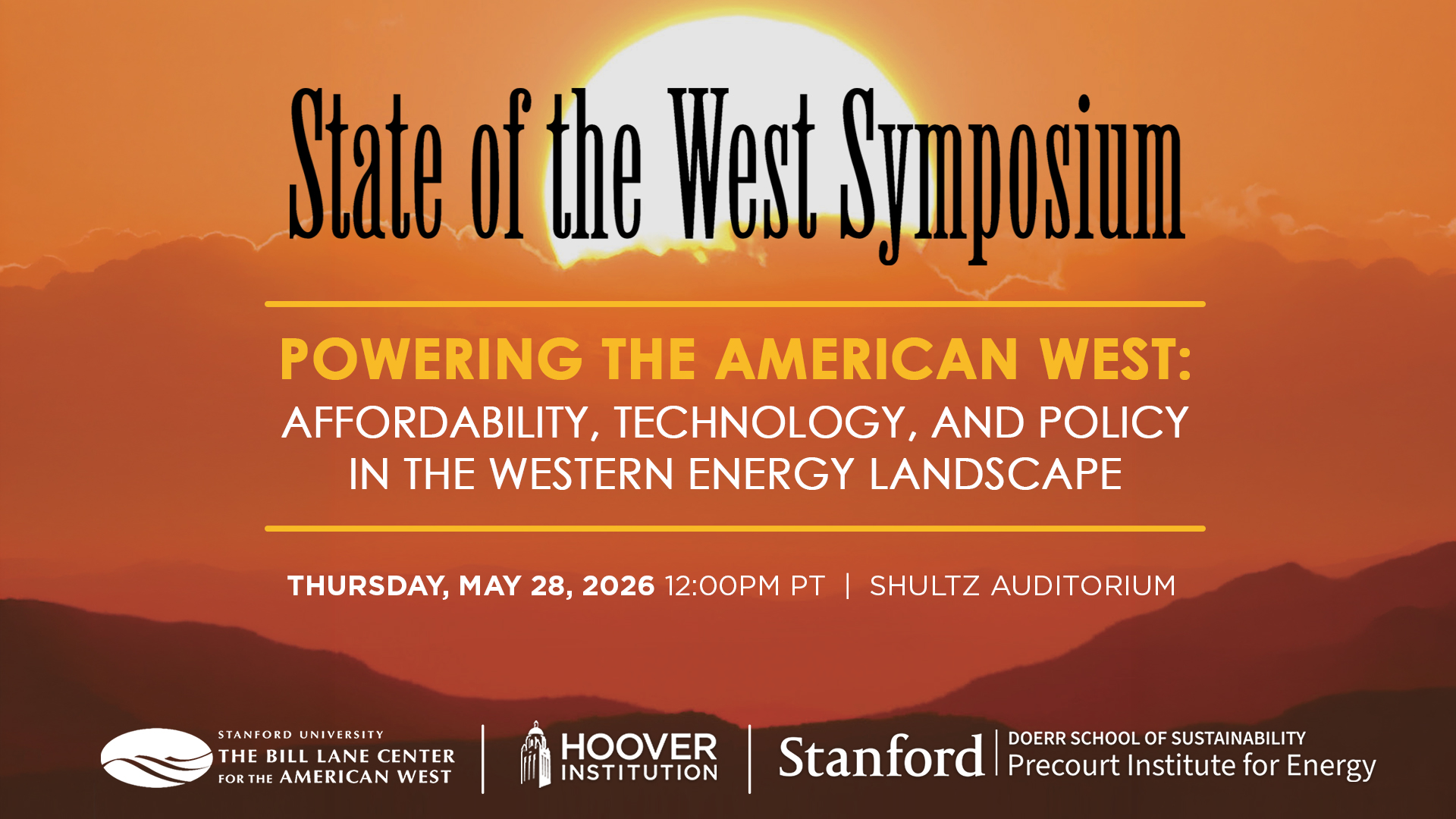
The Bill Lane Center for the American West, the Hoover Institution, and the Precourt Institute for Energy held the State of the West Symposium: Powering the American West: Affordability, Technology, and Policy in the Western Energy Landscape on Thursday, May 28, 2026 at 12:00pm PT in Shultz Auditorium.
With its abundant renewable energy resources, major centers of oil and gas production, pioneering geothermal energy development, rich mineral resources, and vast transmission infrastructure, the American West is a powerhouse of the U.S. energy landscape. The region is at the vanguard of energy transitions, and plays a vital role in the country’s energy security and economic development. Yet rapidly rising demand, increasing costs, aging infrastructure, and complex permitting processes pose formidable challenges to the region’s energy ecosystem and well-being.
This year’s State of the West symposium considers the state of energy in the West, from ensuring affordable energy in the age of AI, to opportunities for permitting reform and the future of nuclear energy.
| Thursday, May 28, 2026 | ||
|---|---|---|
| Time | Content | Speaker |
|
12:00–12:30 PM |
Check-in and lunch |
-- |
|
12:30–12:40 PM |
Opening remarks |
Sec. Condoleezza Rice, Tad and Dianne Taube Director of the Hoover Institution and the Thomas and Barbara Stephenson Senior Fellow on Public Policy |
- Well, good afternoon everybody. Apologies for interrupting your lunch and conversations. My name's David Kennedy, former director of the Bill Lane Center for the American West, and this is the 16th annual Symposium on the State of the West that the Bill Lane Center is organized this year. We're very pleased that our partners are the Hoover Institution about which, and from whom you'll hear in just a moment. And the Pre-Court Institute for Energy also here on campus. And our topic, as I'm sure everyone in this room and online with us knows, is powering the American West affordability, technology and policy in the Western energy landscape. So I'm very pleased to introduce the director of the Hoover Institution, Condi Rice, who will offer a proper welcome. She's a person who is in the category of needing no introduction, so I'll keep this brief. Former Stanford Province, former National Security Advisor, former Secretary of State, as well as an accomplished pianist, ice skater and golfer, which has led to the speculation that she's actually, Well, thank you David, for that great introduction. I just have to say that when people introduce me is having done all of those things, I think you must be thinking, did she actually do any of them well? And the one that I would say I did not, am not doing particularly well is golf. So any of you who are golfers, you will understand that I'm really, really grateful to the Schultz Energy Policy Working Group to the Bill Lane Center to David in particular, the Bill Saint Bill Lane Center for the American West is really a great jewel here at at Stanford and to the Preco Institute for Energy from the Door School for this great symposium on the state of the West powering the American West. I just have to say that I'm always excited when we have this symposium on the state of the West because there is so much that we in the West were endowed with in terms of resources and land and innovation and people. And it really is upon generation after generation to build on what was done in those who came west to, to take advantage of this extraordinary place. Of course, one of them was Senator Stanford who founded it here, the the university, the Stanford University. I remind people that Stanford University is barely 120 or so years old, of very much younger than its Eastern counterparts. And then of course with him was a man named Herbert Hoover, a former president of the United States, also a man of the West. And this kind of frontier feel to this place, to Stanford University, this was their farm, is an extraordinary reminder that there were those before us who understood that the West was going to be in many ways the future of the country. I'm also grateful that we think about it not just in terms of the United States of America, but also our friends in Western Canada. I grew up in Denver, Colorado. I was born in Birmingham, Alabama. But I have to tell you that as a little 6-year-old when my parents and I crossed the Kansas border for the first time heading toward Denver where my parents were gonna go to graduate school, I remember thinking I should have been born here. And indeed, I think those of us who are fortunate enough to reside in the West continue to believe that and to think that this is a time of extraordinary rapid technological change. Of course, as we watch AI and advanced computing, accelerating energy demand, increasing pressure on grids and reshaping how we think about infrastructure and policy and how we think about energy security as we are watching what is happening in the Middle East as well. This is a time for a comprehensive view of how we are going to meet the energy needs of the future. And the West has a great deal to say about how that will be done. I often say that we wanna do it responsive to economic growth. We want to do it responsible to energy mix and we wanna do it responsibly to environmental sustainability. And so what I've called the three E and getting that right is really in many ways harder and harder. But there are many, many opportunities that we here in the West have to contribute to that as I think in PE in particular about the energy demands for AI and the frontier technologies and the possibilities of what we must do about the grid bringing into, finally back to nuclear power, which has been largely ignored for a lot of reasons. I think, about the role of states and local decision making here in the West. And so I know that we have folks here who can address how this is being handled at the state and local, and indeed at the level at which many people expect that their energy needs are going to be met without driving their costs past affordability. I think we have to especially be concerned about this with AI because I'm watching something about AI that is really quite troubling to me. It is the case that the American population is more sour on AI than any population in the entire OECD, so among developed countries. And that's a challenge. And we have to ask ourselves why is that? Well, on the one hand, they're being told that it will take all of their jobs. Secondly, it, they're being told that it will run up their electrical bills. And if that's not enough, then Tron, the AI powered robot is going to eat you at some point. Indeed, a friend of mine has an 11-year-old daughter and told a following story that her, his daughter was being particularly nice to her chatbot and kept saying, oh, this is such a great answer, thank you so very much. And her father said to, you do know that it's not human right. You don't have to be nice to it. And she said, daddy, when they come for us, I want to be on the list of people who were nice to them. So we have quite a challenge in getting Americans to accept what I believe is a future in which AI could have for us great opportunity in drug discovery and healthcare, in in education, and of course in industrial productivity. But we do have to deal with some of the very real concerns that people have about particularly what it will do. And this is one of the subjects of this symposium, what it will do to the cost of the energy that they need in their lives. So as you look at permitting reform and what the next generation of nuclear energy can do and what policy frameworks can help us to deal with these issues, I just wanna say that here at the Hoover Institution, we like to think that because we are data-driven, evidentiary based, and indeed non-partisan in what we do, that we can shed more light than heat on some of these hard questions. Thank you very much for being here to do that. I'm also delighted that Senator Wyden iss gonna be with us. He told me his mother worked at the Hoover Institution. That's quite something, but there's something more important than I wanna say to you, Senator w and I know you had a terrific basketball career given the state of Stanford men's basketball. You have any eligibility left at this point? Yes. So we're really delighted that you're here with us. Delighted to have everybody gathered in this room. As I said, I know that you're gonna talk about some of the hardest problems that don't have easy answers, but hopefully it's a start in getting to think about at least what the agenda must be as we face these very challenging but opportunistic times in the future here in the American West. Thank you very much.
|
12:40–1:25 PM |
Lunch keynote |
Sen. Ron Wyden, United States Senator for Oregon |
- Well thank you Condi. And it's now my particular pleasure to introduce Senator Ron Wyden at the Bill Lane Center for the American West. We have a definition of where the west begins. It's at the 100th meridian, which happens bisects the state of Kansas. And the Senator was born in the west, adjacent part of Kansas that lies on the wrong side of the hundredth meridian. But his family saw the light when Senator was just a little boy and moved west to Palo Alto, where as you've already heard, he star at Palo Alto High School as a basketball player, recruited to play for uc, Santa Barbara. But in another series of epiphanies, he transferred to Stanford where he earned a political science degree in 1971. So Stanford, I think, can take some credit for his subsequent career, which is quite an amazing career. Eight terms representing Oregon's third congressional district, which stretches from Portland East through Multnomah, Clackamas, and Hood River Counties. And includes of course Mount Hood itself. Five full terms in the United States Senate in an historic seat once occupied by Wayne Morse. He's the ranking member of the Committee on Finance. And at the Committee on Energy and Natural Resources, he serves on the subcommittees for Energy, public Lands, forest and Mining. And the chair, he chairs the subcommittee on water and power. So he is an especially appropriate person to launch today's conference. I have to add, and in a book that the Senator published last year, it takes chutzpah we find on page five, Ron's 12 rules of chutzpah. I have to say, talk about chutzpah. Moses only had 10 and you've got 12. But number one is, and I quote, if you wanna make change, you've gotta make noise. And Senator Wyden has been making some very good noise through a long and consequential career. We intend to make some more noise here today in the days to follow. So, Senator, please come and get us started. What an inflationary introduction. And I'm so glad to be with all of you. And David said that I was supposed to be the keynote speaker today, and I was a little apprehensive about that because the previous keynote I gave was on healthcare. And I was director of the Great Panthers for a long time. And when I was done with that speech, the senior citizens came running up and said, Ron, this has been such a brilliant speech. It's been so good, just phenomenal. We want all of it to be written up in the press. And they went on and on. And I knew that I hadn't said anything that was any big shakes. So I finally said to some of the seniors, I said, folks, you've been so nice. Maybe the press will write up what I have to say someday. You know, they'll write up my remarks posthumously and the small senior jumps right up and says, oh boy, Ron with you. I hope that's really soon. So I'm giving shorter talks and as David said, and let's give David a round of applause. What a what a what a gem. My friend David Kennedy is, he stands literally at the head of all the historians that I think we can think of. So grateful that he's here. The Weiden family goes back a long way with Stanford and Hoover. My mom somehow found time to raise my brother and me while breaking ground glass ceilings in the sixties while working as a librarian. I could brag about my mom all day long and she's an inspiration for that chutzpah book. But I'll save the reminiscing for a little later. Now, in beginning my remarks, I think I wanna make an admission. Before I attended Stanford, the only thing I really knew about energy was that drinking gallons of chocolate milk in high school fueled your prospects to get a division one scholarship. That was the extent of what I knew about energy and obviously much has changed since then. My view is that the energy policy decisions made today really have the chance to make or break the economy. And there's some big questions. Let me walk you through a couple of them. Are we gonna produce the energy we need to power an innovation economy? Are we gonna bury middle and working class Americans with unsustainably high costs or are we gonna come up with policies that bring the costs down? And I don't have to tell you, this is on the minds of everybody. They feel like they're going into their gas station and getting mugged. Are we gonna ensure that the electric grid stands up to the kind of climate disasters that are becoming more and more important? And I will tell you, these fires that today that we're seeing are not your grandfather's fires. They're bigger, they're hotter, they're more powerful. And the reality is the summer all over the west, people think they're gonna get hit by a wrecking ball. So I thought that I, I kicked this off with a couple of comments about the recent energy policy debates, if you can call anything going on in Washington DCA debate right now. And then we'll talk about some of the things that are relevant for the West. Now we passed the Inflation Reduction Act in 2022. And I spent years working to come up with a frame that I thought would stand the test of time. And we call it technological neutrality. It gives everybody the chance to play. No matter what part of the energy system you're part of, the more you reduce carbon, the bigger your tax savings. And coming out of the Bush administration in 2009, after we couldn't pass the Markey Waxman, you know, bill, it was clear you had to find something fresh and Mitch McConnell was going to oppose anything. But I went to senators and I said, look, we've gotta find a new frame. And everybody said they were for all of the above. Nobody knew what that really meant. And the fact is that scientists were saying, we don't know what the big carbon reducers are gonna be years from now. Let's just figure out a way to encourage it. And that's what we did with our legislation. I saw how it would work when Joe Manchin, you all remember him, took me to West Virginia. And when I talked to him about that, he said, look, all the people on the democratic side are going after coal and the like. And I said, Joe, how about if we all go after science? And he said, you got something new. And I explained technological neutrality and that was the foundation for a fresh start. And the system on the books when we started was as backward as you can get it defined picking winners and losers. There were almost four dozen tax incentives on the books. All of them had different definitions, different sets of rules. And some of them, especially for oil and gas, were permanent big automatic checks for the oil and gas folks. The incentives for the renewable crowd were all temporary. So what you had was this huge clumsy patchwork of tax rules distorting the energy industry in America. And I said, wait a minute. Let's come up with something that really is going to be an attractive alternative and give us a chance to do some simplifying of the tax code and the process. So when Joe Manchin said, okay, I started in on the committee Committee 'cause I was fortunate enough to become the chairman and Lisa Murkowski was the senior Republican Joe Manchin was participating. And we spelled it out, the more carbon you cut, the bigger your tax credit. This meant scholer got into tax credit. It also meant that if you had natural gas, for example, energy generation plant and equipment lowered your carbon output, U2 got a tax break. And we know that that's gonna be one of the tough issues. 'cause natural gas is one of the challenges in terms of base load power here to tap all the potential for renewables. But the end of the day what I was proudest was this was simplification of the tax code that was a Republican priority and it was a Democratic priority. Avoid picking winners and losers and come up with a transparent goal and stick to it regardless of the sentiment. On the side of the debate, we said this is something that can work for both sides. And we got it passed. And here's what the numbers are. We've got the receipts everybody, companies between August 16th, 2022 and December 31st, 2024 companies announced in advanced 751 new clean energy projects totaling 406,000 new jobs and over $422 billion in investments across 48 states in Puerto Rico. That was between August of 2022, December, end of December, 2024, the biggest investment in fighting climate change in American history. Just put that, you know in your thoughts here. The biggest investment in fighting climate change in America over a two year period. So after the election, things got more challenging, obviously we had a great argument, the real benefits went to the red states. Sit on that one for a second. The red states, this wasn't something that somebody in Boston got all the perks for. The red states got the bulk of the, of the benefits because there was such an interest in building their economy. And I told the clean energy advocates, they ought to go out and make arguments too in favor of this, the national security, you know, threat. So clean energy was doing really well. And then Trump came along and took a shellacking to to clean energy. Now some of the parts have hung around that you're gonna hear us talk about coming up. There's something called direct pay. How many of you have heard of that? Direct pay is what you get if you don't pay taxes. But you still want to have clean energy and get the incentives. And for geothermal, for hydro, for nuclear, I heard Conde mentioned nuclear. All of them can benefit from from direct, direct pay. And I'll just close with this 'cause I think perhaps David, you wanna have some questions? I understood. What's your, what's your pleasure? Have some questions. Take Some from the Floor. Great, we'll we'll do it. Come on. Anybody come on up. On a fundamental level, the Republicans are talking about an energy policy that is frozen in time. It's frozen in 1970, maybe with a little bit more methanol, ethanol mixed in, but it's still living in yesteryear folks at this point. It's not an anti-innovation worldview. It is anti-consumer. Consumer. It's bad for consumers who feel like they're getting clobbered when they show up at the gas station. It's one of the reasons why I'm getting tough with the big oil companies in terms of buying back stock because what they're gonna be doing unless we really promote renewables. So Republicans I think are thinking again about what the possibilities are for renewable energy because we are on the side of the markets. You know, you're having a discussion with the Democrat who's the ranking member of the finance committee, which coordinates taxes. And he hasn't mentioned a mandate once. Nothing resembling a mandate. We're talking about markets, we're talking about consumers, we're talking about innovation, we're talking about everybody gets in. Those are pretty good stakes to put down in terms of where we want to go. So let's do this. I'm happy to sit through a panel or whatever you'd like to do, but I just so appreciate being back. My mother used to say when I was going to a basketball game, dear, make sure when you're out tonight after the P game, make sure you're running with the right crowd. Whenever I come to Stanford, I know I'm running with the right crowd. Thanks for having me. Come on, come on up. I'm curious, where would you like to see more investment taking place to help make either energy supply chains more resilient, sort of more, more clean, sort of more renewable? Where specifically would you like to see more investment taking place? Well, obviously we've gotta strengthen the grid. And I wrote the law that allows utilities to get some incentives for it. But the biggest hurdle we've got is having people in the business community getting off the sidelines and telling the Trump people they're not making sense for markets. You know, when we were getting to the point of the decision in the Trump administration about what they were gonna do, I brought up that all the natural gas people, the energy committee, and they basically made a presentation and I walked them through it. 'cause we discussed it where they said, look, we're gas people, we support natural gas. We don't want anybody to think we're not for natural gas, but given the demand today and given AI and all the challenges we need, every bit of energy we can get we're for solar and wind. And the Trump people said, huh, and then just went off and ignored it. So I think the biggest thing people in the private sector can do is just talk about markets and talk about consumers and talk about all the things that I just ticked off. The no mandates, the freedom to have choices. I mean, when I started this, I had real problems with some of my friends in the Democratic party. You know, they really just said, we're not gonna do something like that. And then they saw if you have a marketplace, renewables are gonna do really well. It's not as if they're not gonna do well. And you have a chance to make sure that people understand you're about freedom and liberty. You having a Democrat here with you, Stanford grad who's talking about choices for for people and not going back to yesteryear. And we will be back in yesteryear if we continue this damn idea of just rejecting out of hand renewables no matter how attractive they are in the markets. Yeah. Senator, thank you for being here. What, what are the prospects for permitting reform? I'm a little bit of a outlier on this permitting, you know, issue because we did this on forestry back when I was one of the few people in the Senate who came from a place that had lots of forests and you had to strike the balance between jobs and and, and the environment. We can do this, but you have to have some ground rules in the one area that I've been interested in is I don't think you should bar anybody from the courthouse. In other words, everybody should have a chance to say their piece, but you shouldn't get a constitutional right to a 10 year delay. And we have got to find that balance. And I think we can, but we have to start in with that kind of, you know, pro proposition and a big chunk of this, most of the environmental laws have been litigated now between environmental people and business people. So usually if you just take those down and start working through that frame, you can make some progress. But I think there's a balance here to be found. And obviously it's important for renewables, it's important for fossils, it's important for the economy, it's important for markets. That's not under dispute. But I think saying that people have a first amendment right to be heard on something involving public policy, put me down as for it. But I also think you don't get a constitutional right to unlimited kind of, you know, make, make ideas up kind of policy. Easier said than done, but that's where you ought to go. Yes, right there, sir David Hayes, nice to see you, Senator David, another legend in the house. Let's give him a round of applause for being there again. And and again. You are, you are beloved in my state. Wow. I'm gonna move there then. Good. Thank you Senator. I'm, I'm wondering what you think about the, the, the stress on the grid now and the, the fact that it's such a decentralized system that we have and yet we're facing, you know, huge differentials around the country in terms of ability for the grid to, as you say, deal with climate change, et cetera, but also the huge interconnection problems that, that are, are holding back clean energy and query. Whether it, it's time for the federal government and the Congress to step in more and talk about a national grid and, and perhaps, you know, develop some national expectations of how grids are operated for the, the benefit of the larger populace. The, the question is hugely important and I continue to believe that some of the most important work in the environment and healthcare, you know, I'm one of the few democrats who's not for just, you know, government run, you know, healthcare. I think we need a public-private partnership. I think we need a public-private partnership in the area that you are, you know, talking about. Because look, this is a national economy quote, also a global kind of economy. And there is no question that we have to step up and make sure that we're in a position to deal with this. And you can't deal with that unless you harden the grid. We did make some changes in the Pacific Northwest in terms of the West. I think you might've been one of the environmentalists who helped me, you know, on it and I support that. But I think a public-private partnership, particularly in innovation and as it relates to energy and science kind of policy as well as healthcare is the fit that would be the right way to go. Now it's not as sexy as people who are gonna just, you know, stand up and say, you know, everybody's gonna be in the government program and no other program's gonna exist and the like. But I think it's what we need for markets and solving problems, public-private partnerships. Yes, Senator, thanks for your remarks. David Federer here at Hoover. David's allowed to ask a question 'cause he drove my daughter and I, and let me introduce my daughter Ava, who's in the front row too. A big, a big fan of the Stanford community. Thanks for being here. Thanks for your comments on markets. You know, looking at the EIA data for last year, the highest growth in power generation in the US came from coal and from solar. And I think the coal was probably a, a short term adjustment with some, putting some units back online to meet demand spikes. But that solar piece is interesting in the context of, you know, some of the pullback and support from a policy perspective because it shows the power of growth, right? There was growing demand and the rising ties have lifted all boats there. There's a, a famous quote here at Hoover of a U Chicago economist who said, once you start thinking about growth, it's as if nothing else matters. So it strikes me that that dynamic could be as important as whichever policies are maybe selected to preference one another form of energy. But you know, you made this comment on how the policy environment changes. George Schultz here at Hoover, he's talk about it being a rollercoaster and people pay attention to one thing, one decade, and then they stray and start looking at the next energy of course is a a long time investment horizon. It's large amounts of capital. The lifetime goes far beyond any political administration. It's easy to ask is do you see a way judge pulling from your own experience how to have more consistency in US energy policy or comprehensiveness in US energy policy across administrations. We know administrations will change, we know congress will change. Or is that something that in our system we should just not expect and investment should try to flow around that regardless? Well, I think with leadership you get people to take those kinds of policies on. I mean that's what I tried to do with technological neutrality. I started that and it took almost 10 years to kind of massage that through all the legislation, you know, making and people said, a democrat technological neutrality, isn't that all of the above? I said, well it's really science driven and that's heaven forbid what leaders are supposed to do. You get an election certificate to do something other than wear a blue suit and a red tie and show up and smile, you're supposed to take on big issues. And after Waxman Markey went down folks, I said, we are on the ropes in terms of energy policy. We're not just behind, we're on the ropes because John McCain and Lindsey Graham, who were very interested in climate and I had breakfast and they told me you couldn't even get a hearing on a bill that passed the house. Now put that one into kind of thinking about the legislative process. I mean John McCain and Lindsey Graham who were supportive of it, always wanted to help. In fact, Graham McCain and Joe Lieberman, you know, who were called themselves the Three Musketeers and they said, can't we at least get a hearing on it? So I think that's the way you're gonna move ahead. And people like me, that's what we get election certificates, you know, to do. And that's how I try to spend my time. I think that, you know, the reality today is we are a polarized, you know, country, there's no question about that. But at the same time, people wanna solve problems and that's what I'm committed to doing. And don't give people election certificates if they don't wanna do it. You're being way too logical. Speaking of Rose's, environmentalist and citizen, speaking of polarization, who do you look to? A few names maybe in Congress on both sides to help narrow our political abyss in years and months to come? Well, big announcement today, and only David Kennedy knows David, you in the house, where are you? David knows that in chutzpah about page 10, I decided that I would make some history by announcing that I am the only United States senator not running for president. I thought there ought to be just one, just one who's not kind of putting on their suit in the morning and getting ready to, to go. You know, I have ones that I work with in my committee, Lisa Murkowski, you know, on energy, and she gets a lot of, you know, discussion in the book. Mike Repo is somebody who's from Idaho, who I think is very thoughtful and he's very conservative, but he works with me on things like healthcare, cost, cost containment, those, those two would be be naturals. We've had some challenges getting people in the intelligence field to, to take on some of these issues, but that's an area I'm spending a lot of time on. I've worked with Jerry Moran of Kansas on it because the challenge with, with respect to intelligence is keeping up with Ben Franklin. Ben Franklin said, anybody who gives up their liberty to have security doesn't deserve either. And I call myself the Ben Franklin caucus. Those three would be people that would kind of meet my test of responding to your question. Because at some, some point you've gotta find after the initial debate, some people who wanna follow up and do the hard work and I all three I think would meet your definition. Yes, Thank you so much, Senator, for your remark remarks. I'm wondering if you see a particular role for the Western states and the West more broadly in some of these energy challenges that you've talked about. Well, I, I think anytime you can get Oregon, Washington, and California together, you're gonna get some good idea generating. We've done some of that in terms of healthcare. I think you probably have read that Bobby Kennedy's vaccines policies are so extreme that the three states have been talking about various kinds of approaches and obviously it's a good fit for the grid and, and and the like and, and fighting fire. I'm telling you folks, this fire season has the potential to be really brutal. I mean, normally what happens in a fire season is that we have different states and different parts of the country affected at different times. Now it looks like we're all gonna get hit at the same time and I don't know where we're gonna get the people to, you know, deal with it. Now, the Forest Service chief recently said that we had saved $12 billion by protecting the prevention fund over the last years. This was a bill I had with Mike Repo and everybody said they saved $12 billion just by focusing on good management. And I said, yeah, it took a few years, but it was worth it. And those kinds of things with Idaho and Oregon taking the lead on efficiencies and particularly forest management and the grid and the issues we're talking about, it's a natural, I'm Robert, I'm a student here. I think what we've seen with this administration is that they're responding to an abdication of Congress to act on permitting and act on energy reform. And we've seen the executive branch just kind of consume a lot of that power in the energy policymaking space. I guess more of an institutional question is what's the playbook for 2028 in reasserting congressional, you know, vigor or authority over this issue? Or is this always gonna be tied up with interior and action? Well, first of all, I'm, I'm a little bit in a different place with respect to the role of Congress. And I'll give you an example. You know, I've taken a real lead in terms of international trade on the finance committee. I think you ought to grow stuff here and build stuff here and sell it all over the globe. Well, we won a floor vote in the United States Senate to get rid of Trump's global tariffs. We won by three votes. Mitch McConnell told me that if I did his laundry for six months, he would vote with us and we won. What did Donald Trump do? Absolutely nothing. He didn't even believe in the rule of law. He went to the Supreme Court, he lost there. And by the way, this gives you a sense of how they do it. They actually, through their lawyers said that if he lost in court after he lost in the Senate, he would get refunds to people for the money they lost. And he's been stonewalling that. So there's people that are working to make him accountable and he doesn't particularly think that he's anything really except the ruler. And that's why everybody calls him the king. Now, something happened on Thursday that was really a big deal. Did y'all see what was going on in the Senate on Thursday? How many people know what I'm talking about? Okay, on Thursday the Senate Republicans were prepared to pass their ice package and it was the ice package wishlist, you know, making sure they gave a lot more money and none of the reforms in terms of masking and identities and all this kind of thing. And they were prepared to go. And on Thursday, the whole question of the weaponization money, or I call it the slush fund, was set up and those senators had Trump people come in and they just took their heads off. I mean, it was like we could hear people shouting from the meetings and the Republicans canceled their legislation. Literally their top choice was the question of of ice. And they canceled it on Thursday afternoon and went home because they couldn't defend the slush fund. They couldn't defend the weaponization money. So we'll see what happens next week. But I think that there may be a, a beginning of a rejection of some of these very flawed policies. And the slush fund, I mean I've been doing this a while. I mean the Slush fund just drips with corruption. I mean this is not a close call in terms of right and right and wrong and you know, you set up a lawsuit and then you take the money to hand it out to criminals from the, the J six discussions, this was pretty bad. But the Republicans for the first time last Thursday, this, this could be a day that goes down in, in legislative history because they just pulled it. They took their big thing, which they could have passed and said, we can't go home and defend the slush fund legislation, which would've been linked to it. That's that. Is that David there in honor, in honor of respecting history, we've got to give David the, the mic Senator, I'd like to bring the conversation back to the western region and just a little bit of background, this region has a distinctive energy profile. For example, in Hydro, California gets about 20% of its energy from hydro. Your home state gets about 40%, Washington gets about 70%. British Columbia gets 85 or 90%. So thanks to topography and climate and so on, we have some special advantages in that energy sector. We have special areas, areas that are particularly productive for potential wind powered energy along the hundredth meridian, for example. And in southwestern Wyoming in particular. And of course we have the Mojave Desert, Eastern Oregon, Eastern Washington, where there's an abundant sunshine for much of the year. So we have some advantages with solar as well. So in that general profile, where do you see the, the opportunities for the Western region to develop more clean and or renewable energy? Well, David, let's take a couple of 'em separately. Hydro for for example, is basically in Oregon's DNA. I mean we have been pioneers in this and I protected it. I protected it in the clean energy tax credits and I told the Trump people when they were thinking about taking it out that this would be something they would deeply regret. And we have been able to keep every bit of the hydro legislation. There'll be some things we pursue in order to keep expanding it, but your message is right. And probably one of the big things that we've gotta do for the West is keep these regional organizations, like in my part of the world, Bonneville power. You know, if they were able to privatize Bonneville power, which some of their ideologues would like to do, and I've been able to block it, that would dismantle all the things that you're talking about as related to Oregon, Washington, California, and, and some of the Rockies too. So message sent and one I share, Yeah, in Stanford University. I want to ask about, based on Dave's definition, the West, to get your insights regarding the Canada, US and Mexico collaboration. And now we are on the six years review, right? And also the Mexico has the sovereignty of energy, this kind of desire, but the electricity grid is connected between the Canada, US, and the Mexico. What's your perspective regarding the three nations and North America collaboration in the West? We're at an inflection point, particularly as it relates to, you know, Canada because the Canadians are so angry at Trump, it's beginning to play out in a whole host of issues. For example, when we deal with these huge fires and the like, the Canadians are always helping, they're always stepping up, they're always trying to be useful. They aren't gonna give Donald Trump the time of day when there are these fires. Maybe they'll help some states like Oregon that they have great relationships with. But nationally, the damage that Trump is doing to allies, you cannot even add it up. It is monumental damage in the fire issue is just one example. On the plus side, on the finance committee, there are a lot of us who are portrayed, it always used to be almost a requirement that you be portrayed to have a chance to be part of the debate and the like. Now that's changed a lot, but there are a lot of people who are pro trade on the finance committee and we are weighing in hard for keeping three countries part of this because there are people who don't wanna have three countries and people who want to throw the whole thing out the window. But us, Canada, Mexico has been a success. There's some things that we can do better, particularly in the enforcement area, but I'm a strong supporter. Senator Creo is a strong supporter. So the people who are, you know, running the, you know committee are committed to keeping the three straights there, the three states there. And I think our pushing back on the Trump administration has been productive. Okay, I have a lengthy closing speech and if somebody from the United States Senate shows up and you know, talks for a while and we had some good questions, we had a lot, David, thank you for doing that. I like that much more than just filibustering people. If somebody comes from the Senate and says they're gonna give you a closing address, my advice is to get outta the room as possible, get out as quickly as you can because they're nearly always boring. My closing address is first to my friend David. Thank you. Thank you. I've been so lucky to know David all these years and I'm not the only one. There are people in the Senate, Senate, Cory Booker, all kinds of people on the Republican side, all of whom will tell stories about David and tell people are unconscious because of the great memories and the likes. So big. Thanks David and all of you. I thought that this would be interesting when we got to the questions, there wasn't a bad question in the house. And so I hope that you'll continue to offer up ideas and just give you my last kind of judgment about myself. When I decided to do this for public service, I said I'm not gonna do it the traditional way. The traditional way is to do your politics first and then think about ideas, which is why when you asked about the U-S-M-C-A, I wanted to talk about, you know, the kind of value system. We didn't do our politics first. We said this is crucial and that's not the Washington way. And I think David's point about how are we gonna get things done in the west, we're gonna have to restore some of this. You're gonna have to set aside some of the partisanship and focus on getting some results so that both sides will win. And as long as I'm doing this job, we're gonna put that focus on policy before just stark politics. And once you get the policy, you work like hell to make 'em law. And if people like you will give guys like me ideas and suggestions, that's the coin of the realm to be continued. Thanks for having me.
|
1:25–2:40 PM |
Panel #1: Powering Growth Without Breaking the Bill: Affordability in an Era of Surging AI Energy Demand |
Moderator: Liang Min, Managing Director, Bits & Watts Initiative, Stanford University Panelists: Jerry Fenn, Chair of Utah Public Service Commission John Reynolds, President of California Public Utilities Commission Tracey LeBeau, Administrator and Chief Executive Officer of Western Area Power Administration |
- Okay. Good afternoon everyone, and welcome to attend the the next panel. And we're going to discuss and some of the topics that Senator and also Secretary County Rice talk about how to power AI or power load growth without breaking the bill affordability. And my name is Leon Ing. I serve as a managing director for Stanford Bits and WA initiative, and I'm electrical engineer by training. And today I'm very delighted to have a three legal professional and a lawyer join me for this conversation. And the full disclosure, my wife is a lawyer, so I always listen to my wife for any inputs and and insights. And join me today. From my left has an administrator, Tracy Labra is, Tracy is an administrator, and the CEO of Western Area Power Administration. Wapa, and received the JD from University of Iowa and bachelor from Stanford. And then left of Tracy is the chair Jerry fan and the chair of Utah Public Service Commission and receive the JD from Brigham Young University. And the far left is President John Reynolds and the president of California Public Utility Commission and received JD from University of California, San Francisco College of Law that they legal, professional and devoted their career as a public servant. And for this energy transition. Really appreciate your service for your state and for the country. Appreciate. So, you know, as we heard from the keynote and the opening, you know, we are meeting a moment, very interesting moment when electricity demand is no longer flat across the west. We are seeing a new wave of load growth driven by the AI data centers. We bring the job back to United States, the manufacturing load, and we're doing the electrification and the broad economic development. A lot of opportunities that when we bring the jobs back to us, when we do electrification, when doing data centers, we create jobs, we increase the tax and base and build new infrastructures. And, but it always also raise essential question, which is, how do we power growth without asking household and the small business to carry the cost they did not create? Right? So the affordability is really the central questions. And no doubt we need more infrastructure. You know, in, in United States we have aging infrastructure issues. We need to build more. The harder question is who pay for it and how costs are allocated and how regulator protect existing rate payers will still enable the load growth or economic growth. And in American West, we're a very interesting situation, right? Because 80% of the land are public land. So when we build a new infrastructure, new transmission line on renewables and the, the state federal tribe, local community partnership are very important. It cross land, cross energy, cross water, cross communities, everything. And little bit insert what we're doing at the Stanford in the end of last year, we published, we, we heard the grid electrical grid quite often of over the last hour we published a, a study to quantify the grid utilization across American West. The number are staggering. The average utilization across American west of transmission network is below 35% range between 20% to 55%, right? If I'm operate airline business only, about 35% seats occupied. You may, we may broke very quickly. And so this is a number we, we we published, but it's very uneven, right? We do have a specific corridors, a transmission line are highly utilized, highly congested as an aging infrastructure. We need to upgrade them. And with all these kind of opportunities and the challenges. So with the next hour we're to discuss the load growth, we're going to discuss the affordability and we're to discuss public land and regional coordination. And the more importantly, with all the public servant and the legal professional here, we're going to discuss policy. And so first I would like to start with, give, set a stage, what does a load growth look like across the west? Let's start with the guest far off the of the east from, from, from Tracy, from from Colorado. Let's start from you. Give us the broad picture about what's going on in American West about load growth. Sure. I I, and obviously I can only speak from our vantage point and just to give you a sense of, you know, what, what, what we are observing and are involved in throughout the west, you know, so we, you know, we market and deliver hydropower from 57 dams throughout our 15 state footprint. So we are like from, we have customers and operations from Minnesota to California to, you know, Montana, Canadian border to Arizona, Mexican border, and Texas, which is a, people tend to forget. And in doing that, so, you know, we, we do the marketing, but you know, we also manage the grid. So we've got, you know, 24 7, 365 grid operations and you know, line crews over all, all those 15 states. But what's really interesting about us that probably is not well known, is we, we own and operate our, our own 17,000 miles of high voltage transmission, but we also operate other transmission on behalf of our customer. So actually we operate 26,000 miles of transmission throughout for those 15 states. And so in a lot of ways, operationally we're, we're almost twice as big as Bonneville just 'cause of our footprint. So it's hard to generalize even amongst our own what, what what we observe. And because we've primarily, you know, we're all wholesale and we primarily serve electricity and electricity utilities like municipal utilities and electric co-ops and so forth. A lot of military installations throughout the west we're, the way that we are seeing it is our customers, our utility customers are coming to us, you know, like, you know, electric co-ops or munis, like I said. And so they're getting approached by large loads and they have load growth responsibility, interestingly enough, wapa does not. And so they'll come to us and say, we know how to do just, we know our business, we know how to do distribution. We would love to have this large load come and interconnect with us, but that is gonna drive high voltage transmission expansion that's gonna, it's gonna drive that. And so rather than them and feeling like they're, they wanna get out of their lane, they turn to us and say, can you, can you manage that for us? Can you help us, you know, design, you know, design, construct, maintain the high voltage end of a lot of these big, these big projects. And so that's how we're primarily getting pulled into a lot of the large load work and it's really happening all over our entire footprint. And you know, it's really also interesting, and I think we'll probably, I'll probably come back to it again, is, you know, always keep in mind, you know, we spent a lot of time talking about FERC and you know, national legislation and so forth, which, you know, we, we have interactions with them, but you know, largely we're non-jurisdictional. So a huge chunk of the west is not jurisdictional. And so we're, you know, self-governing entities think about, you know, and so, you know, while a lot of us follow, you know, a lot of the FERC rules for, you know, particularly on the wholesale level are, you know, 700 plus customers all over the west. They, you know, they don't have to. And so it's, it's really fascinating. You know, think about the entire Intermountain West, which we serve, you know, the, all the Rockies and you know, from from Canada to Arizona, you know, they're, you know, they're, it's just, they hold a very interesting, unique position and you know, who, you know, you and often are not included into the conversation. And as we talk and talk and talk about inter-regional big projects, and we'll talk about it a little bit later, I guess we, that is a conundrum we have to address. And I think that's one of the biggest conundrums we have to address is how to, you know, you know, you know, look to state, you know, a state state, you know, some new state guidelines laws, look at FERC rules, we gotta, we gotta think, we gotta do all of those things, but we also have to address a lot of those entities throughout our very unique kind of how the west is, was developed and how we still operate in a, in a lot of large ways. And a lot of them are not in energy markets, organized energy markets. So that is another, you know, another kind of interesting twist on all of this. But, but I still think, you know, at the end of the day, and you know, my message is to our customers and to a lot of the public power out there is, you know, we did the hard work on, you know, developing a lot of this, you know, 70, 80 years ago. And, you know, we, we live in our, the communities we serve, we're close to, you know, those customers in a very unique way. And I think in the, particularly in the west, that that, you know, public power is gonna, you know, be called upon again to do, to do some tough work in the next couple of decades. And, you know, and I think they're up for their challenge. Thank you, Tracy, to share the public power perspective. Let's now you're based in Colorado. Let's move to a little bit close to us, move to Utah at the chair fan. And Jerry, can you share with us what's going on in Utah and the enabling states? Sure. Thank you for the opportunity to be with you today. I, I just think as a, I began, I want to just say how much of a privilege it is to be on the stage with Secretary Rice. I've long admired her as a Renaissance woman, not the least of which is because she was one of the first two members of Augusta National Golf Club back in 2012. And I also had opportunities, I used to have the eight Western states for CenturyLink to meet, and I met with Senator Wide and he always treated me with respect. So I appreciate very much the opportunity to be here. I want to talk today a little bit about what we've been doing in Utah, but I think by way of preface, I would say that for decades, the electric sector has planned for relatively slow and predictable growth. Artificial intent intelligence is changing the slope of that curve. And so the challenge now is not only to consider how we power growth, but how we do so in such a way to, to preserve affordability and reliability and the public trust in Utah. We've seen an awful lot of changes in the last few years, and historically, as I mentioned, growth has been relatively flat. But in the last 16 years, load growth in Utah has increased by 31% in the Pacific core, the, the investor owned utilities service territory, the increase in demand has been somewhat tempered by, in, in increased efficiency nationally. But there's been this unprecedented increase in the last few years with respect to artificial intelligence, which is driving data center development in Utah. So I wanna talk just a little bit about that. A year and a half ago, governor Cox in our state, under unveiled what he called Operation Gigawatt, his goal was to double the energy production in the state in 10 years. And so state leaders have an all of the above strategy. There's a un unlike what some people think, there's still a commitment to solar and wind in Utah. Some of the problems in the past have been with respect to dispatchability, but one of the great things that's happening in the world today is the advanced technologies with respect to longer life batteries. So when the wind isn't blowing and the sun isn't shining, we are looking at a hundred hour batteries that are the future to be able to get that power back into the grid. But there really is a, a all in approach with respect to nuclear energy in the state of Utah. And I want to talk just a little bit about that, that plan. So the push for nuclear energy in the state of Utah really is on several fronts. And, and some of this is, and I think received national news in the last little bit. And we have multiple different directions that we're going from small modular reactors to micro reacts that are being developed in Utah. And and to what has been recently announced is a, a project up in the far northwestern sparsely populated part of the state, which is a data center that would be powered by a natural gas pipeline that runs through the area, which is in its original format, would be able to produce nine gigawatts of, of power. The whole state of Utah uses about four gigawatts. Okay. So, but in the short term horizon, Utah is involved through Rocky Mountain Power in what's called the Terra Power Natrium Reactor. It's a 345 megawatt sodium cooled fast reactor. It's on the side of a retired Pacific Corp coal plant in Kemmerer, Wyoming. And it's expected to come online in 2030. And so that is one of the projects that's we're looking at right now and anticipating that will be online in just a couple of years. In addition to nuclear energy, though the state, because of our geologic strata, it seems to be very well situated for geothermal power. One of my friends is the head of the engineering program at the University of Utah. And the University of Utah has been leading out for a number of years with respect to geothermal development. A private company has located in the same geologic structure at about 13,000 feet or so, they're able to get the, the power or the, the temperature right to turn is not water, but to turn the, the liquid into steam. And that that particular site is, is expected to start producing 90 megawatts of continuous power in 2026 with the potential to expand to 400 megawatts by 2028. But there's about two gigawatts of potential geothermal power potential in that particular strata in that area. But throughout Utah, we have other geologic formations where geothermal power is a real possibility. So I, I think that that's one of the things that is being driven by our legislature and our governor in conjunction with Operation Gigawatt. And the last thing I'll say is that the state is involved in a proposal. They're one of 27 states who submitted proposal, although the, the, the Department of Energy secretary, a symposium last Friday, said that, you know, you may say this in all 27 states, you know, but that it was a very strong proposal. What it is, it's a, it's called a Nuclear Lifestyle Innovation campus, and it's proposed to be put out in the West desert on the other side of the Great Salt Lake. And it would lead the nation in a build out by co-locating the entire nuclear fuel lifecycle there from uranium fuel enrichment to nuclear fuel fabrication, to advanced reactor deployment. And what has also been pretty much a not in my backyard approach for years and years, and it would be include use fuel reprocessing. There's a lot of reprocessing of, of nuclear waste that's possible. And then, and then management of waste storage. Now that's the plan. But our governor's been pretty clear that if somebody thinks that Utah's just gonna be like Yucca Mountain was considered years ago, just to be a waste repository, that he's not interested in that project. So that gives you an idea of what we're doing with respect to development of resources to bring power to the grid. We could talk about a lot of other things, but that's, that's in a sum summary of, of what are some of the, the things that are happening right now. Wonderful. Let's move on. Go back to our home state. Have a President Reynolds. John, can you share with us, you know, what's going on in our home state? Gladly and wonderful to be here with everyone to, like others, we are seeing load growth and data centers are part of that story, although they're not the whole story. We're also seeing load growth from electrification of transportation and buildings. We are now over 2 million electric vehicles registered in California in increasing share of new buildings are all electric. And we are seeing low growth on that front as well. Our sister agency, the California Energy Commission, develops our demand forecasts in the 2022 demand forecast versus the 2024 demand forecast. We saw 2.9 gigawatts of load growth from electrification. We also saw 2.9 gigawatts of load growth from data centers. So it gives you a sense for the, the amount of load that we're anticipating. And the data center queue, of course, is growing. Not all of the data centers in the queue are likely to actually end up being built and powered, but there is a very substantial number that we are staring down and anticipating, and we are preparing to, to build the grid to meet the most likely outcomes. At the PUC, we've, we've been focused on our part in the cycle of resource development. So the, the CEC develops a demand forecast. We develop a model portfolio that anticipates the, the resources that will meet our demand reliably while meeting the state's climate goals. And then our, our partner, the Kaiso, as our balancing area, develops a transmission plan and ultimately builds the grid to support our model portfolio. And all of those resources end up getting purchased by load serving entities who deliver retail energy supplies to our customers in California. We've also experienced extreme weather events in 2020 and 2022. We had extreme summer heat in 2020 that led to rolling blackouts in 2022. We came very, very close on the California grid, but we're able to avert those blackouts. And in the wake of those events, we have been building new resources at, at or near a record pace, and we will continue to do so. We've brought in, we've brought online some 30 gigawatts of new resources since 2020. Lots of solar and lots of batteries among other resources. And the combination of those different factors, electrification, data center load growth, and extreme events certainly are making the electric grid planning process a more challenging prospect and is necessitating this pace of development. And I think I will pause there. Yeah, let's, let's little bit deep dive on this topic. You know, you share the number regarding, we had 2.9 gigawatt electrification load plus 2.9 gigawatt on the data center load based on the CEC load forecasting, right? But on the, the some of state invest on utilities earning course, you know, the data shares like we have 10 gigawatt in interconnection kills and then the reports released by EPR and the Lawrence Berkeley lab and many other organizations. So talk the very big numbers, right? Do you see the AI demand and, and this forecasting are real or it's materials today or will be materials in the future? And what's the difference we're talking about here? I'm happy to kick off. It's, it's definitely real and material. It's not necessarily as large a number as we're seeing in the queue that will ultimately come online, but it is definitely going to have real impacts on the, the necessity of what we will have to build. And I think we're seeing this really around the country. We have very, very large queues for data center growth, load growth, not all of that will come online, but it is a set of staggering numbers that we're, we're seeing at commissions and utilities around the country that put a lot of pressure on planners in terms of what the grid's needs will be if even a fraction of that load comes online. One thing that I think we are, we are certainly doing here in California and that you've seen a lot of innovation around the country is how do we design rates in a way that protect existing customers while supporting that kind of load growth. Here in California we have what we call rule 30. We have an interim rule there that requires large load customers to pay up front for the grid upgrades that are necessary to bring them online. And there's a, a process where we will evaluate long-term costs allocation between data centers and other customers depending on, on the benefits to those different customer groups. So there's an opportunity for some of those funds that come back, depending on how that grid infrastructure will ultimately be used, but there's no guarantee. We've seen some states, I think, around the country be very assertive in the sorts of requirements that they have put on data centers to put money up front to support resource builds and grid infrastructure builds in order to protect other customers from cost increases and in order to ensure reliability as, as these customers come online with very large power demands. Wonderful. Thanks for the insights, you know, rule 30 to protect the customers that, that's a really good examples and hope that, you know, we're gonna move forward on the rule 30 with the, and Jerry, can you share with us what you see in your states or enabling state regarding load growth, how real they are and what the mechanism that Utah is putting together to protect the repairs? So on, on the artificial intelligence growth Yes. Is your question. I, I'll talk a little bit about the costs and who should pay for that. I think you're gonna ask another question about that down the road, but it's obviously real and it's material and, but President Reynolds just I think talked a little bit about the fact that we have asymmetrical information on load forecasting. Because what happens is that these hyperscalers and and large data center companies, they get in the interconnection queue in several different states. And so you don't know whether they're going to necessarily build in your state. And so we talk a bit a little bit about flexible load tariffs and how you and you, how you try to deal with that perhaps later in the program. But, but I I will say we, we have to have integrated resource plans in place that can accurately reflect what our load growth is gonna be because of AI based data centers. And, and it, it, it isn't really very readily available, so you have to have to push and through confidentiality agreements, get that information. And we have statute in place, which I'll talk about with respect to cost allocation here in a minute, that, that deals with that as well as how you allocate costs. But I'll just say in, in Utah, I mentioned the one ex, probably the largest data center in the world, ai it's gonna, would have actually 60 different buildings if that. It's the, the, the person who's behind that is the guy named Kevin O'Leary, who I think you probably heard of from, I think is Shark Tank. I've never watched it. Is that the program? Anyway, he's, he's the key investor behind it, but it's met with some opposition in the state of Utah. So the governor recently announced it was scaled back from nine gigawatts to one 1.5 gigawatts. And, and we'll see where that goes over the course of the next several years. But we actually have a history in the last number of years. When I was a telecom executive, I was involved in a very large government data center providing the fiber pipe to that, that was before I got involved at all in the electric industry. But in the last couple of years we've had artificial intelligence, AI processing data centers that have gone come online in Utah, and one of them is off the electric grid provided its power and its turbines are powered through gas, through through natural gas, through the, through Enbridge gas. We also have another one that we've recently approved. And I, I have to be careful about, a lot of the information is confidential, but it's a very large data center that is approved under new statute that is going to be serviced by the electrical utility, Rocky Mountain Power. And finally we have just this last week, a a data center filed an application that would be a private generation provider, which will not be connected to the grid. And our, our review of that is pretty, pretty basic and pretty limited now with respect to getting it right. I know there's an awful lot of fear out there about data centers that are coming online and AI specifically, many people worry about what that's gonna do to job markets and, and what that's gonna do to the future of our economy. But I I have reason to be optimistic. I think we tend to adapt tech technology. When I was Bill Lad, your former governor had a movie come out called Terminator, and then Terminator Cyber Dine Systems had developed Skynet, which became self-aware, I think it was a few years before today, it was like in 2021 or something like that. Anyway, it became self-aware and it destroyed humanity. Now I didn't have any nightmares then when I watched that movie, and I'm not having nightmares today. Okay. Because I think while there are a lot of concerns and I think some legitimate concerns about what AI can do, we have a tendency over time to adapt to technology in our lives and, and the possibilities involved in what AI can do with respect to science. I have a, a son-in-law who's a intellectual property lawyer, changing their world completely. And I have another son who's a neurologist and does deep brain stimulation and AI is going to help him an awful lot in his medical practice and it won't replace him. But, so I, I think the future is bright as my own personal bias, but I, I understand what, why people fear the what it may do because it's going to be disruptive. There's no question that it'll be disruptive, but with one door closing, another door may open. And that's, that's all I can say about that. Thank you Jerry. Tracy, you see deal with a lot of, you know, states and the federal customer as well. What do you see the load growth look like? Yeah, Actually for the pub public, the, the federal load, Yeah, it's definitely, it's definitely happening. You know, in addition to our, you know, 700 customers, you know, our, we are just interconnected. We're so interconnected with, you know, utilities that aren't necessarily our customers. The, you know, the big IOUs. So from a grid operations perspective, I'm actually very excited and I think there's a ton of opportunity. I think primarily, you know, we are experiencing it, like I said, you know, our, our, our customers will come to us and ask for help and we, we require to get paid, paid in advance. That's just our, how our funding mechanism is regardless. And, and, but we are also getting large interconnection, generation interconnection applications that are connected to, to these large loads. And so, and we're processing, we're, we're in the midst of processing a number of them as we speak, particularly in desert. Southwest seems to be a, a bit of a hotspot. And so we're, we're seeing it through those two lenses, you know, and very excited about, you know, what, what, what it, the opportunities it could bring on the, you know, on the, on the, on the side of, you know, what some of the things that keeps me up at night a little bit. I'm glad that they're, they're, they're building their own generation and interconnecting it. I I was a little nervous about, you know, conver you know, a lot of planning, a lot of conversation in the last couple years about behind, you know, behind the meter, you know, generation at some of these, at some of these, at some of these sites. And I think, I mean, I, because I think it was born out, born out of frustration that there were, it was taking too long to procure power. And so, and, and so I get that part of it, but again, from a grid operator standpoint, it's been, I'd rather have them on the grid in that, in the way interconnected as opposed to behind the meter for larger, you know, for larger loads. You know, it's, it's good to have that visibility to kind of see what they're doing, anticipate to have those, you know, communication connections with them if they go be behind, it's a little, it's, it becomes a little worrisome from a couple different standpoints. I mean, we, we've got a big Bitcoin operation on our system up in North Dakota. We built a little, we sandboxed some, some models to just to kind of help, help with load forecasting and just we're, so we've been kind of playing around with that and watching how they, you know, they, they, you know, how, how they're, how, how they operate, which is very different from, for us. And so that's been a learning experience. But, you know, just from a, a cybersecurity and physical security standpoint, it's the behind the meters that has gotten us a little worried just to not have that visibility. And, you know, if there's a critical mass that goes off, you know, all at once, you know, through just, you know, a issue in operations or a nefarious actions out there, you know, that that type of, you know, large loads just dropping from our system is really, really concerning. Particularly if we don't have visibility into it. So that's something that, you know, we, I'm, I'm encouraged to see some of, a lot of these big interconnection generation interconnection projects come on. 'cause it's been, you know, a lot easier for us to be able to have that visibility into it. Wonderful. So the AI load growth is real, but we need to manage it in terms of the planning perspective, in terms of real time operation perspective as well. Right. Let's, I mean, I know that Jerry won't discuss the, the, the, the rate protection. Let, let's save this a little bit because there's another big elephant in, in the west or in the room, is really about the market restructure across American West, right? So one talk about, I mean, because for some of students may not familiar, you know, we have one called SPP market plus one is called the California eam. And so the, the, the American West energy market is restructuring right now. And this three folks are in a very important position. I believe Jerry is serving in the board of SPP or the advisory board of SPP and Tracy. You're leading the, the WAPA in terms of making decisions. And John, you know, instead of California, how fast we can grow and how broad we can grow for the California markets markets is a very interesting conversation. But in the meantime, how we be able to make sure that we have affordable electricity in the meantime, how to power the, the large load growth, right? The market coordination and the management. I want to get to your perspective from each of you. What's the transition of the western market restructuring going to impact the, the rates and impact the load of growth? You want me to start on this one? What with SPV. Okay. So yeah, as, as you indicated, the issue is seams. So when seams are the, both the, the administrative boundaries and the physical boundaries between the elec, the, the seams are those boundaries between wholesale electricity market. So you have the California independent system operator, which operates, it just went live EAM, which stands for the energy day ahead market. And that's overlaps in several states. And in Utah, a co-op just joined Southwest Power Pool or SPP. And so they are now, their market is in, there's a seam there between SPP and CO and the, and the EAM. And so the, the question really becomes how do you coordinate those physical as well as is administrative boundaries. And I, I think that that it's, it's complicated, but I was at a panelist last week where the, the two CEOs of those organizations talked a lot about their goals to prioritize reliability and to respect existing rules. But, but here's the issue, it seems to me, and that is the success, the success of this western market evolution is gonna depend on whether these multiple regional optimization systems that are layered onto historical decentralized grid operations can coordinate one interconnected physical grid enough to maintain reliable service. So here's the positive, effective coordination is gonna improve transmission utilization. It's going to improve regional dispatch efficiency and it'll improve congestion management. Poorly coordinated seams are gonna increase congestion costs gonna rate result in curtailments operational uncertainty and cost shifting between regions. One of the things that people are concerned about is just arbitrage and the fact that that, that the energy day ahead market will close an hour before the SPP market does. And so, you know, even that's just, there's a lot of concerns with respect to that, how this is gonna shake out. You got me, I don't know, stay tuned I guess is is what you said, but there's a lot of complexity involved with it. But that's where both these organizations I think have a lot of really smart people and it's their, their desire to make it work and to make these seams become seamless. So we'll see what happens. Yeah, I can, I, I wish I had a map because, so as I was, you know, I said a number of different times kind of teed this up that we operate from Minnesota to California up and down, and we're in e we were up until April 1st, we were in every single market. And so I'll, I'll talk a little bit about, you know, about five years ago. Well, one really, really interesting fun fact is part of our system, our eastern part of our system is in the eastern interconnection. We put that part of our system, so a couple thousand miles of line into the Southwest power pool, full regional transmission organization, full RTO. So they took care of imbalance and they took care of real time and day ahead and all that kind of stuff. So we've been in there for 10 years and operating with that, it's been wildly successful. So about five years ago, you know, our, our, our customers throughout on the western interconnection side, like in the Dakotas little bit of part of Montana, Wyoming, and Colorado came to us and we started a conversation that maybe it's time for them to go into the RTO and, and the reason why there's kind of two, two prevailing reasons why they were very interested, well maybe three, one is they'd, they, they've been watching what, what the, the, how well it was working for their, for their counterparts in Eastern North Dakota, South Dakota two is they were losing bilateral parties to trade with. 'cause they were starting to go and, you know, drift into markets. So they're just, the, the idea of being able to optimize a larger part of the grid more and, and, and kind of decrease, you know, make it one networked grid instead of having to pay a bunch of transmission rates on top of one another, moving it across systems. That was another reason. And you know, and just, you know, the theory of, you know, more, you know, economies of scale, you get more entities into one market making decisions for the good of that market the better. And so the kind of, the fun fact for us is because we're on the eastern interconnection and the western interconnection, which includes all the west, we've got, we are very unique. We have three DC ties that connect those two, the those two interconnections critical ties that, that connect. And for the last, you know, 20 years when, I mean they, we, we constructed them a long time ago for the last 20 years, you know, we know that we've been needing, we we're gonna need to refurbish them, rebuild them, expand, do something in the future, but just didn't have a way to allocate those costs across the broader set of set of entities throughout the west like we did initially way back when. And so putting them into this market was the, putting 'em in the S-P-P-R-T-O was the first time anybody ever did that. And so it was kind of, it was kind of interesting to go through that process. But so, but now we've got a way to cost allocate, upgrading those three ties, which I think, you know, for the theoretical and there's been a probably, you know, dozens and dozens of studies that have been for the last 20 years talking about geogra, you know, optimizing geographical diversity and generation and moving it across more parts of the west is, you know, a goal. I think that is a shared goal. And so being able to optimize and, and really connect those two interconnections, I think. And so on April 1st we went live into S-P-P-R-T-O pudding. So we've got almost 8,000, no, I think we got more about about 8,000 miles of line now in S-P-P-R-T-O. And so we're, you know, we're, we're, we're still kind of working through to and haven't, I don't, I don't think we're in a position to talk about kind of operational operationally. It's, it was smooth. So the re the fact that you guys didn't hear about it is a, is a success. Nothing crazy happened. And so, but, but in terms of, you know, you know, benefits and stuff like that, we, we we're not quite there to report that out. And then here in California, we've got a sub substantial system. We've got almost 3000 miles here. We're work with, we worked wonderfully within the California ISO for years now. You know, we, even though that we're non-jurisdictional, whatever we, we trade, we work with them, we operate with them, it's been a really, really wonderful relationship. People talk about governance all the time. I don't know what that really means. Alls I know, alls I know is that, you know, we've got a fantastic working relationship with California and we want to see California succeed. So whatever that what, whatever the end game looks like in terms of markets in the west, you know, we're involved, but we would love, love to see and we've, we've navigated seems before, so it's not easy, but it's doable. Go ahead. I think what I'll add is, you know, we are an electrically interconnected system and we have, as a region benefited from the resources that exist in, in states that are not our own. In California. We have imported energy to support our reliability needs. We've also exported energy to our neighbors who've benefited from that, from our, our resources as well to meet their reliability needs. And ultimately as, as regulators really around the region, we're looking to deliver the most affordable, reliable energy that we can consistent with our state's goals or, or lack thereof on climate. And having more geographic diversity and resource diversity that is connected and has reduced administrative barriers helps us deliver that efficiently. That is, I think, a shared interest among, among regulators around the region. There are technical challenges to seams between having multiple markets in this electrically interconnected region, but there are, I agree with Jerry, very smart people, very dedicated to ultimately developing efficient markets who are gonna figure out pathways to make those seams as as manageable as possible. And ultimately I think that will be to the benefit of us as, as regulators around the region supporting our customers with the most reliable and affordable energy that's consistent with our goals. Wonderful. I think our student volunteer already notify us. We have about four minutes left. I would like each of you use about the one minute to kind of close this conversation to share with us one policy change that could improve the reliability for the next two to three years when we see the large load growth is happening or is coming. Let's start with Jerry. I know that you wanna talk about the how to protect the rate repairs. Well, yeah, I think that we need to ringfence the residential and commercial customers from the costs of large load centers. And that's what our legislature's done. We are under a mandate from the legislature to make sure that that large load data centers we're talking a hundred megawatts and greater. There's several different ways. I won't take the time to talk about how those can come online, but the overarching principle is they have to pay their own costs. Some of 'em bring their own generation, but we have to analyze the contracts to make sure that the incremental costs associated with the transmission and the, and the new load is not passed on to other customers in the state. And so that's a, that's a principle charge of this commission in the state of Utah. Okay. John, anything beyond the rule 30 you would like to discuss here? Yeah, I actually want to take a step back and look at some of the underlying reasons that costs have risen in California over the past decade so quickly. And that fundamentally is not about load growth and resource development to support load growth, it's actually about wildfire. We have seen a tremendous investment by our electric utilities in reducing the risk that their infrastructure sparks catastrophic wildfires. We've also seen very real liabilities, a consequence of electric grid involved wildfires. And ultimately we need to, as a society confront the increased risk of wildfire. There will definitely continue to be necessary electric system investments to reduce the risk of wildfire, but it is a broader problem than just the electric grid. We have also seen catastrophic wildfires from non-electric sources. This is a problem across the west and a very serious component of California bills. Our consumer advocate has estimated about 27% of Northern California's electric bill is associated with wildfire risk and liability less in Southern California, but still a very substantial percentage. So that is really the key driver of cost and we've got some process to really focus on investing in the grid in the most efficient ways to reduce that risk. That's work that we're gonna need to continue. We also really need to make sure that the fixed cost of the grid, including our wildfire risk costs, are borne by all customers in a fair way. And that's another set of policy levers we need to pull. I'll, I'll just talk, just Okay, I'll just talk, I'll, I'll finish up with, you know, bringing us back to, you know, the energy in the west and you know, one, one of the, you know, driving policy areas for probably the last hundred years that's very particular to the west is that nexus between energy and water and yeah, I know that's a topic of interest and conversation here at Stanford. So I guess my challenge is to start thinking about kind of that, that next, what's gonna be happening in the next 5, 10, 20 years relative to energy and water. Because while, you know, the, the senator noted, you know, that special relationship too between hydropower and the west. The reality is, you know, talk about operational challenges. The reality is, and I'll just kind of give you a, you know, a jolt, a little jolt, you know, because of ification. I think we are estimating in April that is, excuse me, in August. It's a very, very, very real possibility and we're planning for it right now that Hoover power is not gonna be generating, they're gonna go below power pool and it, with Hoover being so iconic in the west, I think that's gonna wake people up. And we've been operating at probably 40% for years for the last probably five years. And some of those, you know, you know, outages that happened here in California, you know, and for decades we were able to like just turn on Glen Canyon and turn on Hoover and send it over here. But we're not able to do that anymore. And can I just say that Glen Canyon is facing the same challenge? It may be a Deadpool come September, they may not Be able To have water power. Its turbines at Least that's actually the up the update is they're, they approved the water release. Oh the Water release from Flaming Gorge. So Powell's okay, but they didn't release, they're not gonna release to Ho Hoover. Okay. So that's why Hoover usually, but Glen's usually been in them. So think guess maybe the challenge is to think, start thinking about what that looks like, you know, for large swaths because it's not just Hoover, it's the entire, it's all the Colorado River basin, you know, Sierra Nevada up here. Our systems up here are just one bad year Shasta. It could be very, you know, very threatened very easily. So I think we have to start thinking about what, you know, if that, if there, if that generation is not there in the future, what do we do with this wonderful grid system that we have? I think that's one of the good news is like, so I've been hitting up le lean here, like help, help us model what that might look like in, in the next five, 10 years so we could start making those the right investments in the, in the grid in the west. Wonderful. We have a professor make and mortar here and does research on the ENO energy and water nexus. And I mean, I want to quote, I mean all I I chair another conference maybe a month ago, let's months ago, we have a local assembly member there in Pepin. And I want to quote one thing. She said, we can generate electricity but we cannot generate water, right? When we power all theis we need electricity, but in the meantime we need the, the cooling, which is the, some of the liquid cooling in the water as well. So we fuel like two 40, right? We have about 20, 20 minutes for the q and a. This little bit scare me with regarding that. Okay, now let's open the floor and I have the q and A session. I see Brock. Yeah. Thank you. Thank you again for all your comments. I have two, two questions. First one is for Commissioner Reynolds. Let me pick up on one of your last comments. You know, we need to make the most efficient use of the grid and you talked about kaiso playing the transmission role, the forecasting, all of that. One of the missing pieces is the role of distributed energy resources. And this has been an issue that's been ongoing in the state of California for a number of years. It started, there was a lot of anticipation pilot projects in 2016, but since that time the utilities have kind of dragged their feet on kind of getting DERs deployed. Kaiso has rules that kind of prevent it. And right now it's kind of stuck in a a, a myriad of regulations. This is a resource that could play a pivotal role in California. How do you see, you know, kind of the PUC and other groups helping to unlock this resource that could be deployed to help offset data center load and all of the other different challenges California faces. 'cause it takes many years to build the necessary transmission. I think the, I think there are a couple angles I'll take in response to that question about DERs. I think one is we have a tremendous fleet of DERs that have been deployed. And so the, the question is I think how do we unlock them to deliver the best value to the grid possible? And I think there are a couple of different potential answers. One is probably going to require a degree of evaluation of what are the right distribution grid investments to unlock greater and greater orchestration of those resources. Another question I think is what should our rate design look like in order to adapt to a world that has so many more smart energy devices throughout the grid edge that have more capability to ramp up and down than historic electricity uses have. And I think we've been, we've been working on moving of course the time of use, but we've had a lot of, of ongoing thinking about more dynamic rates and we have an existing process right now. We have a, a new rulemaking actually on advanced rate design that will look at some more advanced rate making and rate design that can help us unlock these types of resources and provide customers with essentially the right signals to use energy at the right times and allow them to use their devices to ultimately serve the grid and benefit those customers with, with reduced costs. So I think those are major components. I, I don't want to speak for Kaiso, but of course there's, there's the broader market question as well of are, are these resources eligible and how should they be eligible for market participation? Yeah, Okay. And the, So, so at a conference that has the word affordability in it, I'd be interested in what each of you would say is gonna happen with rates over the next few years. Where's, where are they gonna go? And if you could expand a little more on a second question on what is the role of conservation and how are you encouraging conservation as a way to be more sustainable in terms of the energy infrastructure in looking ahead? I'm happy to start. I won't give you a prediction on rates and part of the reason I Won't Oh, come on. Part of the reason I won't give you a prediction is because I think we're ultimately gonna be balancing the investments that are going to be necessary at the grid. And there are investments that will be necessary for safety, for reliability to meet load growth, to energize customers more quickly and to replace aging infrastructure against actual load growth, which can actually put downward pressure on rates as long as we're really efficient at building the infrastructure to support that new load. And perhaps most importantly on the policy of rate design and how we split costs among different customer categories. You know, we have historically had almost entirely volumetric rates in California and many fixed costs on the grid get recovered volumetrically. As a result, when we have even investments that are fixed in the grid, you have had increased rates in order to support meeting those grid needs. We've also been very successful at energy efficiency and as people have used less energy, they ultimately we've had to increase rates in order to support the fixed grid needs. There are lots of open questions about what exactly rate design will look like and I think there will be both upward pressures of, of necessary investments as well as downward pressures from load growth and potentially rate design that can have some significant impacts on what that future will look like. It's definitely true that conservation is important. It's wonderful to see people getting essentially the same energy services at a lower cost if they're able to use efficient appliances in order to support their needs. We've been in a very long-term energy efficiency drive, which has had tremendous success and we've in many ways been able to decouple economic growth from electricity load growth. At the same time we're now moving to a model where we want to see more electrification. We want to see people use more electricity for their end uses of energy. We wanna replace more gas appliances and more gasoline powered vehicles with electric power. And that means changing the set of incentives that customers confront. In addition to the energy efficiency programs, we've historically run the high electricity rate from recovering our electricity costs. Volumetrically has also been a very real incentive for customers to be, to conserve energy and be as efficient as possible with their electricity uses. And moving to a model where we're supporting more electrification growth definitely means that there's, there's a, a need for reduced electric rates to unlock that growth With respect to conservation, the, there are lots of conservation programs out there. We can do a better job of getting the word out on how folks can take advantage of, of programs like cool keeper we call it. And other things that people can do to use electricity and off peak hours. Now with respect to load large load customers, one of the things that will be discussed, I think it's on the table when we talk about flexible large load tariffs, is of a, those that are willing to engage in load curtailment and not operate at full capacity during peak hours. And, and it's has been estimated that that if that the grid can accommodate up to a hundred gigawatts of new large loads. If, if users would agree to brief intermittent reduction in consumption, the average is about 0.5% of their overall usage, but doing it during critical peak hours. So there's just a lot of things out there that we have not fully utilized or explored. And part of that is getting the word out that we need people to cooperate and look at ways that they can take responsibility to engage in conservation efforts to keep prices down. Thank you for this discussion this afternoon. I'm curious for any examples of how you're using AI yourselves to help make grid operations more efficient? That's a good question. I like maybe Tracy, you can take this one since your operate Grid. Yeah, we can. We've been, I always say we're not first necessarily first adopters, but we, we like to be early adopters and we've been, like I I mentioned before, we've been kind of sandboxing some, some tools to help with just fast load load forecasting in, in some strategic areas on the grid. You know, I, I hope to use, you know, we have so many, we're so, we're so we have so many engineers throughout our system and both, you know, you know, planning engineers and field engineers all over the place. I just love to, I'm, I'm so anxious to see what kind, what sort of tools pop up to just make them more, you know, give them more, you know, bandwidth to really focus on what they're great at and kind of, you know, let AI do some of the, some of the work that's maybe less, you know, less of value. And so kind of really we're super excited by about that. I think two, two interesting areas. 1, 1, 1 is a pain point of us for us, and I've heard it from a lot of utilities that are are internal as-built drawings, particularly for entities that are so old like us who've had substations and lines all over the place for, you know, you know, 60, 70, 80, sometimes 90 years. Our draw, our internal drawings are just so old and, and, and so there's a, a, an entity, I forget it was, I I wanna say it was Duke that was recent. Heard them talking about they were just putting a, applying AI and just getting all their as-builts into, into a, you know, digitized into the system and catching anomalies and just bringing everything up. I mean, 'cause that really ties to safety. You wanna make sure you have the, the most updated di you know, line diagrams and maps for before people go in and actually work on the system, right. And so I'm super fascinated with that. And then the other is, you know, we've got a lot of, you know, we've got a lot of, over the last, you know, probably 10 years, we've put a lot of cameras at our substations, you know, for security reasons. But we have so many rural, small substations throughout, throughout the west that, you know, we can't put a camera on every substation. We don't have fiber at every, every substation. However there is, we're looking at an AI tool that we can put a sensor at some of our really remote ones and that, that would be able to discern noises that either might be a, a car backfire or is it a gunshot. And so just trying to make different, so, and that, that 'cause that helps us, you know, like, okay, if, you know, I mean we, we see it in our system like what's happening at the sub, but it helps us just kind of understand, gives us some context of what's going on and also, you know, if it really is a gunshot, then we can let you know local law enforcement know that that's what we, that's what we think we're hearing. So just, so just for a situational awareness. So we're, we're exploring some of those, some of those tools as well. As an example from California. The California utilities have deployed weather stations on the grid to support their evaluation of fire risk and have been using machine learning to predict weather conditions and fire risk. They are also using machine learning for smoke detection on cameras that are display deployed with those weather stations in order to inform themselves and then ultimately first responders about about smoke that is indicative of fire. Yeah. And identify vegetation. So wildfire risk. Yeah, I, I I would just say the same thing that particularly with respect to vegetation management and having drones that can go along transmission corridors and the use of AI technology to, to ferret out, if you will, what type of risks are there with respect to vegetation that may have overgrown or that trees that may fall in and, and evaluate the risk. The AI is really an, can be an invaluable tool. Tool there. That's a good question. You know, we, we heard that the utility executive talk about the, the AI application, but more excited regarding regulators, you know, how open they are, be able to accept what the, the, the transformational outcome from utilities because it's not traditional way with how we model, how we access the assets, how we model the grid. Right. Wonderful. Let's, Dave Tracy, I'm gonna address the question to you, but others may have views. I wanna return to something you said kind of offhandedly in your original presentation about how the challenges, and by implication, I suppose, the opportunities as well in the west o to the west peculiar pattern of historical development. So I wonder if you could say more about that and maybe along the way tell us what, if anything is distinctive about the energy profile of this region compared to others. Could you ask the first question again or restate the first question? You, you said something to the effect that the energy issues in this region are, I'll put it, I think the way you said are complicated by the, the character of the region's historical development. So can you say more about that? Oh yeah, it was, it was more or more on just the, the whole, at least in our world, you know, the, the, the years and years and years of, you know, authorizations to go out and build dams and build the transmission systems that are associated with them. And, you know, between us and Bonneville, you know, I you're hard pressed to, you know, kind of cite a major line throughout the west without, you know, running into one of us. And so, but yeah, the, the difference, I think the difference being that we're just so many parts of the rural west was, was, you know, all, all of that policy that manifested itself into, you know, going that last line mile because, you know, private entities wouldn't do it. I think it's just a little, I think it's, you know, it's, it's created, you know, this large swath of, you know, public power that you know, is very, you know, that feels, is very passionate about all of those systems and all of, you know, the, the relationship between, you know, the serv, the poles and wires and service that, you know, that that, that we, we provide and you know, and, and they just feel a, a, a degree of ownership over it. And I think that's, maybe it's because it's a lot of it's rural, but there is just a real passionate degree of ownership that that is felt out there. That is, that I think is, is a bit unique. Well, my question was actually queued off of Professor Kennedy's to, to ask about the future of public power. In a moment when the nation is having a fever pitch over to the capitalization of the investor owned utilities and cities like San Francisco scrambling for municipalization for, for years. It's like a, you know, a nostalgic reach for, ah, we wish we had been a public power entity. What is the conversation now in this moment where energy affordability is at a fever pitch between the governance of these assets and their modernization as more capital is required? This question appeals to I think all three of you and you're in different places in your respective jurisdictions about the conversations of public power and democratic accountability for governance of the assets. I mean, I think land, this is one, one of the questions you didn't get to really what, which, and I'll, I'll kind of maybe finish my thought and turn it over to you guys because I do, I mean it's, it's funny sitting in California, I guess CCAs are like, oh, they, they've happened. So, you know, it's almost like a given, whereas you haven't really seen that and you still see some, you know, communi cities and communities throughout other states that are still, you know, thinking about municipalization or, so I think that's kind of still a question mark, but here it's, you know, it's already happened and it's kind of, it's, it's very interesting. But, but I think, you know, kind of teeing off a little bit, what I was also saying was I think, you know, in the West, you know, and, and the, the, the amount of investment and build that has to happen and rebuild that has to happen in the next decade or so. You know, I think, you know, the work that I think communities have to do, the work that public power has to do and, and our IOU partners is really make that really have a hearts and minds campaign on infrastructure build because we just haven't done it, you know, in, in decades and decades at this level that we need to actually do it. So, I mean, to really get out there and make the, you know, the value proposition clear and where people can have buy-in in and make life much easier for these two gentlemen. So rather than, you know, developers coming in and dumping a big project on your dockets and while, you know, while, you know, a lot of communities feel like they're just passed through, Well, I'll just say I don't see a, a movement in Utah to shift more to public power at present. The differences you fully recognize is that we regulate the prices of for-profit, investor owned utilities and, and that's because they're monopolies and you gotta have a regulatory that determines what's just and reasonable and in the public interest. With respect to co-ops and municipal owned utilities, the theory is that they're governed by board of directors that can be replaced and they're governed by elect elected officials, which can be voted out of office. And so they have a a level of accountability, which because of that, the legislature has made it so that we don't regulate the rates of those entities. We have some regulatory oversight, but not with respect to rates. I won't speak to any specific open dockets that we have on municipalization, but what I will say in principle is that the entire theory behind cost of service regulation involves a degree of cross-subsidization of some customers by other customers. And I think the consequence of municipalization is that you change the pool of available customers to cross subsidize your highest cost customers. And that would have real consequences for customers who remain and bear the costs of the highest cost customers, particularly as we confront increasing wildfire risk and investments necessary to reduce that risk on the system. Wonderful. We have two quick questions, Brock and this gentleman. Yeah, thank you. So part of the energy system is reliant on geological conditions in different states and different jurisdictions. Wyoming has incredible wind resource, but it's a cold state. So a lot of wind hasn't been developed in the state. Similarly offshore wind across east and seaboard because it can be anchored. So each state has kind of geological conditions that allow for certain types of resources. Utah sits on one of the most incredible geological things out in Delta, Utah, where you can build, you know, storage that can store up to about a hundred hours called compressed air energy storage. None of it has been built, it's all on BLM land. And partly because you know, there's limited transmission lines and limited use for maybe within the state of Utah. How do you see when you're sitting on that type of geological resource that could benefit the entire Western region with that type of energy storage, your role responsibility to bring that type of resources into the market for the benefit of the Western region? Well, I think it's a very good question. One, one of the things that we need to do, both with state government as well as federal government, is change the permitting process so that you can bring power or in your, what your example is storage capacity to market much quicker. But Utah has, does have a history of utilizing its resources. The IPP project, which is out by Delta as you know, for the, the power there, it was for many years it was coal fired plants, but that power was essentially sent to Los Angeles, I don't remember the exact name, Los Angeles Water and Los Angeles Department of Water. A dwc Yeah. Los Angeles Department of Water. So that's where that, that electricity went. So I think that the future there needs to be cooperation among the states and, and where you have certain advantages in a state. Part of that with respect to what you mentioned will be for, you know, reformulating the permitting process and, and, and being able to bring solutions to bear much quicker than in the past. I just have a, a bit of a broader partnerships question and I just curious, one of the key land managers that I think about in the west and sites for more energy development is tribal governments. And either in your particular roles or just a more bird's eye view of the, the Western energy scene, how do you consider them as, as partners and energy development as we need to increase load or customers or managers? Just what is your perspective on, on the stakeholder group that it's key to hear about Tracy, you run the Tribe energy program for DOE? Yeah, I think for, for us, you know, they're, they're, they're stakeholders, their partners, their customers, all they kinda, all the above. I think we've got almost 98 tribal customers throughout our footprint and you know, and they're then varying degrees of, you know, planning and so forth. I think when I was at DOE we worked with interior department and got cited, I think it was, it was start, it was a 250 megawatt solar project just outside of Las Vegas with the Mopa band. And so that was quite successful and we kind of, we partnered with them basically. 'cause interior at the time had never seen, you know, had, had rarely seen that large of a, a lease royalty proposal. And so they were having a hard time, you know, from their standpoint of like, well, how, how to do an evaluation of it from a financial standpoint. And so they came to us and or we, we, we started talking and I was like, we got all kinds of economics, you know, wonderful people. So we pulled, pulled on some of our national labs and brought them together and we did, we helped them kind of set up a way to do the valuation as they, as they entered into the lease, the lease deals for some of those projects. So there's been some successes for like large projects, but I think they're, the primary focus over the last 10 years has been more on community scale. Okay. Wonderful. I think we're, we're on time. So want to quickly kind of summarize, you know, the, we are seeing the large load growth across the west and especially for the AI data center load growth, it's real. And in the meantime we talk about affordability, load growth, but also the climate induced nature disasters including wildfires, then the drought across the west. And then when we power the large load growth in the generation and the transmission are very important. When we build more generation, we should have all and above approach, right? When we take care of the traditional generations. Renewables also look into the, the nuclear, the small module reactors, the geothermals, the advanced technology, how we can take advantage of the next wave clean firm power, clean firm generations. And we still need a transmission line, we need a grid. And when we're building more transmission lines, we need to make sure that how we can utilize existing grid more efficiently. And also in the American West, we're under the very interesting restructuring our markets. So the sea management is a bad coordination between iso different ISOs and the states are very important to ensure we have a reliable and affordable power across the west if we don't manage well. And then the locational marginal price may increase eventually the, the customer bill may increase as well because of the pool management across different ISOs. And then in terms of how to protect the repairs and I think, you know, different states at different prices, but the high principle is the large load in the pay, your fair share of the infrastructure generation, transmission upgrades, that's the bottom lines. And also very excited to, to hear that when we power the ai, AI also can be useful for us to have a more reliable and affordable grade for the future. With that, let's give another round applause to John, Jerry, and Tracy.
|
2:40–2:50 PM |
Break |
-- |
|
2:50–4:05 PM |
Panel #2: Permitting Reform for Energy Abundance in the West |
Moderator: David Fedor, Stephenson Policy Fellow, Hoover Institution, Stanford University Panelists: Ben Serrurier, Director of Government Affairs and Policy for Fervo Energy Madeline Silva, Senior Director at Pacific Gas & Electric Company Michael Bennon, Research Scholar & Program Manager at CDDRL for the Global Infrastructure Policy Research Initiative, Stanford University |
- Well, great, thanks. Thanks so much everyone for being here today. We, we, we just spent 75 minutes on power regulation and affordability, and we're gonna go even deeper on this panel into, into permitting. We have some great panelists here, and I'll introduce them in a moment, but I thought I'd actually like to start by motivating why we even care about this, why we're having this discussion today. My name's David Federer. I'm the Stevenson Policy Fellow here at the Hoover Institution. I help direct the work of our Schultz energy policy working group, as well as our global policy and and strategy initiative focused on, on national security. And those two issues really come together, I think, in the motivation for, for this panel. I wanna invoke a, a framing of one of my colleagues, Dr. Phillips Ziko here at Hoover, who says that today we find ourselves in the, in the third great transition since the original industrial revolution. The, the first of those was the, what's called often the second industrial revolution ran from about 1880 to 1940. This university that we're sitting in today was really founded in a way to, to win that industrial revolution. And I think contributed to our success. The United States won that industrial revolution and our victory in the Second World War was, was proof of that. What, what did that entail? That included the, the dominance of, of US engineering and the uptake of engineering skills across our business environment. It involved the mastery of geology to produce energy electrification of our factories, to increase the labor productivity of our people. And, you know, a a lot of that was not actually from government in my assessment. A lot of that came from individuals and private industry. However, it did involve the, the development of really a world's best secondary education system to provide some of the human talent to, to work in those factories, to use these new technologies and, and harness them for economic growth and human flourishing. The second transition since that original industrial revolution, of course, was the IT revolution. The US won that as well. I, I don't need to do a whole lot of motivation of, of the IT revolution, I think, in this setting other than to look around us and say the, the proof is in the pudding. Again, a, a technology revolution in which the government set the foundations through r and d and as an important customer of key technologies that fed into that. But again, largely driven, I think by private sector, by individuals making breakthroughs in labs and elsewhere. So today we have the AI revolution and what will it take to win this one, it's not a given that the US will win a third in a row. There's geopolitical risk, there's safety risk in this revolution. There's a scientific risk, commercial risk. We heard about some of the social issues that are starting to become very present from Dr. Rice this morning. Each of those will have to be navigated safely to win this AI revolution. It's not good enough to sort of push through one or two. Any one can be binding on success and they all have to be considered. I think the opportunity, and this is, is obvious if I think about, for example, the, the mythos model that Anthropic released a a few months ago, and its ability to find vulnerabilities and a wide range of software, including the sorts of software that might be in install installed on SCADA and other control systems that affect energy systems of the sort we're discussing today. I'm really glad that the US has a sort of six to 12 month lead when, when you think about the strength of some of these, these systems and their importance from national security perspective. So I'd like to think that we have a bit of a shared national goal in this moment. There are frictions that of course need to be addressed, but it gives us a moment to, to come together. And that really brings me to, to this panel. If we do a, a net assessment of the AI revolution and the United States versus our main competitor, which I, I think is pretty clearly China, this revolution has a software innovation component and a hardware innovation component to it. So US China, I think about the software side of it. We both have great talent, we have creative people and firms, arguably a draw on the hardware side. Of course, the US has advantage in, in chips due in large part to our partnership with the Japanese on tooling, the, the Koreans on memory, Taiwanese fabs, of course the Dutch. But to actually take advantage of that hardware, we need to be able to deploy that in data centers. Data centers need water, they need supporting infrastructure, communication infrastructure. They need public support and they need energy arguably along tent pole in, in, in this circus. And, and the, our advantage here is less clear in the net assessment. You know, if it takes 15 years to build a new transmission line in the US or a new nuclear power plant, that's too long. So when I take a step back and I think what I hear coming from the left about an abundant agenda and its focus on things like housing and transport and energy infrastructure and I think about the rights traditional interest in limiting government overreach and unleashing the private sector. I see a lot of overlap in those agendas. And so in a way I'm, I I think there's an opportunity here that we should not let go of despite the risks and it can motivate things that we really might wanna be doing. Anyway, back to this previous panel on affordability. You know, affordability in my mind is about who pays. We heard a little bit about how costs get assessed across different players and the power system in particular. There's an element of the efficiency of how we use our infrastructure and I know Liang and others at Stanford have done work looking at how we can use some of that built infrastructure more efficiently, get more out of what we have in order to keep down costs. But the, but the third driver of affordability is really one of underlying costs. How much does it cost to build things? How much does it cost to operate things? And there's a labor component of that. There's materials, but, you know, permitting our, our discussion here to me falls under that third element as we get ready to deploy all this new capital, how can we do it in a more cost effective way? Lemme just briefly introduce our panelists before we get into the discussion. Starting down at the end of the stage, Madeline Silva is senior director for economic development at Pacific Gas and Electric Corporate Company where she focuses on large load customers. She's had a variety of roles at, at pg e over 20 years of the firm, including as chief of staff, the CEO, and as leader of the state infrastructure team where she worked on projects including high speed rail Caltrain modernization, Google South Bay redevelopment efforts and Undergrounding moving down the stage towards me. Michael Benon is a research scholar next door at C-D-D-R-L, the Center for Democracy Development Rule of Law at the Freeman SPL Institute. I've practiced that one where he runs the Global Infrastructure Policy Research Initiative at FSI, Michael Researchers infrastructure Policy, project Finance and Public Private Partnerships. He teaches a course on global project finance at the great course for the students in the room, take it. And he previously served for five years as a captain in the US Army and the US Army Corps of Engineers leading engineer units managing projects and planning for infrastructure development in the United States, Iraq, Afghanistan, and Thailand. Like to come back to that net assessment on building infrastructure across these geographies. And finally, Ben Sury leads government affairs and policy at VO Energy invoked earlier on the stage, a leading next generation geothermal firm. And originally founded out at this university. Ben was previously a manager with rmis, carbon free electric electricity practice refocused on federal policy and wholesale power markets. He is also worked in in renewables development. So I'd like to start actually with, with Ben and Madeline, you know, take a few minutes just to walk us through your company's work, the sorts of infrastructure projects that you develop and how at a high level federal permitting and regulatory processes interact with that you're in the arena. So I wanna hear stories that are, that are concrete. So let's start with Madeline. Hi everyone, thank you so much for having me. It's a pleasure to be here with all these brilliant minds and I really enjoyed the last panel. I, so, like I said, or David introduced me, I work on most recently bringing large load projects onto our system. And so you can imagine that is mostly data centers. In the last three years, pg e has seen a huge onslaught of applications for data centers and we needed to get our arms around that 'cause because frankly we were behind the eight ball compared to other states on how to assess and interconnect these projects. So we started out in 2024 when we launched a cluster load study, which is akin to the cluster generation study that they do at the ISO. And in that load study we assessed, we asked for all applications over 20 megawatts or so to apply at one time so we could assess the system and make sure costs were spread equitably. We also authored Rule 30, which I believe President Reynolds mentioned, but for an engineering purposes. We looked at everything at the same time and then proceeded to give these data center customers their in service dates, which were about 20, 29, 20 30, and everybody was happy. Then we get to last year, we see a huge tripling of demand in our pipeline and we start to see constraints specifically in the South Bay on on how much we can provide. Now we, it's not supply constraints, but it is transmission infrastructure constraints. So we are here with a system that was built for what the forecast looked like 10 years ago and the lagging indicators and needing to propose new transmission infrastructure to bring more megawatts and gigawatts into our greater Bay area. And, and we can go into those stories, but it, it's, it's a long timeline and a lot of it has to do with the permitting schedule. So it's really hard to be at the messenger of that news when we're talking to customers and saying, yeah, you can build your data center in the next two years or however fast you can get it up, but we can't deliver the electrons to you until there's massive upgrades made on the transmission system. And we delivered a bunch of bad news stories, sad news stories to folks last fall that said you'll see power 2034. And that was not acceptable to most f folks. They dropped out, they said they went to Texas. I haven't verified with Texas if they're there, but they, you know, we, we can't, we are not meeting the moment and it's because of how long it will take to build out transmission infrastructure. Yeah, picking up on that from the generation side, if we're having trouble connecting the load, we have similar challenges connecting the supply and I'd say our biggest delay is, is similarly building transmission. We hear similar things from the generation supply side. But to back up for a second. Hi everyone, it's great to be here. I've heard so much about the symposium around the west and the Bill Lane Center from Dr. Kenny for a long, long time and it's really an honor to, to be on this stage. F Rvo Energy is a developer of next generation geothermal energy projects. So what does that look like? We have about four gigawatts of operating geothermal in the country today, total everywhere, largely California and Nevada. The geysers project, for example, it's about 800 megawatts been operating since the sixties. All of that technology is what's called hydrothermal. Basically you've got naturally occurring fractures in the rock, brings hot water to the surface under pressure and you can tap into that reservoir much like conventional oil and gas and extract that, that that heat. What we do is open up what is called hot dry rock. And you can think of this akin from conventional oil and gas to unconventional, it's like the shale revolution. We've go into a hot piece of granite, it's impermeable rock. We drill a horizontal, well go about down about 10,000 feet horizontal, about five or 7,000 feet laterally, pump in high pressure water and sand, create fractures across that piece of granite and connect those fractures with another horizontal well and circulate water through that system, generate electricity on the surface and then pump the water back down. I can go into more of the engineering details, but there's probably people in this room honestly who are better at the engineering than I am a policy guy. The opportunity here is huge 'cause there's a lot more hot dry rock than there are hydrothermal reservoirs. It's a lot easier to find and you get economies of scale. So we're drilling our first project that that chair Jerry f mentioned in southwest Utah. It's a hundred megawatts comes online later this year. We will grow that to an additional 400 megawatts, about 500 megawatt total by 2028. And we do that by copying and pasting the same well. So you get enormous learning curves on the drilling side and you get increasing economies of scale. For our given project, we are also able to standardize our well designed, standardize the power equipment much like the natural gas industry has done a long time ago. That brings down costs and allows us to increase the production per well. So we're going from about 10 gigawatt megawatts per production, well to 15 megawatts just from phase one to phase two. So you get higher power density from a particular capital investment. Happy to talk about, you know, what this looks like across the west. We think it's a real chance in clean firm energy generation. California is very much on the forefront of that from the demand side, but a lot of the early development's going to be happening in the Intermountain West where frankly transmission's hugely important, but permitting is a whole lot easier. There's no way to avoid Federal Nexus when you're doing geothermal, but 90% of the characterized geothermal resources in the US are on federal land. And so even if, you know, you go into these areas of the west that are checkerboard, you got state, you got private, you got federal, we're putting together tens of thousands of acres of resource. The surface footprint's actually quite small and we'll get into this I'm sure when we talk about what permitting actually looks like for a project. But the actual surface footprint's small, but we lease massive areas, right? 'cause we're going a couple miles laterally and you need a lot of land for these things, at least in the subsurface. So there's always a federal nexus. And we work through the BLM largely in managing those resources. It's a lot of federal and state collaboration on this and there's a huge variation of implementation of our various federal permitting and environmental review statutes. So I'll, I'll stop there, but look forward to this conversation because it's extremely timely. Yeah, thanks. Thanks Ben. And, and Madeline, because we're 2000 miles away here in the, the warm and embrace of the San Francisco Bay area. Let me transport us to Washington, DC just for a few minutes and give a, a accounting of some of the recent efforts that we've seen around ING reform at the federal level before we turn to some of the local conversations. So there've been a, a, a flurry of executive orders in the past few years. And then if you go back a little bit farther beyond that legislative efforts, largely I would say around the margin around permiting reform, including for energy infrastructure development. So I, I start by looking back to the 20 14 20 15 Federal Highway bill. This is a great bill because a must pass bill, you can't not pass a highway bill. And so you can roll some things into that legislation that might not otherwise get passed. And what happened in the 20 14 20 15 timeframe was the development of something called Fast 41, which was an effort to address really bureaucratic handoff issues that exist in the NEPA process. We can go into more detail about what NEPA is later through the establishment of something was now called the Permitting Council. And that was the idea was to help coordinate the different reviews that might happen across different federal agencies to be sort of a one-stop shop. And so really address bureaucratic issues within the government. Fast forward a few years, I look to 2023, the Fiscal Responsibility Act, the 2023 budget bill. Again, another sort of must pass bill that further limited nepa, the National Environmental Policy Act with a focus on ways in which NEPA can delay or add uncertainty to infrastructure project. So that included things like putting shot clocks on environmental assessments or environmental impact assessments that it could be required under nepa. I think it's under FRA one year on EAs and two years on EISs. They put page limits on these applications. There's, you know, question how much that matters. And it tried to do things like limit the standing for legal challenges to agency decision making. We've seen expansion of what are called categorical exclusions from the NEPA process, which is certain types of products projects which say you, you don't need to go through a full EA or EIS process, you still have to go through something, but it's, it's restricted and more and more projects have been put under these cxs. Of course you've seen a barrage of executive orders from the Trump administration, mostly focused on addressing what I call cultural issues in permitting in the federal government. So they've done things like remove the Council of Environmental Qualities, regulatory authority for LEAP implementation. There's been an assertion of emergency powers around the development of AI related energy infrastructure projects. There've been efforts related federal lands, but some of the more expansive such in in the executive. But some of the more expansive legislative efforts have not seen much success. Bruce Westerman, a republican out of Arkansas and the House in 2024 had a permanent reform bill that failed to make it into law. And of course, as did senators, Manchin and Brusse towards the end of last Congress. Now more recently, chair Westerman Republican has come back with Democrat Jared Goldman and his speed act, S-P-E-E-D act that has passed the house and now sits in the Senate where it would need 60 votes. So it needs to be bipartisan that narrows the scope of NEPA reviews even further so that it focuses more on the actual project and not on the systematic effects of a project that might be imagined. It limits what would constitute a federal action. It puts 150 day time limit on legal challenges. It limits the ability of courts to vacate an agency decision. So if someone sues an agency for an agent for a permit decision, it puts a time limit and it says that the court could not stop the project, it would actually have to go back to the applicant and say fix, fix the proposal. It doesn't necessarily stop the project and it limits standing Who can sue to people who originally participated in the permitting process instead of coming in after the fact. Another bill, the Freedom Act reps Josh Harder here at California Stanford grad and, and Mike lawyer out of New York, Republican outta New York, focused on permitting certainty. It proposes an insurance type model, which actually would put financial penalties on federal agencies if they don't follow certain rules about time, time limits or delay or backtracking on, on previous decisions. So to give you a sense for sort of what's what are in the conversations today and how things have been going, but I just wanna go back to both Madeline and Ben and ask and, and the projects that you've been involved with, have you seen any effect of those sorts of reforms or are they just sort of conceptual versus having an impact on, on your actual work? Madeline, why don't you start, I'll make it quick. No, Nothing Very Clear Ben. Well, certainly none from the proposed legislation that hasn't passed, Right? Yeah, But I will say there a couple things. One is the Biden administration under for all four years worked studiously on a bunch of cad xs for geothermal and on, I believe the very last day of the Biden administration in office finalized a number of cad xs administratively for geothermal exploration. And for us, geothermal exploration requires a lot of steps, right? We gotta do the upstream exploration, it's like the natural gas industry, but you do like all of the, all of the upstream natural gas industry, the midstream, the pipeline, and then the power plant, the generation, we do all of that, but we do it on one spec, one single site, and it's all integrated. And so we have to do all of that upstream exploration and development work that looks really different from the surface facility work. And so for us it's really important to be fast in the beginning in terms of permitting, be fast in the beginning and be certain at the end we can get a no, but it needs to be a quick no because immediately we're gonna start incurring 50, a hundred million dollars CapEx spend. And when we build out the full well field, we're talking about a billion dollars plus of drilling for pretty large projects. Like we're gonna build the power plant, right? Like we put a billion dollars in the hole, it's gonna happen. And so for us, a lot of the question is about how do we go quickly at the beginning to find the optimal place to put a project and the best way to characterize the resource and optimize our well field. But once we get that approval and get that work done, we know we're gonna build it. So how can we sort of consolidate various individual EA or heaven forbidden in a development context, EIS assessment into a single type type of assessment that we know what we're going through because we can, we can look further out and it's not necessarily a new plan of development. So the Biden administration put cadex in place that gives us a 20 acre disturbance. And within that envelope we can basically, I don't wanna say do whatever we want, but we can do what development actions need to be done to get us as far as we can. 20 acres is pretty solid. We get six and six and a half acres for a well pad, and then we can build some temporary roads in there as well. But if we work within that surface disturbance, we get a cadex and we can drill, we can drill horizontal wells, we can stimulate the reservoir, we can run a flow test. Those are critical steps in terms of de-risking the reservoir and it shows, gives us the data that we need to go out to the private markets to raise capital to go do the next phase of development. It saves the development, the permitting offices a ton of time, right? Because instead of having to come in and be like, Hey, we want to do an EA for this, and then no, it's not quite right, we want to go do an EA for that, and everyone's spinning their wheels on a bunch of projects that don't go anywhere. It allows us to get the data we need under a very limited scope, but enough scope to be commercially effective and move forward. No one talks about this because the Trump administration is not giving kudos to the Biden administration for something. And a lot of democrats in Congress aren't necessarily keen on touting administrative ca exes as opposed to legislative cadex and just Cadex is generally. And so we end up in kind of a weird spot, but it really is a really solid policy that we're already seeing paid dividends, transmission remains assault a bigger piece of this geothermal reigns rather bipartisan, I think in a legislative context. In fact, there's a package of six permitting reform bills that are poised to get a vote and pass the house on suspension. So basically with unanimous consent, I believe next week is the anticipated calendar for that. So those are all bipartisan bills passed that h and r, not all of them are world changing, but you put 'em all together and you start to, you know, get some wins on the board. There's a pathway to that moving in the Senate under a similar sort of fast pass unanimous consent mechanism. We'll see if that actually ends up happening in the senates, likes to deliberate instead. So we'll see. But that's a really a pathway to move forward and, and something that I hope can be a bipartisan foundation to build on more broad discussions about transmission and NEPA judicial review, et cetera. Some of the issues that have been sticking points on the broader energy permitting discussion. Yeah, thanks for that Ben. You know, you mentioned activity coming outta the house. You know, in the senate, I, I read that Senators Capto and White House and Environment and Public Works are reportedly in pretty constructive discussions, maybe less so Senators Lee and Heinrich on energy and, and natural resources. But the, I'm also struck by the, the contrast in your answers in that, you know, there's concern that you could have permitting reform that may not be helpful to, to some users and it could be very helpful to, to others. And it's sort of hard to know really what makes that, what makes the big effect. Yeah, I, yeah, I, I think different. I mean, you can't, it's not one size fits all, right? Like fast 41 I think works great if you have multi jurisdictions across crossing states, big, you know, highway projects, stuff like that. And I, I think Emily do, who's leading the permanent council now is trying to do good things. We've worked with her before and, and she's been really constructive. We met with Fast 41 a couple years ago and, and I think our friends at the Hoover Institute may appreciate this government anecdote. We met with the FAST 41 team and for about 30 minutes they told us about how they had just gotten a bunch of new funding and how wonderful that was. And I was like, this is great, good for you. And about halfway through I said, so, you know, what if we went fast 41, what what does that mean for us? And, and they said, oh, you want to know what it means for you, for your project? And I was like, yes. So we're not using Fast 41, but also we have a much more clear jurisdictional, you know, overlay when it comes to the federal government. Let's, let's turn to Michael Michael here at Stanford. You've studied how the federal permitting process affects large infrastructure, project timelines, particularly nepa, just appreciate, tell us about what NEPA is and some of your findings from that. 'cause when I'm in Washington, people say, you, this guy Michael at Stanford is really a genius on all this. So share your wisdom. Great, thanks so much for having me. So, so we did, a few years ago we did two studies on federal infrastructure permitting. This was beyond energy, and we specifically, one of those studies was focused on the duration of federal permitting, how long the process takes. And the other was spoke was more narrowly tailored. So we were focusing just on energy and transportation infrastructure projects. Most NEPA is land management, you know, the, the majority. And we were specifically focused on the topic of litigation and the prevalence of litigation on environmental impact statement projects. So maybe I should back up and, and, and I won't try to bore you with a, with a NEPA 1 0 1, but we, so the National Environmental Policy Act, the, the, the kind of largest possible environmental study is the environmental impact statement. This is the study that tends to go into the thousands of pages for a very large, environmentally impactful project. And that's specifically what we were looking at. You know, as a percentage of all of the studies that are done under nepa, it's actually a pretty small percentage, like two, maybe even 1% of the, the environmental studies are these large gss, a lot of them are the categorical exclusions. So we're looking at the, the largest projects that are most environmentally impactful. And that permitting process for we, the, we had a few broad findings for durations. We kind of identified a few things. One was that where there was a disturbance, like an actual construction for the project as opposed to an area management plan. Those projects of course tended to have a longer permit duration. We found some interesting distinctions between restrictive states and not restrictive states. So states with a restrictive state level environmental law. California is numero uno I'd say, but that includes California, Washington State, Minnesota, New York and Massachusetts fall into that category. And there were some interesting differences between those states and other states with, with a few different variables. We also identified that projects that had a clear private sponsor, and a lot of this was actually in the energy sector. Those tended to be shorter, specifically around drafting the study. So they actually did not go faster during the review period when there's a public consultation. And so that was kind of interesting. You know, I'll note on the litigation study, we really wanted to examine EIS litigation because there, there's actually real, not a lot of great data on this topic, believe it or not. And because we were looking at specifically, we were looking at a data set of around 350 to 400 s is about evenly split between energy projects and transportation projects. All of our studies were based on a federal data set. They were, EIS is completed between 2010 and 2018. So that's the, the time period we were looking at some of the interesting findings for energy. So we, we, we found some interesting differences between sectors. Our, our, the, our most litigation litigated sector was technically pump storage. But that's a little bit of an outlier because there was only one in the data set and it got sued. So technically a 100%. But we found some interesting trends between sectors. I'll, I'll talk about energy in particular the, the, some of the findings. So we, when we divided the various sub-sectors between energy and transportation energy, there was a clear distinction. Energy projects are sued more, they're canceled more, and their permitting timelines are much, much shorter than transportation. So believe it or not, highways in the United States actually don't get sued a lot on a, at a percentage basis, but they have an on average, a nine, nine plus year permit duration. What we attributed that to for the an, so we actually argued that this was a good outcome for energy and that maybe transportation agencies should kind of adopt some of these practices. Essentially what we argued was higher levels of private investment in energy is leading to sponsors. Like, like we just heard, having to kind of fail fast, right? And we have to resolve this permitting process and that leads to less, well this is what we were arguing, it leads to less litigation proofing and that term, I, I didn't come up with the term litigation proofing, but essentially what that refers to is during, so the, the fundamental issue around these studies is that the, the statute itself NEPA requires an environmental study. It doesn't go into a lot of detail on what needs to be in that study. And that's the fundamental source of uncertainty around litigation in environmental permitting. And the, the, the concept of litigation proofing is essentially an environmental study is kind of like a game of cat and mouse. The agency or the sponsor of the project is producing the study. There are groups or individuals who do not want the project to get built or would like to slow it down, and they try to identify things that were not studied in the environmental study and raise those topics. And the agency or the sponsor is then kind of left to kind of study everything or let things go and take the risk of litigation, if that makes sense. And so essentially what we argued was there were signs of less litigation proofing in the energy sector and that that that was actually a, a better outcome. And the transportation sector, essentially agencies where there's not private investment, you don't have to get some certainty around the project. Transportation agencies will just permit and permit and permit and study and study and study to try to litigation proof their study. Whereas in the energy sector, we saw some, some, I guess higher rates of litigation, higher rates of cancellation, but shorter studies as well. So those were some of the differences. I mean some of the broader numbers that were kind of interesting. So just in, in transportation and energy generally, one of our interesting findings was that not a lot of stuff was getting built even when NEPA was complete. So I mentioned all of our EISs were completed by 2018. By 2022 when we were finishing that, that dataset, only about half of these projects existed, about 15 to 20% were canceled. You know, another 15 to 25% were still in planning. And again, they completed the NEPA process, you know, four or five years earlier. So it's not the only impediment, I guess would be one thing to, to highlight One quick reflection on that, which is fascinating. I, we will do everything in our power to avoid an EIS and that is largely, it's just a, it's a significant step up. But the, whether you are doing an EA or whether you're doing an EIS is largely in our case at the discretion of the BLM field office in which you are working with. And there is inconsistency of approach between the Winnemucca field office in northern Nevada and the Cedar City Field office in southwest Utah into what they consider an EA scope versus an EIS scope. And so we don't have clear direction despite having, we had a great permitting process and a great experience in southwest Utah, depending on when you want to define the starting time of that permitting process, which I always talk about in glowing terms because in my view it was a great success. And our CEO will come in and be like, well, you know, it took us four years to start the leasing before we began that ea. But you know, it, we, we did an EA basically as fast as you could do an EA with the field office. They were great to work with. They were trying to get to, yes, the local community is very much on board. So there's sort of an interplay here about like, we don't wanna be sued, we want to do good development. We have to build a project that's going to be hopefully gigawatts in scale and operate for 50, 70 years plus in this community. So when we think about some of the regulatory approaches that are being taken by the current administration, I think durability has to be a really important question for the private sector. Like the Secretary Bergham graduate of this university was, is is touting sort of 15 day NEPA reviews. And so we're gonna move so fast you don't even know. And I can appreciate that. I can see the appeal and we have seen some other people in the geothermal industry avail themselves of those processes. I think from our perspective, like I don't, I'd rather take 180 days, I'd rather take two years even to get a process, right? If I have certainty and I have buy-in for the next 50, saving myself six months on the front end, but opening myself up to all sorts of durability issues once I've put 200 $500 million to work is a much bigger risk in terms of the certainty. I mean, Ben is mentioning the, the EIS, the environmental impact statement and wanting to avoid that. I've seen numbers that an average length of an EIS is, you know, it takes four and a half years to go through that process. And so if you think of a project, a large infrastructure project escalating in cost by 10% per year of delay, you're really materially changing the competitiveness of of that project. I mean, thanks as well, Michael, for your comments on other infrastructure projects. A a apart from energy, you know, I've, I've learned from some of your work how US construction costs for highway and mass transit projects are among the highest in the world, even adjusting for wages, even compared to sort of western piers US transit projects, two thirds more expensive per mile than Germany, twice as expensive as Canada. So something special is, is happening here and, and it's finally on. We've been talking about nepa, it's important to remember, you know, NEPA is a process. You know, NEPA does not have its own requirements. It's procedural. It says how the actual requirements that are binding on their things like the Clean Air Act, the Clean Water Act, which do have performance metrics, are translated into projects and across the federal government responsibilities for those. So I think some of the interest you hear in NEPA today is about what can we do to adjust that process without changing the underlying environmental performance of, of the projects. But back to Michael, maybe, and we've been talking about the implications for federal permitting. Ben touched on some of the state dynamics as well. So let's turn back to the states and, and think a little about the west. There are a few ways that federal permitting processes interact with state level permitting processes. One that's often brought up is the Clean Water Act, section 4 0 1 where you could, a project could pursue a permit from the federal government under the Clean Water Act. But if there's a discharge into waters, then states also have jurisdiction and they have a year to evaluate that application. There's an issue of gaming that year such that rather than giving a decision at the end of the year, the application gets sent back for being incomplete at the end of the year. And you get caught in a doom loop of clean order wreck section 4 0 1 applications. You hear a lot from pipeline firms from transmission that has to cross over different water bodies. There's also proposals in some of the new federal permitting bills around how to deal with state primacy. So some of these new bills actually sort of take another approach and they say, well, if states are going to have a permitting process that is functionally similar to what the federal government should do, maybe that's just replace the federal government process. We just have one or the other. And and to that end, I wanna draw on a, on recommendation number 25 of a letter last week from the Western Governor's Association to US Congress on on ING reform. And there they say, redundant federal regulation of energy development, transport and use is not required where sufficient state or territorial regulations exist. Existing state authorities should not be replaced or impeded by Congress or federal agencies where additional regulations are necessary. Federal agencies should consult and coordinate with states, t territories and tribes to ensure collaboration. So sort of two different philosophies of how to deal with that interaction. But back to sort of the, the academic literature, how do we think about the variations across different states as and from a permitting regulatory process as we build large infrastructure projects? And have we seen any notable efforts at permitting reform at the state or local levels in the west? Yeah, well, so I, as, as, and many of you have probably seen one of these graphs or memes about Texas and California building stuff, right? So I think you are starting to see a lot of differences between, you know, states where it's easy to build and states where it's not. I think that will get worse if there's federal permitting reform. You know, and maybe I can talk a little bit about our, our study and then also some of the, the state level reforms. So our, our study did identify that state restrictive states, so states with a CA like California that they, the federal permitting process takes longer in those states, which is interesting because, you know, current federal policy is that the federal permitting process should govern federal projects. Now California does CQA in parallel to NEPA for, for a big, big project. And so it's questionable of kind of how much the actual SQA process drives the permitting process versus nepa. Our outcome was that in those states with restrictive laws, the per the permitting, the federal permitting process actually takes longer. So there's only, there's a couple of explanations. One, it's either sequence controlling development or two, which we, we argued could be the case is that having a law like CQA, which is much broader than federal permitting will kind of create an ecosystem within a state of groups, organizations, law firms. That's just a a, that's a bigger ecosystem that also makes it more challenging for federal permitting in that state. That's possible as well. So that's what we, we argued. Now what's interesting, we, we actually did try to control for political lien because the states, the, the states with restrictive laws happened to also be pretty blue states. So we tried to control for some indicators for political lien and in, and in that case, the blue states were actually faster with permitting than red states, absent the Californias, okay. So it's, it's, we, we kind of argued that it, it is that this more restrictive state law does have a pretty sizable impact. And then in terms of reform efforts, I think it is really interesting what's happening at the state level. You, especially in California and it's not necessarily, some of you may have followed, there were some big SQA reforms last summer. One was pretty focused on housing, the other was focused on kind of a smorgasbord of, of, of sectors. You know, I i I, my estimation is that se a is probably the most reformed law in American history in that it was passed around 1970 and by 1972 there was a big sequel reform fight. And basically literally every year there's a sequel reform. Not much has changed right? In, in, in outcome. But there are some interesting trends. So the last year's reforms, they were quite a bit broader. The, the, the, the challenge I think that California's having is it's, it's kind of proving out what I call, like carve out environmental law. And by, by that what I mean is California's kind of keeping CQA broadly consistent. The the, they're not making broad reforms as much as they're as so much as they are trying to carve out sectors. So if you're an apartment building transit, you know, and you you meet this standard and you don't meet these other criteria, now we're gonna try and pull you out into a more predictable SQA process. And so they, they, they, they really put that to work last year. They took a bunch of sectors and tried to carve out kind of a, an easier development pro process. So that'll be interesting to watch. Not as much on the energy side of things, but other, other sectors and especially housing, they're trying to make kind of reforms, not as much broad reforms to the law, but there are, there were some broad changes that were made. So idea to do that, A tax law on it, just like, yeah, one more carve out Good idea to carve out or bad idea to carve out. I I don't, my prediction, this is just me, my prediction is that it will not work well and that it hasn't worked well in the past. Now if there's some real car, basically the problem with carve out environmental, what I call carve out environmental law is that in the legislative process, there's so many kind of tags that are added to the process that basically, like California has passed carve outs to qua that have never actually triggered a project. Like there's no project that has actually made it into the carve out. And so the, just during the legislative process, it's kind of, there's too many requirements that get added. And so it's harder to to, to create reforms. What does work, I'll add, this isn't so much energy, but what has worked is single project carve outs actually. So all of our stadiums that have been built in California over the last 20 or 30 years, they, they were single project carve outs and that I think can be somewhat effective. And I mean a single project, they, there've been single project kind of quasi carve outs for things like California high speed rail partially changed the process too. So we actually, so if we went, we went through this with the California legislature trying to find a pathway to a couple sessions ago to think about geothermal, oci a different context and take some of the model from the Biden era administration cadex, which was probably a dumb approach, frankly from the beginning, simply 'cause Seql looks different than NEPA and stuff like that. But one of the things that happened during the legislative process was the, you, basically everything that you would have done through the squa process started getting front loaded. So it was like, okay, you get this cadex if you do everything you would've had to do if you just did squa in the first place. And it always 'cause kind of, and at the end of the day we're like, we're, we're not gonna use this. And so everything kind of died, which is fine. We'd rather have more meaningful reform that that can work for a project. But So, so we're getting ready to move to audience questions. So think of some good ones. But before we do, I want to come back to Madeline, 'cause I saw her visibly wince when Seql was invoked earlier on, on stage. But Ma Madeline could, could you walk us through a, like an example of a specific project that you've been involved with and just give us a sense for how a project develops from sort of a, a financial planning, permitting and construction perspective and the ti and, and sort of how, why permitting matters, you know, for how that comes together. And, and then to maybe to close us out, like if you could may wave your own magic wand, like what would help Right. From a reform perspective. So generally, I, I know you want a specific project, but I will say generally pg e has not been in the business lately of building new transmission lines. So we are, we, we study the need, we submit our forecast to the California Energy Commission and they look at the forecast that of demand and supply. They submit it to the CPUC. The CPUC goes through a whole process, then they, we go to the ISO and then the ISO looks at need-based build out and they take about a year or so to make those assessments. So we're talking, okay, we've just gone through about two plus three years I just talked about, and then we, the ISO then bids out the project to the, the best, you know, entity to build it, which has typically not been pg e it's has been these private entities such as Ellis Power Vera on NextEra. And we're grateful to have them, you know, brave. Then c qa, I think what, you know, it's not CQA itself, it's if CQA it, it depends on who the lead agency is, who applies toce A and then the additional layers that get moved on that. So my main goal, he's not in here anymore, but to avoid, is to avoid having to submit something through the CPUC as the lead agency. Because if we do that, it goes into a whole other public process that goes into a local process and you and you all of a sudden become at the whim of certain, you know, one guy in the permitting department in a, in a city who doesn't like, you know, the, the project night noise impacts. I'm not, I'm, I mean, and that, that is a real project that I'm talking about, but I'm not gonna name names. So, so you know, that to me, and when I asked our permitting department about waving the magic wand is like we've waived the magic wand for all of the operational and maintenance work that we need to do our o and m work. We've gotten programmatic permitting and we love it. It's great. We work with, you know, and so we, we could go to one place, make sure, you know, everything's covered. Okay. Pg e's gonna be doing maintenance on these lines and let's just, you know, come to MOU of some, some sort of understanding programmatic permit. I think what we would like to see is just one agency, you know, with their hands in the pot mandating the environmental review, one place to submit the permit, you know, with one, one agency that kind of takes the permit and goes, okay, this permit's also gonna need this local permit, this noise permit, this air permit, this, this, and this. So we don't have to do all of those running around to get things permitted because that's, that's what's really taking a long time and descenting pg e to do any greenfield projects and, and build anything new. So. Wow. Thanks Pat. So it turns out we can talk a afternoon about permitting, but I want to go to, to questions from the audience. California, yes. Who's brave? Yeah. Yeah. Hi, I have two quick questions. Firstly for Madeline, I'm curious when you have to tell a large low that their COD is 2034, how do you continue to manage that relationship? And then for Ben, I'm curious if when you have, would it be helpful from a permitting reform standpoint to have more clear direction for where an EA versus an EIS from the federal government, so you're not getting that difference in field offices at the BLM level? Oh, well that's a totally separate topic, but I love the question. So, so i, one is if they stay in and they want to hang tight till 2034, we have done a lot of work on re study to see if there's more flexibility and a lot about what was talked about in the last panel on flexible load ramping, using AI to, you know, communicate between our transmission system and the load and seeing if there's ways that we can balance that so we can bring them on sooner. You know, our transmission engineers and the ISO study, the hottest day, you know, September 6th, that's the day that's seared in my memory, 2022 or whatever day that was where the ISO is at peak demand and we have to call on folks to, you know, ramp down. And so that's what we study for our transmission engineers. So if we can have our developers ride along with us to talk about flexible compute and flexible load, then we can probably come to a solution much quicker than 2034. They, they just, again, I had mentioned we're kind of behind the eight ball so that we're, we're about a year or two into all of this ideation and we need, you know, all the help we can get. So we have a few partners we're partnering with to look at that and see where we can unlock more capacity in the constrained areas. The short answer to the permitting certainty question on EAs and is clear lines, they're desirable. I, I don't want to presume that, I don't think it'd be legislative, right? This is basically how BLM is implementing its geothermal drilling protocol. So what we look at the implementing regs at BLM and like how do we apply for drilling permitt? How do we go for, you know, what are the codes and under what project descriptions and stuff like that. So a lot of it has to do with their own sort of regs that they set up. But the second question is actually the, the real thing is like how it's implemented and how it's interpreted by the different field offices. So there's been a couple bills on this. There's like a geothermal ombudsman bill, which I think will pass the house next, next week, which will help provide some color on this. We're always pushing for more funding because there's a ton of expertise on subsurface permitting in the BLM. But as soon as you get good at it in like the Winnemucca field office, you get transferred to New Mexico where we are doing a ton of federal land oil and gas and oil and gas. We work closely with these folks. There is a lot of overlap, but not necessarily in the same field offices. They have quarterly lease sales in oil and gas. We're supposed to get a lease sale every two years, but field offices are still not doing that. And so there's a lot of talk about, oh, if we only changed from, you know, two years to one year more leasing. But if you're not, if the field offices are currently, you know, the state offices for BLM are currently not doing a two year requirement, they're not about to start doing a one year requirement just 'cause you changed a letter on a page. So there needs to be more funding, there needs to be more expertise and investment in it. It's not simply just changing of the words on paper. So it's much more collaborative. But yes, clearer direction and consistency in that application ultimately is our goal. So David Hayes, I should disclose that I was involved in a lot of permitting when I was the Deputy Secretary of Interior on the big projects in the west and then in the Biden White House focusing on transmission permitting and just make a comment. This is a really good panel by the way. Excellent. The permitting is like the, the poster child of of, you know, anti-government stuff. But a lot of the problems, particularly in transmission, have nothing to do with permitting. It's, it's financial and you know, when we came into the Biden administration, we were trying to quickly permit 22 inter-regional lines that Rob Gramlich said our our shovel ready. 90% of them had no financing because, because FERC never figured out who should pay for merchant lines. Yeah. And then now locally with, with with transmission hookups, it's, it's not, I don't think it's much of a permitting issue. It's a, it's an engineering issue. You know, you've got a lot of folks coming in, how are we going to plan and build? What are we gonna build in terms of where, you know, to strengthen the all that, that's a lot of it. And, and at least it from many local ones. It's not a federal issue. It's mostly a, a permitting issue locally. But that financing thing is key. And I'll just give one quick example. 'cause this drives me crazy. It took 17 years to fund, to permit the sunz line that went from New Mexico in and connected in Arizona into California. Guess what? 2009, the Biden administration came in and we gave a full permit for that line by twenty ten two years EIS worked all the issues out with the military, et cetera. It, it's one of the, the, the, the examples that Michael said EIS was finished. I come into the Biden administration, get a call from the, the CEO of, of Pattern Energy who had bought the Sun Zia line, said, Hey, we need a, a new EIS we just bought the line. Well you already have your permit. Yeah, we don't like the route, we're gonna change the route. So, and, and the new route is going through a, a National Wildlife Refuge, but, you know, don't worry, it'll be fine. You know, and it went to, into the Fast 41 and we permitted it in two years. So actually Sun Zia is, is a success story to permitting. So there's, there's just a, a failure to I think sort of segment what the real issues are. And I think all of you have done a nice job actually of, and particularly Michael, I've gotta read your, your studies. I think they sound fantastic. So I just wanted to offer that commentary and I don't know if you guys agree with it or not. Anyone Wanna Say? I, I was gonna say thank you. I, I, I raed on permitting 'cause that's what I thought we were supposed to do in this panel. So, no, I mean, you're absolutely right. I mean, I have a whole list of other things that take a really long time and supply chain is a huge, huge one of them. And then the reason why there's been such a cliff of interstate or intra whatever, whatever, you know, federal projects, California is because of the exact thing you said. We can't figure out who's gonna pay for it. So that's why it's just easier to do it within the ISO system. Okay. Distribute the costs for the tac, we'll figure it out. But yeah, you're absolutely right. It's not the only thing. And then we have projects dropping in and out, so the, the forecast changes too. Plus we have a regulatory system that you're not allowed to build something unless there's not a need for it. So you can't do a field of dreams line, which I would love to finance and do because it would be used, I know it would be used, but we, we are always lagging on our infrastructure buildout because of the way we forecast for it. So thank you for that. I completely agree as well. Like this is an interlocking kind of web of challenges for development. And one of my, one of my, for Sun Zia, I mean one of my favorite things, I mean I'm kind of an infrastructure nerd I guess, but when, when there's a large infrastructure project in the United States, I like to just go back and try and find the history of when it started and all these projects started in the eighties and they're still under permitting and all this. It's back and forth. But Yeah, what's that they say about permitting? It's like the three Ps, right? Planning, permitting, and paying. And we like, you know, permitting is a, it's a topic and I think people bang on it. Like we can deregulate our way to this sort of abundant future. But I don't think that that works in practice. Like it's certainly not the long poll in our development tent. I, the transmission piece, which is in part a permitting piece. 'cause it, you know, it did take 17 years and it doesn't mean that things weren't processed fast, but because of judicial review or whatever, it's, it took that long. And Boardman to Hemingway in the Pacific Northwest took what basically 20 years, right? And so we, trans West is still getting built in permit. I'm not. But the question here is largely around, there's also questions about, you know, the commercial structure for it. And we as a company, for example, SPTO, which is the sunz line and the trans West line with subscriber participant, trans or participant transmission owner, which is basically a, a way to, to build yourself a giant line into California. If you wanna do it, you can pay for it. You really need a really big project like Sun Zia like Trans West in, in Wyoming to, to shoulder the cost of that line. But from a commercial standpoint, we vo in this case would have to also own the line. It doesn't really work to have a separate developer of the line and a separate owner of the transmission. That's why you see Trans West and Sun Zia B one unified project. And so we've looked at that, but we're not a transmission developer and we're not about to take that risk. And we certainly don't wanna sell equity in our generation projects 'cause that's how we make money. So that's not really a commercial issue. So again, why we aren't doing SPTO, it's not a permitting issue. It's not a planning issue, it's a commercial issue And, and things Dave just, you know, really important distinction, particularly for transmission lines between permitting and cost allocation. And these things get conflated, but they're really separate issues and both, both end up binding. Other questions? Eddie? Hi David. Hi everyone. Thank you so much. My name is Eddie, I'm current sophomore. So last summer I was a Schultz fellow at the California Energy Commission working on community benefits agreements and that's specifically focused on local community opposition for clean energy projects coming through the state. And so amidst all these laws, I was wondering if you could all also emphasize successful successes and challenges with like legal agreements with local communities, whether that's nonprofits, indigenous peoples tribes, and how that has also worked on a people's side. And if I could just expand your comment a little bit. You know, this is broader issue of who, who, who is a stakeholder who has standing to intervene and participate in these projects. Because what I hear from private sector, they say all this bureaucratic stuff is nice, but what really affects our projects is when we're sued and that causes an unbounded delay and then our costs cannot be estimated anymore. And I know a lot of the legislation's focused on that, so anyone who wants to take that, I I here I I'm happy to speak to it. So we don't have a ton of, we have, we have one really good project to speak to and hopefully, and I'll come back in five years and talk about, you know, five other projects hopefully, which are all equally as good building Cape Stations 500 megawatt project in Milford, Utah. It's a very rural county. We're talking like, I don't know, no more than 10,000 people in the whole county. People live there because it's a rural community and they've had a bunch of boom and bust cycles with hog farming and the railroad. And we came in there to start prospecting Cape Station right after the most recent bust, which was Smithfield, the hog farm closed up, chop produced, you know, I mean employed like 30% of the workforce in the, in the county, including the mayor of Milford. And so we came in and we had all these job numbers printed up and you know, you wanna go into a project and you wanna pump up your job numbers. And so it, you know, some EPA model cranked out a ton of jobs that were gonna be created from this project. And we showed it to the county council and they said, that's too many jobs, it's too much. And one of the lessons for us was first of all like, okay, well actually let's do the math on jobs, but also what is it that matters for the, for the community? Like our success is inextricably linked with their success. A county that is dying on the vine but has a giant geothermal project on it is a complete failure. We wanna be a foundation for the economic growth that works for them. People wanna live in Beaver County, they want to have their kids have jobs there, they want to have high school educations. They want to go to the Snow technical college just up the road and, and, and be able to find gainful employment for their families in this community that they grew up and maybe continue to run the ranch that they grew up on. There's a lot of that sort of dual income situation. And so we worked with the mayor, we worked with the county council and it was housing. The answer was housing. They needed housing. And so if we're gonna bring in hundreds of people and we have about 300 people working on site right now, how do we hire locally but provide housing and work with the plan for the county. And so you can legislate that to a certain extent and I think that it's important for local communities to have a say in these large infrastructure projects that are in a lot of ways very impactful, some positive, some negative on that community. I think it becomes challenging to legislate that from the top down. Because one quick example from the inflation reduction act tax credits. We had to set up an apprenticeship program and there's not a ton of organized labor in the oil gas industry in which we operate. And there's not a ton of organized labor in the state of Utah. And we had a huge preference to try to hire locally to support the economic of, you know, to bring this money to keep it in Beaver County. So we had a sort of a li what we call license plate issue, right? So we could try to sign up and work within organized labor group for some of the scopes, but the risk was we're now bringing in the eligible union workers that don't live in the county. And that in our view wasn't really serving the purposes of developing the community benefits that we were trying to work with and what the community wanted. So we ended up starting an apprenticeship program. So, but, but these are the sort of questions that come into conflict that I think when you're actually putting steel on the ground and is easy to have a words on paper, but harder to put into practice, it's hard to legislate what good development looks like. But I think we do need to show up and have these examples and, and call out people who are bad actors, certainly in this age of data center and AI growth where we're seeing a lot of backlash. And we're not saying all data centers are gonna be good, but if we're thinking about building stuff in this country, I think we need to be also a little more ag agnostic about what those things are. I actually, I was, and I was gonna say I'm one the precipice of it. So I'm standing up in economic development department at pg e we typically have not been a growth company as for reasons described earlier. We were, we used to, I mean we're very much trying to get people to use less energy and have energy efficiency incentives. So I'm very much on the precipice of what exactly what you're talking about. And I, I appreciated that story and you know, I policy-wise have typically stayed agnostic of like, I don't care what's at the end of my, you know, the power line and you know, what that business is doing, but that's not, that's becoming no longer true for our company. And we do want to see these high-end users subsidize the rest of our system. And, and so we actually do want data centers and that is a, I don't know if pg e right now has enough political capital to go out into the world and, and start defending data centers, but I will tell you next week I'm at a town hall in a local city with AWS side by side. And so that's, it's, we're on the for precipice of it. It'll become interesting what we find from that. But yeah, it's a, it's a, it's a very good question in this day and age of data centers and AI And given the amount of money involved, one of the, we had a conversation with a political figure in, in Nevada and we were talking about data centers growth in Nevada, which they've had a lot and it's still becoming contentious. And one of the things that he was saying was like, don't, we're these are such wealthy companies in such a, such a power position. The way that community benefits have been done historically need has been sort of like, here's a check to the local technical or here's an exhibit at the school library. Yeah. And that's, that's nice and here's the property taxes, be happy about it with the five jobs or whatever, right? But we're moving into a space where it's like, no fund the school district, like look at coal strip, the coal plant in eastern Montana funds like 30, maybe more like 80%. I, I'm gonna get these numbers wrong, but is a massive taxpayer to the Colstrip County School district and that's foundational to that entire community. And I feel like there's a missed opportunity here to do that more fundamental community benefit more than just sort of a token like buy off, I think of similar efforts in the oil and gas industry, like the Permian strategic partnership, which of effort to sort of develop the whole local ecosystem and infrastructure school districts. I think Robert's a question in the back. Hey Robert, again, I'm also timekeeper so I'm gonna say, this is the last question. I think this administration and congress has paid particular in interest in critical minerals and that form of energy security. I think mainly because it's a national security issue for your work. I was wondering what you see are the key lessons from kind of the critical minerals actions by the, by the administration Michael? Yeah, no, it, it, it'll be interesting to see where it goes. I think for critical minerals and you know, it's been a long time, you know, it's, it's difficult to build mines in the United States. I mean it's, if you think geothermal's hard, imagine building a strip mine. So it's a, it's a huge challenge and I think, you know, the, the kind of redevelopment or restarting, there's some interesting recycling efforts that are going on that I think have a lot of potential. But that, that front end is one of the reasons why, why I kind of, at least for critical minerals, I think the future might be more in friend shoring than reshoring, right? And to other, to other countries, right? To, to develop some of that kind of top of funnel critical minerals and then maybe, maybe more processing in the United States. But I do think it's, it's a huge challenge. One, one lesson I would take is the supply chain component. I mean refining, we can have all the raw materials that we want, but refining remains a pretty big bottleneck as I understand it. And you think about that for nuclear, and I know Drew will be talking about this I think in a future panel, but like developing fuel sources like you, we need the full thing. We can't just say build this one element of the entire ecosystem here. It does require a much more holistic approach to, 'cause you're only as strong as your weakest link and if that weakest link is refining, it doesn't really matter how many raw materials you have, it's not particularly useful if you can't refine it here. Anyway, Madeline, I I think there are lessons or crossover, you know, on, on the refining piece. A mine might take 17 years to permit and build, but the refining plan doesn't have to take 17 years. And that's actually where the, where the bottleneck is not in the raw resource availability. So just to bring it back to David Hayes's early point, you know, permitting is not the only issue that holds back these projects, but I think one of the reasons we wanna focus on it today is because actually it, it's maybe the biggest opportunity if we have some sense of bipartisan overlap or shared interest given the swirl of AI or other desire to build abundance. This might actually be our best moment in decades to make real progress on permitting. And, and maybe that's where we can actually make the most progress if we can't address everything else that goes along the way. You know, I look with, with ai, we are seeing the largest allocation of private capital, the largest bet that we've seen in the history of humanity. $130 billion just in Q1, last Q1 from the main hyperscalers. So I think about if we're gonna spend a trillion dollars a year on this, it behooves us and I'm very glad to know there are groups of people like this. There are students on Stanford's campus and elsewhere thinking about how to do that in creative ways, in efficient ways, and to back where we started to, to win this next industrial revolution as well. Thanks everyone for your comments and questions. It was great. Thank you to the panelists and your contributions. This is a live issue, so look forward to continuing come back in a year. We'll do it again. Yeah.
|
4:05–4:15 PM |
Break |
-- |
|
4:15–5:30 PM |
Panel #3: Reinventing Nuclear in the West: Next-Generation Nuclear Technology and Policy |
Moderator: Matt Rogers, Energy Transition Leader, Independent Board Director Panelists: Rachel Slaybaugh, General Partner, DCVC V.A. Stephens, Nuclear Energy Expert, Policy Strategist, Legislative & Public Affairs Leader Drew DeWalt, Co-Founder, General Matter Sally Benson, Precourt Family Professor of Energy Science & Engineering, Stanford University |
- So I am super excited to have this panel today. I'm Matt Rogers. I teach a class here on Scaling Sustainability Solutions. And one of the things we've been trying to do is to figure out how to scale nuclear. One of the, we, we started out and we said, there are three technologies we're gonna look at. We're gonna look at solar, we're gonna look at batteries, which are proven use cases, that we can actually scale these things massively globally. And we understand how to get the supply chain to work. We understand how to get the workforce to work. And then nuclear was sort of the cautionary tale. And about three weeks before we started the nuclear module, two years ago, all of a sudden nuclear became the cool kid on the block. And all of a sudden we had all these new nuclear technologies coming to market and getting massive amounts of funding. And we said it was probably the most interesting six weeks in the last 20 years about, about nuclear. But at the core of this class has been a question about, okay, so what does it really take to scale up a technology? We, you know, we funded Vogel now 16 years ago, and you know, it didn't, and, and when we funded it, the Chinese funded similar two projects and they waited, they studied it for a year after they finished their first one, and they now have half of the world's nuclear projects going. They have 30 underway, they just commissioned five in the last year. So somehow there is a way to scale this. The question is, how do we do it and how do we take advantage of the innovation center that is here in the west in order to make that happen? What is, what is that really gonna take? So that, that, that, that's the core or the genesis of, of part of this conversation. The other bit that has been really productive is, as we brought in across the last couple years, most of the major nuclear technology developers around, we've done it in collaboration with Hoover. And that's been a really outstanding way to do it because it allows us to begin to think through the full range of problems. It's not just a technology problem, it's not just a regulatory problem, you know, it's about how do we get supply chain, how do we get the fuel supply going? How do we manage the market? What's the regulatory standards? You know, how do we solve each of the different pieces? Because if we're gonna stand it up, we've gotta solve a whole set of those together. So any event that's, that's the, the genesis of what we're talking about here. We have an amazing panel to, to talk through it. The, the sort of the quick one, one line for each of them version, you know, Sally Benson next to me here is the Preco Family Professor of Energy Science and Engineering. And I would just say, and a force of nature on all things energy across long periods of time. We've got NextEra, Rachel Slaybaugh, who's a partner at DC VC and who has been shaping this industry for about 25 years. If I, if I get my only 20, okay. Two decades of, of, of shaping and is an investor in some of the most innovative players in this, in this space. Drew DeWalt is the co-founder of General Matter and working on the fuel supply question before that, he was the founder of rumix and the idea of how do you actually build things and build things quickly and, and efficiently, I think is an important theme in this. And then Va Stevens was the senior advisor to the head of the Texas Public Utility Commission. And as part of that was driving the Texas Advanced Reactor working group, which is leading to a whole set of very interesting conversations about how does tech Texas go from two to 20 nuclear units or something like that across the next few years. So it's a terrific panel to do this. And maybe Sally, you can kick us off and talk about, you know, how much power do we need? How much nuclear do we need? How does that shape the, the, the, the, the generation stack in the United States and around the world in constructive ways? And what are the challenges? Okay. How long do I have? Why don't you start with three or four minutes and then we'll go through, 'cause we've got a lot to cover here. Okay. Yeah. So I, I have to confess, I, I really do not know anything about nuclear reactors. I'm, that's not who I am. However, throughout my career, I, I guess I've had sort of a 360 degree view of nuclear. First starting with working for 10 years, leading a team of people who worked on, on the Yucca Mountain project, on, on the, trying to understand if it could be stored safely. Then moving on to, when I came here, I got very interested in the question of what is the appropriate electricity mix, generation mix if you wanna have very low carbon emissions, but reliable power. And so we decided to do a deep dive into California and we conducted a very interesting study. It was my group, it was a group from Princeton, and then we worked with sort of the leading supplier of energy systems modeling to the state. A company called E three. And we said, okay, let's imagine we're in 2045 and we wanna have a, you know, zero emission grid. What combination of technologies would we have? And so we developed very detailed models. Each of the models was somewhat different. But the important point is that regardless of the assumptions, we all actually had incredibly similar answers, which I think reassured us. It also reassured the, the people we were engaged in. So one of the questions I get all the time is, well, gosh, solar's gotten so, and batteries have gotten so cheap, and look at what's happening in California, you know, all during the middle of the day, especially in spring and fall, a hundred percent is coming from solar energy and batteries are the largest source of power supply to the California grid. And in the afternoons, and you know, and, and all of that's true, however, when you do the kind of detailed modeling that says, okay, over the course of a year, if you consider every single hour of the day and you look at the variability of the weather, what you conclude is it becomes extremely expensive to have a a hundred percent renewable grid. And that you just have to weigh overbuild solar, you have to weigh overbuild storage, just so that you can provide those last hours of the year when there would be a shortage. So what's the solution? Well, the solution is clean firm power. That can be nuclear, that could be natural gas with carbon capture and storage. And, and then the question is sort of two things. Well, how much do you need? If you look at the total, say, peak capacity of, of the system, or if you look at a fraction of generation, and it turns out that in all cases that the, the sort of clean firm component needs to be, say from 20 to 40%. And, and I, I give that range because if you have a technology that's got a very high capital cost and low operating cost, what you're gonna wanna do is you'll build it and you'll operate pretty much a lot of the time. So nuclear would fall into that. If you have something that's very high, capital costs, like these renewable fuels, those are very expensive, like three x you know, natural gas for example. And so then you don't really wanna use it very much. So we use it very little. So the, the sort of bottom line for nuclear is in California we would need anywhere from say 24 to 40 gigawatts of nuclear power in 2045 to provide the reliability and so forth we need. And because nuclear doesn't like to be ramped up and down that much, it ends up operating at a capacity factor of about 80%. So the bottom line is if it were available and if it were, you know, in line with the anticipated costs, it would be an incredibly valuable component. Yep. Super powerful and important. So Rachel 30 gigawatts by 2045 nuclear in California alone, we're talking about 300 gigawatts on a global basis. Is that doable? What, what, what are your insights as you've looked at all the different technologies out there about, you know, how, how is technology gonna shape it and and how quickly can it actually come into the mix? Yeah, maybe I'll say the, the good news about the US is that we have VO now scaling geothermal to help meet some of that clean firm because I do think it is a stretch for nuclear to make that much by that timeline. How fast are you guys spinning up? 20, 30. Yeah, so you guys are gonna help. Like there's a lot of pieces that have to come into play and I think many of the challenges of how do we get to that scale that fast, it does require really clear commitment. So we haven't really done that in the United States where we've made very clear plans, financing mechanisms, signals. I mean, we're talking about just on the last panel, permitting is only part of the problem. It's all of these things have to come together at the same time. And it's not just permitting, it's financing. And so why has China been able to move so decisively? Well, they've made a plan and executed it and we haven't done that. I think nuclear will scale, will bring new technologies to market in the 2030s. I think they will scale. There's a real chance that they will prove to be economic. But are we building 30 gigawatts of them by 2045 prob that that takes, that's, we're not on that track. Fair enough. So Drew, you're, you're working a, you know how to get things built, which is super important and you're working a part of the value chain that folks worry is gonna be the last bit that gets done and you're trying to make it, which is the fuel side of this equation. And, and people were skeptical in the, in the permitting panel that we could ever get, any new US based sources done and we should just import it from another country. So how, how are you thinking about making that happen? And you said 2030, which is a terrific story. What's it gonna take to get that going by 2030? And and what are the insights from your other construction world that you've applied to make it that happen in nuclear? That's a, that's a big question, but I I I, I'm optimistic, obviously. I mean, we, we as a company are not, we don't enrich uranium just because that's fun. People don't grow up wanting to be uranium enrichers, maybe astronauts, but not that. But I think we're believers in nuclear and a and a big nuclear future. And I actually, I do think it's actually, I I I agree we're not on track for it, but I think we could get on track for 30, 40 gigawatts of nuclear by 2045. And, and that's, that's where I always get challenged on, it's, it's too expensive, you can't do it. I'm like, well it's, it's happening today, just not in America. And so I think there is a real opportunity here, but so much stuff has to come together and including the, the supply chain. I mean, that's how we started our business was being believers in nuclear, had made some investments in nuclear, asked them, you know, what's the, what's the problems everybody talked about? Can we get through the NRC process? Got comfortable with those sorts of conversations. And it was like, what else? And everybody pointed to fuel and then spent a lot of time trying to not start this business because it just seemed like there should be a solution and there just wasn't. And, and so I think we were naive enough to, to try it. Is this, it is indicative of all these different energy pieces of the puzzle. We talked a lot about transmission. There's, there's the shiny object of the, the reactor that, you know, creates the electricity, but people don't often think about supply chains until it's too late. And those are in many ways the harder things to build. And so I think it, it's, it's taken that long-term view right now, but there just has to be policy preference, permitting preference, all the other things for just firmer power as we grow. Because I think the thing that we've come into as a country is conviction that, and this is everybody, the panels have talked about data centers. I think it's right to single them out for good and bad things, but they are the pointy tip of the spear of general consumption of energy growth that is so aligned with health, humanity, better working conditions. And so we, you know, the US has thought we've done okay in this front, but when you compare it to the Chinese trajectory, we're like being left in the dust right now. And so I think there's a big opportunity just like have conviction that we need more energy, we need it from everywhere we can get it just about. Ideally we can do it a little bit cleaner when we, than we've done in past decades. And there should be a preference for firm power at this point. We've deployed enough sort of intermittent power that we're trying to firm up. But I think there needs to be a preference for firm power to get there. And, and I, and I think this is, you know, one of the big programs that we're government programs we're on was a Biden air administration program that has been sort of reinforced under this administration. And so I think there's, fortunately for nuclear and geothermal, there is bipartisan support. So I think there's comfortability around the durability of some of these policies. But it's, it is just time to, you know, make final investment decisions now and not wait for all the pieces to be together to make these inter intermittent final investment decisions, which is what really happens. And so I think functionally nuclear is gonna answer the call. What I like about it, you know, some of Rachel's investments, right? You have all these different form factors from your one megawatts to your fifteens to your fifties, to your eighties to your three hundreds. And if you get, you know, the type of power and also like heat actually for industrial processes that you get out of the nuclear process, you can hopefully more thoughtfully place these along a grid and sort of hopefully lessen some of the need for firming, lessen some of the need for more localized storage. And so I, I guess a long way to say is I think there's this big portfolio approach of which nuclear has to be a big piece. Can I add one quick thought? Yeah. Just tying back to a, a lot of what we've been talking about today with data centers and load growth is something that has fundamentally changed about pulling nuclear forward in the last two years is load growth in data centers. When before that it really was like, oh, retiring infrastructure, oh there's some good things about nuclear. There is some of that. What is changing? That driving force to actually sign long lead contracts and make financial commitments. And so that has meaningfully changed the potential to get on that scaling track. Can I add something? Yeah, sure. Yeah. So I mean if you look at the, the, a common metric that people use to describe the cost of electricity is something called the levelized cost of electricity. And often we see nuclear or natural gas with carbon capture and storage compared to solar or wind and the cost is much higher. And people say, well it's just the most expensive thing. But the problem is, is that's not the right way to think about it. You need to think about it's the value to the system and a relatively small amount of clean firm power enables a massive amount of this really cheap power. So we can afford to pay more for this premium product that we can dispatch when and where we want it. Yeah, I mean in like in the hydro world we say it's three to five times the capacity of a hydro project you can bring on, on renewables because, but you need that, that clean firm, you need the reactive capacity, you need all that to make it work. So VA why is Texas different and what can Texas tell us about where nuclear is going over the next decade or two? Why, why is Texas different really On nuclear? Someone said earlier people are leaving California to go to Texas 'cause we can provide electrons sometimes in Texas we brag about stealing things from California. Sometimes in Texas we say, God dang, those Californians, I wish they'd go back. So I know that's not the answer to your question, but I didn't hear anyone laugh earlier today. So now everyone's laughed a little bit. What's the real question that you wanna know? Oh, what do we do differently? Yeah. What, what is it that that Texas is doing differently to, you know, you're, you're driving the small modular working group. How, how do you think about it and what is Texas doing to attract more nuclear to Texas quickly? Well, so I think I'd love, I'll, I'll put it in perspective. I'll tell you what we did and say I think any other state that's interested could do this. The governor showed leadership. He's not the only one that has, someone's mentioned bipartisanship. I mean obviously there are blue and red states for different reasons that have looked at nuclear. But he gave, at the time PUC Commissioner Jimmy Glock, Felty, I was his chief of staff, a directive to basically within 14 months put together a working group to draft a work product, a report of what does nuclear make sense to help Texas never have another winter storm area again. And about six other things that were important. And so we put together a working group, a pretty small working group, but we had made it where we made it very open. We had our meetings were on teams, we had meetings often we formed subcommittees on some of the topics that have been mentioned today. Manufacturing slash supply chain. I think Drew's familiar with that part of it. We had one on higher ed and workforce. No one said much about workforce today, but I, I can talk about it if you want me to. We had one on end users and one basically on permitting regulations and markets. Since, you know, ERCOT is a different market than some of the other states in a way it could be more difficult, could be easier, but you know, they can't just put it into rates. So that's what we did. We did it in on time under budget. We didn't hire any staff to do it. That's why I look so tired all the time. I used, I used to be Drew's size when I started this and, and then, then like two months later our legisl legislature came into session and they passed a bill with bipartisan support. Overwhelming that the governor proudly signed. And it probably almost to the letter passed the seven main recommendations of the working group. And it's 'cause they weren't the governor's recommendations, they weren't the legislatures, they weren't ours at the PUC or Ercot. They were people that are in the business that wanna be in the business, the universities, someone else has mentioned the national labs today. They're immensely valuable partners in this, you know, gain at Idaho Oak Ridge. I mean it's just, it's been a phenomenal partnership with them. And so that's kind of the shortest answer I can give on what we did. And I think it worked out well. But it was a lot of work and a lot of dedication and particularly of the volunteers that, you know, they had day jobs and they came and participated and gave ideas and sat in rooms and came up with policy recommendations. There were probably at one point about 82 recommendations that got paired down to seven in the final report. Now they still live in a file in my head so they're not dead. But I'm just saying But that's real work to get down from 82 to seven. Yes. And and to actually get it passed through. 'cause we were just talking about how hard it is to get, you know, it passed through and, and, and it's now operational. Maybe you wanna talk about you were excited today because there's a set of proposals coming in. What's the hope out of that process? So one of the recommendations was some state funding and SA state funding incentives. 'cause that had worked in other industries like chip manufacturing for instance. And so the legislature did appropriate 30 $350 million, which is pretty not in just terms of nuclear funding, not nearly enough we realized. But in terms of a first time appropriation for a new industry, that's how we kept describing it. It's not a reactor, it is a new industry. And like one of the skeptical, skeptical state senators said to the guy with Fermi, why should we give you money? Like, it is not about fermi, it's about creating an industry. So we that, because the, the state showed we have financial incentives, they created a, a twofold grant program, one for people interested in building reactors and one for supply chain and product development. And the deadline for those grant applications was five o'clock today it has come and gone. So some of those of us who've been involved are having champagne corks beam popped. Maybe I have my phone out here. 'cause I asked if they knew how many applications they had gotten at the deadline. I doubt they've counted yet, but if I get an answer, I would love to share it with y'all. The Only challenge with all these things, when, when we first did, did the first round of RPE funding at, at, at DOE, everybody put them in at 11:45 PM Why they, they do that as undergrads, they do that and as engineers, I don't know why, but at 1145 and they crashed the whole system. And so hopefully your system stayed up and was operational. Well, and and for anybody that asked me, I advised them to, to give themselves a fake deadline of before Memorial Day. I look, the clients that I'm working with did not do that. But, but I think some people got them in like maybe by noon today. But I, I just, I think it's important to, for the Texas case, I, one of the things I did for our business was go out to almost every state west of the Mississippi and figure out where, where can you build new nuclear? And, and Texas is clearly on the list, but it's, you know, something Ben said earlier about like durability of these things. I, I just remember there was, there was funding and incentives for like a big micron data center in Texas that ended up going to Ohio and is now regretting that decision because the financial incentives aren't enough, right? You have to, the money's great property taxes in Texas aren't great. So it's helpful but you really want bright to do business permitting certainty. And I think durability of support from state actors. 'cause nuclear's always gonna be harder, I think than everything else. And so you need that support when things get hard. You don't want sort of your state government or your local municipalities working against you. You want to working together. And so as much as the three $50 million that that program created and hopefully more, it was, it was signaling we're not just gonna talk about it and we're gonna do something about it and we're gonna commit to it. And I think for anybody trying to build these new businesses, whether it's deploying reactors, manufacturing, processing, uranium, like you want comfortability that you're gonna have support and that you're gonna be able to see these long infrastructure projects that, you know, once you get a permit and you put a shovel in the ground are still gonna take 3, 4, 5 plus years. And so that's where I think you see a lot of differentiation in where nuclear companies and, and I guess the nuclear industry at large are choosing to plant their flags. Well and if I might say something about that, 'cause one of the other recommendations I'm particularly proud of that was in the law and now it has happened at the, and by the way, this, the Texas advanced Nuclear Energy office is in office of the governor. There was talk of it being at Ercot or the PUC, like no, it belongs on the governor's economic development side of things. One of the places in that entity is a, basically I was, I nicknamed it the Sherpa, they wouldn't let us call it that in the OR legislation. But it's basically single point permit officer for all things nuclear, whether it's local, whether it's state, mostly local and state. 'cause that's what we really can, can help shepherd somebody through. So there's a single per person that, that is their job in that office because we heard feedback like that and input like that. So Super powerful. Rachel, you, you talked about the hyperscalers as being the anchor customer for making this happen. Is that enough? I mean, you think about it from a financing standpoint. What's it gonna take to get this financed? And is the hyperscaler demand enough to pull it through? Or how do you think about, you know, what are the conditions that are gonna be necessary to finance this buildup? I mean, I, I think we don't know yet. It's an important plank. I think you know what a lot of people want is cost overrun insurance because a lot of financiers look at Vogel and they say, well we can't underwrite that risk. And it doesn't matter if your reactor is an AP 1000 or if it's something else. A lot of the financiers I talk to, they really want cost overrun insurance. And how much is that really needed? You know, I don't know. But it, it's what it's what people want. And so, you know, funding from DOE, whether it's loan program office or, or grants from the office of nuclear Energy, those are really helpful and maybe those get you around some of those risk requirements. And then after you've built one, you kind of can, can get yourself going. But the, the firm offtake and demand is certainly without that, the rest of it doesn't make sense anyway. Yeah, I mean when you, when you get $110 a megawatt hour for restarting three mile island, that sort of sets a bar that everybody's like, Hmm, I can finance a lot of things at $110 a megawatt hour. And if that becomes the standard, we can get started. But I, what I hear you saying is it's not every project, but maybe we need a decade of some level of risk insurance of some kind in order to pull this off. Even just to get through the first of a kind. Yeah, just even just, just one, maybe 10, but, but some number to get it, get it going. Sally, you, you were talking about the, the supply chain and how we stand that up and what the risks are as we're looking at, against restarting an industry, not just restarting a, you know, a it's not just building one reactor, it's restarting an industry. How, how are you thinking about that and where do you, what are you most worried about? What are you most excited About? Yeah. Well, when I was in Washington, actually, David and I were in the same building. I was there for two years and we got very interested in fusion as you know, even farther out than fishing. And it was clear right away that the fuel, the supply chain issues were gonna be paramount to whether it would ever be able to develop. So we developed this idea of parallel processing. You basically have to bet on success that the industry is going to emerge and that when it starts to need these large volumes of fuel that we have it there available. So I think that was really the lesson is, is that we have to compress and do at the same time all these things. And, and so more recently we've been looking at the nuclear fuel supply chain here at Stanford through the context of a project called Steer that we work on, which tries to figure out where, what are the biggest opportunities for investment. And you know, if you look at the nuclear fuel supply chain, and you have an expert on this, but the, the bottom line is there are many steps. And the mining is, to me it seems like the least worrisome part of this because we actually mine all over the world. But if you look at the process of, of conversion to UF six and, and then if you look at the process of enrichment and then deconversion, you know, I mean there are many, many steps and it turns out they're not all co located. They're actually kind of, all these fields are moving all over the world. And if you look at, for example, the conversion step, they're five facilities a around the world that do this. This is highly risky and half of them are in places which easily one can imagine that those being shut off to us in a short time. If we look at, you know, the, the Russia ban something on the order of what 30% of our fuel supply is at risk. So it's gonna be a lot of work. And, and again, it's many components and how that all fits together that I think we should really make this a huge priority and get going. And it's, I, I know the administration, this administration has put some funding into it, but the way I looked at it, it's, I think it's $2.1 billion spread over three efforts. To me that's really a drop in the bucket. And if we are going to be able to realize even a fraction of the nuclear power build out that we're talking about, we're gonna need way more than that. It needs to be a national priority and we have to have a reasonable assurance that enough of that is within friendly borders or our own borders. If so, if she, we choose to be able to, to guarantee the, the supply of these fuels. Drew, you've been working this, how do we get this within the borders in order to make this happen? How optimistic are you, what are the key unlocks to make this actually scalable? Yeah, there, I mean there's a lot of pieces in, well said Sally, I think it is a global industry. These, these materials go all over the world today. Some are from friendly countries, some are from not, the mining is primarily in Kazakhstan, Canada, maybe in Australia if you want it, even if the US got to full sort of uranium production capacity, it wouldn't, it would be, it would matter for America, but not for the global supply of U 3 0 8. And so it's gonna be global, but it needs to be friendly and there needs to be very core capabilities in the United States. And, and I like what what we do is particularly important to be in America. But I think all those pieces and, and I think there's, you know, coroll layers between l and g and Europe and Russia where you just do not want to be fully reliant on something that, that, that that's that important. And nuclear is that important in America right now at over 20%. And I, and I think, you know, one of the things I I do like about our business if I about say so is we don't, we don't have to bet on a particular reactor being the answer. We just have to bet on nuclear being a bigger industry in the future. And, and I went through this with a bunch of nuclear utilities recently and if you look at it, you know, there, there are so many factors of why you need more fuel. And that's even before you start building new reactors. And they're, and yet all these sort of supply chains are coming online much slower. So you're gonna see a lot higher prices here in the future. The good thing about higher prices that it will stimulate investment in and, and make like us mining more cost competitive, it'll stimulate more investments all over the supply chain and in reactors and then eventually bring the cost down as you're getting to scale manufacturing and factory manufacturing of pieces and parts. So I do think we're just in this really unique time right now. I I feel like we have like this five year window honestly, where there's, you know, if you, if you actually dig and ask enough to any of these hyperscalers, like what would you pay for power if I could provide you the power tomorrow, the answer is almost infinite because of the amount of money they're making. And so you have the ability to put more expensive solutions on the grid in this window right now. And so you can invest in there and then you just have to make a bet on coming down that cost curve super fast. And so I don't know that all these, you know, permitting reform that, that we've talked about, this administration and hopefully future administration support for this, all the money from hyperscalers, all the investment from private capital going into not just reactors but supply chain pieces. Like this is a perfect storm in a great way of laying the foundation for a nuclear future that is both much more cost competitive, like cost advantage to things like coal and natural gas, but is also better base load cleaner, safer, all those things. And, and so I think it's, it's just a really exciting time. So via, you were talking about the workforce question and, and how, how, how's, how are you thinking about it? How's Texas thinking about rebuilding the nuclear workforce? Well, I don't really have the answer to that question, but I can tell you that it's something that a lot of people are now thinking about. And you mentioned Vogel, what there are a lot of people that tr were trained to build a reactor that already built Vogel. I I think one of the, one of the things not, not a and m but someone from the University of Texas said was you only need so many nuclear engineers. You really just need people that can do the other component things. It's those, it more just a typical civilian construction project plus some expertise. So these, these are the questions that our, our legislature did not do anything on workforce specifically. I think that's gonna be kind of our next step. But I think again, people like Drew and other companies and supply chains that are hiring and I know other supply chain of manufacturers of like vessels and valves are, their workforces are already growing. They're doing partnerships with junior colleges, you know, some of the private universities, all different, I don't know about apprenticeships but I know training programs. I did wanna mention something about cost. I'm kind of gonna jump around 'cause I wrote down some things earlier in talking about levelized cost and the investment cost and all that. One thing that, that why we had end users on our work group was 'cause we had a real life story of the cost of losing power. And so, and there's one company that's in, in Texas, it's a chip manufacturer. They lost power for th a major end user. They lost power in the 2021 winter storm for three days. It took them one month to start back up and they think it costs them about half a billion dollars. So that's real money and a real incentive for them to look for a highly resilient form of electricity. And they pro they think that if, if they would've had a small modular reactor or access to nuclear, they probably would not have lost power during that ice storm. And I can tell you that for real life examples, one of the existing Texas nuclear plants is on the coast and it does not lose power when hurricanes come through. So I'll just throw resiliency and cost avoidance of losing power I think could help draw, draw nuclear as a solution as well. So I kind of used, used your question to answer a different one, but I'm happy to talk about workforce with any students that are here later. Rachel, you've been doing a lot on in terms of just rebuilding, you know, you, you've a tool on engineering talent. You've been thinking about this workforce question for a long time. How, what, what is it gonna take to, to get the people side of this thing to really work? Yeah, I mean it's, it's deeply related to the supply chain question of it's hard to build out a supply chain when the size of the market is uncertain and you don't know how fast it's coming online. And to Sally's point, you kind of just have to go, it's a little bit similar with workforce that you wanna train all these people to do these really specific skills, but they have to have jobs when they're finished training. And so you need to know about how many of them you need about when. And so some of the skills are, you know, cross, cross purpose and, but like nuclear grade welding, you know, you don't need that welding skill in that many disciplines. So there is a little bit of the clearer of a plan and the firmer the orders, the more you can make your workforce training plans just like the supply chain and there's a little bit you have to just go ahead and build it, but you know, if the market doesn't come through, who's your supply chain selling to? If the plant doesn't get built, where's that cohort gonna work? So it, it requires some planning and maybe some, some backup planning. But there have been really great, you know, partnerships with junior colleges, community colleges, appre apprenticeship programs. It it is the case. You don't need that many nuclear engineers. You need a few. But designing the nuclear core, that's like one small part of the plant. It's not what drives the cost, it's not who most of the people are. Yeah, don't tell a and m that I said that. So, so just for real quick, you said something that triggered something. Oh yeah. We kinda started calling it part of the supply chain, the people and the things and it's all just has to get built up together. You were talking about the, this idea of parallel processing and, and in order to actually get there, we can't do this thing one at a time. We've got a parallel process to make that happen. You wanna talk a little bit more about what, what that means and how we bring that to life quickly? Sure. So, so if you think about, I guess particularly like SMRs, you know, this next generation, so there's still technology work that's being done to, you know, the first of a kind proving that this they'll work and so forth. And, and I think that what there must be, I don't know, half dozen, you know, leading contenders maybe more. And so that needs to continue and we need to support that actually the government is supporting that. The private sector is supporting that. So then we need to say, okay, well we've gotta have the workforce, right? So we, by 2035, it's likely that, you know, we're gonna need workforce. So okay, when do you start training them? When do you think about, you know, okay, well we want them there when they, they're needed. So maybe there's some interim pathway, you know, involving, you know, other kind of work in the meantime. And at the same time we need to start looking in a very deliberate way. How much fuel are we going to need? Is it going to be, you know, a low enriched uranium or is it gonna be a high, high enriched uranium? Do we need to make specialty form function like triose, you know, fuels that we don't even need today? Well you have to start figuring out how to do that now. And, and it, it's just an entirely different approach to trying to be more coherent strategic and, and, and getting groups of people to work together very early. And also the public acceptance piece I think is incredibly important too because, you know, nuclear, it's, you know, I think enjoying the benefits now of a, you know, being viewed as it very favorably, but, but that's not because we're not talking about putting in people's neighborhoods quite yet. So, so all of that just needs to be done and it has to be somebody's job and there have to be real financial resources to do that. And in addition, we also need to think about closing the fuel cycle. So we need to, you know, go back to, do we want a repository if we don't, do we wanna reprocess, well what are the risks of reprocessing? And we would have to write legislation to to, you know, open up those doors. So that's what we mean by parallel processing. It's just doing it all now, being deliberate, being strategic. And if we look at other countries that have been really, really good at doing that and, and we need to get back to being good at that. You know, we've done it before. Yeah, we, we know how to do it. Rachel, One quick addition on workforce. So depending on size of the project and location unions can actually be a really powerful tool here. So at the time when Vogel was being built in Georgia, there was also a plant that ended up not completing in South Carolina. So even though Georgia is a right to work state, they used all union labor and they were able to call across the country and pull in the workforce to get that plant completed. And South Carolina really struggled and they didn't actually get the workforce they needed. And so for a big project like that, you can really leverage unions and their ability to help train and also repurpose in a way that's probably more effective than, you know, a state by state training program. Similarly with factory manufacturing and as you're building up, you know, even nuclear factories. So I, it is one of the things that we've seen help True and, and I'm on the other side of not worrying about workforce. It's just one of those things when you look at historically when we're fracking in the middle of nowhere, we found the workforce. When we started installing soul on roofs, we found the workforce. There is a, a bit of a messy transition where I think workforce programs and government programs can help it be a little less messy and a little less poaching and stuff. But you know, I think there's, you're never, it's never a bad idea to invest in people and being engineers and technicians and welders 'cause you need 'em for more than just nuclear. And the nuclear piece is, is usually maybe like slightly more advanced safety. But I, I would argue an offshore oil rig is a more dangerous environment. So I think the the workforce will show up. I think it's gonna be there. I think nuclear is exciting. I think the biggest thing that's missing is you have to do stuff. The workforce gets built when you do stuff. When you build the vogel, when you build the plant, people show up. And right now there's, there's, that's my criticism of nuclear on average is everybody's excited. Everybody's trying to be in these government programs, but there's more talk than people doing things. And as soon as we push over that edge, which I think is happening, the workforce will, will backfill in, in like really amazing ways that, that I don't think I have to wr my hands over about right now. Well, and and and if we can actually get multiple things doing people act, you know, teams learn really, really well. Human beings are really, really good if they get to do the same thing again and again and you, that's how unit costs come. I mean that's sort of the core of Wright's law is we actually know how to, if, if we can make the next airplane, it, it actually is cheaper if we get to do it again and again. But it is just, it's, it's in comparison to, and I agree it's an important supply chain, but like you don't have to make that advanced of an investment there. Like you do have to do in the, the piece and parts and you know, making of reactor vessel heads. Those are much longer term investments. So those are the ones that I worry about more. And the, Sorry, in our, in the the grant program that was established there wasn't really a workforce component specifically. That's something that's more of a niche thing that's some people are thinking about. And I would put public perception in that same category. I I think about it a lot more because at one of our meetings I heard somebody say support for nuclear is right now about a mile wide in rooms like this, but it's about an inch thin. And I, I use that line 'cause it wasn't mine. But I think that's just where we are right now. And, and there that's, someone brought up community benefit alliances. I mean one of the students, any kind of community outreach and they talked about it before again asked them what, what, what is the answer? How do you get the public perception to be, okay, I know this is very different, but I went to two uranium mine ribbon cuttings when I was the director of the task force. And two former governors of Texas kind of came outta retirement to come cut ribbons, one of whom used to call nuclear nuclear. And I thank you Kanye Rice's old boss. And, and I talked to, I sat with the, I made a point to sit with the employees, not with the Rick Perrys and whoever else, George Bush and others, and asked them what was their background, what was their training. Almost every one of them had been in the Permian Basin. Yeah. And trained in the oil and gas business. And when Russia happened, there were jobs needed in the uranium mine. So they opened them back up. We should work to go to questions 'cause there's a lot of great questions out there. So Thank you so much. Super fascinating. I'm wondering if you could talk a little bit more about the state proposals for nuclear lifecycle innovation campuses. Is this a turning point in which we approach nuclear more holistically thinking about it from mining and fuel fabrication to disposal at the end of life? Is this a successful example of the parallel processing that you were talking about, Sally? I'm not, is are you talking about an existing program that's going on? Yes. Different states have submitted proposals for nuclear lifecycle innovation campuses to house the, the full lifecycle Of Oh, okay. Yeah, yeah, yeah. And right. And I believe that was a a a Biden initiative to yeah, just sort of build capacity community based capacity for us. Yeah. Anyway, I I think, yeah, I think that's a great idea and, you know, get people exposed, learn. Yeah. We have to start somewhere and familiarity is a really good place. I think it's, it's, it is, it's a more recent program that outta this administration I think is, is really interesting. But it hits on exactly what you're saying. You know, there's spent fuel that's not waste yet has like 90% of its energy still intrinsic there, but you gotta clean it up. And so I think there's a, there's a more recent than excitement around nuclears discussions and companies thinking about reprocessing, recycling, however you wanna talk about it. But this lifecycle innovation campus I think is like not new in the sense that you might disagree, I don't know as much about Yucca, but like Yucca might have happened at Yucca had they done it this way versus sort of forced the issue. But I think when you package it with now it can happen because all the other pieces of the nuclear industry are growth industry versus just a non-growth industry, not other benefits. I'm just gonna put my waste somewhere. And so I, I actually think it's gonna change things in a really great way. I think they're gonna do this in probably two or three different sites and it's gonna really open up a full view of this because I do think the reprocessing stuff is important. France has done it forever. We should do it. It's, it's a longer leg of the stool to get there. But I think it's super important. So I'm, I'm pretty optimistic and I think some of the states that have put in for it that are probably gonna get it are, are the right states to do it. So it, it'll be a fun thing to be a part of, I think. Hi, I am Tony Stainer, I'm A DCI fellows who, believe it or not, I'm actually a student. So I had great group taking Matt's course scaling sustainable solutions and learned, you know, about all the things that had to come together and how it's gonna take this kind of coordinated effort to get this done. And you know, in the spirit of kind of all of the above, you know, it's something we absolutely needed to do. And then there were discussions about whether you do SMRs, you do this, and you know, all that. Then I took Amory Levin's course in the winter and Amory's got a great video online on how you can do the grid, you know, without nuclear and you know, you need natural gas in there, you know, three 5% or something. But you know, he talks about it. I mean we need energy right now. We have existing solutions. We have, you know, the vo we have geothermal, you know, flexa watts are really important. You've got bidirectional, bidirectional charging with EVs coming. You've got, I mean they're all kinds of things with the data centers, et cetera, you know, and the kind of, I mean his position is is, you know, nuclear is a single point of failure for terrorism. You got nuclear proliferation and that happened before the war and in Iran. And so, you know, I bring that up as kind of just, you know, just another voice in the room. And Sally, I, you know, I know you did all this work and came up that you need 20 to 30% base load. So you need nuclear and you're really smart and you've got all these models, but Amory's really smart and he's got these models and he's saying that, you know, you can do it this way. And rather than, you know, dumping billions into this, my God, you could just build out renewables and vo and you know, get rid of the NRC and we'd be a lot better off. So what do you think covered a lot Of territory there. Do you wanna start? Yeah, maybe. Yeah. I, I believe we could do this. I believe we could have a hundred percent renewable grid. I think it'll be very expensive. And just to give a real example, so, so we did some work on Diablo Canyon and we, you know, it was set to close in 2025 and MIT came to us and said, would we be interested in using our model to do a study? And we said, well maybe Diablo kept Canyon could be kept open for, for producing desalinize water, you know, huge water shortage in that part of the coast. Or maybe we could produce hydrogen or maybe we could simply keep it open and, and, and have it help the California grid. And, and it turns out that by keeping that plant open to 20 to 2045 was gonna save $21 billion for that one, you know, nuclear plant with 2.2 gigawatts. You would have to build 19 gigawatts of, of solar just to replace it in terms of the reliability. So yes, I think it's possible. It doesn't all have to be nuclear. It can be, it can be geothermal, it can be natural gas with carbon capture and storage. Actually our study showed the best grid is the one where you have the most options available to it. And it can use each asset in a way that optimally uses it. So the profitability is the highest for that asset. And it's efficient because, you know, materials use is efficient. So yeah, I mean our studies suggest that there, you can have lower cost grids and, and one might argue even more reliable power, particularly for large loads. But you know, I completely respect a Marie's opinion. It's different than mine. And it, I think it's just how you look at things. I honestly would love to see a debate because he's got data and you have data. Yeah. It's a, it's not an opinion. Yeah, it's a fact or, you know, I mean you look at the data and that's what we're at Stanford to do. Yeah. Anyway, it's a good debate. Rachel May, Maybe we should move on. I don't know. I could go on this for a long time. Maybe we Did you out. Yeah, let's move on. Yeah, I was gonna say, I flew in here from Texas, so y'all can have a ab debate. A debate another time. With all due respect. I like hearing the opinion, the opinions too. And, and I'm welcome to come back and listen to that debate because I think it'd be great to hear I had one more data point to share. Good. 'cause I got this while one of the other panels was going on back to data centers, sorry. One transmission company in Texas alone from their March 26th report has 384 different requests to connect. 255 of the 273 gigawatts requested are from data centers. And that's one transmission company alone. Yeah. And that's for data centers alone. So that's back to the, the, the kind of people that are kind of entities that are looking for a certain kind of power to, for, for AI and the other purposes of data centers. I'm not a, I'm not a athlete, I just know that I have access to knowing where to get this data. It's good data. Well, and I mean at Exelon for the last five quarters, we've added New York as demand every quarter and most of it's from, from data centers. And you know, that scale of demand growth and what i, I got worried about is, we were listening to this earlier, is we were talking about losing capacity from hydro in the west as we're gaining demand growth. And it's like we can't lose any capacity and we have to add capacity at scale really quickly. And the level of scale and urgency i I didn't quite get from some of the earlier conversations just 'cause the, it it's both parts of that. Rachel, do you have Yeah, I mean maybe the, the core point is we need so much power and it is from data centers, but it's also from other types of electrification. It's from Reindustrialization. And using all of the tools in our toolbox gives us the best shot at making a grid that is robust and reliable and affordable. And at this point it's like put, I mean people are building like jet engines that burn natural gas because we don't have any choice. I mean we just, whatever it is, build the power. So we should use all of the tools that we have and if they're clean and reliable. Great. Other questions Well over on that side? Thank you. It's been a really interesting discussion. So, you know, it came up a couple times on the, the panel kind of now seems like a very critical time for, for nuclear and there's huge reno kinda interest in this. You all are on, on the front lines here. What kind of challenges or or misperceptions or misses do you all see that kind of people aren't thinking enough about today? Today I, I think one of the biggest misperceptions is that it's not doable and that the past failures are gonna, are omens of future failures. And I think that while we've been in a pause and I'm not a nuclear engineer, are expert by any means, I just listened to a lot of people that have spent a lot of time thinking about it. While the US wasn't doing much of anything. The national labs, the universities, technology driven, data driven companies and individuals, MITs were coming up with new advanced technologies looking at ways to, to make these things safer, have a smaller needed footprint, use less water, recycle, reuse, still be carbon free and highly resilient. And I think, I dunno if it's, no, it's a misperception, but that word is not really out there. National labs aren't really their best PR people by law. They probably can't be, engineers aren't really good at talking to human beings with all due respect. And so it's kind of a combination of, you know, it's like again, the perfect good storm of a lot of powers needed, a lot of innovation has been shown. Hopefully investment's going to come and like back to like renewables again, very important. I mean to the Texas grid right now about solar and natural gas are kind of tied with the highest percentage around 41% each. And nuclears, you know, steady, but it's less than 10% right now. But I think that that, I don't know if there's really a Miss Vogel, arguably it was a miss, but p the Georgia PUC commissioner who loved to talk about Vogel would be happy to talk about its failures so they're not replicated by others. So those are two things that I can speak to. Yeah, and I think if you talk to anybody in Georgia or Southern company, like they took a lot of crap for that and now they're, everybody down there is stoked that that thing exists, right? And so I actually, I think there's an, there is an opportunity now because I think people's ears are open to nuclear, that there is an opportunity to educate on all these things because I think functionally we get sort of myopic about the US situation, but this is happening everywhere. Somebody mentioned non-proliferation before, like I, I compare that a bit to like what's going on in the AI race. Like at the end of the day, who's gonna be a better steward of non-proliferation? The United States or China and Russia, like the United States has to be a leader here to hopefully like guide this in like a, a slightly better direction than it would be otherwise. And, and that's not a big, I mean I guess that is a values statement, but, but it's more like the, the United States has to be in the game for all these things that are so important. And if they're not, somebody else is gonna decide and then we don't have a seat at the table to even discuss it. And so this is where nuclear has always been on its back foot on like, let me explain to you how safe it is. Let me talk to you about the physics of it and, and hopefully you'll understand it, but like functionally on every metric per capita's li lives loss per megawatt hour, mega megawatt hours, all these things, nuclear wins on all these things, right? And, and so I think other forms of energy are great, but like nuclear is so good. And I actually went to a state and, and somebody said like the governor was essentially like, you can't, you can't go there in our state 'cause you're doing nuclear. I was like, oh actually I'm doing this thing. And if I look at my risk register of all the things you should worry about, the thing being next door to you from like high pressures, high temperatures, processing, processing, human exposure, exposure to the environment. I'm, I'm green on all these and that massive wafer plant that you just put in is red on all these, right? So like in the, in the realm of all these industrial things that need to happen, nuclear is in a great spot but everybody just assumes it's not because we don't talk about it as much and, and we're more on our back foot in these discussions. Yeah. Yang did you have a question? I think you, fascinating conversation. I would love to discuss a little bit about technology. I think we talk about like large scale gener, nuclear power plants and SMRI want to learn from you regarding, you know, different techno technology generation three three plus, you know, the A WR versus generation four, especially along the small module reactors because a lot of American companies or startup doing is generation four, right? But we paid hard lessons over the last five decades. When we build the large scale nuclear power plants in the United States, every single one design is different. If you look at the France, the standardized design and the lower the cost. But in the SMR in the generation four week I, I see kind of similar trend where a lot of great ideas, different designs and, but what do you see the future regarding, especially for the SMR about technology? Rachel, do you wanna take that? Sure. So maybe just to level set a little bit, generation three is most of what's online today, they're light water reactors largely. Some of them are pressurized, some of them are boiling. Generation three plus are advanced light water reactors like the AP 1000. It has advanced safety features, more sophisticated coping mechanisms, fewer parts and pieces. That's most of what's getting built newly around the world. Generation four, some people been it a little differently, but basically anything that uses not water coolant is generation four. And then some people put small modular light water reactors in generation four. So part of the confusion around nuclear is there's a lot of taxonomy and so there are a few different key variables their size, how much power does the reactor produce? You can have large, that's like a gigawatt. Small people usually mean sort of 50 megawatts to 300 megawatts or micro. And that's in the like one to 10 megawatts. So there's size. The next major distinction is coolant. So how are you transferring the heat from the nuclear fuel to go do something useful with it? Water is what we use today. When we say light water, we mean water because nuclear couldn't possibly name anything in a clear way. Advanced reactors are using things like helium or sodium or liquid lead or organics. So there's what coolant is moving the heat. And then another one that people talk about some is what spectrum the reactor is. And so that's what energy are the neutrons that are causing the fission. So if we don't say anything, we mean thermal reactors and that's what we're using today. And again because it's confusing, thermal means the neutrons are in thermal equilibrium with the environment. Don't worry, there'll be a test later. When we say fast, that means the neutrons are moving quickly. And the reason we make the distinction about fast is that fast reactors can burn up nuclear waste and consume other kinds of fuels and materials. So when we're talking about advanced fuel cycles, we're interested in fast reactors because they can burn up nuclear waste in a recycling process. So that's the taxonomy. Okay. There are a bunch of different people working on a bunch of like every combination you can think of is in there in terms of coolants and fuel forms and sizes. And so where are we going? I think over the next five years we're gonna start slimming down from a very large number of design choices into a few. We're already starting to standardize around two to three fuel forms. So that's a really big important piece. And then you want pretty standardized components and I suspect we'll land on one large reactor type, maybe two small to medium reactor set types and maybe two micro reactor types is my guess. Drew, do you wanna talk about fuel types and how, how that's gonna play out? It, it's interesting 'cause I think, well you're right, there's a, there's a lot of nuance there. 'cause even within the tryo thing there's a myriad of specs of which You gotta tell people Whatso is, Uhso is a fuel where it's like a peanut m and m and you put the uranium in the middle and then you wrap it in ceramic and it's supposed to be a fault tolerant fuel. So even if you melt down, it doesn't release from the peanut m and m and there's some other cool things you can do. And so it's like the reactor. So I was, I was on a submarine for a while and so you have the actual reactor vessel is your first level and these fault tolerant fuels, the fuel itself is the first layer then the reactor vessel than the containment unit. So I think it's actually back to the previous point, some, some gen four in general and gen three plus are more fault tolerant, more passive, just generally safer from even before. But yeah, there, there's just a lot of stuff. There's, you know, people aren't even coalescing around sort of the assay levels that they want enrich to and things like that. So there's a lot to shake out. But I, I fully agree with Rachel that like in, in many ways the market's gonna solve for this and it's probably gonna solve for the first one to scale the first one to like get to the fifth reactor and it's not necessarily gonna be the best technology. But there's again, what I like about all these different, this menu of options is that some of them are great, you know, the radiant is amazing for like Alaska on an island isolated for that kind of use case. Do you want a thousand radiance, you know, powering a data center? Probably not, but maybe it's Unlikely. Yeah, you shouldn't do that. You should not build a power plant. You shouldn't build a gigawatt with every megawatt having its own turbine don't do that. So, so I think I, I think that's the market's going to, I mean you said sort of narrow, but like functionally people are gonna fail 'cause they're not gonna get through the tape to show that they can do it and then another set are gonna fail because they can't sort of effectively scale and then you're gonna be left with some stuff that I think the market really wants and will invest in with a lot of dollars. Other other questions? You, you Don't mind them quickly add another perspective. Usually how about another kind of route is really kind of ap, I believe AP 300, right? They, they scale down to the, from 1000 to 300 and the G has one in Canada, I don't remember the acronyms, but EWRX Three, you don't have history 100, 300, right? Let's see, because a lot of communities we have like Texas, you have in Dallas area, Houston a little bit south of Houston coastline, then a lot of nuclear and Pennsylvania, right? New York and also, so communities are familiar with nuclear, they're comfortable, right? They are about technology as well. How about we just build more of the small size along these communities, so we standardize them, right? Still like three plus gen, three plus technology. We just scale down them and standardize them. That's another way the all the license is already there. It's fast track of this license. What do you think about this kind of route in terms of the nuclear for, for for United States? Yeah, a absolutely. So I think we will get to a place where there, it, it is standardized and to the point of maybe not misperceptions, but lack of awareness is in other countries they've made nuclear cheap by building the same thing over and over again. That's where we're heading towards. And existing nuclear sites is a really great idea. Many of them are already cited for more capacity than they have and as long as they have the transmission site or yeah, transmission access. So a, a number of people are looking at existing nuclear sites. One other thing people are looking at is repowering recently closed coal plants. Partly similar skillsets, transmission, a lot of shared equipment. So those are, there is a lot of thought around what are the right communities? Who has the skills, who has the familiarity. So yes, people are very much looking in that direction. So just to comment, I'll try to turn into a question on, but reflecting on the profundity of growth, which comes back I think to sort of Sally Amory debate, when the pie is expanding, it's a different conversation than you lose. I win with my sort of preferred model of the grid and that's what's changed. That's why we're having this panel, you know, that's, that's why we're all excited to match earlier comments, this return to growth and what that means for nuclear. But I just wanna observe that it's, you know, it's not just about new builds, it's not something that's just gonna happen in the future, but growth is a, it's really, it's stabilized the existing fleet that's giving us 20% of our power, which was not a given thing five or six years ago. And that's huge. I mean just extending 40 to 60, 60 to 80 on the existing fleet, that that's a hundred gigawatts. I mean that's a lot of nuclear. We're we're restarting some of those closed plants. You know, it's limited how many we can do, but that's happening and that's how we get these more credible costs actually for how we can deliver, get more nuclear back in the grid in a data center relevant timeframe to actually serve sort of near term load growth up rates. You know, unsung hero of the nuclear fleet. We haven't built nuclear power plants for 30 years. We sure have upgraded them and we've gotten the equivalent of 30 more gigawatts out of that existing fleet. And maybe we could do more, you know, I'm sort of optimistic that we could do more and then of course the new builds of a variety of, but just I guess coming back to that growth question and this like risks, how much of that is dependent on continued rapid load growth and what do we lose if that goes away? Or if this largest capital allocation in history says, ooh, you know, maybe not. I, I I don't think that'll happen, but how levered are we and on how levered is this panel on, on that load growth and sort of where does it need to be to sustain the sort of new, these great new vibes that we're seeing today? Yeah, and may, and maybe I'll answer that. The, the first step, all the work we did was pre-data center and if today about 20% or 21% of end use energy comes from electricity. If we look at vehicle electrification, if we look at the heat pumps, if we look at, you know, rebuilding industry, all of that together will need to double or triple our, the size of our electricity system getting up to 60% or so dependence on electricity. So that's already, it's a transformation story, which for electricity ends up being a huge growth story. And, and I think that that is already unleashed. You know, I think people like electric vehicles, we like having, you know, more manufacturing in our country. So I, I think that trains left the station and I view the data centers as really an accelerant on something that needed to get jumpstarted. So I'm really grateful that there's something really pushing it who's got a lot of resources and get us back in the mode of growth to our electricity system. Maybe we could use this as an opportunity to say, 'cause we're coming to the end of our time speed round on what gets you most excited over the next decade? I I guess you mean for this panel? For this panel, yes. I, I suppose that because we spent so much work and talked to so many people and more importantly listened to so many people and so many factors we didn't talk about a lot like general population growth, the, the difference in generational understanding what Hollywood's impact has been. Certain Netflix TV shows what the military has been doing safely for generations. I went, I went to the port of Corpus Christi and said, let's look at where to build an SMR. He's like, where's your snorkel? Go down to Ingleside where the submarine fleet is. That's where we have them. So there's all these things going on and it is, I hate to use the word again, a perfect storm, but it is kind of like, it is something like the tie, the five years, whatever it is, you know, who's gonna predict the exact numbers of what's needed when and where. But I just think it's, it's, it's, to me it's exciting to see that so many people are coming together on common ground from different political scheme, different political sides of the aisle from different, at sometimes our state. You have a more of a divide between rural and urban than you do Democrat and Republican. Pretty much every sector has a reason to be excited about a new technology that's safe and carbon free and highly resilient. So to see something actually take place in people to see that, they look at it like it, like people look at solar today or something that they just are used to seeing Drew. Yeah, I, I laugh, I think in nuclear it's everybody's like sort of locked arms. We're all in this together to build this nuclear future. And then as soon as somebody sort of, especially in the reactor game, if somebody succeeds in some level, everybody's quick to say, well that's not a big deal. But, you know, the valor flew a reactor to Utah didn't have fuel in it or anything, but it was awesome and they did it, you know, July 4th at INL. They're gonna do some things up there too. And I, I think for me it's just like people doing things is gonna lead to more good things. And that's, I just see people doing more things radiant, buying graphite cores and doing full power tests. Like we're not just in the paper and the policy and the fundraising world. People are building bending, metal, installing it, moving dirt and, and I just, that's really exciting, Rachel. Yeah. Okay, that is actually what I was gonna say is that like people, people are actually doing things right. I've been in this game for a long time. I actually went into venture to try to step away from nuclear 'cause I was like, I need a break from these people that are not getting anything done. And lo and behold, a few years later now, nuclear's actually getting things done. And so radiance turning on a full power reactor. Kairos is building a test reactor. Tarot power is starting to build their reactor, standard nuclears manufacturing fuel. Today we have an enrichment startup company. Y'all like, things are happening and that, that is new. People are breaking ground on factories and it's just, things are, it's real. Sally, you wanna, They all said what I was gonna say. Yeah, I mean it's incredible for, I've spent the last 20 years here at Stanford working on energy innovation and it took a really long time to see so much happen, but it's starting to happen and I just wake up happy in the morning because it's like, wow, we're doing it. You know, we can say, you know, our, our, this incredible generation of young people is out there doing it. So thank you. We We can finally see if the models were right. Yeah, Yeah. You can actually have data to put into the model that's from today. And with that, what gets me excited is having this panel here. 'cause I think it's the leadership that this group's provided over long periods of time that allows us to now celebrate things that are really happening. So if you'll join me in thanking the panel For being here. Thank you everybody. David, do you wanna finish us off? Yeah, thank you Matt and thank all this panel and thank all of you for persisting through the day and for your interest in this pretty important subject matter. The lane is the long-term sponsor of this annual meeting. We had par partners this year from the Hoover Institution, the Pre-Court Energy Institute. Very grateful for that. The longer term mission of the Lane Center is to encourage the resources of this university to focus on the long-term health of this region. And we try to encourage thinking at regional scale and we try to identify those aspects of life in this region that are distinctive to it. And certainly energy issues are of global significance. There's no, we have no monopoly on our interest in energy issues, but this region has a distinctive energy profile and we've seen a lot of that today. And I want to end on a little bit of a note of urgency about this, although I'm encouraged by the all the energy we see developing on the nuclear front in the future. But one of the distinctive features of this region's energy profile historically has been, its more than usual dependence on hydro generated power. And the most iconic dam in the region, of course is Hoover Dam. And you've all seen photographs of it, maybe visited it, it generates power and water for approximately 40 million people in the American Southwest. As of today, the Lake Mead, the reservoir behind Hoover Dam is 178 feet below full pool and it's been near that level for some time going down slowly. If it drops 15 more feet, 12 of the 17 turbines in Hoover Dam will no longer turn. That will be a huge blow to the, the region's energy supply. And it's encouraging in the face of that fact that we're that close to losing a major source of energy, that there's so many innovative things help happening elsewhere. So I wanna thank everybody for their attention to this important matter today, especially our partners at the Hoover Institution and the Preco Institute. And it's now my happy duty to declare this session closed and there is a reception outdoors and you all deserve a drink. So please go take advantage.
|
5:30–6:30 PM |
Reception |
-- |