







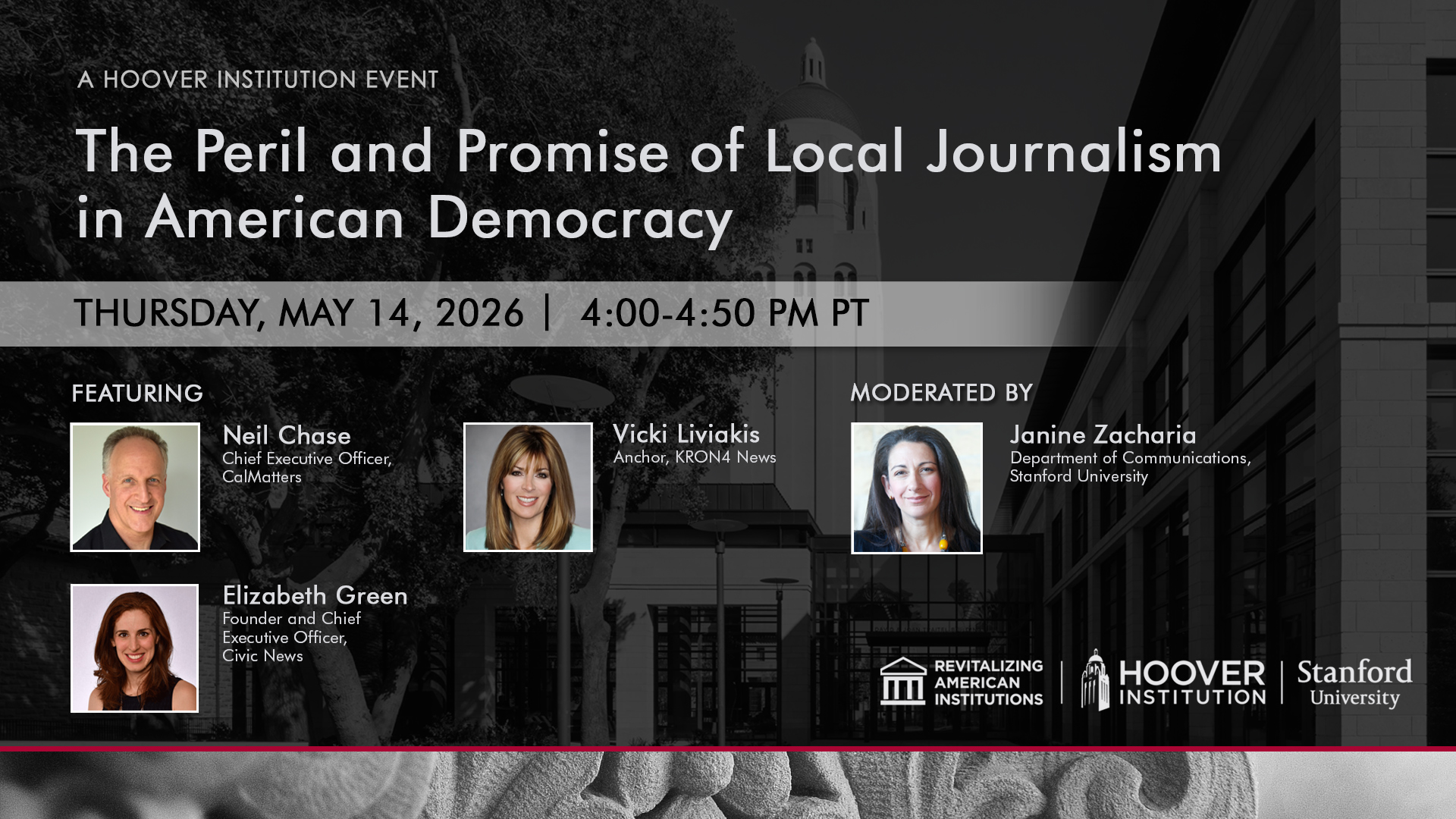

The Hoover Institution Center for Revitalizing American Institutions held a panel discussion on The Peril and Promise of Local Journalism in American Democracy on Thursday, May 14, from 4:00 to 4:50 PM PT in Hauck Auditorium.
News media have undergone massive change in recent decades. A variety of new information platforms have emerged, while traditional news outlets have at times struggled to make the transition into a digital-native era. These developments have been particularly acute at the local level, where many Americans now live in “news deserts.” Our eminent panelists discuss how these developments have fundamentally altered American politics, including regional disparities in representation, the accountability of government officials, and electoral campaigns. Additionally, we consider how the changes have shaped journalists’ responsibilities and media innovations.
- Good afternoon. I'm Brandon Keynes, Roone, faculty de director of the Center for Revitalizing American Institutions at the Hoover Institution. And I'm delighted to welcome you to our panel today on the peril and promise of local media. Possibly no other period in American history has had such rapid change in local and state media as the beginning of the 21st century. At the same time, we've had many new innovations that many that leaders today will be talking about, while many local and state outlets have collapsed and or degraded their capacity significantly, we'll be talking about both those perilous components as well as some of the more optimistic notes that our leaders today have been innovating in. We're delighted to have Janine Zakaria from our own department of communications at Stanford moderate this panel, and she'll be introducing each of the leaders who will be our speakers. But I'd be remiss for not saying just a word about Janine, since she herself is a leader in the world of journalism, having worked for the Washington Post and Bloomberg News before joining us at Stanford. So thanks Janine, so much for moderating this panel, and thank you for sharing your afternoon with us on this sunny day.
- Well, thanks Brandis for that introduction. It's my honor to be here to moderate this panel on the peril and promise of local journalism in American democracy. As Brandis was referencing, the news media, of course, have gone undergone massive changes in recent decades. New platforms have emerged while traditional news outlets have really struggled at times to make the transition into our modern digital native era. And this is, these developments have really been particularly acute at the local level where according to Northwestern University, Madill School of Journalism, their 2025 state of local news report, nearly 40% of all local US newspapers have vanished in the last two decades. And approximately, and this number is quite striking, I want us to sit with it for a minute. 50 million Americans live in News de deserts or where air, they have limited or no access to reliable news. So we really wanna talk about what the impact of that is for our democracy. So we'll talk about how the job of the journalist has changed. We are at Stanford, so we of course have to talk about the advent of ai, both as a threat, I would say perhaps, but also as perhaps a way to create some solutions in reaching some more people with our news. And so joining us to discuss these topics are, I'll just read there abridged bios in the interest of time, you have their fuller bios in the program. Neil Chase at my far left, he's the Chief Executive officer of Cal Matters, the nonprofit newsroom covering California policy and politics. And he was formerly executive editor at the Mercury News and the East Bay Times. Elizabeth Green in the center is the founder and CEO of Civic News Company, the nonprofit publisher of Chalkbeat Vote Beat and Health Beat, which we'll learn a little bit more about what those are if you're not familiar with them. And then she's leading a growing network of local newsrooms across the us And Vivi AKAs, an Emmy award-winning journalist, a television news anchor and producer. She is Theron for news anchor here in San Francisco and began her broadcast career in radio as an anchor and news director at KFRC, right in San Francisco and has worked nationally and internationally. So thank you all for being here. I was looking over some recent stats. Everyone and the Pew Recent Center had a recent study where they said eight in 10 US adults say, when it comes to important issues in the country, Republican and democratic voters not only disagree on plans and policies, but they can't agree on basic facts. And why is this more than half say it's because these groups of voters are getting different information altogether. So I'd like to ask each of you how you see this impacting this division, these silos impacting our democracy today, and what solutions, 'cause this is a problem, those of us who do this for a while, we talk about it a lot. What solutions have you been experimenting with to reach different people on different sides of the aisle? Neil, you wanna start?
- Sure, I can start. You know, at Cal Matters, we're primarily focused on California. And the thing that strikes me about that conversation is at the national level, it's red, blue Trump versus whatever. When you get to local issues, the school issues that the Chalkbeat covers, right? The local issues that we cover, the statewide issues housing in California, when there's a big debate on the floor of the, the state legislature, it's not Democrats versus Republicans, it's urban versus rural. It's NIMBYs versus mbs. It's, it's a more subtle differentiation. And for that reason, it's, it's better at the local level. There's still, there's still problems, right? But the, the, the harsh differences is, is, is not there. And then what we're seeing in certain communities, Stockton is a great example, right? Stockton, California has more people than St. Louis or Pittsburgh or Orlando doesn't have a major university campus doesn't have a lot of things that big cities have. Like at 320,000 people, the newspaper there used to have 86 people in the newsroom. It's down to two. But there are new startups there. And there was a big disinformation site that became the main news source for the city for a long time, which is really dangerous. But these new startups, these nonprofits that were seeing start some non-profits, some for-profit, they, they're picking off pieces of that, and they're starting to share information that's getting more of the actual facts out there and engaging people in the local community. And they build trust by physically being there. So how do solve the national problem? I'm not sure. How do we solve the problem in the state and local things that we do? I think we're, we're in a better position to do that by establishing the trust with the journalism organizations and being physically present.
- Although still a struggle if you're going from 86 to two, right? I mean, you gotta get more, what you're saying is we need to get more journalists out into the community.
- And there are, these new startups have another, there's probably another five or 10 journalists in Stockton now than there were three years ago because these new startups, and hopefully that'll pick up a little bit, when we had 86 people remember, some of them were typing in stories and running copy around the room and stuff like that. There's, you don't need that many people to do a good job on journalism, but you certainly need more than we have.
- Yeah. Elizabeth, you wanna add to that? I,
- I mean, I, I really agree with what Neil is saying, and I think the literature plays this out. So the devastation of local news in the last several decades has created a lot of great natural experiments for political scientists. And so we can see when local newspaper is gone versus when it remains that there's less voting across party lines, there's less down ballot voting in general, and there's generally more polarized dialogue. So I think this is not just something that we're experiencing, but something that the Hoover Institute might publish in a peer reviewed paper or something like that. And, you know, and in my experience with our work, so Civic News Company publishes these three publications, each of which has local reporters in bureaus around the country. And one example of how this works is Vote Beat is our vertical that covers election administration. I would say that we could all agree that is a pretty polarized issue right now in the US because people on the right really don't believe in large numbers that we can trust election results and have real concerns about, for example, voting machine tabulation efforts. People on the left have real concerns about voter suppression. And when Vote Beat goes to a community and it's covering these, the issues of how do you actually administer voting and count ballots, it really, all of those touchstones are hit in our reporting. And yet we have both the hardcore voting rights activists on the left and the hardcore election security advocates on the right as Vote Beats super fans. And what's a super fan? The, I mean, the Republican party chair of the state of Arizona makes videos saying, you gotta read Vote Beat. And so that's, I would say, you know, a pretty MAGA infused Republican party in, in Arizona. But at the same time, voting rights groups are sharing vote beat stories.
- What, what, why do you think that he was so down with Vote Beat if it, if it, it didn't run in accordance, like didn't accord with what they believed happened?
- Well, she, and I
- Think she, sorry, look at me.
- Yeah, look at you. I think she, I think that what it comes down to is that when you are really focused on the same nerdy shit that the activists are focused on,
- We'll edit that out of the video. It's okay.
- I'm sorry.
- That's okay. It's all right. We can handle it and
- Stand. We're on cspan. When you're really focused on the same nerdy details that activists on either side are really focused on, you're showing up at the same county clerk offices that they are, they're calling you for information. Yeah. And you're building relationships with folks. And so they might say they might disagree with conclusions on either side, by the way, I mean, our reporting often shows that claims on the right and the left are not true. That's
- Right.
- And they know the truth. They know that you're
- Telling the truth,
- But they are going to understand that we're just as obsessed with this issue as they are. And so they can get the same details from us that, that they're looking at and they need, and that's where trust is built.
- Yeah, go ahead Vicki.
- I, I'm sorry, I'm sighing because I, I keep coming back to something like basic, you know, media 1 0 1, Marshall McCluen, and, you know, the medium's a message and I, I keep wanting to grab for my device because I'm addicted like everybody else. And what has happened to us is that we're, our, our world is now, you know, narrowed down here. And between the bots and the rage baiting and the, you know, the information overload in a sense, and getting hit from all corners, I really empathize. I feel sorry for people when they're, when we're asking them to, you know, be, become a responsible citizen when we're asking them to, you know, be educated and aware of the issues, you know? So it seems our big battle that we fight is just to engage people, empower them on some level, you know, sit through those boring, you know, school board meetings, trying to try to decipher what is happening in, in budget battles and, and, and to make it interesting enough so that you'll sit through it and somehow, because my, my worry is apathy. I think when it comes to voters, the, the, the greatest sin is apathy. You know, I, I'd rather deal with somebody who's hot and upset and, you know, because that you can work with apathy. If you, if you can't get them outta their home to vote, Then you lose the battle altogether.
- So, Vicki, you're in a very unique position, you know, as people who follow this, know local news is by far more trusted, the most trusted, right. Especially local TV news. Talk about why you think that is, and what is it like for you when you go out in, in San Francisco? I mean, you're, you're a public figure, you're an anchor five o'clock anchor. What, what kind of reactions
- Do you 4, 4, 5, 6 4.
- Five six. So what kind of reaction do you get?
- We do 15 and a half hours of news per day, and it's not a big staff. So I sit there for three hours and Yammer on. I mean, that's, you know, and there's, I mean, I can barely get a potty break in. So I think it's saturation. It's, you know, being the familiar face. I've, I've been with CR for 25 years, almost, I can't believe it. But, you know, they, you're, you're piped into their living room, into their bedroom, God forbid, but they, they get to know you. They, they look at you as a neighbor, as, you know, someone that they, they can count on. So if we're, and we actually do run into them at Target stores, trader Joe's, and that's where I get a lot of my stories. And that's where I have to get into. People come
- Up to you, they wanna tell you something
- A hundred percent.
- Yeah. So you get sourcing. So, I mean, in this, this is why it's so critical to realize that number of 40% down, because there's fewer Vicky's out in the community. And what happens when you have fewer people out in the community, you can be defined as enemy of the people or a traitorous or things like that. Right?
- Well, alternative facts, let's start with that.
- Yeah.
- You remember when that came out? Yeah. Many like, what is that
- Scandals ago
- Or fake news?
- Yes.
- You know, and so once those silly, you know, monikers are out there, then, then we're at fighting that battle just to get to level, you know, so I, and you know, I, I don't know how to battle that, except that you just put your head down, you do your job, and hopefully the storm will pass.
- Well, we're not, you know, Neil, when we were talking, you said people talk about replacing the old days of newspapers, but it's a total transformation and some is never coming back. But what we are getting, we have, we are growing with Chalkbeat and vpe and Harvey and with Cal Matters. So talk about this transformation, the positive things that are happening. Actually,
- It's very different, right? If you remember that Sunday newspaper you used to get, or if you carried it as a kid, those things were heavy, right? The old examiner and Chronicle would become rap of the comics on the outside. It wasn't a newspaper, it was everything. You, it was the, the ads, it was the, the TV guide. It was like, it was your lifestyle all bundled up and dropped on your doorstep. The things we're doing now, and TV news is maybe the closest thing we have to that still giving you a, a, a package of many different things in a, in a newscast. Most of the things that we're doing, certainly the, the, the different businesses that Elizabeth's team has built, specialize about one topic, you know, nationwide around a topic, what we're doing focused on, on government politics in California in a state. The, the difference is that we're covering things we were never covered before. There are communities in Los Angeles right now that are getting good local news coverage they never had before with some of the new startups there that are neighborhood focused news startups supported by kind of a citywide infrastructure. At the same time, the Los Angeles Times is doing far fewer giant stories about the whole area. So I've had people to me, don't just replace the coverage we used to have in Sacramento. You could make it better. It only used to do certain things. It didn't cover certain topics. It's, it's sad not to have all those journalists we used to have, but also even then, we weren't doing as good a job as we could have of serving certain neighborhoods, certain communities, certain topics. And it's, it has changed, but not all for the worst.
- Yeah. Elizabeth, do you wanna add to that?
- Yeah. We're talking about revitalizing American institutions is the broad theme here, right? And so, obviously probably everyone here would agree that a lot of American institutions need are, are being forced to change, and then they need to rebuild trust as they change. And so news is just one of those, and I think we have the one luxury that we are ahead of everyone else because we got decimated a few decades before everyone else, so sorry, universities. Oh, yeah. Or learn from us universities. But I, I really do think we've gotta make the lemons into lemonade. And we are doing that in many ways. And one, you know, for one example, I I, I am old and young enough to have started in the old era and then built been part of building the new era. And so I had the experience of working at the old bundle newspaper where I was an education reporter. And I can tell you that my editors knew Jack, Jack nothing, Jack nothing about education. And now the editors that we have overseeing our same New York City education coverage at Chalkbeat know a lot about education. And so often Chalkbeat reporters encounter readers who say, I don't trust the press. I never did, but now I trust Chalkbeat. And that's what making lemonade out of lemons is, is it's just doing a better job with less and then growing it significantly.
- So Elizabeth, you told me that with your, what you're calling these verticals, vote beat, health beat, sharp Beat, you're looking, your audience is the 15% of Americans who are active in their local community, right? Yes. They're people who are quote, looking for journalism that has disappeared. Why are you targeting those most engaged people?
- Yeah. So we, we call these people civic catalysts, and we, first of all, if you target everybody, you'll reach nobody. So don't try that. It doesn't work unless you're a large tech platform that's going to spread misinformation and social malaise. So let's not try that strategy. And, and then second, like just from the perspective of we have not as many resources. So what is a strategic use of journalistic resources? And by the way, who actually ever read school board coverage anyway? Like, let's be honest, I'm an a total education nerd, and I don't even read all the school board coverage, as you said. I think the meetings are riveting, but sometimes they're not, because some citizen goes on and talks too much,
- But thank you pandemic, because now we don't have to sit in the room, we can just watch it on Zoom.
- I like reading that. We could get into reading a spirit debate about that. Disagree. I like reading it. I don't think we should be on Zoom. I think it's the demise of our country, but I I hear you.
- We'll have to have another panel on that one. Yeah.
- But anyway, I don't know. I I'm trying to say a point about 15%, which is that there are a slice of Americans who are especially civically active in this country. And I think it's a pretty encouraging statistic. In our survey research, we ask, did you take an action recently to do something in your community? And they, we find that 15% of Americans did, and then we find that their information needs, their demand, essentially for news to inform their activity is higher than the average person. And by the way, like who among us is paying attention to every single issue, right? As I was saying, even in, in the good old days, we were probably more often reading the weather report or the sports page, or the movie listings or the classified ads than we were reading the entirety of like paragraph 10 of the city council meeting.
- And if you can reach the 15% of people in a town who are active and engaged in Kara wanna do something about the work, they're gonna make the place better for everybody.
- Exactly. So it's
- Not just about reaching the entire
- World, and they're the trusted messengers to use a public health phrase. Because who do people trust actually even more than local TV news, which is the, the top top. But do they trust other people that they know in their community? And so when I am in my neighborhood interested in an issue, I go to the mayor of my block who I know really cares about it, right? And that's the civic catalyst who's paying attention. And if that, you know, senior citizen or whatever doesn't have the access to the information they need, they're gonna give me less good information when I have to go vote for the down ballot race,
- I can go,
- Well, I'm, I'm grateful to our audience, our demographics on broadcast is, is is high. They're, they're older folks. I'll just leave it at that. And so we are, we're fighting the battle to adapt to where the people are. And the people are again, you know, on the go, they, they're looking at their devices. So we're streaming, we've just created a podcast studio.
- You're learning how to shoot vertical video
- Yourself, right? It's vertical. And then horizontal 16 by nine, which we're teaching our,
- Yeah, - You gotta hit it every which way to Sunday. But we're, we're, we're trying to, we're chasing the younger demographic anyway, which may be a losing battle because quite frankly, they're getting most of their news on TikTok.
- So why aren't you going TikTok?
- Well, we are, I, I'm probably meet them where
- They're at.
- I, I'm one of the last to adapt, but I was one of the first to adapt Kran, just like the newspapers went over the edge before the other broadcast entities. They fired or paid off a of their senior veteran reporters, high AKA highly paid, and went to the VJ model, which you may know as as MMJ. So explain
- What that is.
- MMJ, multimedia journalists. Yeah. Okay. So the newspapers are using it now, but we, we started that, we were actually one of the first in the country. And so we each got a little red car, a Pontiac vibe with a branding on it. And we had a little camera, broadcast camera that used to be, you know, a hundred pounds. And then it was down to, you know, seven to 10 pounds, 4K. And we would shoot our own stories, edit them, and then, you know, put up the live shot. So we then got rid of editors, sound technicians, videographers, sat, sat, truck opera, you know, so a whole line of people gone and it was all the pressure in the work was just this one person. So think about it as a reporter, you wanna be present to ask the questions, to, to, to have your eyes available on all the action. Instead, you're working on your audio levels and making sure that your white balance and whatnot. Kids these days though, are kind of born with the ability to, to, to operate that way. But it, I believe it kind of bifurcates your brain and it, and, you know, attention span is affected by it. But that,
- I mean, what you're talking about though is expanding your audience. Okay. So you're doing it through learning these new techniques, maybe shooting for social and all that. And so Elizabeth and Neil, I feel like you both, I mean, you've got this amazing content well reported and you've gotta get it though in I, I would like to see it beyond the 15%, Elizabeth. I mean, even if you hit the 15, so are you giving it away free to local news? Yes. Yeah. And you're, and making it available. 'cause I would love then Vicky says, oh, today we had a report in vote B. And we have that, we have a lot
- Of that. We do have a lot. There's a lot of synergy.
- Yes. - In fact, I should talk to you about that after.
- Yeah. Our, our, we have our, when, when I say that we're targeting the 15%, I mean that when we publish our stories, our newsletters, the, the intended audience is that 15%. But when those people then are sharing our stories, they're sharing it much more broadly. When Apple News is sharing our stories, it's much more broad. We have active and robust, sometimes weekly partnerships with local television news to make sure that a, a broader public can reach that. And it's exactly the same at Cal Matters.
- Exactly the same we are that we started with the premise that we're gonna give our news away free to any news organization in the state because we want people to be able to have it. But it turns out just giving it away, I was the editor of the Mercury News when Cal Matters started, and they would give us the stories for free and somebody had to go find the story and take the time to publish it. And so we usually use the stories when we had a hole in the paper and it was, it was deadline. Right? It turns out that when you really partner closely with people and become close partners, we're very close now with all the NPR stations in California. They treat us like another station. We share stories, we work together. The morning of the fires in, in Los Angeles, right January 8th, we were texting back and forth for about a half hour among the three media stations there on Cal Matters. And we agreed, let's build a whole new product. It's a newsletter with all four of our report, all the reporting from all four news organizations put together in one newsletter about the fires and then distributed back out to all of our audiences. That entire product was built in like half an hour of texting back and forth because we had these trusted relationships. We used to fight. We used to, that's what
- I'm saying. This is so,
- It's so different, different what you're
- Saying. 'cause it was, everybody was so competitive before, but these cut have forced this, we've been forced into this,
- Which is maybe better. I was in a news room watching Prime tv, right. And, and seeing like, do they have the story yet? Great. They haven't got it yet. We're gonna Right. We're gonna beat 'em. We're gonna beat beat 'em. Well, to be
- Honest, we
- Six steal
- Stories from the newspapers anyway.
- No, that never happened. Except every day. Right? Right. Except every day. Except every day. It's so different now. 'cause they, most of us, there's a couple places Los Angeles Times that haven't started becoming completely, you know, collaborative with everybody, yet, hypothetically, but we all now understand A, we're too small to do it on our own. B there are brilliant people doing things. I'll give you a great example. I'll talk about the person next to me. Like she's not sitting right here in 2020. You and your product leader were texting like at midnight or something crazy. And you said, this election's gonna be a crazy thing. We need to help people understand it. We should just dump all the education coverage and cover elections instead. And then you became sane five minutes later and said, no, let's do both. But you created vote beat outta thin air. You reached out to folks like us and said, can you do the California part? And we said, sure. Yeah. And a new product was born that was covering an issue that had to be covered that wasn't as important, you know, years earlier. Right. And so by doing these things collaboratively, by sharing everything we do, and by getting outta that tit for tat thing, if your team calls me up and says, can we get this one thing we need help on? I'm like, sure, we just help you. It'll, we'll sort it out later. It's, it's, it's a different environment. And that allows us, I think, to be better, better service to the folks we're trying to serve.
- I have an example of that, which is the Chicago, I don't know if you guys have heard of the city of Chicago. It's really known for very robust local demo democratic health. And that was a joke, you know,
- Where all the
- Governors have
- Gone to jail? Yes.
- Anyway, they recently did a, a big shift in the way the school board is governed. And so it's not, there are a lot of elected school board seats in Chicago. So suddenly overnight, like everyone in the city of Chicago has to find out that they need to vote for school board and what do, they don't even know what district they live in. And there's all these candidates running. And so we, instead of like competing with the lo all the local media, we do this big collaboration that Chalkbeat Chicago team leads. And so there are interviews with every school board candidate, like with detailed policy questions that, by the way, I never in a million years would've been able to get into the paper back in the day. Like, because the editors are like, that sounds boring, but you're like, what matters? But now we can, and not only that, but we printed a print version with the Chicago Sun Times. We were on WBEZ and now there's gonna be a whole other expansion of this elections this year. And now we're partnering, I think with over 20 news organizations to get that done. And so that's just like, not the way things happen, but as a result of this, just as I said earlier, more people voted in the school board elections that like the turnout was incredibly high nice. Like really like astronomically high for a school board race and more. And, and there's like a whole other kind of polarization and education that isn't Left right. But there's union and, and charter school basically. And more of the independent candidates who weren't backed by the kind of big money won in that school board race. And that's exactly the kind of what the research would've predicted. And it happened. And I think that's healthy and good.
- That's huge.
- It's a great metric. I wanna talk, I wanna shift the, the conversation a little bit to our current political environment and threats. Threats to journalists, both physical threats, but also governmental threats from the FCC threatening to investigate newsroom. You know, every
- Department of government,
- I mean different, they're coming from different ways and defamation suits, harassment, you know, there's a lot going on that could have a very serious chilling effect on our ability to report. Neil, do you, do you wanna reflect on our moment?
- Yeah, I mean, we've seen certainly things where the administration has gone and done something legal against a television network or some large organization. And they've either fought back or, or capitulated to the dismay of many of us. But there are a lot of other things that we're watching for, for instance, we run nonprofit organizations, right? We are not, and in, in the tax code, the ability to be nonprofit is because you are religious, educational or something else. And none of that says journalism. We, every time when a news organization becomes a nonprofit, we treat it as education under the tax code. Well, it'll take one stroke of the treasury secretary's pen to say, you know what, journalism's not educational. And so nobody who donates to it, to cow matters or to Chalkbeat anymore is gonna get a tax deduction. There are threats to sue us for every story we write, which, so there are people who are filing lawsuits, but now we get hate mail from readers saying, you're gonna get sued for that. Like Trump is gonna shut you down for writing that story. There, there's this conversation about every time you don't like something, you take it to court. Where did they get that idea? I, I have an idea. So it's, it's an environment where people are trying, it is a chilling effect. They're trying to slow you, slow you down from doing your job. The sheriff of Riverside County who's now running for governor went out and confiscated 600,000 ballots because he decided that there might be some election fraud and took them, like, took possession of them to count them. A number of news organizations went out and filed lawsuits, and we all invested in these lawsuits and we got it, we got the ballots back. But it would be very easy to say, I don't wanna do that, because then what if they take away my tax status or something else? And, you know, easy to be really noble about all this stuff, but I've got 80 employees who count on us for a paycheck. So it's hard, but you have to, you've gotta stick to those principles and try to make it work and know that a lot of it is bluster as opposed to anything that even if it got to court could ever actually cause something. But just the,
- The chilling effect that the chilling it has on everybody else,
- Paying lawyers to fight something that is,
- That you're gonna, well that's it. I mean it's just distracting newsrooms you have to, the lawyers, the, the newsroom lawyers are just way too busy right now.
- Yep, yep.
- Vicki, I mean, we'll talk about a different kind of threat with you. I remember when I used to go out with teams when I reported in the Middle East, we would put tv, we would put TV on, on the, on the, on the outside of the van with mask tape, hoping they wouldn't shoot you so that it would be a deterrent. You would never do that in Oakland now.
- No.
- So tell, talk about how Kran is dealing with danger.
- There was a vendetta against those little red cars I told you about that had the branding because one of our reporters was doing a, you know, standup, I think it was an Emeryville, and two teenage thugs came up and, and wanted his camera. He said, Hey, cool, take the camera, you guys are good. He walked away, we had security as a backup. And the, the, and these are moonlighting cops. So he was quick to the draw and said, drop the camera. The teenagers did not drop the camera. They, they drew. So he drew faster. And the way it was reported in the papers the next day was that, so the, the police officer security shot the, the teenager in an area that was not his leg. And so it was, anyways,
- It's
- Dangerous. It's okay. It's then another incident happened in Oakland where our security guard was killed, was shot and killed. Kevin nida, and I don't know if you've been following the local news, but it was traumatizing to the reporter. She had PTSD and had to get out of the business.
- Yeah. And you're, and you're seeing this, there's these threats now. So you have to, you have to be more discreet now when you're out. You can't go with the big camera. It's safer to shoot
- With small camera. That's why I tell you, these things have gotten so good that I shoot a lot of my stuff on this and then I just put it up on Latco and it's on the server and it's on the air within, you know, seconds. So I don't, I I was carrying a camera, not the big a hundred pounders, but the, you know, little 4K and don't even need that. The advantage also is that you're viewed as a, you know, just Joe person on the street because as a journalist these days, it's not like you're everybody's friend and you know, I I just, I'd rather be under the radar.
- Yeah. There have been some very high profile attacks on journalists. There was the killing of journalists in Annapolis several years ago. And just, you know, personally I wanna say that when President Trump before the 2024 election set at a rally, I wouldn't care if someone shot through the press to, you know, to get to me through the press. They'd have to shoot through the press section. I'm paraphrasing and I wouldn't care. I had a former student who was covering that and you know, he spoke to me later about just, you know, how chilling that was. And so, I mean, there is this environment that we're in that it's not only about dollars and cents and how it's hard to make do with less and all this, but that I think people who are trying to do this kind of journalism are, you know, literally perhaps in danger.
- Yeah. We, and I think, I think the, the arenas that we're covering are also under terrible violence threats. So whether it's the county clerks who make almost no money but have to administer our elections, or the people who do public health work that health beat covers or school teachers, like the, if you're in public life or certainly elected officials, right, you're facing violence more frequently and the threat of violence. And so anyone who's in that arena is also part of that and has to make a different set of decisions than we had to make in the past. And then I just wanna say that I think what is I also see as, as pervasive, I don't know what you guys see this, but it's, it's harder to be a reporter of public institutions and also public companies I hear than it was a decade ago. Just much harder. Like, so we, our reporter Jesse Gomez in Newark, New Jersey, was covering a school board meeting at which members of the school board did something that was out of order, which was kind of basically kind of secretly extended the contract of an unpopular superintendent. And she was like, oh, hi, I'm the only reporter in the room, I'd like to note that, I'm not sure I have some questions about this. And she was physically intimidated and they tried to like, take her out of the space. And this is, you know, a not the largest city in the country, but not a tiny small town. And that's a climate where we have had a lot of trouble just getting basic answers from government entities about, you know, taxpayer funded programs. And so that's the climate that reporters are working in across the country when they are working. And I think that's almost more point, it's a really important point, insidious point than
- Violence. And when you're watching national news and the scrum and, you know, our president is attacking, verbally attacking, especially female reporters. I mean, it sets a tone and it kind of makes it, you know, I guess
- Opens it gives permission, right? It, it, it lets somebody else thinks that the president can do it. I can do it.
- Yeah. I mean it's just, it's sort of like the, the compact, when I would report, and, you know, when I was reporting in Washington, say from, I don't know, the decade of the first 2000 to 2010, you know, you knew you were gonna, maybe they wouldn't give you a comment, but they'd at least give you a no comment, right? Or you would be able to talk to officials on background, whatever. You'd be able to, there was like a, a system in these things.
- They would answer the phone, they would call you back,
- Right? And now it's like, I don't need to talk to you and in fact I'm gonna assault you or like get you out of here. And so that's definitely part of it. So we have about 15 minutes and then we're gonna open it up to you now. And I, I believe someone's going to be going around with the microphone, so here they come. So please raise your hand and identify yourself. If you'd like to ask a question, direct it to whoever you want. We have one right over here.
- Hello, my name is Isabelle Ismail. I'm a senior research program manager here at the Hoover Institution. I'm also involved in my local city government at a nearby town. One thing that is kind of different from what you guys were discussing in my experience is that the discussion about politics and policies in local towns can be equally polarized as at the national level. And in our town we have one out of town reporter who watches the city council meetings on Zoom and then writes stories. And oftentimes we feel that maybe she has a certain slant and it's only one side of the story getting reported. So I'm, I'm wondering if you think there's, and this is, it's a small town, so it's not like a lot of people are rushing to cover. So I'm just curious if you think that there's, how do you encourage competition when you kind of rely on nonprofit newsrooms and what other ways might there be to encourage balanced discourse?
- Yeah, there are, there are a couple programs out there that are trying to address that. There's one called documentaries that started in Chicago training people in a community go documenters documentaries to, to training people in a community to go into local public meetings, take notes, share what happened, not necessarily expecting them to be the journalist who's gonna track down that illegal vote they just took or something like that. But getting the information out. And then there are more and more tools coming that are being built right now that allow anyone who wants to, to go in. For instance, you would go in the next day with these tools and say, I'm gonna make my own report about the school board meeting or the city council meeting, and I'm gonna listen to the video and I'm gonna take some video clips and say a little something about it and I've got a piece I can put on TikTok or on Facebook or wherever you wanna put it in your community. And some folks are taking responsibility for doing that on their own in the communities, which is not the old model of a professionally trained journalist going in there, but there 483 cities just in California, right? We're not gonna get people in. There's a, a a a program now at Berkeley that has put 80 new journalists mostly in smaller newsrooms around the state with state funding, right. The, the state of California is paying for this. Got
- One in the room, there
- You go
- Over there.
- And, and the funding just got renewed. It was proposed to be renewed this week. So tell
- Gavin, we need to tell Gavin that.
- Yeah, it's, there's, there's more money coming in the budget. It, it, it, we're not gonna get journalists to do all the things they used to do, but there are other ways to accomplish this and we're gonna have to see how communities figure out, you know, how to deal with this need.
- I would just like to say that we should ban zoom meetings for public meetings. Go, because, oh, this is part what you were saying. Yeah, well, well here's my concern. Imagine you do have a reporter, which sounds like you do. Then if, and oftentimes I'm hearing our reporter say nobody is going in person, right? So the, maybe some people are in person and it's hybrid, but sometimes everybody is just zooming in. And so when are the moments when a reporter could actually like read body language or go ask somebody to coffee or go talk to the person who's in the back row who didn't speak, but is like really vigorously has an opinion and you're like, oh, what do you think? And they're like, well, did you know that they just are corruptly spending all this money? And you're like, great, let's go for coffee anyway. That, that's the way that like people learn things. And so now we have a AI crawling all of the school board meetings and we, I mean literally we chalkbeat have AI crawling school board meetings that we as much as we can and try to get stories from that. But it is so imperfect. And at the end of the day, what you're describing I think is like just way too common and actually a better case scenario, which is that you have somebody watching on Zoom and so this is a big effing problem.
- No, but listen, Elizabeth, I mean I I became out of, a lot of it came out of COVID obviously, but if I have a choice between some, you know, nobody going, 'cause they can't still, we still don't have the people. Right? I
- Know.
- I mean, so I mean Zoom has opened up, at least some people can have exposure to the issues and then we can do like, you know, Cheryl, my colleague, they can like, have all the transcripts of it and they can, we can use ai. You built an AI right there. Aren't they scanning all the legislature? So I'm not, I just wanna push back a little bit on this, you know, effing zoom thing as you put it. Like it's, it's not, you're,
- You're right, you're right about all that. And I'm right, like it's
- Mixed. Yeah, yeah. We're both right. Real quick. Okay. Let's get to some more questions. Yeah, yeah. Go.
- Hello. Thank you so much for this insightful conversation. My name is Jean Kova, I'm a content development specialist here at the Hoover Institution and common from journalistic background in countries like Russia and Belarus. And I have a question about exclusivity. You were mentioning that media outlets voluntarily and happily share with each other all the data they possess and, and basically become in France. So how do you treat exclusivity right now? Or it's not like what I mean is put in the story first being first reports. How do you protect
- The
- Scope sharing, right? How do you protect if you are sharing the details? Well, you don't, so it's not the thing anymore.
- This is an easy
- Solve problem.
- Problem. Well, yeah, I mean if it's an exclude, you run it first,
- Right? Then it's all, and then the date is available, you see?
- But no, you don't share
- And they credit
- And credit.
- Yeah. - And it depends on the nature of the story. When we do a story about the DMV giving licenses back to people who are killing people with their cars, that's a story that we worked on for a year and a half the day we break it. Sure other people are gonna talk about it, but the story's still coming from us. We, we make a conscious effort not to cover breaking news stories that somebody else's covering unless we have special expertise on it, we're too small to do all that. Right. And so it is, it is less important because we are less worried about getting credit for having broken the story. If it's something really big that we worked on, we will get that.
- Well, there's that other level of the legality of it, so you have to run it through all your lawyers and then everybody else is a beneficiary of that. That's right. That's right. So you've already taken the hit. That's right. So I can
- We, yeah, yeah. I wanna give my colleague Cheryl Phillips an opportunity to talk who's founded our big local news, which is a big part of the solutions here.
- Hi, I just, I just wanna say that I think there's a, a new collaborative model that is working and, and I think Chalkbeat has been a part of this from, from time to time as well as Cal Matters. But you can, you can work on a big project, you can work on a big story and, and know what your lane is, and then collaborate across news organizations and time the publication. We did that with the, the Fentanyl, Baltimore Banner, New York Times investigation where we ended up sharing the data and findings and providing resources to 11 local newsrooms. And we all published pretty much aligned. And you know, I think that that drives change because change happens at the local level.
- That's right. That's right.
- Hi Demares, I'm a Knight journalism fellow here at Stanford. Given the title of today's talk and the recent developments around the Voting Rights Act, can the panel talk a little bit about where covering and informing communities of color plays in? And I noted that the panel doesn't have any newsroom leaders of color, and can you just talk to that a little bit?
- Sure. I mean, I mean, we, we, in our newsroom, we strive to make the newsroom match as much as we can. The demographics of demographics of, of California, I'm the only white person on our leadership team, but it's much, it's, it's much deeper than that, right? Because no matter who's in the newsroom, if you're not making the effort to put the news in front of people who are gonna find it useful, then you're not achieving your goal. And so, you know, there, there was a time right when you would write your story, you would give it to your editor and you'd be done. You'd go downstairs to the bar, next to the newspaper and you start drinking because you're, the goal is just to write the stories. Now it's as much about getting it out there. And so we have an impact team in the newsroom, and their job is to, it's a huge part of our team and their job is to take every story we do and think about who would benefit from the story, who needs to know about it, who would find it useful, and then how do we get it out there? And we go out and find partners for our bigger stories. A little bit like Cheryl was saying, like finding the local news or, or the, we work a lot with ethnic media, we work with community news organizations. We try to figure out where this would be useful and how to put it in people's hands, who are, who are gonna find it useful. But the, the challenge I talked about before of old, older news organizations didn't really serve a lot of the communities in their geographic areas is still a big problem. And what I'm especially happy about is these new efforts a little bit like your, your your town you were talking about, right? Somebody in a community sees a need and philanthropy, I was with the League of Community Foundations, they're, they're all over the state now. They're starting to step up and say, we're gonna raise local money for very local needs, a community, a, a a, a demographic group, a a a group, people speaking in certain language where philanthropy will step in and help make that happen for that group that needs to be served. And so it's not enough now just to do the stories and put 'em out there. You have to be equally conscious about who you're trying to get it to, who would benefit from it, and what is the effect of people in your community getting it or, or not getting it. And work really hard on that.
- Tamma, do you wanna highlight some of the news outlets that, you know, are specific to the communities of color that are, are doing well or, or are funded well or not funded as they should be? Or
- An organization like Houston Landing founded and burns through nearly $20 million in 18 months. And so that's a very frustrating thing coming from community news and coming from community news that serves communities of color to see money being dumped in, in large quantities into non-profit startups, some of which are successful, some of which are experiments, but local and ethnic media that's been there for decades. It's been serving communities that have been largely ignored by large institutions are, you know, fighting for scraps. I'm pretty sure that if you look at the amount of money that the Black press has gotten from philanthropy over the last 10 years, it's less than the amount of money that got put into Houston Landing. And almost nobody is talking about that within nonprofit media or philanthropy. And I think that we should
- No, you're right. I think for raising that important point. Just one second, Neil, if you don't mind, Elizabeth, I mean, you were involved, I mean you had, you led the summit for Local news in partnership with the MacArthur Foundation. You published a roadmap for local news in 23. I know that you're not, and then this led MacArthur to invest in a $500 million, what's known as Press Forward Initiative for local news. And I know you're not involved in the decision making on how they, they spend the money, but talk about DeMaio critique here. What do you think?
- Well, I think it's a good one and I'm glad you raised it. And I think, you know, just like the trend in philanthropy, as in a lot of the country was, is that it's, there was a passing, a passing investment that after 2020 that has not been sustained or persisted in the black press. And I think that's notable and important to say. And I, I think that there's also some of the efforts to do corrections don't work well. So, you know, there's a lot of efforts to try to invest in leaders of color, of newsrooms or organizations with leaders of color and then not actually financing them. And then, you know, how's that helpful at all? So how do we solve this problem? I think has to, we have to think about the larger solutions as we re-envision American institutions. They have to be in service of all Americans. And that, by the way, also really includes, I think, many different groups and that are not being served. And I, I guess I would say, how does Press Forward have to do with that? I think press forward included a lot of the recommendations of our report roadmap for local news, which were about reimagining institutions. And I won't comment on how financing is going because I don't think know
- Yet, but basic think what they're doing is they're, they're, it is a way for them to give money to local news, organ news outlets, right?
- And to foster local support for the, the whole idea behind it was that they would foster the development of local philanthropy to support those local newsrooms, right? So you, you start by seeding it with money, but then you build that local support. It's happening in some places, but not, not enough.
- It's like there's a lot of dissatisfaction with the effort, I would say in the field. Probably some people here know about that because when you commit a really big philanthropic number, then you feel pressure to give it, spread it to every single institution. But when you spread it to every single institution as best you can, each one is getting a $5,000 gift. And it's like, thanks so much. I can pay a reporter for a few months. Yeah.
- And - Now what's that? Where's that gonna get us? And so ev that can be disheartening because we don't wanna think that major philanthropic commitments then go to waste. But I, I definitely see positive energy, positive trajectory in philanthropy that we, you know, even if we're not where we wanna be, still having the message sent that philanthropy should be involved in journalism is an overall good thing. And that's the direction we're seeing.
- Just wanna add, Vicki, I want you to have the last word here. We've got some students here in the audience. I think we've made the case for that. We need more local journalists, right?
- Absolutely.
- And
- We're hiring younger the better. Seriously
- You are.
- Yeah. You whatcha hiring for
- Oh yeah,
- Yeah. Every day.
- Every day.
- Because people cycle in and out. So,
- But I mean, for me, being a journalist is the best job on the planet with all the negative things that we talked about.
- Yep.
- And that's why I'm doing this. That's why I've been here 15 years teaching the next generation of journalists to go do accountability reporting. 'cause I think our democracy needs it. And you've been at the forefront of all this and I just hope that you would echo me by saying that it is the best job.
- Absolutely. I mean, if I, I hope we didn't come off as being negative because we do this because we love it. Because we hope that we are able to elevate our, our communities and to engage people and to have democracy lived to fight another day. Yeah. Alright, well please join me in thanking our panel and thanks again to you
- RAI for having us.
- Alright.
- Enjoy the rest of your day.
- Okay. And I'm gonna, I forgot.
- Oh,
- He'll roll a picture.
- Oh, I have a picture.
- Yeah, I a way out. Okay. So that's a newsroom. That's our newsroom. And there is the AP style book. I'm not sure anybody has read that. Yes, we use it. We have a digital
- Version. We use it every day.
- And just to give you an idea how, what happens is days without a BART incident, 29, this is where our priorities are. And then right below that, go to the next, oh sorry, go to the next, the next is a tighter shot, but it is the yo tighter shot. Okay, there we go. Iranian nuclear weapon site warning. So this is the modern day newsroom, local news. This is how you have to think. Thank.
About the Speakers
Neil Chase is the Chief Executive Officer of CalMatters, the nonprofit newsroom covering California policy and politics. He was formerly Executive Editor at The Mercury News and the East Bay Times in the Bay Area, and was a journalist at the San Francisco Examiner, Arizona Republic, CBS MarketWatch, and The New York Times, and was an assistant professor at Northwestern University's Medill School of Journalism. He currently serves on the boards of directors at LION Publishers and UNITE-LA and previously chaired the Board for Student Publications at his alma mater, the University of Michigan.

Elizabeth Green is the Founder and CEO of Civic News Company, the nonprofit publisher of Chalkbeat, Votebeat, and Healthbeat, leading a growing network of local newsrooms across the United States. In addition to Civic News Company, she led the Summit for Local News in partnership with the MacArthur Foundation and published the Roadmap for Local News in 2023, helping to spur MacArthur’s $500 million Press Forward initiative for local news. She has also written for The New York Times Magazine, U.S. News & World Report, and The Atlantic.
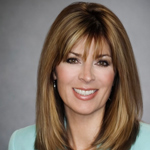
Vicki Liviakis is an Emmy Award–winning journalist, television news anchor, and producer, with decades of experience in premium nonfiction and narrative storytelling. She is a former national network correspondent and anchor for NBC, CBS, Fox, Paramount, and PBS, with international reporting across Europe and Asia and the creator of acclaimed series and documentaries for cable and public broadcasting, earning multiple Emmys and a Webby.

Janine Zacharia, a former journalist for the Washington Post, Bloomberg, Reuters, and other news outlets, is the Carlos Kelly McClatchy Lecturer in Stanford's Department of Communication and a winner of the 2020–21 Dean’s Award for Distinguished Teaching in the School of Humanities and Sciences. She is the author of several playbooks, including How to Report Responsibly on Hacks and Disinformation, and Polarization and the Press: 12 Ways to Restore Respect for Your Reporting.