







- Security & Defense
- US Defense
- Determining America's Role in the World
Executive Summary
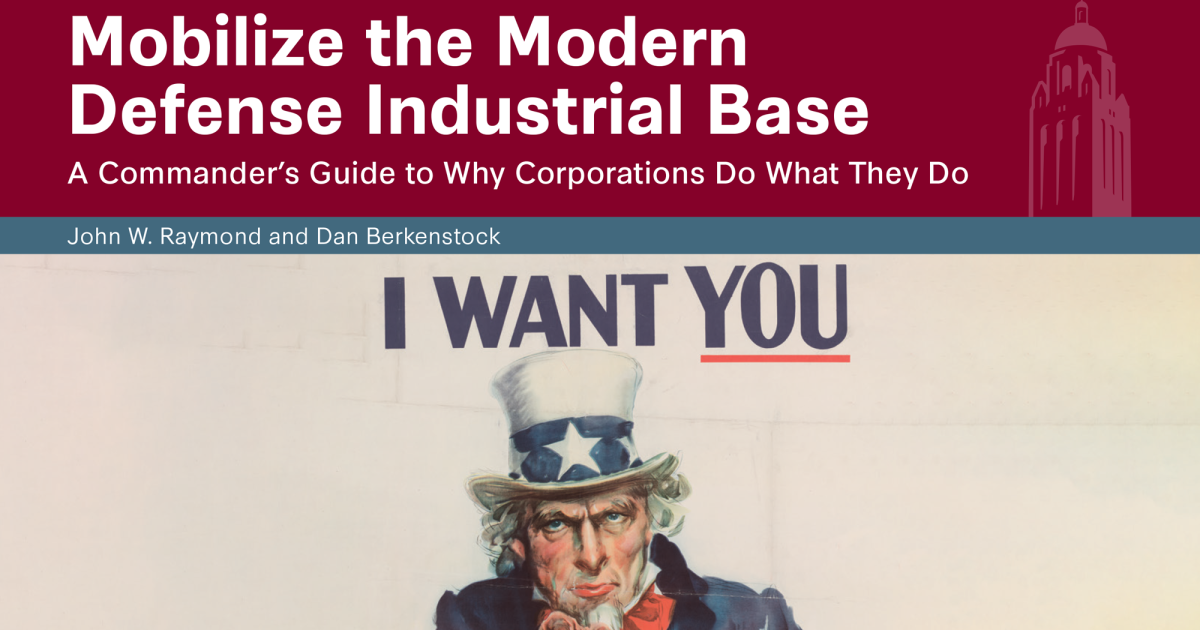
America's greatest strategic advantage in the competition for military dominance is not its defense budget but its commercial capital markets. In Mobilize the Modern Defense Industrial Base, Gen. John (Jay) Raymond (ret.), founding chief of space operations of the US Space Force, and Dr. Dan Berkenstock, founding CEO of Skybox Imaging, offer military commanders a practical guide to unlocking that advantage. Published by the Hoover Institution's Technology Policy Accelerator, the briefing confronts a fundamental asymmetry: While adversaries like China can compel their entire economies to serve national security objectives through military-civil fusion, the United States must persuade its commercial sector—and the investors who control it—to align with defense priorities. That requires commanders to understand a language most military leaders have never been taught: the language of capital markets.
The briefing delivers three concrete lessons that any commander can apply immediately. First, whether a company is publicly or privately held determines its appetite for risk and its willingness to make long-term bets on defense programs. Second, the real decision influencers at most technology companies are not the executives in the room—they are the venture capitalists, private equity firms, and institutional investors behind them, each with distinct financial incentives that shape corporate strategy. Third, knowing where a company sits in its funding lifecycle is the master key to influencing its direction: Early-stage companies need contingent contracts more than grants, while mature public companies need predictable revenue. With US private capital deploying nearly the equivalent of the entire defense budget each year, commanders who understand these dynamics hold the key to mobilizing an industrial base that no adversary can match.
Key Takeaways
- The distinction between whether a company is publicly or privately held often has the largest first-order impact on its behavior, because that single fact determines its risk tolerance, success metrics, and time horizon.
- Investors are often the ultimate drivers of corporate strategy, and what companies do or don’t do is explained largely by investors’ financial incentives: steady returns for public institutional investors, big bets for venture capital, efficiency gains for private equity.
- Early-stage venture-backed companies are uniquely positioned to pursue bold, mission-aligned capabilities, but more than immediate research dollars, they need contingent contracts from defense customers, because future revenue commitments are what unlock their next funding round.
- The United States deploys private capital at nearly the scale of its entire defense budget each year, representing a massive latent resource that commanders who understand investor motivations can help direct toward national security ends.
Mobilize the Modern Defense Industrial Base by Hoover Institution
Cite this report:
John W. Raymond and Dan Berkenstock, “Mobilize the Modern Defense Industrial Base,” Technology Policy Accelerator, Hoover Institution, June 2026.

