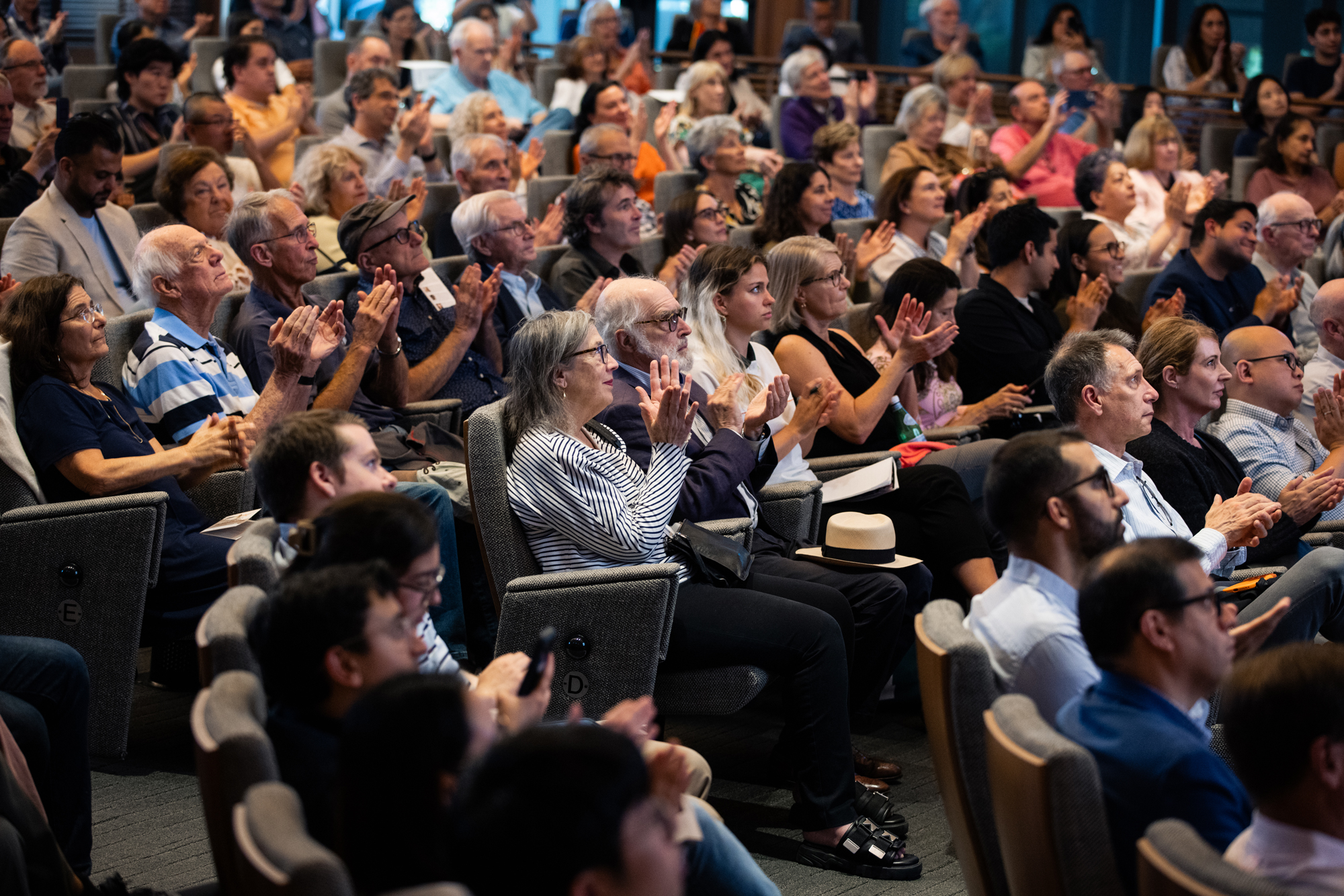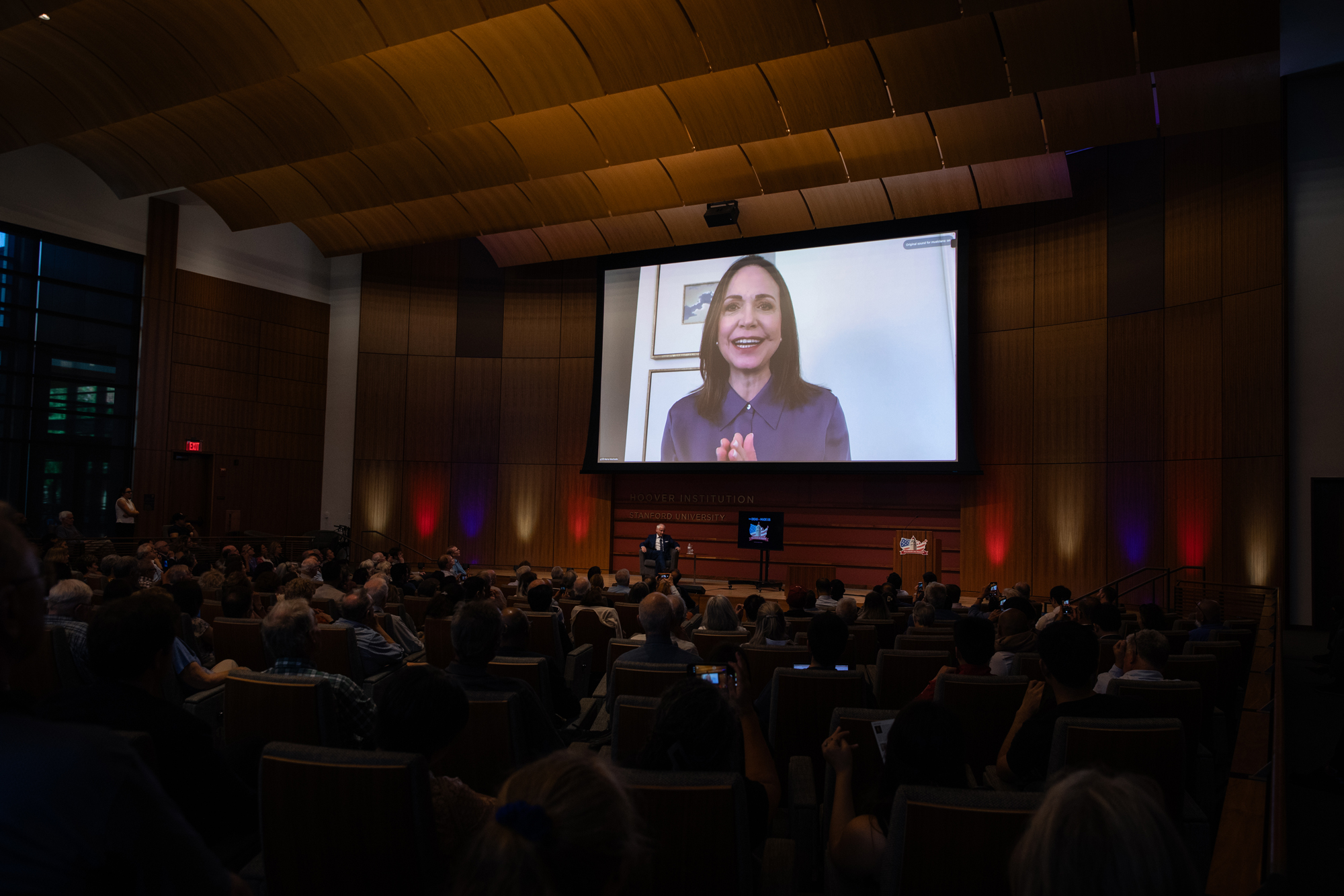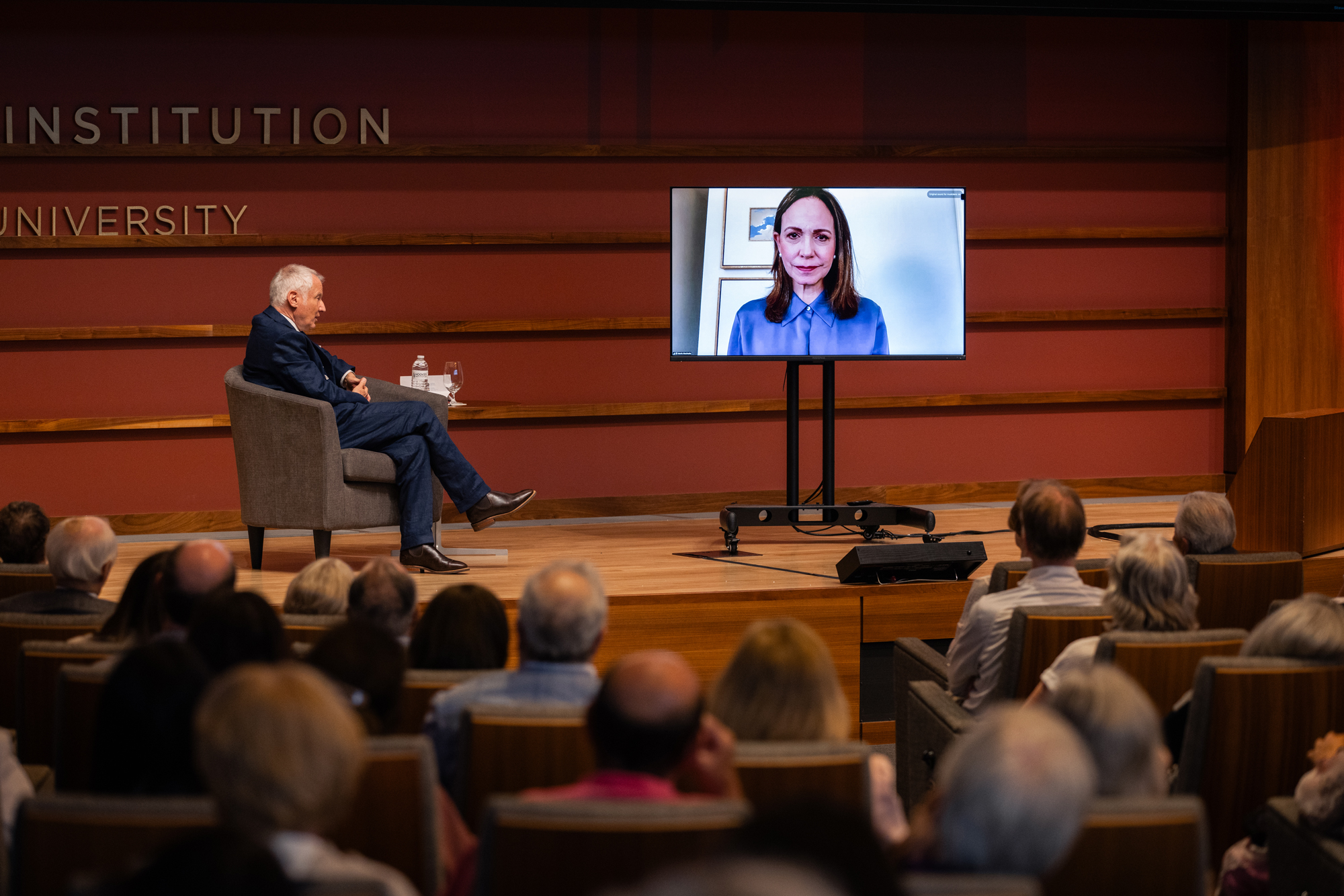
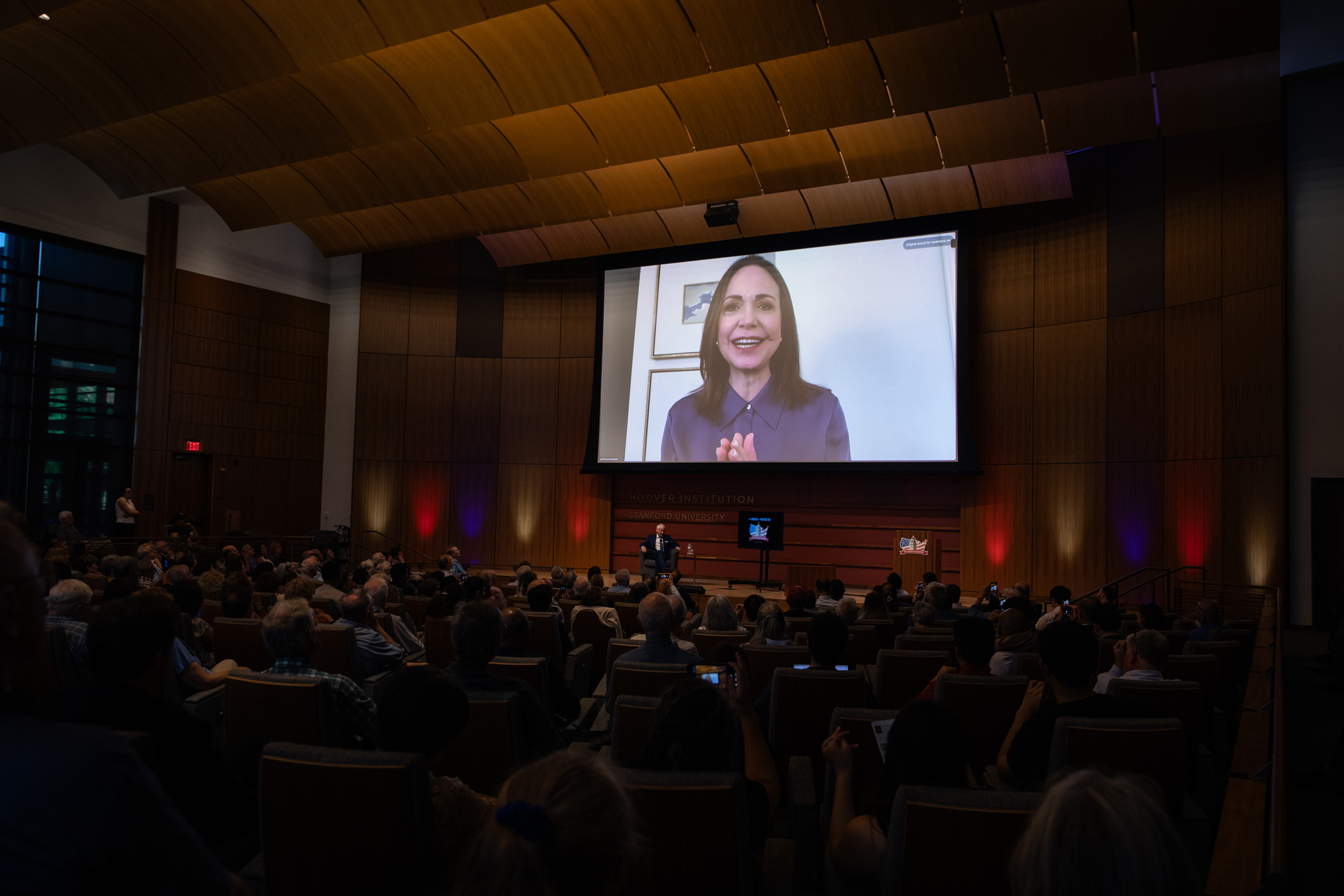
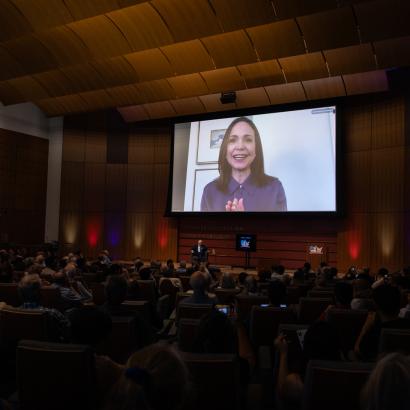
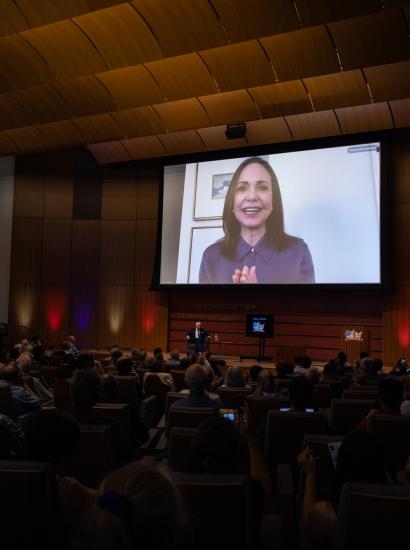
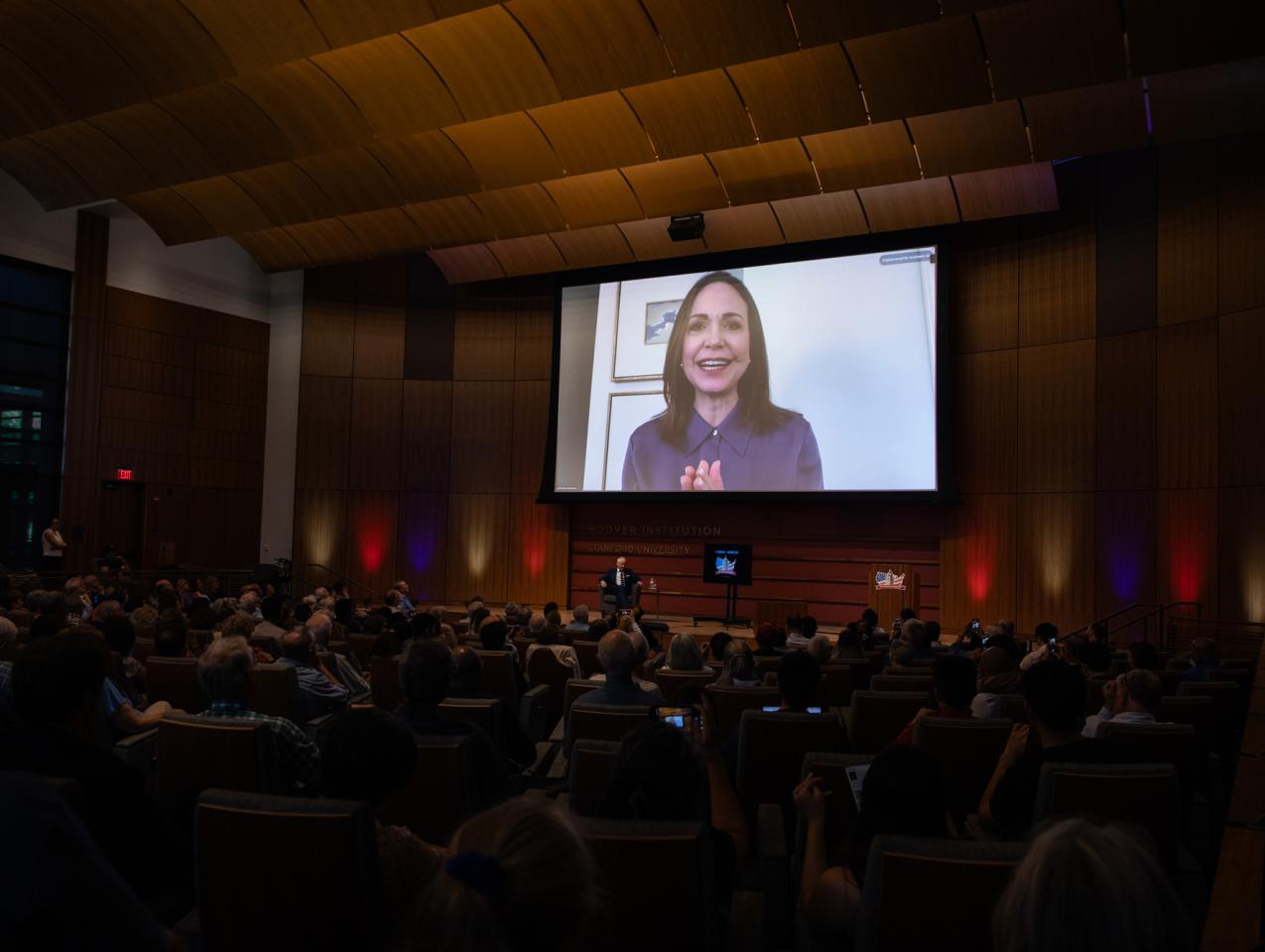
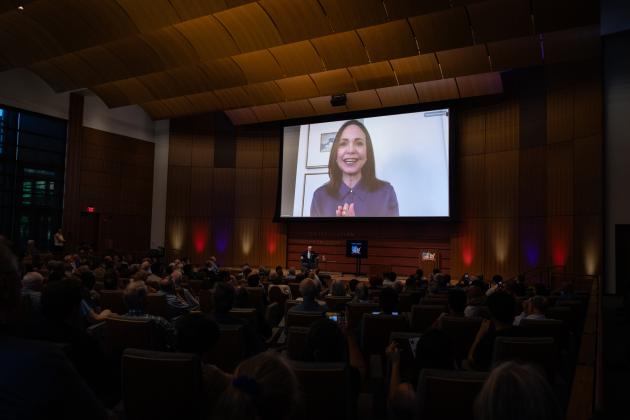
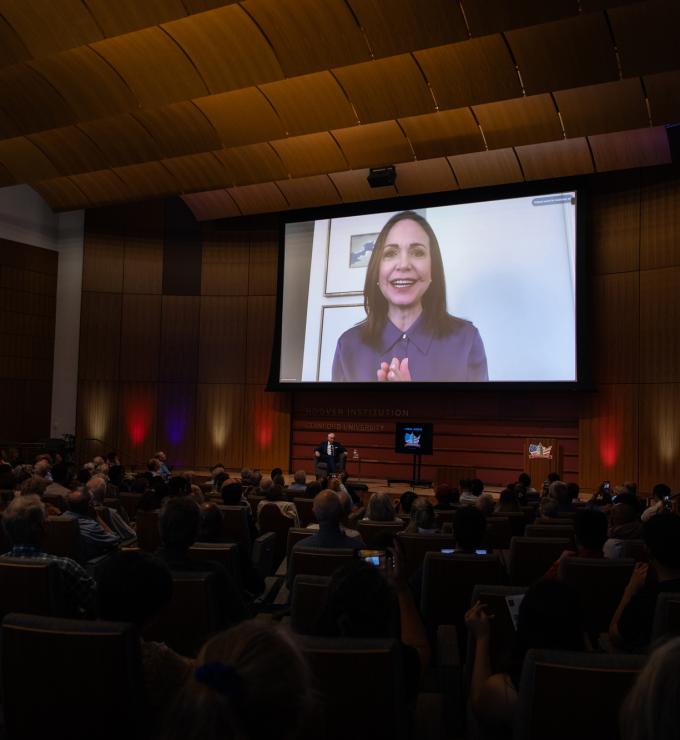
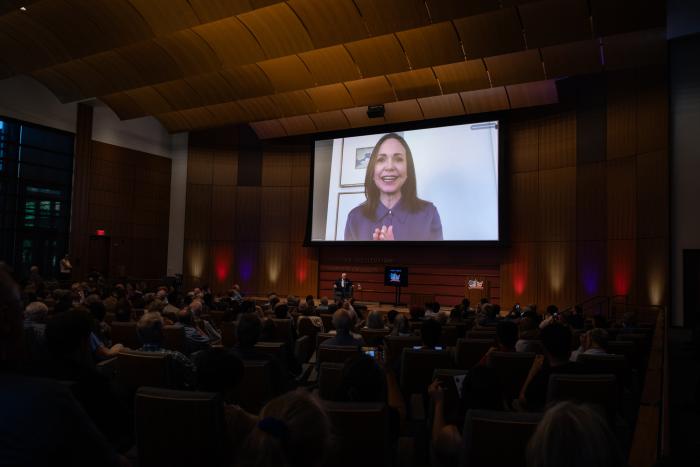
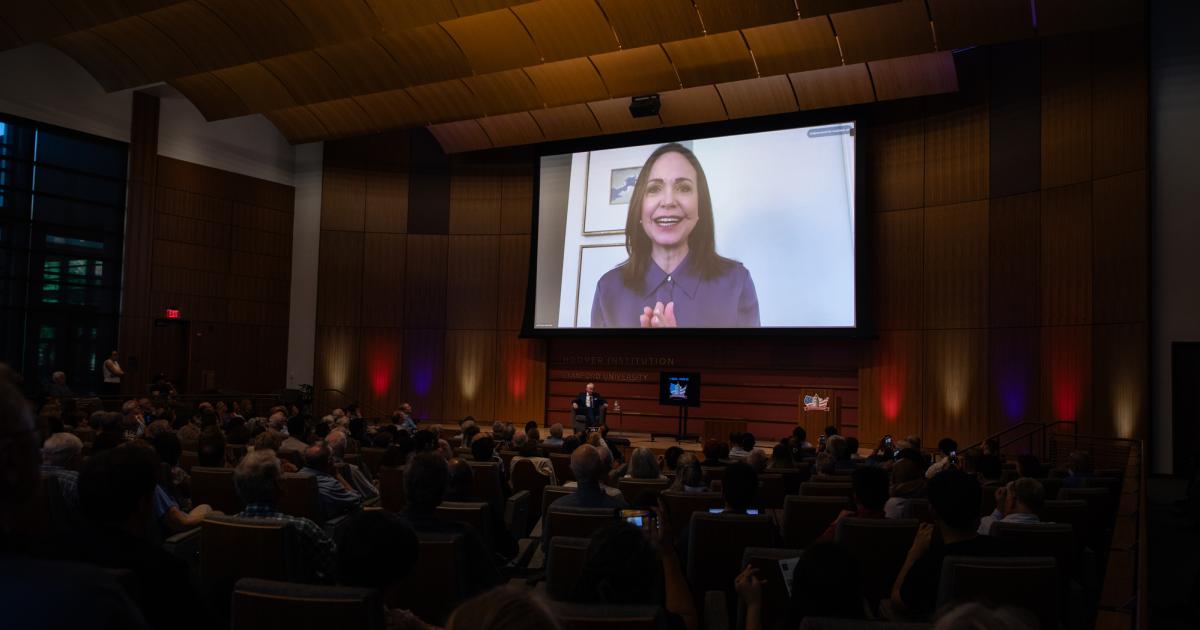
Hoover Institution (Stanford, CA)— Nobel laureate María Corina Machado, joining a panel of fellow champions of freedom who have confronted tyranny in their own countries, told a Hoover Institution audience on June 17 that the courage and resilience of the Venezuelan people remain the driving force behind Venezuela’s fight for liberty.
The 2025 Nobel Peace Prize winner, who helped lead Venezuela’s Unitary Platform coalition to what is widely believed to be a decisive victory in her country’s 2024 elections, told attendees in Hoover’s Hauck Auditorium that her compatriots continue to make sacrifices to seek basic political freedom.
“The title of this event, ‘Choosing Freedom,’ is no mere abstraction for Venezuela's democratic movement,” Machado said. “It is a daily act of courage by millions of people who refuse to surrender their humanity to tyranny.”
She detailed how up to one million Venezuelans worked together, sometimes in secret to avoid scrutiny from the security services, to build an impromptu vote-tallying network to challenge claims of a Nicolás Maduro victory in July 2024.
Machado is an industrial engineer by training, and stepping into a political career meant sending her children to live abroad because it was not safe for them to remain in Venezuela.
“I did it for them, and I did it for love. Love of freedom, love of my land, and certainly the love of my children and my country.”
During the campaign, she was told by commercial airline representatives that the Maduro regime would threaten any of them with decertification if they allowed her to fly. So, she campaigned across the country by car.
She added that after the events of January 2026, when a lightning airborne raid by US special forces captured Maduro, removing him from power and forcing his subordinates to release political prisoners and open up Venezuela to foreign investment, her movement is ready press for greater freedom as what she described as a “dam” of repression starting to break.
“What has started happening after January 3rd is that it was a huge dam in which a crack happened, and it started flowing,” Machado told Kleinheinz Senior Fellow Stephen Kotkin, who moderated a discussion following her initial remarks. “And you're starting to see people speaking out, demonstrating, the media for the first time starting to say the truth. And believe me Steve, this is unstoppable.”
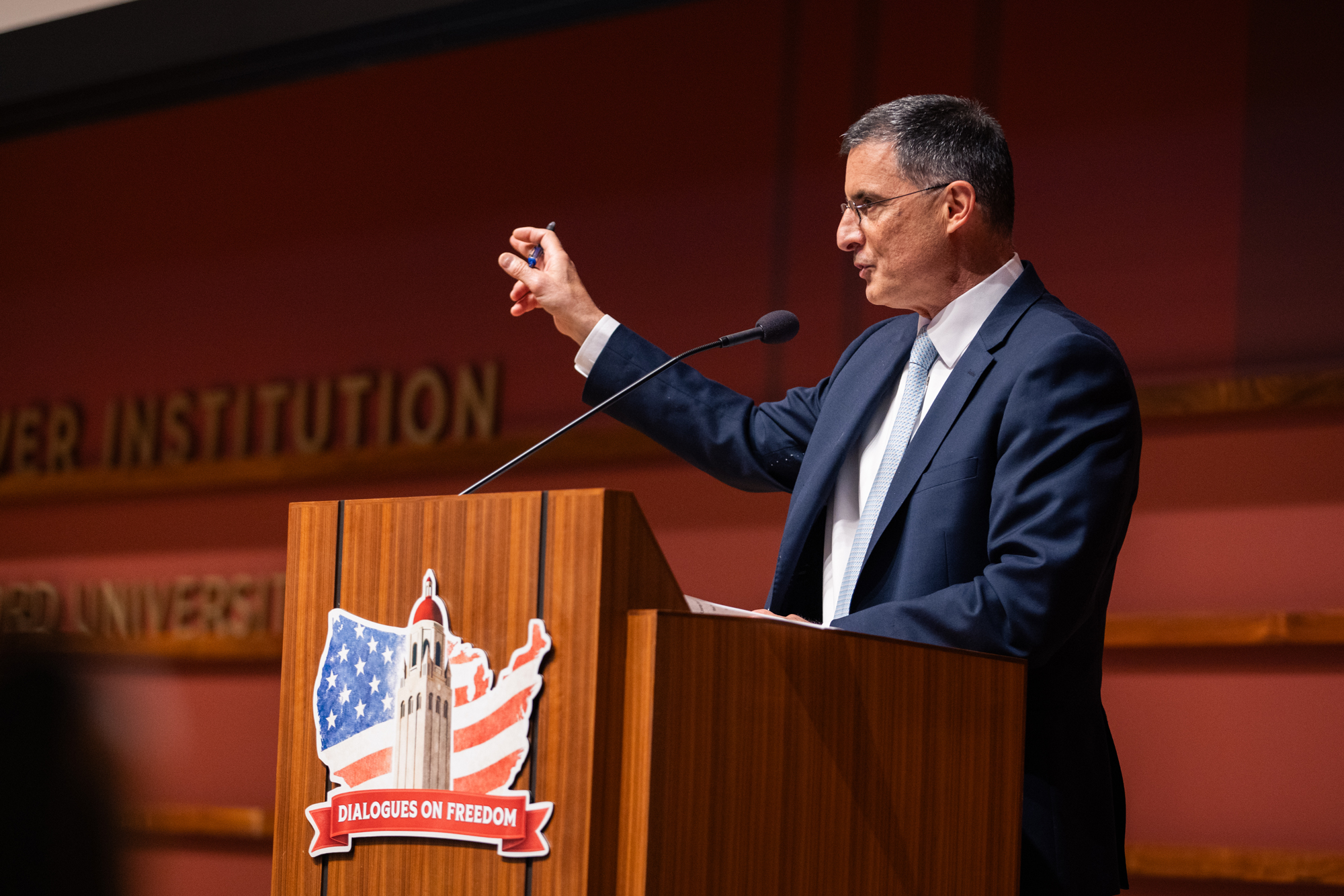
This year, in commemoration of the 250th anniversary of America’s founding, the Hoover Institution launched Ideas That Made U.S.: Dialogues on Freedom, a speaker series featuring leading voices to explore the foundations of American freedom and the ideas that will shape its future.
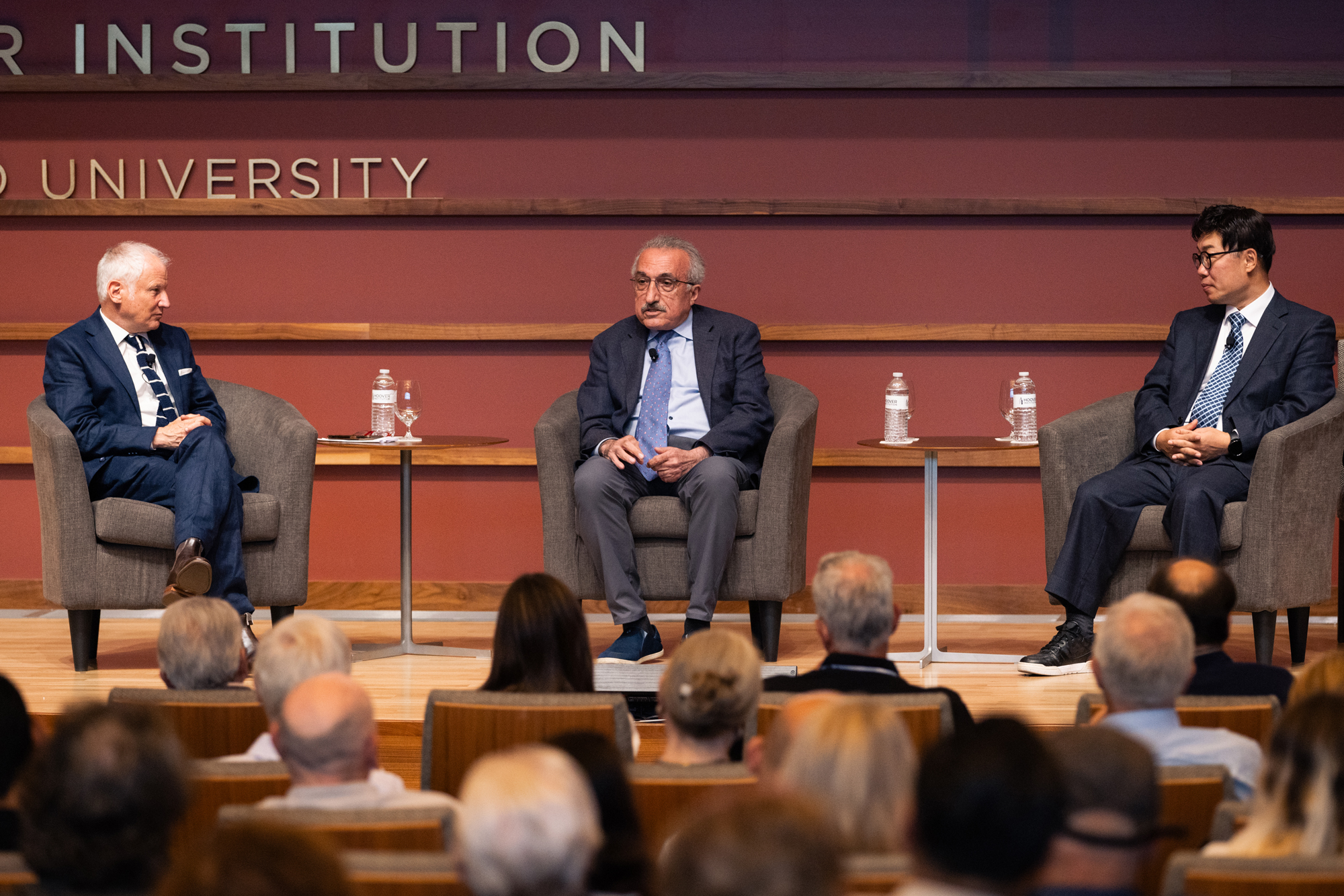
In the fifth installment of this series, Machado, Hoover fellows Abbas Milani and Ayaan Hirsi Ali, and North Korean exile Joo Sung-ha spoke about their own struggles to secure personal liberty, and how they each have devoted their lives to securing freedom for others who still live in the shadow of oppression.
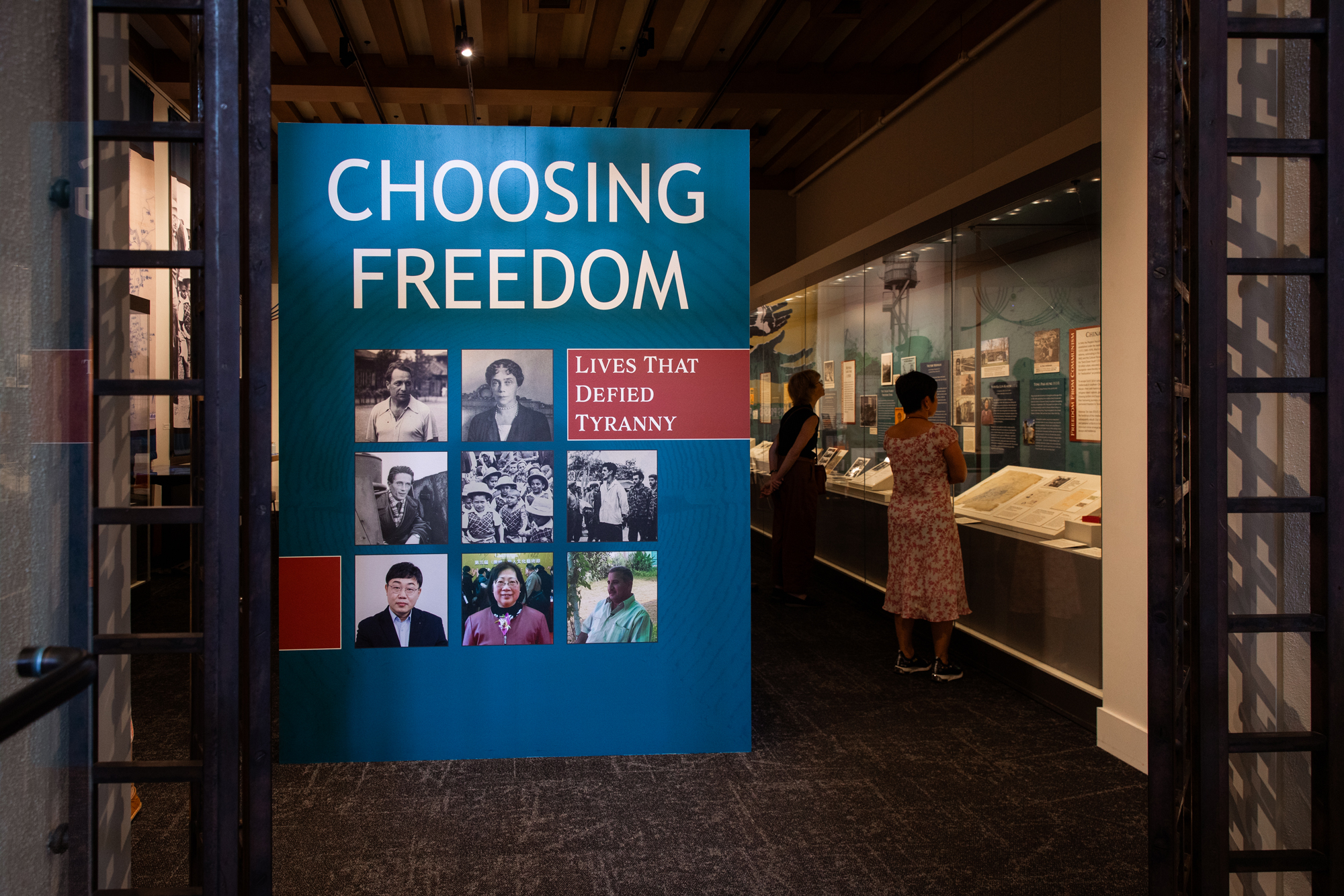
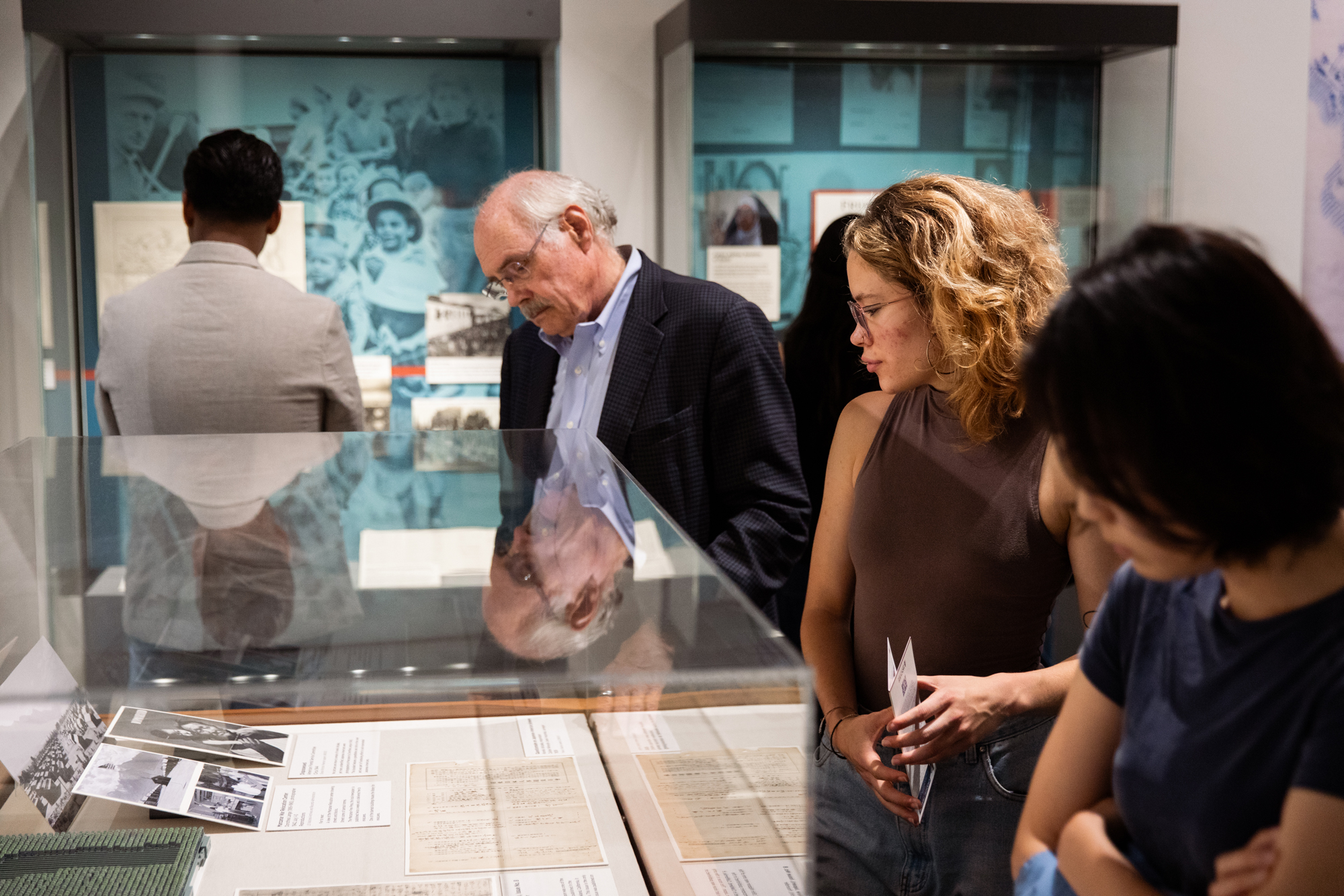
The event coincided with the launch of a new exhibition at Hoover’s Library & Archives, Choosing Freedom: Lives That Defied Tyranny, which features firsthand accounts of individuals who escaped authoritarian repression in their homelands to secure freedom abroad.
It features personal testimonies, smuggled belongings, and powerful images, drawn straight from the Library & Archives’ extensive collections, telling the stories of people who chose to defy oppression.
From Evin Prison to Stanford
The story of Abbas Milani begins with his imprisonment in Iran’s notorious Evin Prison in 1977.
Educated in America, Milani returned to Iran toward the end of the Shah of Iran’s rule to begin his career as a political science professor. Because Milani identified as a Maoist at the time, the shah quickly ordered him confined for his beliefs.
He spent a year in prison. Inside, he crossed paths with many of the leaders of the coming revolution that would depose the shah in 1979.
After the revolution, the new Islamic Republic’s rules put Milani in a sort of purgatory. He was released from prison and he still was paid a salary, but he essentially was no longer allowed to teach.
“They wouldn't let me teach, but they wouldn’t fire me either,” Milani recalled. “They would pay me a meager salary and said, ‘You can only teach PhD students.’ But there was only one PhD student.”
His own body started to tell him it was time to leave. He said he was diagnosed with a range of serious health issues during that time, including lymphoma and heart disease. He traveled to see a cardiologist in Los Angeles for a second opinion.
“[The cardiologist] says, ‘There's nothing wrong with you. You have Khomeini syndrome.’ And I said, ‘What is Khomeini syndrome?’ He said, ‘Your body is telling you, don’t live there.’”
So, at the height of the Iran-Iraq War, he took his family and relocated to California. Since then, Milani’s profile as a scholar of modern Iran has grown. There are no threats of imprisonment, and he can teach any pupil he wants.
“I don't think this is possible in any other country in the world,” Milani said.
Milani also urged the audience to distinguish between Iran’s ancient civilization and the regime that has ruled the country since 1979.
“Iran is not the Islamic Republic of Iran,” he said. “The Islamic Republic of Iran is ... the dark side of Iran.”
Milani described Iran as one of the world’s great civilizations whose cultural and religious influence helped shape the development of the Abrahamic faiths. At the same time, he argued that outsiders often fail to appreciate both the complexity of Iranian society and the peaceful co-existence of peoples within its domain.
“Today, I think the West, the United States misunderstands how powerful the urge for democracy is in Iran,” Milani said.
Citing research conducted through Hoover’s Iranian Studies Program, Milani noted that demonstrations have occurred in Tehran on average every few days for more than a decade despite the regime’s repeated use of violence and repression. The persistence of those protests, he said, reflects a society that continues to seek political freedom and democratic self-government.
While rejecting the notion that democracy can be imposed from abroad, Milani argued that Western nations can help create conditions that strengthen Iran’s democratic movement rather than its rulers.
“Help the people get what they want,” he said. “And you will have a peaceful Middle East.”
Milani further observed that the Islamic Republic has fueled one of the largest waves of emigration in Iran’s long history, driving many of the country’s most talented citizens into exile. Those individuals, he suggested, represent an important reservoir of talent and experience for a future democratic Iran.
Ayaan Hirsi Ali’s Long Walk to Freedom
Ayaan Hirsi Ali’s pursuit of freedom began on July 24, 1992, when she took a train from Germany to the Netherlands and applied for asylum.
Only 22, she was fleeing a marriage that was forcefully arranged upon her. Once in the Netherlands, Hirsi Ali obtained a master’s degree and successfully won a seat in the House of Representatives in 2003.
Her advocacy for women’s rights, especially the rights of young Muslim women and girls, eventually made her a target of violent Islamists. Theo van Gogh, a filmmaker she partnered with to make the short film Submission in 2004, was killed in public by an Islamist who objected to the film’s content.
She was offered a form of witness protection by the Dutch government after Van Gogh’s murder but declined to accept. She said she needed to continue her advocacy, without fear of reprisal or the need for state protection.
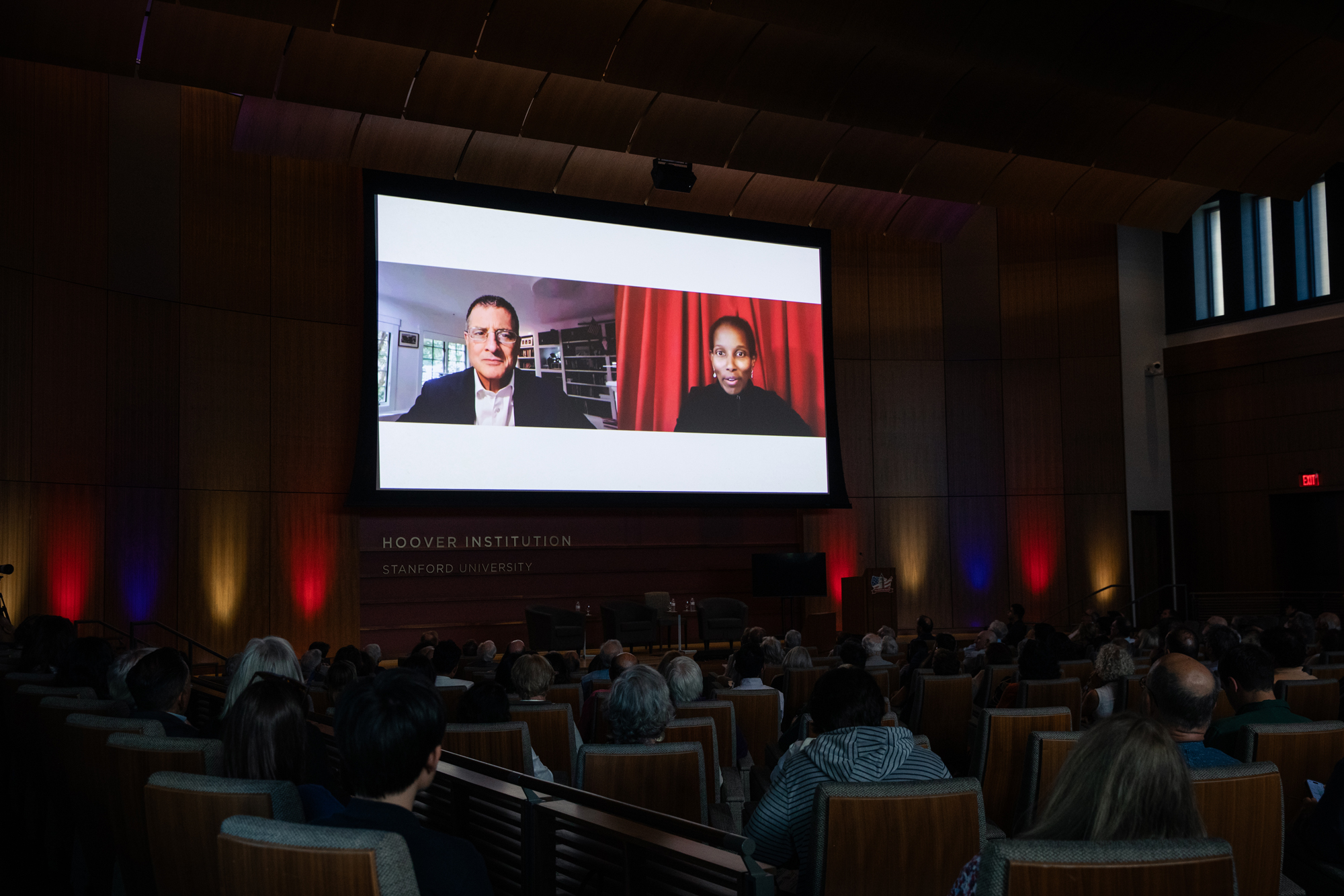
“I tie free speech to freedom of conscience, and I think if you don’t have freedom of conscience, you don’t have integrity,” she told Eric Wakin, Everett and Jane Hauck Director of Library & Archives in a prerecorded interview presented at the event. “You have a society that lives only in fear, and people will profess to say things they don’t really mean. It’s really living a lie and deceiving one another continuously.”
In pursuit of freedom, she chose to live in America.
“It’s very easy for me to come into a country like America and choose to be free, meaning I’m consuming the legacy of the institutions that safeguard my freedom,” Hirsi Ali said. “But to choose freedom also means to protect those institutions from tyranny, from anarchy, from corruption and all the rest of it.”
Fighting Tyranny with Ideas
Joo Sung-ha, who fled North Korea about thirty years ago, recounted his experience living through a period of extreme suffering there. He spoke of a scene at a train station during the 1990s famine that motivated him to leave.
He saw a girl of about nine and a boy of about seven who were begging for food. They claimed to be siblings to garner sympathy but had really only met three months prior.
He gave the girl some fruit, and she immediately gave it to the smaller boy.
“At that moment, I felt the biggest anger I have ever felt in my life,” Joo said. “Children in such situations do not usually survive for more than six months. But her sharing the food with him felt to me as though I was witnessing the greatest humanism in my life.”
He fled and later became a writer with Tonga Ilbo, one of South Korea’s leading newspapers.
He said that because of North Korea’s cooperation of China and its ever-widening domestic surveillance dragnet, the most successful avenue of escape—sneaking across the Yalu River into China—has deteriorated from perhaps a 10 percent chance of success to near zero.
“In the past two years, there has not been a single North Korean who escaped from North Korea via China and then came to South Korea. North Korea now is more or less like the Alcatraz prison where no one can escape,” he said with the help of a translator.
Hirsi Ali said that for all of its challenges, America still serves a guiding light for her and others who wish for freedom to flourish around the world.
“America is the greatest nation on Earth, and I’m proud and humbled to be an American citizen, but we can’t take these freedoms for granted,” she said. “We’ve got to continue to defend them for the next 250 and the next one thousand years.”
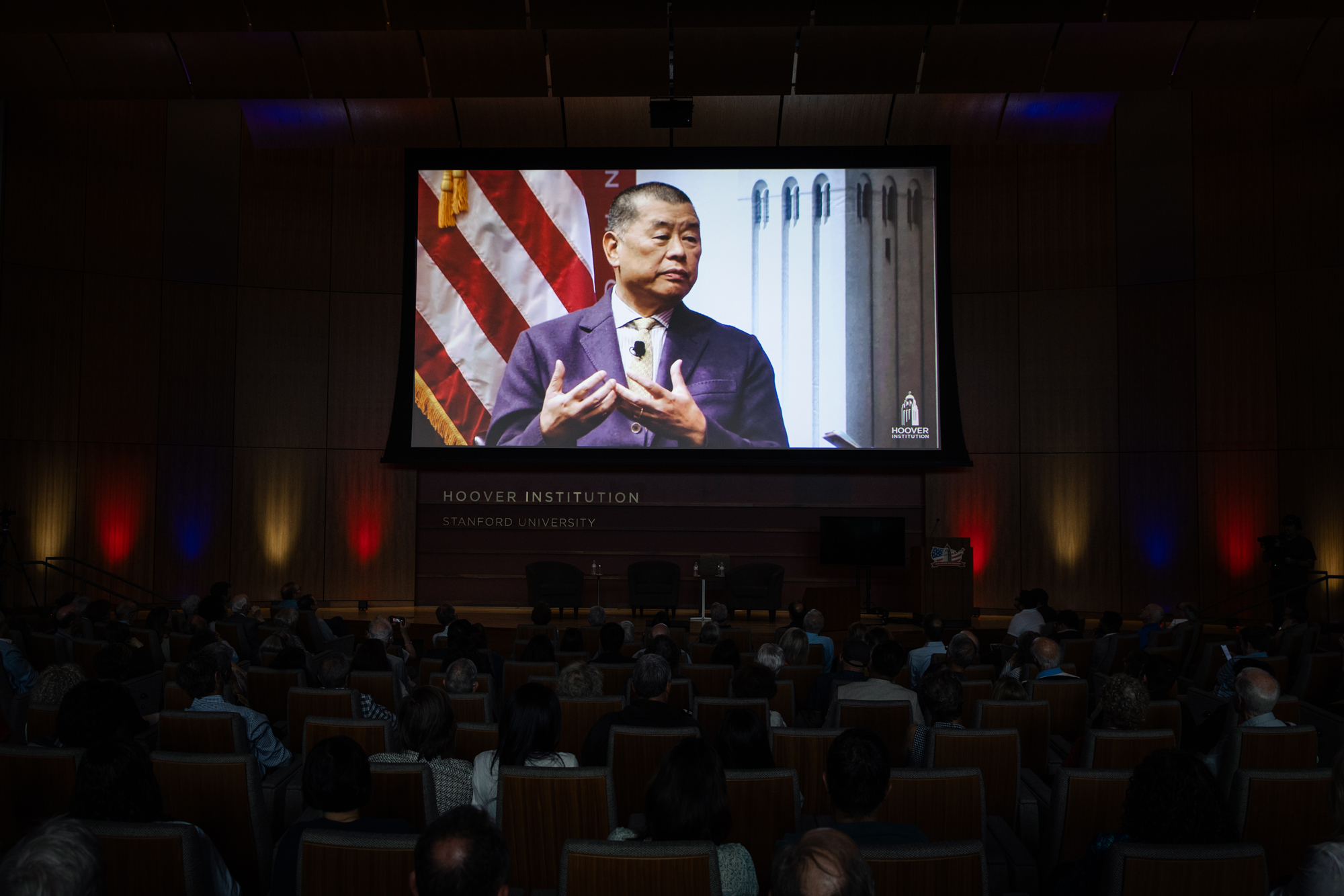
Attendees also watched excerpts from a 2019 Hoover conversation between imprisoned Hong Kong businessman and democracy advocate Jimmy Lai and Distinguished Policy Fellow Peter Robinson. Explaining why he refused to leave Hong Kong despite the growing threat of arrest, Lai described the mindset that guided his decision.
“If I always think, ‘If I say this, what are the consequences?’ ... I can do nothing. My life is finished,” he said. “I just do what's right and go on my life.”
Now imprisoned for his pro-democracy activism, Lai's words underscored one of the evening's central themes: that freedom endures only when individuals are willing to accept the risks that come with defending it
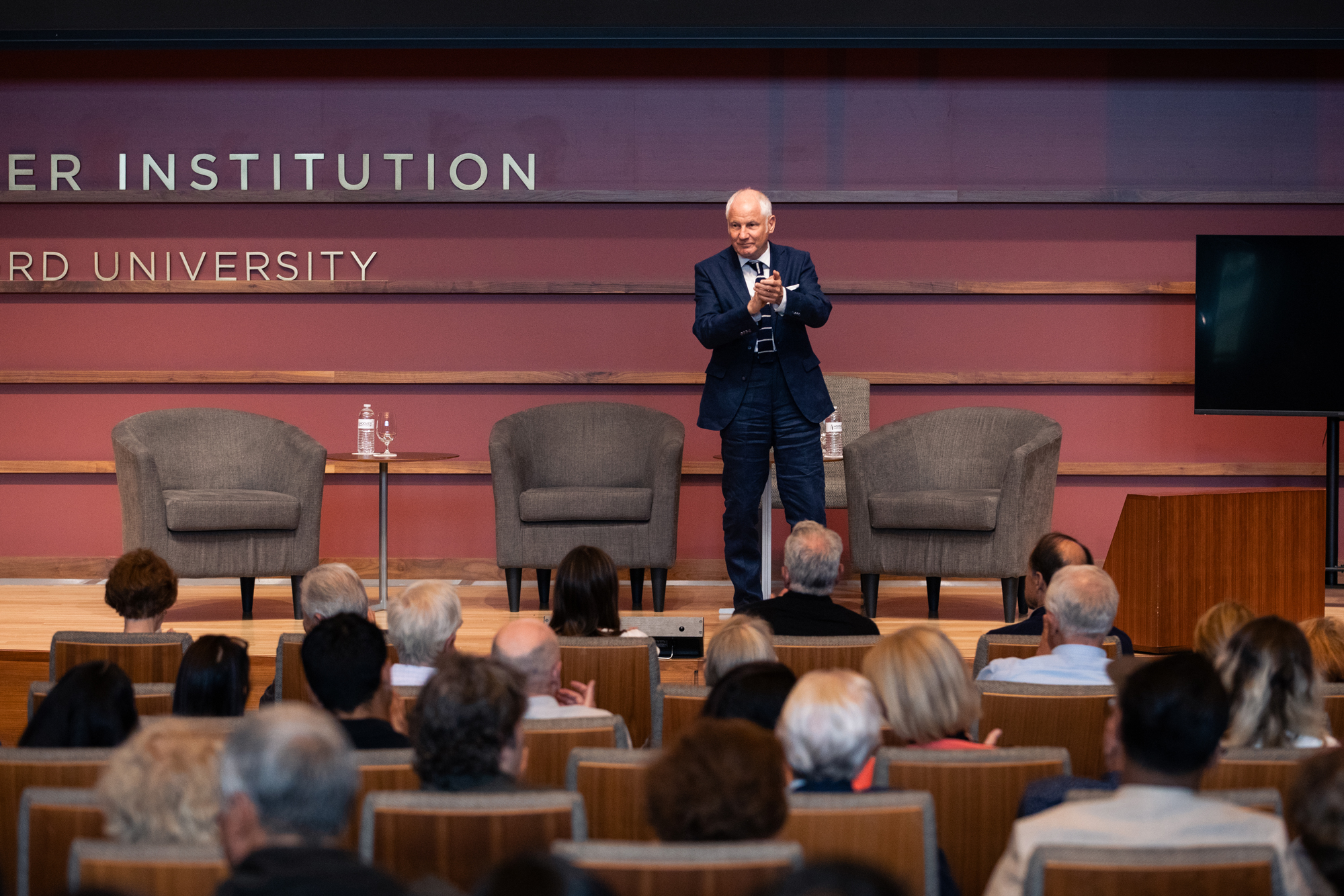
At the event’s conclusion, Kotkin called upon its audience to meet the examples set by the four speakers.
“Freedom is an idea. It’s a state of mind, especially when you’re living in unfree conditions,” he said. “It’s a set of institutions, and God bless the institutions we inherited. It’s a process that challenges all of us. If the people you saw tonight in those conditions can stand up for freedom, what about us? Can't we do that too? Yes, we can.”