



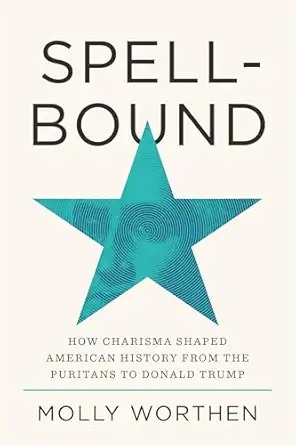
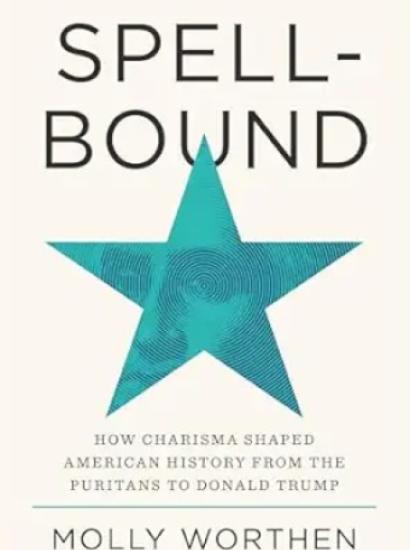

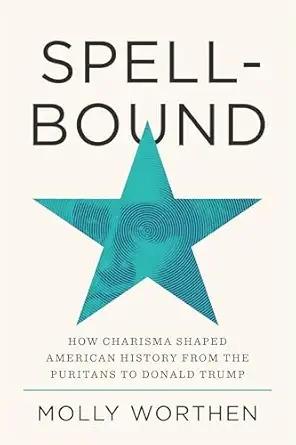

The Hoover Applied History Working Group hosted a special book-launch seminar: Spellbound: How Charisma Shaped American History from the Puritans to Donald Trump on Tuesday, December 2, 2025.
What happens when Americans lose faith in their religious institutions—and politicians fill the void? Please join us for a seminar that will discuss the forces that create leaders and hold their followers captive.
Everyone feels it. Cultural and political life in America has become unrecognizable and strange. Firebrands and would-be sages have taken the place of reasonable and responsible leaders. Nuanced debates have given way to the smug confidence of yard signs. How did we get here?
In Spellbound, Worthen argues that we will understand our present moment if we learn the story of charisma in America. From the Puritans and Andrew Jackson to Black nationalists and Donald Trump, the saga of American charisma stars figures who possess a dangerous and alluring power to move crowds. They invite followers into a cosmic drama that fulfills hopes and rectifies grievances—and these charismatic leaders insist that they alone plot the way.
The story of charisma in America reveals that when traditional religious institutions fail to deliver on their promise of a meaningful life, people will get their spiritual needs met in a warped cultural and political landscape dominated by those who appear to have the power to bring order and meaning out of chaos. Charismatic leaders address spiritual needs, offering an alternate reality where people have knowledge, power, and heroic status, whether as divinely chosen instruments of God or those who will restore national glory.
Worthen’s centuries-spanning historical research places a crucial religious lens on the cultural, economic, and political upheavals facing Americans today.
FULL SEMINAR
- Hello, my name's Neil Ferguson. I'm the Milbank Family Senior fellow here at the Hoover Institution at Stanford, and I'm also the chair of the Applied History Working Group. And we've been lucky today to be joined by Molly Worthen, a professor of history at the University of North Carolina, and the author of a new book, spellbound How Charisma Shaped American History from the Puritans to Donald Trump. Molly, thanks very much for being with us.
- Wonderful. Thanks so much to all of you for coming. Thank you Neil and Joseph and Amber for putting this together and Ro need for agreeing to, to talk, talk with me about this. It's so fun to be able to be back at Hoover 'cause this is really where I cut my teeth as a historian about 20 years ago, the subject of my first book, his, his papers are Hoover Institution Archives. So this is where I really learned how to deal with documents in a serious way. When I started this project almost 10 years ago now, I was in a, a state of confusion about what I was even writing about. I confused charisma with charm. I thought that I would be writing about loads of really charming people, people with high emotional intelligence, very good at working a room. I think I also associated charisma with inspirational public speaking and charm inspiring oratory. These things they showed up in here and there among the research, among the subjects that kind of became my cast of characters, but really more in the breach than as the pattern of things. I realized that whatever charisma is, it is not charm. And a key giveaway is it's deeply polarizing effect on people. Charismatic leaders have a lot of people who adore them and a lot of people who loathe them and not too many who are just sort of lukewarm. So my plan this afternoon is to tell you about a new way of thinking about charisma that has helped me pull together some patterns across American history and in our own time. First, I'll give you the definition that I settled on after my meanderings. Charisma is a relationship between a leader and followers based on telling a story. A charismatic leader invites followers into a compelling narrative that somehow does a better job of making sense of their lives than whatever stories they were using before. But if you are on the outside of that story, you are totally baffled. You really do not get it. I think a clue to this is the way in which even totally secular people often resort to quasi magical religious hypnotism metaphors. We use verbs like mesmerize magnetize. We talk about leaders converting followers to a cause. I think charisma is a concept that we punt to when we can't identify totally rational material, sort of quid pro quo explanations for the relationship between leaders and followers. But we sense that there is something really serious going on. Something we, we just don't understand. This is why the sociologist Max Weber borrowed the term charisma from the New Testament, from the world of church history and biblical studies a bit more than a hundred years ago. He's really the one who deserves the credit for coining the term as we use it today, at least outside of church context. So as we use it in kind of everyday conversation and, and when he used the term, he meant it to describe a kind of authority distinct from the authority of tradition or the authority that comes from a position in an institution. Having a, a large military force at your disposal, a, a power that seems to reside in some important way in the leader as a, as a person. Now the word charisma comes originally from the ancient Greek carris, meaning divine anointing, chosenness by the gods chosenness that could bring with it a, a special power for good or for evil. In the New Testament, St. Paul makes this charisma grace. Spiritual gifts bestowed by God has slightly different meanings and different different contexts, but that's, that's generally what he means by it. So Weber took the New Testament idea and he, he reframed it, I think trying to make it a useful tool for his secular colleagues in these burgeoning new social science disciplines where they, they were generally pretty allergic to theology, but there was, there was a sense that there's, there's some sort of x factor in politics that needs, needs a tool to explain it to me though, the phenomenon that Weber and the secular observers after him have tried to name is really not all that far from the supernatural thing that Paul named in the New Testament. I think in both the religious and the secular sense, charisma centers on a human desire to touch other worldly power and to seek a place in a big transcendent narrative that lends meaning to our lives. That gives us a sense of control over chaos. And whether you find a charismatic leader, compelling or revolting depends on whether he or she is offering you an attractive part in this story he's telling. Now, I wanna add a caveat. When I call a leader's message a story, I am not saying that it's necessarily fiction. I think we tend to equate storytelling with making stuff up, but that's a mistake. Humans are storytelling, story seeking creatures. This is just how we organize information about the world. The difference between a charismatic leader who is an agent of moral progress and one who is not has everything to do with whether they offer a story that is grounded in reality. There absolutely are charismatic leaders who are fabulous, who pull back the veil on a pseudo reality. But charisma in and of itself, I think is morally neutral. I think this way of approaching charismatic leadership, thinking of it as transcendent storytelling might help with a problem that scholars and journalists who study religion have been dealing with for a few decades now, for a long time, those of us who work in this field have relied on the benchmarks of institutions and poll numbers to track the religious impulse. So, you know, we, we pay a lot of attention to church attendance and membership figures, statements from religious leaders at the top of prominent institutions, this kind of thing. Those tools, it seems to me, don't serve us very well anymore. Every year seems to bring a new study showing the rising number of the so-called nuns in the United States, right? The, the people who don't affiliate with any religious group think that figure is now about 28%, although it seems to have plateaued and it may actually be dropping, especially among younger Americans. And maybe we can talk more about that if, if you all are interested. I'm, I'm especially interested in this, the spiritual but not religious crowd. This is, you know, an option that is often offered on these polls and about half the people who say they have no religious affiliation will, will go for that label. I think it's a mistake to assume that the religious impulse is going away just because it is no longer landing in the usual places. We can't count on finding it in the way that, that we have been able to in the past. The question then is where should we look? And I think one place it's interesting to look is in the relationship between some leaders and their followers. So my book starts in the aftermath of the Protestant Reformation that covers about four centuries of history today. I thought I would focus on the later part of the book that's immediately connected to our current political moment. I wanna tell you about a, a kind of charismatic appeal that has developed over the past few decades that I think seems to have real power now and think about how bringing the history of religion and the history of politics together can really help us understand what's going on. So let me start with a basic question of authority and trust and how Americans develop a narrative of what's going on in the world, because that, that's gonna be the broad context for any leader who comes in with a new story to tell. It's become a cliche to observe that Americans have a low opinion of institutions. I won't, I won't snow you with familiar poll data. I'll just, I'll just mention one that I think is really striking, right? So in 1958 was the first year that the national election study asked Americans, do you trust the federal government to do the right thing all or most of the time? And in 19 58, 70 5% of Americans answered, yes, that number has sloped down ever since. There was a slight bump at nine 11, but otherwise it's pretty much sloped down. Now it's at an average of 22% with self-identified Republicans scoring a bit lower, Democrats a little bit higher. Last year, according to Gallup, 32% of Americans said they had either a great deal or quite a lot of trust in churches, an organized religion that's down from about 60% a generations ago, a generation ago, trust in higher ed newspapers, mainstream media, congress, even the military has, it's all dropped recently. Now why is any of this important for the story of charisma? Because these numbers tell us about one category of leader who definitely lacks charisma right now, and that's experts. Institutions tend to be full of experts, they're staffed by experts. They are in the business of training experts. They are premised on the idea that you need a certain kind of experience and certification by, you know, senior people in the guild to deserve the faith of of the public. On any question, that whole idea is falling apart. I wanna suggest that the era immediately preceding our own, so roughly the 9, 19 45 into the early 1970s that this period set us up for where we are now in some special ways. This was an era when respect for professional expertise, the charisma of experts respect confidence in the story that experts tell about the world, you might say, when that reached a peak and then fell apart. In our own time, we have seen the rise of a different type of charismatic leader, a type I call the guru. Now what's a guru? First a guru tells you to put your trust in him or her as an individual. Now they might link themselves to a tradition or an institution or a scripture, but they, they position themselves as as the best. Really the only interpreter. Second, a guru presents a totalizing worldview. If you accept the assumptions that he or she presents, you have answers for every big question about right and wrong, the ultimate goals in life without having to think much about it. Third, that worldview is based on an alternative reality, A, a new set of facts at odds with what outsiders see. And last, gurus tend to operate adjacent to electoral politics rather than right in it, although sometimes they make the leap. Before I say more about the guru, I wanna talk a little bit more about the age of the expert. The fifties, the sixties were the heyday of the cultural authority of secular scientific expertise in North America. Now think of higher education booming after World War ii, loads of federal investment in research. Later the technocrats working for John F. Kennedy on economic policy on the Vietnam War, pitching the new frontier to Americans. A story really that said, invest in expert led innovation, expert led foreign policy and America will spread democracy, high standards of living, we will get to the moon. I'll add that the fifties and the sixties were the last time when maybe we could say that traditional religious institutions and religious experts were in charge too. Meaning this was the last era when mainline Protestant churches were thriving, at least by the numbers those denominations peaked around 1965 and have, have diminished at least by the numbers ever since then. So just to give you one data point here, the the Presbyterian church in the USA, the the liberal Presbyterians had about 4.25 million members in 1965. Today has about 1 million. And over that time the US population has grown by 75%. So that's really quite a, quite an extraordinary drop off. Another trend I want to flag in the post-war era is the beginning of the charismatic renewal movement, which was an explosion of Holy Spirit charisma, like the original New Testament style charisma in churches that had never known this power before, at least not in the miraculous sensory way, hands up in the air, people speaking in tongues, getting slain in the spirit, this kind of thing. These revivals spread around the world. And in some ways charismatic renewal did breathe new vitality into established churches. I'm thinking about, you know, one of the early big nodes of the revival was among middle class liberal Episcopalians in the Los Angeles area or the Catholic church with which initially was, was a little bit freaked out, a little bit hesitant, but the Vatican pretty quickly realized that this was embracing this revival was gonna be key to encouraging the expansion of Catholicism, especially in the global South. But at the same time, I think you could argue that charismatic renewal chipped away at traditional Christian institutions, which perhaps is something revivals often do, and it emboldened over the long term independent megachurch pastors, other types of religious entrepreneurs rather than older groups and denominations. Now you probably also associate the fifties and the sixties with the rise of the counterculture. Certainly a movement driven by skepticism of institutions. My point is that by the 1960s we have a complicated picture. The experts, the educated establishment, church leaders still seem fairly comfortable in their cultural authority, but that is starting to erode. So let me give you a snapshot at the end of this period, this was a moment in my research when I really saw the value of putting the narrative of mainstream political history alongside the history of the strange supernatural stuff that scholars usually sort of keep cordoned off. So let's zoom in on one place in time, 1970, Southern California, specifically UCLA picture Angela Davis striding across campus. She's 26, she's a proud member of the Communist Party. She's just coming off a stint in Germany doing graduate work in Marxist philosophy and she's come back to the states mainly to get involved with the Black Panthers. UCLA hired her to teach a few classes on the side while she does this activism and and finishes her dissertation, she likes to teach in a miniskirt. Her natural hairstyle frames her face in a perfect sphere and the students love her. She just packs them in even after she dismisses them at the end of class, they come down front and crowd around the podium working up the nerve to ask a question. Protestors hanging around the lecture hall too. Middle aged Czech refugees, members of the local chapter of young Americans for freedom, Ronald Reagan is governor at this time. So he's on the uc board of Regents ex-officio, and they are trying to get Davis fired or at least deny students credit for her classes. There are death threats. Davis has to get a bodyguard. Now what is the story that Angela Davis is telling? Well, from one angle it's the Marxist arc of history, the coming class war. But Davis is also pitching legions of students on a story about institutions and how they have failed on everything from Vietnam to civil rights. She has burrowed as many of them have into the heart of the ivory tower as a PhD student, and she's using academia's own platforms to declare the whole system illeg illegitimate. Now, just a short walk away from the UCLA classrooms where Davis is teaching, you'd find a very different scene in an old frat house. The frat boys are gone, the house has been taken over by a group called the Jesus Christ Light and Power Company. And this is a Christian commune run by a former campus crusade worker named Hal Lindsay. When reporters find him, he's usually in a tank top and jeans and leather boots and he's talking to college kids and his Texas drawl about the rapture and the coming of the antichrist. It's 1970, right? So he has just published his famous mega bestselling book, the Late Great Planet Earth, all about the Coming Apocalypse. This frat house is an outpost of the Jesus people movement, which was a mix of disillusioned hippies, middle class kids, fleeing their parents' churches. So it's a movement that grew out of institutions, but it loathes those institutions. Here's Lindsay talking to a reporter. He says, these kids hate impersonalness, bigness, irrelevance, materialism. And I've just given you a description of the average institutional church. Now, I'm not saying that the new left student activists and the kids listening to Hal Lindsay are one unified movement, but I am saying that the Jesus people seeking the Holy Spirit and the charismatic relationship that Davis has with her followers are on a continuum. They are related responses to the same cultural situation. They reflect a shared sense of being fed up with the cosmos, a desire for a new eschatology, really a promise of ultimate rectification of injustice. There's a way in which it's these young people shaped by working inside institutions but feeling betrayed by them who helped tear down the authority of universities, the authority of of the mainline churches. I think it makes sense that the late sixties and seventies were also an age of new religious movements ranging from the infamous and scary ones like Jim Jones, people's Temple to cases that were sometimes benign but sometimes abusive like the evangelical cha, charismatic Children of Love or Scientology. We also have, at this time a profusion of religious communities coming out of east and South Asia, which could sometimes turn authoritarian but also appealed to Americans who were looking to break away from traditional spiritual authority. But I'm thinking of the Maharishi Mahesh Yogi and transcendental meditation, the guru Maharaji who was just 13 years old when he came to the US and started inspiring disaffected student radicals to kind of quit their lives and move into Rems. Now these movements, they varied tremendously in theology and practice, but they all orbited around a guru, a charismatic leader who could look at you and make you feel seen, make you feel that all your problems that you thought you were carrying by yourself are a real and serious. And they're not random. They are part of a bigger narrative, which you too can see if you come along and come learn how the world really works. The sixties and seventies are also the age of the rise of humanist psychology. When we have psychologists like Abraham Maslow and Carl Rogers hanging out at esson writing books that say essentially the key to happiness is this thing that Maslow called self-actualization, cultivating the authentic inner you. No matter what the institutions and and traditions tell you, humanist psychology promises essentially that you can be your own messiah, you can be the agent of your own salvation. And the most successful gurus play on this and they say yes, follow me, follow me on the path to your authentic self. By the time we're in the 1970s, the decline of mainline church membership and attendance is undeniable. Scholars zoom out and often call the big picture here secularization. And that's a term that we normally understand as as a comment about organized religion, but to me that's too narrow a way of seeing it. The main meaning of secularization is eroding trust in institutions in general. And a corollary is eroding trust in experts, the rise of charismatic cult leaders and gurus independent of any religious institution, even if they were themselves deeply pious in some sense. I think this is a key aspect of secularization by the time we get to the 1980s, the guru is not just a leadership model that you see on the margins. The guru is a model of leadership that has taken off in a number of cultural spheres. It's taken off in the self-help industry in the business world, the burgeoning leadership studies programs at business schools where the trendy message is that your boss is not up high up on the hierarchy away from you, he's alongside you as your coach. He's gonna help you become your most authentic self and align your sense of of self-actualization with the company mission. There's also that interesting mix of self-help and televangelism that we see in Oprah Winfrey who was just coming to national prominence at this point. Her show is nationally syndicated in 1986 and I'd argue you see hints of it in a brash New York businessman who went on Oprah's show a couple of times and nonchalantly mo mused about running for President Donald Trump. Two things make charismatic leaders more compelling, maybe more dangerous in our current era. First, I think in the past institutions and traditions were stronger and provided some counterweight and alternative context, a source of identity for people trying to evaluate a story they're hearing from a leader. Second, the cultural authority of organized religion has been on retreat for at least two generations and this has fed both a crisis of meaning and a tendency to transfer religious impulses to politics. It's also, I think, fed a crisis of confidence among many laypeople and leaders who have stuck with the traditional in religious institutions. And when you are insecure about your status in the culture, you're going to be extra vulnerable to a leader who comes along and promises you political power. I think the history of charismatic leaders in this country and their influence now only becomes legible if we ask theological questions. What is the transcendent narrative a leader is offering? How has he turned the feeling of tribe into the feeling of a pure holy remnant? I'll add too that we're seeing right now Pentecostal and Holy Spirit oriented, Anglican and Catholic churches growing in really quite unexpected ways, not just in the US but across the west. There's interesting numbers coming outta the uk, France, some other places. What if we consider the possibility that secular and religious people are not actually so different and that the contact with supernatural power that these new converts are seeking has at least a family resemblance to the promise of transcendence that is available in at least some varieties of politics. And if we are on the outside, if we're watching people in our culture under the sway of, of some leader whose appeal we do not understand, I think it's worth asking what story is he telling and is it possible that that story is not all wrong, that it at least exposes blind spots and contradictions in the one you are living in? I'm trying to get into the habit of asking these questions. I think it's a an interesting spiritual discipline for anybody living in a democracy. Thank you very much. Thank you very much.
- Thanks very much indeed, Molly. Let's now go straight to Ron it for some commentary and then we'll open it up to general discussion. Ron It.
- All right, thank you. So thank you and thank you to everyone who organized this Joseph, Amber, Neil and Molly obviously for coming. As I mentioned earlier to Molly, it was, it's always fun to get an invitation to comment on a book that you've been meaning to read because then it makes you read it. So, and then it happened that I received the book and you know, opened it and began preparing for this, just coincidentally when Zoran Ani went to the White House. And so one of the things that really struck me as I started to read this introduction was what do you do with Momani and Trump's visit and, and in particular the photograph that circulated after their visit in the Oval Office, the portrait of Ronald Reagan in the background sort of looking down at Trump, looking like sort of gleefully but also sort of in awe of Momani who's like standing there cheerfully and trying to think therefore as I read this book, well if I buy the setup, which I do, that sets Trump in this era as one of the exemplars of this guru moment. What do you do with Momani who also seems maybe to be a charismatic leader, I mean TBD in some ways, but certainly came onto the political scene in ways that echo many of the traits of others in this moment, but also seems a little bit different. So on the one hand he is offering a story can believe it or not, but he offers a story about affordability and how to live in New York that was compelling. He's also notable because as many reporters have covered, he went and talked to people on the street after Trump's election trying to figure out what were people most interested in. But then it raises questions, is he simply charming or is he charismatic? Or maybe as I then read the book, is he an exemplar? Maybe he's more like George Washington whom you call a recoil, this man that was reacting to the charismatic agitator type of the moment. Or perhaps in line with someone like FDR who you point out kind of engaged in political judo in his time to take advantage of the moment. So I'm curious, especially since this is an applied history workshop to sort of apply this setup and the typologies to another leader of the moment who it seems is one of the few who could take on Trump and at least sort of garner a different reaction that moved from sort of the disparagement common in the, well I guess now he uses truth social more than Twitter, but in in Trump's social media postings to sort of this moment in the Oval office where there seems to be some awe of him. So that's sort of my first question that I'm just curious where you see someone like Mom Danny in this moment and whether he fits or challenges or is maybe one of the other figures working in sometimes as you point out in opposition to the sort of charismatic type of the moment. So that was sort of question one that arose for me. If we then step aside from the present and think about this text Histori graphically, and I know this was written as a sort of public facing popular book, so it doesn't have the sort of the academic apparatus that would've positioned it within the literature, and that's totally fine. We don't always need that. I wanna be clear, but I was struck as I read it, thinking about how when I put my hat on as a scholar of American religion, this seems to be really clearly in one line of scholarship, which which is to say it fits the line of scholarship perhaps first inaugurated by Anne Tave with her book Fitz Trances and Visions about these certain kinds of leaders who engage in certain kinds of spiritual practices, which may seem a little bit messy and challenging to dominant sort of main line or orderly religious experiences, but emphasizes the experiential in the religion. And then also a book like Katie Lofton's book on Oprah, which said, let's take Oprah seriously, which you do too, but take Oprah seriously as a religious figure, not just as sort of a celebrity in the fandom sense. So it seems clear to me that there is a histori basis in religious studies where like scholars of religion might pick this up and be like, yeah, okay, I get it. I get where this is coming from. This is doing something new in the sense of thinking about these types over time. It's an impressive coverage of 400 years. But religious studies scholars, I think would actually be pretty comfortable with this type of narrative overall. I'm not sure that political historians or for example, historians of capitalism, because there is a thread around capitalism winding through this text as well, would would find it as I, I just, I wonder if they would know what to make of it in the same way. And so I'm curious in part about how you think this fitting in to these different kinds of literatures, but also what you hope scholars from these different spaces might take this and work with it. How, what will they, how will it move forward conversations in these spaces? And then also thinking about what does this tell us about the need of historians to think about both the language of religion but the experiences of religious leaders in US history. And this is a sort of recurrent claim amongst historians of American religion, which is that the other historians aren't paying enough attention to religion in one way or another. It's everywhere. And nowhere it's in religion is what John Butler called the Jack in the Box in 20th century US history. It pops up when it's exciting, which many of these figures are, but also we need to pay attention to the ways in which they change structures too. And I think this is making a case for the way in which a certain type of leadership understood through religious terms is actually changing structures and institutions through the role of these individuals. But I'm curious what you think about that and then pursuing that line a little bit further. One thing that I was thinking as I was reading through was, was wondering to what degree is this a story of American religion versus a story of American Christianity? Which is to say, notwithstanding the term guru, and notwithstanding the role certainly of eastern religions coming in in the late 20th century, the vast majority of figures in the book are Christian in one way or another. And there's a brief sort of look at someone like Albert Einstein as Jewish, but I'm wondering how much you see this as Christianity versus religion and to what degree that tells us something about Christianity in the United States and its influence, but also thinking about whether charisma, which as you point out, is a New Testament term, therefore is particular to certain forms of Christianity where other groups may adopt it or it might be useful for thinking with other groups, but might work differently. I, I don't know. And also then the ways in which I was really struck, and even just listening to you now thinking about that space, that transition from expert to guru and what that meant in terms of who's considered most secular, who is considered what are sort of the ways in which Christianity is woven into the fabric of American life, even when it's not religious and what that then tells us about American religion. And so finally, I was also curious, and this is kind of a process question, but also maybe an archives question. This is covering and it really is an impressive and delightful read through so many centuries of American history, which also meant of course you had to make choices about who to include and who to exclude. Every author has to do this. I'm curious about who might have been left out maybe even reluctantly or frustratingly, but like you just had to let go of, whether it was in the research process or the writing process, just realizing whether it was they didn't fit or they didn't quite help you make the point in the way you wanted to make, or they were redundant to making a point and you just had to choose. But I'm always interested in hearing about who gets left out of these stories and to what degree do you think those were, those might change the story if someone else came along and came up with a different set of charismatic leaders. Would there be an orthogonal story, a different, just a sort of slightly different shaped story with the geography of it change? You've mentioned, you know, again, this is a US story, but it also, these, the, the role of charismatic religion is certainly growing not just in the United States but around the world. So what happens if we perhaps expanded this globally, what might shift in this story? So another way of saying that is what's particularly American about this story and what about charismatic leadership seems to work across many spaces. And with that in five seconds, according to my timer, I'll stop.
- Thank you very much in indeed for that, that that response. I don't know if you, Molly, want to reply to any of Ron's points or whether we should go to the general discussion. I'll leave it to you.
- Well, there are great questions and I have lots of lots to say, but I don't, I defer to what, what your normal,
- Why, why, why don't you re respond to, to Ron's observations and then I'll, I'll I'll broaden it out.
- Okay, great. Thank you. This is, this is so thought provoking. I'll, I'll try to say a little bit about each of the points you, you raised. I think it's too early to, to judge mom Donny, right? It's too early to judge the effectiveness and staying power and whether, whether he is offering a story that that is coherent and meets big existential needs as opposed to a set of policy proposals, right? They're not, they're not the same thing. I think. And I think what's interesting about Mom Donny is the way he is doing this mint and trying to distance himself from the story that he was very invested in for much of his, you know, younger life, which is a, a, a story that the democratic out, you know, failure in the 2024 election proves did not work for, for the left in this country. That's a story premised on dividing people according to certain identity categories and ranking them in a hierarchy and positing a rectification of power imbalance that, that sees people in fairly narrow terms as as citizens of a particular identity group and the 2024 election, I think one way to read it is a, is a resounding rejection of that story. And so I think it's interesting the way he is, he has tried to downplay that to some extent, although not totally erase it by any means. And he is leaning into what perhaps is the Democrat's best hope, which is an old school class-based class alliance driven, driven narrative. Although it's one that has, does not have a great record of, of success at least compared to, to peer countries in the western world. And, and whether the, this particular kind of combination of, of different plot lines from the, the most, the immediate past of the left that he is piloting will work beyond, you know, the, the left wing of New York and outside of a context in which that the, the institutions of the Democratic party are very weak, right? I mean that's, he, so he he's very much fits into the guru narrative and that his success is, is a testament to the complete unappealing status of, of establishment institution candidates and the failure of the democratic sort of main line to, to police, right? I mean, so same could be said of Trump, but I think it's certainly to say this your second question about, about the reaction of political historians. I I suppose, you know, your, your question brings me back to my first semester at UNC when I was given the 20th century required colloquium in, in, in modern US history that all graduate students in American history have to take. And I quickly had to read all the big books in kind of mainstream political history because I realized that my own training was actually a sort of DIY old fashioned church, church history degree. It wasn't really, I'm not, I'm just a sort of a fake Americanist, but what I realized is that every, every scholar in the humanities, I think certainly every historian has to have an anthropology. You have to have a theory of what humans are like. And I think often we are not, we're not encouraged to be self-aware and reflective about about this, but it's always there. And in reading the, the sort of fashionable history in political political history and the history of capitalism, what I encountered then, and I think this is still true, is a, a sort of soft in coit marxian anthropology that, that reads humans as fundamentally materialist and motivated by materialist things seeking. You know, there there's a sort of a vague penumbra of of fuco that has kind of settled on the humanities since the 1980s. And I think that's, that's not as true in history as it is in some of the other fields, but it's, it's there. And so to the extent that historians in these lanes pay attention to religion, they usually see it as a veneer that you have to chip through to get, to get to what's really going on to get to, you know, the, the, the racial prejudice or the, you know, the thirst for, for power in one form or another. So I think there would be, and I'm, I'm speculating I haven't sort of gotten a lot of this feedback directly. I think there would be just a, a, a skepticism of my, my my theory of what humans are like in this book. And it, it's a set of presuppositions, right? I mean, I'm not, I'm not sure I can demonstrate what I have just sort of sensed intuitively since I was an undergraduate, which is that humans are in a fundamental way, religious creatures. And all I mean by that is that they seek a relationship to a place in a, a, a transcendent story. And, and they seek some, some object of worship to locate outside of themselves and orient them, orient themselves to, and seek meaning by, by, by serving and, and relating to that, I, I just think that's what we're like, I think that is true. I would, I would be willing to, to support that as an observation about our species. I do think the book I've written is a very peculiarly American book and, and this here I can maybe combine the last two questions because I think they're actually related. It is a post reformation book and it is a, it is a book about how certain impulses in the reformation find their most extreme outworking in the United States, which I see as very much a protestant country that reflects the, the seed of Martin Luther's great revolution, which in, in so many ways how the seed has grown, what would horrify him, he very much understood himself to be reasserting proper submission to proper authority, not releasing some sort of anarchic democracy of spirituality. But in his emphasis on individual conscience, in his priority on, on how the individual stands before God, he unleashes he, he breaks the monopoly on, on, on charisma in the Holy Spirit sense that the, that the Catholic church had managed with greater and lesser success, but generally managed over the, the course of, of the Middle Ages. And that seed, I think finds its true eff fluorescence in in the American context in, in most explicitly in particular corners of American Christianity. Sure, in in the Pentecostals in the highly centrifugal, you know, evangelical churches. But I think generally there is no escaping the, the, the Protestant hangover and the Protestant saturation regardless of what, what a person's metaphysics might be if you reside in this country. I think the, the Protestant assumptions about what counts as legitimate religion, the emphasis on sincerity, the very idea that you can have a private religious experience and that this is the thing that needs protecting and it's reasonable to cordon off what people do in the public sphere. This is, this is a Protestant definition of what, what religion is. So I I think it has seeped into the culture. I I think it has kind of, and then there are, there are things that going on in the book that I think are, are, are sort of just pagan the, the through line of, you know, what historians often call new thought that, that, you know, shows up specifically when i, I write about the spiritualists. But it's, it's the bedrock of the prosperity gospel that is so important for understanding Donald Trump that really sees the world as, you know, an an an invisible landscape of energy that you know, can be manipulated to serve your ends if you, if you can, you can will, you can pray the reality you seek into existence. That's not exactly Christian. There are versions of that that show up and meld with all, you know, religious traditions. But it is one of the main and most powerful theological traditions in the US and I think it's core to understanding the bridge between New Testament charisma and arian charisma.
- Thanks Molly. Well, we're now going to open up the discussion and I've just demonstrated the best way to attract my attention, which is to turn your name card on its side. A couple of people have already done that. I've been given a batting order here by Joseph. So Luke NTA is first and then Barry is second, and then Friedrich is next. So Luke,
- Thank you very much. I really enjoy it. It gives me a lot to think about as a sort of political historian of the sixties and seventies. I, I'd like to ask about something that hasn't come up yet today, which is the role of the media and in particular kind of the role the media play in both building charisma and demolishing it. And I go back to 1965 'cause that was the year that came up earlier in 1964, by most measurements, Vietnam was an asset for LPJ. It was a way that Americans rallied around the flag, the president, the service members. And in 66 it was a main reason for his downfall in the midterm elections really allowing Nixon and other Republicans a path to come back to relevance in 68 and beyond. And not a lot occurs in Vietnam during that short period of time, but one thing that does change is the way the media covers Vietnam. And so I'm curious in particular kind of the role that you see the media play and just kind of as an aside, and I remember in this sort of summer of 2020, it seemed almost impossible at a certain point to know where, I mean, you knew almost where every major American corporation stood on political issues at a certain point you couldn't get on an airplane and not know where your airplane stood on voting rights or don't say gay or on Trump or whatever the issue of the day was. You know, I, and I, I wonder if part of it is the media when it has a tendency to sort of fetishize politics and, and when that goes too far, when I think it becomes too separated from the concerns of middle America. And I think when institutions and experts are saying things and producing content that doesn't resonate with their lived experience, you know, that helps to contribute to big backlash.
- I'm gonna take three questions in a row just in order to make sure we get as many as possible. So we'll go to Barry next and, and then we'll
- Thank you and, and thank you moley for this fascinating and very fascinating conversation. So I wanna know what you would do with a term like demagogue, how that would fit into your story. And I guess it's easy to go think of history and think of lots of different politicians who had charisma over the ages. You've given us one reason to think explanation of why this is an American story is about American, the American take on Protestantism. But I wonder if you have other thoughts on how this is different from charismatic leaders in other countries or other cultures.
- Thanks Barry. Friedrich,
- Maybe just a very brief, I want to also to ask about the media. So short follow up on Luke's question, it's your focus on the story and the narrative is at the center of your account of charisma. But if you put the media at the center of that account and you look at the transformation dominant media from print to television or radio print, television to social media, how does that affect your story?
- There's three questions there. One, two really about the media. One, I guess the news media, then the question of how did demagogues and non-American ones fit in? And then this question of the changing nature of the, the public sphere.
- You, your questions characterize the media one as, as a, as a technology, but then also as an institution. And I think they're, they're distinct but related. The story of, of charisma in I think every era is, is inseparable from, from whatever the, the most effective means of mass communication is at the time. And the, I think in every age I studied it, it became clear that mastery of whatever that that means is, whether it's the penny press or the radio or beyond, is a necessary but not sufficient condition of building a, a mass movement. And in fact, focusing on, on the role of media helped me understand that the locus of charisma is the story and, and not the individual, although the leader is a, is an, is a key character in the story. I'll tell you an example, a sort of an aha moment for me, which was the deeper dive that this book helped me do in the, the story of Joseph Smith, the founder of the Mormon Church. He is understood, I think my, my kind of superficial understanding of him before I went more deeply into it was as a, a very individually charming, compelling person, interpersonally very tall for his era, electric blue eyes, you can find, you know, converts saying, I, I shook his hand and I felt the Holy Spirit thrill me from the top of my head to the soles of my feet. And that's always what I had focused on. But going deeper into the, into the sources, you can find just as many if not more accounts from skeptics who said, this guy's an obvious charlatan. I didn't wanna shake his hand. He had these sort of weird, fat, sweaty hands. No, thank you. And so, so what then accounts? So I was sort of squaring that this very polarizing reaction with, with some of the anomalies in the early history of Mormon conversion, particularly the conversion of significant numbers of British people north of a thousand British residents convert to the church of Jesus Christ of latter-Day Saints in the late 1830s shut down their lives in the British Isles, move across the Atlantic to this tiny podunk town on the banks of the Mississippi Navu, Illinois, never having laid eyes on this prophet. So what is going on? Right? Clearly, clearly it's not about a personal encounter with Joseph Smith. And I think the key there is the media is the way in which Mormon missionaries carrying tracks and, and, and the Book of Mormon are carrying the story in which Joseph Smith is crucial, but it is the, the charisma can travel, can travel across the ocean because it is not tied to this encounter with with him as much as that media, the media technology is central. I was, I concluded by the end of my, of my research that we tend in our age of social media and internet to exaggerate the degree to which we are different from eras that came before I think the advent of, of the internet and social media exacerbated, but did not create many of the dynamics that people lament in in politics. I mean, if you want, if you want to, to suss out the roots of the most recent kind of culture, war wave of extreme polarization, I think you, you go back to the, the 1990s and, and the kind of culture, the media culture around Rush Limbaugh, it was well underway before, before the internet. So there's a way in which my book is really a book about, about continuity and about the, you know, the kind of arrogance of of the 21st century modern who thinks that we're really all that different from, from Puritans in the 17th century. But I think this is distinct from the media as an institution and maybe one way of understanding that episode in, in the mid 1960s is the, the media is an institution and plays this role in tearing down the, you know, tearing down the big guy without perhaps realizing, you know, their own, their own status as expert elites who, you know, who, who have an apparatus of of fact checking and so forth, that is not of self-evident value unless it, unless it aligns with, with enough data points from people's lived experience and is, is deeply susceptible to, to the polarization that that follows, you know, in gets catalyzed really in the, in, in the decades that, that follow this question of demagoguery as a word. I mean, it it came up most prominent in, in my work on the, on the 1920s and the 1930s, which left me thinking as I, as I saw it slung about as an insult on, you know, by every party against everybody that one person's demagogue is is another person's charismatic hero. So, so on that level, I think it, it is a, you know, you you see FDR R's own speech writers saying this, this guy, you know, we, we've had faith in him as the rat, the voice of reason. And yet here he is, you know, leaning into this, this populist firebrand stuff, what is going on, right? But I, I do think there's a way in which to the extent that when we, when we say demagogue, we mean a an outsider who is whipping up people without, you know, access to institutional power against institutional elites. There is perhaps a way in which that kind of, of of political maneuver has more resonance and, and I maybe more broadly this kind of anti-institutional charismatic actor that I'm, that I'm tracking who is usually anti-institutional or that not always has more resonance in the American context because of this country's legacy of suspicion of centralized power and suspicion of institutions and the way in which, you know, between the, the, you know, the disproportionate intellectual roots of the country in free dissenting church immigrants, you know, with the, the revolutions lopping off of a substantial part of our Anglo political heritage, right? The, the Tory part of the heritage that would later give rise and legitimate centralized authority on both the left and the right. I mean it helps us understand the differences certainly between the United States and Canada where there are sort of air sets echoes of many of the patterns that I'm describing in my book, but it's very different I think in large part because Canadians have a lot more trust and faith in institutions. So absolutely that, that political history that is, is related to but distinct from the, the Protestant heritage is part of this American exceptionalism.
- Right. I'm going to take three more questions and I'm gonna encourage everybody to err on the side of brevity just because we are going to run out of time. Otherwise Paul and then Leo and then Philippe.
- Alright guys, thanks again. This is excellent. One question I had, you mentioned the importance of having an anthropology, right? And one question I have is, do you think there's a symmetry on the political left and political right of charisma? And so taking Roni's comment right about Trump and Manami, we can also think maybe more historically about FDR you mentioned and Father Kauflin and the radio program he had that I think at, I think at his peak had about 30 million of the 120 million Americans. So that's the question. To what extent is there a symmetry on the political left and political right for charisma?
- Thanks
- Paul and Leo.
- Thanks. Thanks for doing this. So I'm Leo Spader, I'm the Marine Corps representative to National Security Affairs fellowship program. So your comment about that the, the rational economic man theory doesn't explain everything. There's something, you know, that people are looking for something bigger themselves. Certainly we would not have a military at this cost if it was just about dollars and cents. So my question, especially going back to the Reagan years where you were talking about how religiosity religious attendance was going down and the rise of gurus, yet you had Reagan and kind of saying, America's the shiny beacon on the hill and we have a unique American experience of the American experiment. Anyone can be an American, why do you not, why did we not see more that drive of the American experiment being that trans, you know, transcendent narrative rather than kind of moving off to the gurus as, as you mentioned to
- Today or in the 1980s?
- In the eighties. We can talk about today as well, but really I think there's a better example of, you know, Reagan as a clear moral leader of the US versus communism. You know, I think it's a cleaner question than today. And
- Felipe yeah, thank you so much for the talk. I was wondering if you could break down a little bit more the relationship between the declining in trust in experts and church attendance and maybe a useful thought experiment would be like if we saw suddenly a rise in trust in experts, would we also see a rise in church attendance? How, how inextricably bound are these two elements,
- Paul? Well these are all great questions. I, I think the, the question of symmetry, the, the short answer is yes in insofar as I, I don't think that there is a particular ideological valence to the ingredients in, in charisma. I mean each era i, I write about is characterized by a particular charismatic style, a a a sort of charismatic story that has special effectiveness in that period because it speaks to particular anxieties and desires in that period. It's very contextual, but it, it also, the effectiveness of a charismatic leader depends on identifying potential who are dissatisfied with the narratives offered by kind of mainstream institutions and, and sources of cultural authority. So to the degree that in a given era, you, you might see more charismatic figures on the right or the left, I think depends on who, who's in institutional power and who's out. Charisma is the option of the weak. It is the least reliable form of authority. It is ephemeral. I mean this, this was an observation that Weber made. It can, it can evaporate in a flash if the followers decide they no longer believe that this leader is, has been sent by the gods. I mean that's, that's Weber's line. And now we rarely see it in, in pure form. And I think many of our most effective leaders were, were charismatic and combined it with, with institutional power. But when leaders make a play for, for mobilizing mainly on a set, on a charismatic storyline, it's, it's usually because they don't have other options. So I think that's, that's the key is to look at who, who has institutional power and who doesn't. I think the 1980s Leo are, is a, is a really interesting period. I don't write about Reagan at length in, in the book. I mean this Ron gets to your question of, of selection. And I think in, in the case of, of Reagan, perhaps it was, it was a matter of, of re redundance and feeling that I, I didn't need him to, to make my, I mean make my story work and try to avoid the temptation of including every, every president, right? 'cause there is that temptation. So I mean I I think that his, his Cold war story of, of the activation of the country in this, in this cosmic existential battle was one that not only did did Republicans depend on that, but, but so did Democrats actually, and Democrats were allowed to become, I think more and more secular and technocratic and kind of distant from the, the theological roots of their own ideas because they could draft off of this very theological story that was just a given. That was the framework for, for anyone who wanted to, to tell a story about, about American success and Americans' duties in the world. And I, I think part of the, part of the way to understand what follows from the 1990s on is that absent, absent that powerful framework, the left to some degree, this is true across the west, right? It's not solely an American story. The left loses its way. And I think there has been a, a search for a satisfactory story in some sense ever since the end, the end of the Cold War. And I, I think too that that persistent kind of religious ethos that you see in, in Reagan and certainly at that point, conservative churches were still growing and, and, and seeing and seeing membership growth, both, both because of higher birth rates and, and also, you know, there's all sorts of interesting theoretical work on the way humans seem to prefer affiliating with a group that requires more of them, that has more differentiation from the culture and, and liberal churches were losing that differentiation that starts to no longer be the case in the nineties, but that that religious impulse can, can continue to thrive even as the institutions are, are attenuating and maybe Philippe, this, Philippe, this gets to your question, which I really have to think more about, and I'm, I'm trying to put it in, in conversation with what's happening now and the way in which younger Americans, gen Z and, and to some extent millennial, especially men are, are going back to church, are converting and they're, they're selecting these more, more theologically, conservative, highly supernaturalist churches. And I'm, I'm construing expert rather broadly, right? To, you know, in a way that is perhaps at odds with the cultural image of expert. But I think it obtains in that these are all, these are all churches in which the, the clergy do have something that is fairly called expertise. And, and that it is an, but it is an expertise that is, I think, attractive to, to young people be not because it, it grows out of technocratic institutions and it lays claim to mastery of the scientific method. But because it is an avenue for connection to deep tradition, to deep rootedness in the past as, as well as a sort of timeless relationship with divine power that seems to offer someplace to stand as I think young people feel broadly failed by the promise of, you know, the kind of rationalistic technocratic elite to solve all these problems when in fact increasingly they see that they're inheriting this climate that's on fire and unfundable social security and, and all the rest of it. So I don't, I don't think, I think that short answer to your question is no, that we could, we could see a pretty meaningful religious renewal and that would not, that would not track necessarily with a renewal of faith and experts. I think in higher education in particular, we have a lot of our own rebuilding work to do.
- Well. It's the time of the afternoon when I have to disappoint the people who didn't get to ask their questions because we are out of time. If we kept going, I'd get into terrible trouble with the powers that be. And so it's, it's up to me now to draw this, this seminar to a conclusion. First, can I ask you just to join me in giving a round of applause tomorrow, let me now announce what lies ahead in, in the new year. On February the 12th, we'll be having our annual symposium, which will be on America and the World at two and 50, and then on March the 11th, our next seminar will be on a total defense, another new deal related seminar. This, this time on Andrew Preston's new book, and I look forward to welcoming you to that. This gave me an enormous amount to think about as a historian of, of Germany originally, and it was remarkable. Maybe Barry was hinting at it that we never really got into Hitler or German charismatic leadership, which if nothing else explains I think quite well why all European leaders today are notable for their total lack of charisma. And I think that's, that's not accidental. But, but this has been a, a fascinating discussion. It only remains for me to thank you for watching this broadcast from the Hoover applied History working group with Molly Whan, the author of Spellbound, how Charisma Shaped American History from the Puritans to Donald Trump. And it's available as they say in all good bookstores. Thank you very much, Molly. Thanks. Thanks.
BOOK INTERVIEW
- Hello, I'm Neil Ferguson. I'm the Milbank Family Senior Fellow here at the Hoover Institution at Stanford, and I'm also the chair of the Applied History Working Group. And we've been lucky today to hear a presentation from Professor Molly Worth, who's a professor at the University of North Carolina, and the author of this fascinating new book, spellbound How Charisma Shaped American History from the Puritans to Donald Trump. Molly, great to have you here at Hoover. Question, charisma, we use the word a lot, but you do a great job of explaining where it comes from and what its peculiar political significance is. In the United States,
- Charisma has two main meanings. One is the old meaning, the word charisma, as Paul uses it in the New Testament to mean chosen by God a gift of grace by God. But the sociologist Max Weber took that word about a hundred years ago and repurposed it in something much closer to the sense we use it today to describe a kind of authority that is distinct from authority, that comes from status in an institutional position, or having access to a lot of military might, but is a relationship premised on followers believing in some kind of supernatural capacity in the leader. I came to focus on charisma as this deeply polarizing quality that is a relationship based on a leader's ability to invite followers into a transcendent story, a story that that gives them a role, a sense of agency in their lives, and answers questions that the current stories on offer and the culture don't answer.
- This is a very ambitious book. It goes all the way back to the period before the foundation republic, and it comes up to the present. I get the sense that charisma ebbs and flows in American politics, that there are periods when charismatic leaders loom large, and then there are periods when they're somewhat marginalized. One of the points you made with us earlier on today had to do with that period after World War II when perhaps not surprisingly, there's a bit of a revulsion against charismatic leadership. Talk about that and talk about how that changes and when it changes.
- Charisma and the rise of charismatic leaders always has a relationship to institutional crisis for sure. And that's perhaps the ebbing and flowing that you refer to The period right after World War II is this anomalous period because Americans generally over the long DeRay of the country's history have had a real suspicion of elite and experts. But in the course of World War ii, charismatic leadership becomes so closely identified with Adolf Hitler, and there is this sense, both among the scholarly class and among journalists, that this is what charismatic leadership leads to. It leads to Holocaust fascist terror, and if that's the case, it has no place in a modern pluralistic democracy and lead to go 180 degrees in the other direction and place our faith in the story that expert technocrats tell. And so the period from 1945 into the late 1960s is a period when experts really did have something we could call charisma. They told a story that Americans bought into and observers of American culture, especially in the academic class, they turned their attention to newly independent countries in the global south in Africa, and they locate what I'll call the kind of old fashioned notion of charisma there. They see it in rise in new leaders like Kwa and Krema who right about, but they think that their own culture has outgrown it, which was a mistake.
- So talk a little bit about how things evolve in the 1970s because in, in your book you give a sense that in the 1970s there's this kind of plethora of of gurus, of charismatic leaders on, on the left politically. And this seems to pave the way to a new era in American politics that begins to emerge in the 1980s. It's linked to religion and a change in the nature of American spirituality. But tell me a bit more about how that change happened.
- One thing I'm trying to suggest in the book is that the stories of these religious leaders and lupus that we might be tempted to think of as rather marginal and strange and distant from the experience of quote unquote normal people, actually tell us something very meaningful about the culture broadly construed. And they are perhaps exaggerating expressions of desires and anxieties that are much, much more common in the by coverage. In the 1970s, I really went down a rabbit hole with the story of the guru Maharaji and his organization Divine Like Mission. He's this 13-year-old chubby Indian kid who inherits a ministry from his father, and he comes to the United States in 1971 already with a fair amount of of resources at his disposal, but the degree to which he is able to persuade frustrated middle class suburban kids and disaffected student radicals to really pull out of the mainstream of life and move into RAs and get a job at an organic grocery store and spend all of their savings going to, you know, gatherings where they might be able to kiss the lotus feet of their 13-year-old guru is really quite astonishing. I think there's a, there's a temptation to see it as weird and strange, but really it helps us see in clearer form a crisis of institutions that is, I think, more broadly captured by some of the poll data that we begin to see coming out of this period in which Americans are losing faith in the federal government in later on the mainstream media at churches. And that opens them up to vulnerability, I think, to charismatic gurus.
- So it begins with sort of cult-like phenomena of the sort you described, but then this thi for self-actualization in the 1980s, it kind of goes mainstream and in some ways gets commercialized. Talk about that change and the kind of people that it produced,
- The, the cult of self-actualization becomes almost the, the American state religion. I was fascinated by its development in the business world. There's this interesting turn that the world of, of management consulting takes in the early 1980s. In 1982, the former McKinsey consultant, Tom Peters co-authors of what called in Search of excellence in which he really rejects what had been the dominating wisdom, which was a very quantitative approach to the success or failure of businesses. And he says that's all wrong. And in fact it's made American companies way too risk averse. And what's most important is the story you tell, the story you tell employees, the story you tell your customers, and whether you are meeting people's spiritual needs. This is quite explicit. I interviewed him and he, he was totally horrified by the idea of being called a guru, but I do think that he's part of that broader trend, which then finds its way into leadership studies programs and the, the kind of broad world of, of top psychology spent a lot of time writing about Tim Galway, who made his name as the author of the famous book, the Inner Game of Tennis. And he had been a disciple of Guru Maharaji. And he takes this sort of air SATs version of kind of neo Hindu, Buddhist look into yourself, you know, find enlightenment, but then applies it not just to skill in particular sports arenas, but into then the burgeoning world with executive coaching. And I think much of that language in that way of talking about our relationship to leaders filters into other cultural spheres as well. So
- How do we get from that to the phenomenon of, of Donald Trump? He, in a sense goes from being a marginal figure, a kind of huckster in New York real estate through reality TV into politics. And in this extraordinary 10 year period that we've lived through becomes the dominant figure in American political life. You put him in your subtitle, so you have to explain to our listeners how he fits into your overall
- Story. Donald Trump is both a, a symptom of, of the age, but also an individual who has something that I think we need to recognize as a kind of genius in his ability to shape his own story and his own self understanding to to, to meet certain needs of a broad swath of Americans. He was telling a story about himself from his earliest appearances in the New York tabloids in the 1980s. It was one of, of being a kind of entrepreneur cowboy who is operating in a rigged system and is constantly fending off bad actors who would try to screw him over in various ways and they would never be able to get away with it. He would always get revenge. And it's a story that that translated in a fairly tidy way into the story that he came to tell in his national political campaign as, as someone who was fighting this battle on behalf of the screwed over little guy who'd been left behind in globalization in the progressive elites turn toward catering for a specific number of identity categories. But I think in Donald Trump's story that is blended with his theological background, he grew up going to Marble Collegiate Church in New York City, hearing preaching at the feet of Norman Vincent Peel, the grandfather of Christian prosperity Gospel, really a metaphysical worldview which you can conjure reality to, to meet your desires. And I think he was positioned to sense the potential for powerful alliances with a kind of underappreciated demographic among conservative Christians. And that's the independent charismatic churches who are quite global and complicated in, in their, in their diversity, but are definitely a, a product of this anti-institutional age untethered from the checks and balances that I think are required for humans to, to navigate successfully really quite scary ideas about, about demonic and supernatural power and the end times of these things. And I think Donald Trump in, you know, in his climb to a particular kind of an image of businessman authority through reality television building on decades of a particular narrative about himself was poised to take advantage of this unprecedented weakness in so many institutions across American life from the Republican party and its own establishment guardrails to the mainstream media.
- Well, one of the great things about this book is that you take seriously the kind of aspirations, spiritual needs of, of ordinary people and show the different ways in which over time they've been met. And I think anybody who reads spellbound will have an entirely new view of Donald Trump and indeed of American politics by the time they've finished it. Thanks very much for coming and joining us here. The book, once again is Spellbound How Charisma Shaped American History from the Puritan to Donald Trump by Molly Worthham. I highly recommend it. You will think differently about American politics when you're done reading it. That's it for me. It's been a pleasure, Molly, to have you here. And I will only say once again, thank you for tuning into the Hoover History, applied history working group.
ABOUT THE SPEAKERS
Molly Worthen is a professor of history at the University of North Carolina at Chapel Hill and a freelance journalist. She received her B.A. and Ph.D. from Yale University. Her research focuses on North American religious and intellectual history. Her most recent book, Spellbound, is a history of charisma as both a religious and a political concept from the Puritans to the Trump era. Her second book, Apostles of Reason, examines American evangelical intellectual life since 1945, especially the internal conflicts among different evangelical subcultures. Her first book, The Man On Whom Nothing Was Lost, is a behind-the-scenes study of American diplomacy and higher education told through the lens of biography. She created an audio and video course for The Great Courses, “History of Christianity II: From the Reformation to the Modern Megachurch,” as well as a course for Audible, “Charismatic Leaders Who Remade America".
Molly lectures widely on religion and politics and teaches courses on North American religious and intellectual culture, global Christianity, and the history of ideas. She writes about religion, politics, and higher education for the New York Times and has also contributed to the Atlantic, the New Yorker, Slate, and other publications.
Ronit Y. Stahl is the Gary and Donna Freedman Chair in Undergraduate Education and associate professor of history at the University of California, Berkeley. Her work explores pluralism in American society by examining how politics, law, and religion intersect in institutions such as the military, hospitals, and schools. Her first book, Enlisting Faith: How the Military Chaplaincy Shaped Religion and State in Modern America, traces the uneven processes through which the U.S. military struggled with, encouraged, and regulated religious pluralism over the twentieth century. It won the Frank S. and Elizabeth D. Brewer Prize for the best first book in church history in 2018. Before arriving at UC Berkeley, Stahl was a fellow in the Department of Medical Ethics & Health Policy at the Perelman School of Medicine at the University of Pennsylvania and a Postdoctoral Research Associate at the John C. Danforth Center on Religion and Politics at Washington University in St. Louis. She received her Ph.D. in history from the University of Michigan in 2014, an M.A. in Social Sciences in Education from Stanford University in 2005, and a B.A. in English from Williams College in 2002.
Niall Ferguson is the Milbank Family Senior Fellow at the Hoover Institution, Stanford University, and a senior faculty fellow of the Belfer Center for Science and International Affairs at Harvard. He is the author of sixteen books, including The Pity of War, The House of Rothschild, Empire, Civilization and Kissinger, 1923-1968: The Idealist, which won the Council on Foreign Relations Arthur Ross Prize. He is an award-making filmmaker, too, having won an international Emmy for his PBS series The Ascent of Money. His 2018 book, The Square and the Tower, was a New York Times bestseller and also adapted for television by PBS as Niall Ferguson’s Networld. In 2020 he joined Bloomberg Opinion as a columnist. In addition, he is the founder and managing director of Greenmantle LLC, a New York-based advisory firm, a co-founder of Ualá, a Latin American financial technology company, and a trustee of the New York Historical Society, the London-based Centre for Policy Studies, and the newly founded University of Austin. His latest book, Doom: The Politics of Catastrophe, was published in 2021 by Penguin and was shortlisted for the Lionel Gelber Prize.