The Stanford Emerging Technology Review
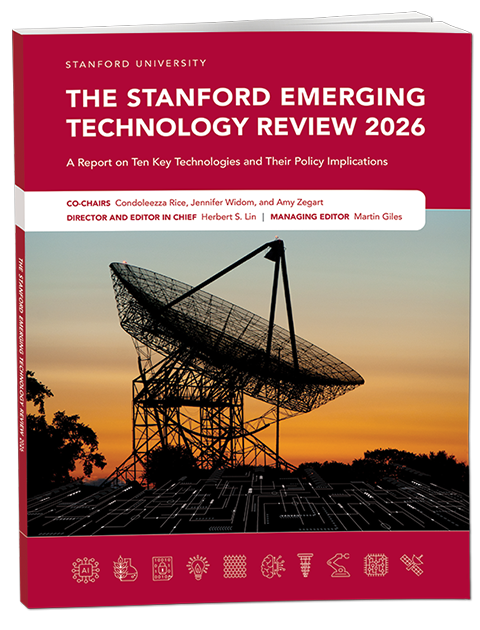
The Stanford Emerging Technology Review harnesses the expertise of Stanford University’s leading science and engineering faculty to explain the current state and policy implications of ten critical technology areas: artificial intelligence, biotechnology and synthetic biology, cryptography and computer security, energy technologies, materials science, neuroscience, quantum technologies, robotics, semiconductors, and space.
Key takeaways include:
- These ten technologies have applications across a wide variety of policy issues, including economic growth, national security, environmental and energy sustainability, health and medicine, and civil society.
- Innovation that emerges too fast threatens the legitimate interests of those who might be negatively affected; moving too slowly risks a nation losing first-mover advantages.
- Frontier bias causes overemphasis on new technologies and sometimes results in overlooking impactful uses of established ones.
- Biotechnology is one of the most important areas of technological competition between the United States and China, and China is now leveraging two decades of strategic investment to secure global leadership. Absent swift and ambitious actions, the United States risks biotechnological surprise and a loss of biotechnology sovereignty.