







- State & Local
- California
- Politics, Institutions, and Public Opinion
- Campaigns & Elections
- Empowering State and Local Governance
- Revitalizing American Institutions
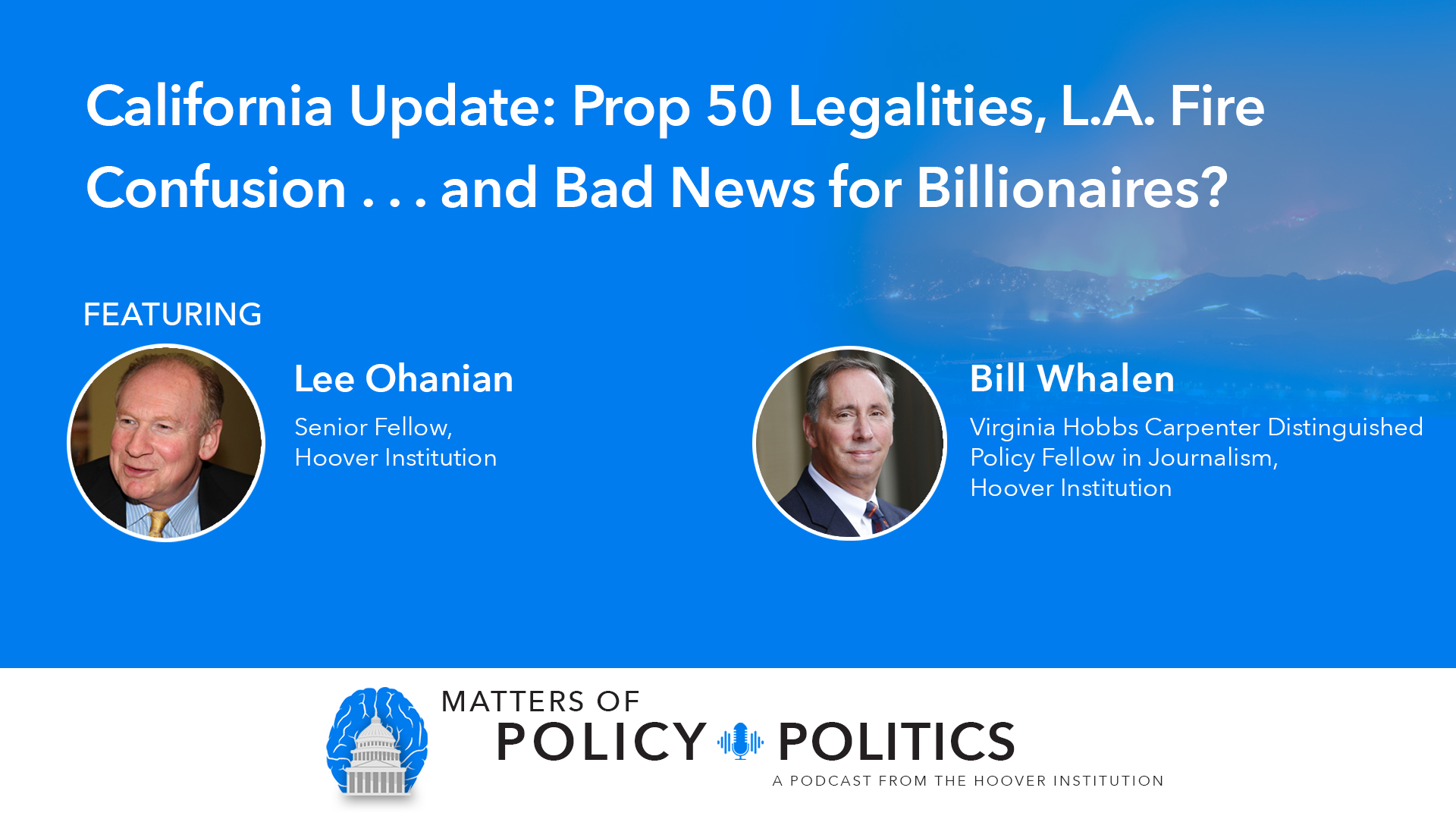
After a lopsided victory earlier this month, can California’s redistricting Proposition 50 survive a legal challenge? And why do last January’s devastating fires in Los Angeles continue to raise unsettling questions?
Hoover senior fellow Lee Ohanian and distinguished policy fellow Bill Whalen, both contributors to Hoover’s California on Your Mind web channel, join Hoover senior product manager Jonathan Movroydis to discuss the latest in the Golden State including former House Speaker Nancy Pelosi’s pending retirement, what the indictment of a former Newsom chief of staff says about Sacramento’s political culture, plus a tech-rich Northern California county’s search for more tax revenue – and, speaking of wealth, the politics and sensibility of a 5% wealth tax on California billionaires possibly headed for next year’s ballot.
Recorded on November 18, 2025.
- It is Tuesday, November 18th, 2025, and you're listening to Matters of Policy and Politics, a podcast devoted to discussion of policy research from the Hoover institution and issues of geopolitical, national and local concern. I'm Jonathan Movroydis. Every month I have the privilege of moderating discussion on politics and the economic situation of the Golden State with two Hoover fellows and experts on these issues. Bill Whalen and Lee Ohanian. Bill Whalen is the Virginia Hobbs Carpenter distinguished policy fellow in journalism and the regular host of the show. Lee Ohanian is a Hoover Senior Fellow and Professor of Economics at the University of California Los Angeles, both right for Hoover's web channel, California on your mind. Good day, gentlemen. How you doing?
- Good. Good. Yeah, doing well. Fell a lot of, lot of material to talk about today.
- Let's recap. Election period. Most notably, and I, there is news on this front that I'd like you both to comment on, but most notably, proposition 50 or the Election Rigging Response Act was passed on a special ballot by a majority of 64% of voters effectively amending the California Constitution. The proposition redraws the state's congressional districts away from the one outlined by the bipartisan California Redistricting Commission. This is a major victory for Governor Newsom, which came a week before his colleagues in Washington caved to the Trump White House and the Republicans and agreed to end the government shutdown. The presidential election is way off, but Polly Market has Governor Newsom far in a way as the front runner for the Democratic Presidential nomination in 2028. Just to start off, bill, can Newsom sustain the momentum and rack up future Ws and who are some of the other potential winners in the Proposition 50 follow up, but maybe just comment on the news regarding Proposition 51st.
- Sure. So the news today is that a a three judge panel in Texas federal panel in Texas shot down Texas' redistricting plan, which is what started Prop 50. Newsom decided to redraw the Congressional Maps of California response to Texas redrawing as congressional Maps maps. Texas wanted to add five Republicans in that state to help improve the Republicans chances all in the house next year. So Prop 50 responds by redrawing California and adding five Democratic seats. So now Texas will go back to its old map and business as usual for the 2026 midterm. And the question becomes, what happens to proposition in Cal 50 in California? Yes, you have the governor saying during the summer that he would stand out of Texas stood down. But what is noticeably absent from Proposition 50? If you read the fine print of the measure Democrats, when they were debating this, they considered putting in what they call trigger language. And the trigger language said that if Texas does not go through with its policy change, its congressional map change, California will not go through with its change. But then lawmakers thought, eh, why do we wanna do the trigger? Maybe that's not a good idea. So there's no trigger in prop 50. So the Texas ruling does not really affect Proposition 50. Now that said, prop 50 is not entirely out of the woods. The judges in Texas shot down the Texas Redistrict plan for one simple reason, they deemed that it's tantamount to racial gerrymandering, and that's what it's issue in California as well. There are at least two lawsuits pending right now, one by conservative activists and the other by the Trump Justice Department, and they claim the same that this amounts to stand amount to racial gerrymandering. So we will see what happens with those two court cases. So you could have, ironically, sadly, I would say, given how much money was spent in California on this, on this ballot measure, you could ironically, kind of like a Roadrunner cartoon end up with the coyote kind of back on the cliff after all the, the craziness in the past few months. In other words, California may end up going back to its original map, Texas, its original map. But what's complicates all this guys is that the clock is ticking on California already with the redrawn maps. You have members now all over the state trying to decide what district to want in, so to run in. So you have Republicans moving into new districts. In some cases, Democrats moving into districts, Democrats versus Democrats, Republicans versus Republicans. I cannot begin to fathom the chaos that would ensue if the, if a court came in and said, prop 50 is null and void. So anyway, stay tuned. It's supposed to be a quiet November here and an off year. It's not. December's supposed to be quiet, but the courts could throw yet another wrinkle into this plan. Lee.
- Yeah, bill, this is, you know, I look at this as what happens when a bad idea goes too far?
- Yeah, - So, so, you know, so just as a little bit of context, Texas had enormous population growth between 2010 and 2020. They received some extra receipts. They red redo their, they redrew their districts as states are supposed to do after, since after a decade census is Texas, put forward a redistricting plan that, that was sued in 2021. They needed to redo it. They came up with this new plan, which was now struck down a federal district court because it violates the Voting Rights Act in 1965, which holds that the, that districts cannot be drawn to suppress racial minorities. So I'd be surprised if, if, if, if this holds up for Texas and that they have to go back to earlier maps for the 2026 for the 2026 House elections and other elections. And of course it built, as you know, did California advertise Prop 50 as battling Texas. So they were trying to get five extra seats for Republicans and California was gonna offset that by getting five more seats for Democrats and the whole issue. And I recall the governor saying, well, you know, Texas started this. And then the whole issue was, well, we'll stand down if Texas stands down. Well, Texas is standing down because of federal district court, but as you note, the text of 50 has no trigger language. There's nothing about Texas in there. So now California Prop 50 overwhelmingly passes, bill, you got that right. I got that wrong. You know, it's interesting, bill, the, the Republican know campaign on this, I thought was just not well organized and it really didn't get the vote out for Republicans, which was required if this had any chance of passing turnout was about 50%. My my sense is the Democratic turnout was higher than Republican turnout. You know, on the Democratic side, they had a very effective campaign. They spent an awful lot of money on it. Former President Obama did a commercial for it. On the Republican side, there was former Governor Schwarzenegger, who the citizens Commission for non nonpartisan districts was his baby. He made I thought, some very powerful ads. But at the end of the day, Republicans had to get out and vote and, and they did it. And you know, bill one, I think my favorite new district is one that extends from the absolute northeast corner of California all the way to the northwest corner, which is according to MapQuest, is about 430 miles. Then you drive about over 300 miles down from the tip, you know, from the northwest border of California, Oregon down to Marin, which is where our governor's relatively new house is. And you know, the ci the Citizens Commission was, was founded on the idea one person would vote and therefore putting together districts that were roughly of equal size and among communities of interest. And I can't imagine much in common between the people that live in the corner of Northeastern California and, and Mill Valley, which is in, which is in Marin County. So the, there, there are multiple suits against California's Prop 50. There are emails that suggest that the districts were drawn to emphasize Latino voters that could be interpreted as being, as violating the Voting Rights Act of 1965. And there's, and the Trump administration, I believe was provided with some information on voters who are no longer active, moved out of state or no longer registered who, who voted. So yeah, that's where we stand. But I hope both in my own opinion, we should have one vote, one person representation and I hope both of them go down. But, but again, just the hundreds of millions of dollars of the spent on this, just a lot of, at the end of the day, this, this may just be a, just a gargantuan waste.
- So for those keeping score at home, there are six states in America that have now fiddled with redistricting in the middle of the decade, California and Texas. We mentioned also Utah, Missouri, Ohio, and North Carolina. The Scorp board reads as follows, this is before the Texas decision. Today before, before the court reversed Texas's plan, Republicans actually had a nine to six advantage. That includes the five in Texas plus four, the combination of Missouri, Ohio, and North Carolina. California is plus five for Democrats, plus Democrats get an extra seat in Utah of all places. Now you take Texas outta the equation and now Democrats have a net gain of two seats, six to four. If you took California out of the equation, you're now looking at a net gain of four to one for, for Republicans. So more to be continue. But you know, Lee, looking at the, the tactics behind Prop 50 was very fascinating 'cause I think it's a window in perhaps the next phase of politics in California. This includes a candidate about to run for governor. It seems we'll get to in a minute. Prop 50 ran circles around the opposition for two reasons. One was just better organization, a much more focused, organized campaign on the Yes side, the no side was actually two campaigns at times competing with each other at times being inconsistent on message. If you followed the, the one campaign run by the, by the physicist, Charlie Munger based here in Palo Alto, he put $30 million of his own into the campaign. He paid for the Schwarzenegger ads that was about good government. And you're right, that was a good message by Arnold that was on, on brand for him. If you looked at the other note campaign though, they were talking about all the horrors to come from handing over California to Democrats, illegal immigration and so forth, just conflicting messages. They were horribly outspent in terms of money, but they really were just kind of pounded on social media. And this is the change to watch for in California. We had been so wed to what I would call Vestige media, and that's a combination of newspapers, radio and television. And as long as I've been in the state, 30 plus years, television has always been king. You have to go on the air, you have to go on the air late before an election and move voters. Well, that's no longer the case because first of all, ballots are handed out a month before elections in California. So if you wait until a week before the election, you're losing a bunch of people who have already voted. But secondly, people are changing their news habits. They're not so much tuning into the nightly news. They're going on their phones in the computers during the daytime and they're searching for news on social media feeds. And here the Yes side just had a far better social media campaign than the No Side did in terms of just being spot on in terms of Cy pounding, Donald Trump finding just kind of ways to bait the conversation every day. So, you know, I give them credit where credit is due, they simply outmaneuvered the opposition and that's why I thought the thing would pass to begin with. But you know, again, the tragedy here is, as you mentioned Lee, you know, it cost at least a couple hundred million dollars, maybe $300 million just to pay for the election. You tap in, you know, 150 to $200 million more spent by the two sides. That's a half a billion dollars, give or take a few, take a few. We can just sit here all day long and talk about better uses for that money in California. So, boy, it would just be very sad if after all of this that we ended up back at square one.
- Yeah, you know, bill, Republicans are only about 25% of the state's electorate, the Democrats 40 something, and then niche parties and no party preference are another 25. And on the Democratic side, you've got 2.7, roughly 2.7 million union workers in the state,
- Right?
- That by itself, that's a big voting block. And they're very well organized. And when campaigns come up like this, they, I suspect, get a lot of information and get a lot of nudges and pushes to go out and vote and, and vote for Prop 50. So it's an awful lot for Republicans to push up against, but they were never gonna have a chance unless there was enormous turnout. And I think an awful lot of people just had no idea. And we see roughly a 65%, 35% voting on this, on this proposition. So yeah, we'll wait and see what, what the courts say, but yeah, half a billion dollars, a lot of airtime and a lot of political energy spent on something that may be absolutely zero. So stay tuned on this,
- Right? But even with the turnout lead, you're gonna lose because this was ultimately a referendum on Donald Trump, plain and simple. And Donald Trump is not popular in California. And so this shows the extent to which, you know, Trump hatred fuels things, by the way, in case you guys are curious if to see now a kinder, gentler Kevin Newsom as a result of the Texas ruling. I just got an email from his campaign for Democracy Pack. I'm on their mail list, I'm a glutton for punishment, this kind of stuff, but I always like to see what emails are. So here's our governor now asking for people to give money to something in Missouri called people, not politicians. What they're trying to do is they're trying to kill the redistricting effort in Missouri, but this is Governor Newsom, this is his presidential campaign right now. He's sending out these emails, he's trying to build lists and he is building a national network by doing so, and very clever politics on his part. And so, you know, this is a very ascended Gavin Newsom right now, but it goes back to your original question, Lee, about, you know, his, about his, his his his standing right now, you know, presidential politics sometimes is a case of the tortoise and the hare, if you will. And we see somebody two to three years out and we kind of, you know, obsessed with that person to think they're the next great thing in politics. Do you remember a guy named Scott Walker? Lee,
- Yeah. Governor of Wisconsin.
- Yeah. So going into the 2016 campaign, no, going into the 2012 campaign, I'm sorry, date myself here. But going into the 2012 campaign, he was the next great thing in Republican politics. Why governor of a swing state? He fought unions over, over, I think union dues in, in Wisconsin. There was a big kerfuffle over the legislature not competing to vote on this stuff. And conservatives thought that, boy, he was the next thing for Republicans and he ran and he was just a hot mess when he ran and it collapsed, his campaign fell apart, not always good to peak early in politics right now. And that's a risk for no amount to maintain this, this drumbeat of his for the next, for the next, you know, year or so because he does, by the way, have to govern, which we're gonna get to in a few minutes as well. So can he maintain this kind of frenetic anti-Trump pace? At what time does, at what point does he have to put beat on the bones, not just being, not just being the Democrat who Donald Trump hates the most presidentially, but just what's he gonna run on in terms of policy ideas or maybe I'm just a dinosaur here and you know, Kevin, the realization that in 2028 maybe ideas don't matter, it's just gonna be a a a campaign decided over who hates Trump the most.
- Yeah, that's a powerful force in California. You just bring up Donald Trump and it seems like it gives you, you know, 10, 15, 20 points just right off the bat. And that's just an awful lot to, to overcome. You know, Newsom is, Newsom is, as Jonathan mentioned, he's hot right now in terms of what being on top of the democratic polls that, you know, for an election that's still two years out. But, you know, bill, it's interesting, there's a, there's a techie political consulting polling firm called Decision Desk, and they aggregate poll results over various kinds of po over various politicians. And they aggregated approval ratings for Newsom over 67 polls roughly the last two months. Favorability comes in at 35%. So, you know, so I'd look at that number and now it is, it is up from 25%, which was back in the spring when Newsom was, I think being, taking a lot of criticism about the, the LA fires. So it's up to 35%. He seems to be on top of the Democratic polls right now. That seems to suggest to me just the, the Democratic party in terms of finding national candidates is having a really difficult time.
- Yeah, they are. So in 2027, look for this with Newsom, you know, he had a big win in California, prop 50. He is cashed in on that. He, he went off to Brazil for a climate conference afterwards. He did a rally in Texas along the way to just show that he has kind of a national scope, if you will. But you might have noticed in this year's a gubernatorial races, he did not campaign in Virginia for the Democratic candidate. He did not campaign in New Jersey for the Democratic candidate. And I'm not sure he was invited in, in either case. And there were other governors who were invited, especially to New Jersey. So this is a question of bringing California into other states, and it's a, it's legitimate concern, especially when you start looking at the industrial upper Midwest. And the question of how Newsom is a California and you know, is, you know, translated in those states as well. So look for this in 2027, Democrat in 2026, first of all, beginning of the year, democratic organizations across the country have usually, they used to be called Jackson Day dinners. So I think Andrew Jackson's been canceled now, so they have some other phrase for it, maybe they were Obama dinners or something like that. But these are fundraising efforts in the States and they like to bring out big sexy names. And so I'm guessing Gavin Newsom's gonna be in popular demand for those dinners. But the question Lee and Jonathan's gonna be come October and November of next year, where is Governor Newsom gonna be campaigning and will he be campaigning in those seven swing states that Donald Trump picked up from Kamala Harris or is gonna be campaigning in rather safe blue spots or not? That's gonna tell you really how he translates, I think, as a presidential candidate.
- And you know, it's interesting, Virginia and New Jersey are bluer than upper Midwest Rug Belt Rust Belt states, and, and they ended up winning despite not having Gavin going to bat for them. So yeah, I think they feel like they can do just fine with without him and with and with a governor's race coming up for us just one year out, he seems to be kind of taking up a lot of air in the room that I think some of democratic candidates probably wish they could have.
- Yeah, and the other thing about news, I could move on after this is I'm still trying to figure out what exact lane he fits into in, in the greater Democratic race. In other words, think of the primaries as kind of a swim meet. And each of these candidates has their own assigned lane to swim in. I'm not sure what lane he is in right now. They're, they're only anti-Trump Lane. It's like, it's like, you know, kitty swim in that regard. But is he gonna run as something of a hybrid between a mainstream and an a OC kind of candidate? He's gonna drift further to a OC you know, other way to mainstream or not. I'm just trying to figure out Lee, where his niche is in that field.
- Yeah, yeah. He's gonna have to find something other than just the loudest voice in the anti-Trump camp because that one is, that's a crowded phone booth.
- Yeah. So Governor Newsom, after his victory lap on Prop 50, he went to Brazil for the COP 30, the UN Climate Change Conference. And during his visit, he blamed the wildfires earlier this year in January on climate change. Not sure how the squares with an October 8th press release from the governor's office, which pointed to the arrest of the arsonist who started the Blaze Lee. In your latest column for California on your mind, you discussed the LA fire Department's after action report on the January, 2025 wildfires. You write what is most notable about the report is an omission of any discussion of whether the Palisades fire, which began January 7th, could have been prevented, had reasonable measures, had been taken thong, the containment of the Lacman fire, which burned about eight acres in the Palisades on January 1st last week, two Republican US Senators Rick Scott and Ron Johnson held a field hearing in front of Palisades residents in which they stated that they could, they would lead a probe into the fire, investigate whether it could have been prevented. Lee, your thoughts on the field hearing whether the fire could have been prevented and also the the complicated cleanup process in Altadena and the, and the, and the Palisades.
- Yeah, we know this, this is the story that just won't go away. And you know, the reason it won't go away is because there's a handful of people, Palisades residents who lost their homes, who, you know, who are mad as heck about policy and about governance. And they seem to be on a mission of trying to uncover what happened. And the reason we have this federal ation now with Scott from Florida and Johnson from Wisconsin, is because I handful these people. They're on social media all the time. They are, they are, they are following what's going on in court with the various lawsuits against the city of Los Angeles and also the state of California. You know, sky's coming from Florida, a state that has just enormous nu n numbers of natural disasters. You know, they're, they're in the middle of hurricane, they, they're hurricane central and they've made a lot of changes in recent years in terms of preparation, in terms of protection, in terms of delivering efficient outcomes, being able to protect their con, being able to protect their constituents. And so they, and what was interesting is no one from California or the city of Los Angeles attended this hearing. And a number of Palisades residents who lost their homes spoke, you know, in a heartbreaking terms about, about what happened. Scott and Johnson concluded, well, you know, this, this should never happen. We send enormous numbers, amounts of federal dollars to California for fire protection, protection, you know, how did this happen? So there's a federal investigation, but you know, when this first happened in January, January 7th, the narrative was big winds, super dry conditions, what could, you know, there was nothing anyone could do. And so climate change was the headline that everybody was discussing. Now we're here 10 months later and the narrative has changed enormously. So federal investigators have concluded that a small brush fire that was set by an arsonist on New Year's Eve reignited to become the Palisades fire. A few days later there has a whistleblower has come forward, and some of these people on social media have received phone texts from LA fire department people who were at the burn site and who allegedly report according to these text messages and the whistleblower that the fire may not be completely put out. And they also report that their battalion chief or supervisor told them to come back. And, you know, just this morning some of this material was released because it's in a lawsuit. So I'm just with me for about 30 seconds where while I read this, so this is for, this apparently is from text messages on January 1st, after the LAFD had put out a roughly an eight acre fire called the Lacman fire. Still feels warm in spots. Rock pile is hot. We should hit this again, no use of thermal imaging. Those are text messages. LAFD, the fires extinguished, the mop-up is complete January 2nd, they go back. Fire department personnel at the burn site text. This is a bad idea. We shouldn't be leaving. There's heat in the duff. I don't know what duff means, but that's the quote. We didn't run thermal imaging. The LA fire department, they agreed they did not use thermal imaging. They called it a judgment call. At least one fire expert has called that a critical mistake. But it seems that no one even needed thermal imaging because there's a video that was discussed in the San Francisco Chronicle that apparently shows smoke coming from the burn site. There are reports to local city council from her constituents reporting smoke on the burn site. Now we get to January 7th, which is when the Palisades fire started, text message from fire department is the same area. It re-lit. Told them it wasn't cold. How did this get past the supervisors? We left it hot. Now look, and and the rest is history. So this is, this is part and parcel of the lawsuits that are going forward with the, against the LA city and against the state. Now, governor Newsom's office is trying to distance himself from all of this because the fire occurred on essentially state park land. There's language that indicates the state park is responsible for making sure these burn areas are cleaned up. There's no further danger. The governor's office or the state, I can't remember which said we didn't even know about the Lacman fire. The, the, the park department didn't even know about the Lacman fire. Now in court hearings, the state parks department provided a one page, almost fully redacted document about an action report related to this fire, almost fully redacted. The plaintiffs in the case find evidence that the state park people were there. There's a photo of a person with the state park windbreaker on that was reported by KFI. And this is really important because what's also coming from either whistleblowers or text messages is that they were not allowed to bulldoze this area. Obviously bulldozing is gonna facilitate putting the fire out. So this is looking, this has the pen potential about coverup. It has the potential about gross negligence. And based on if these allegations are correct, yes, the fire could have been prevented and potentially the very low cost.
- So there is a documentary coming out in early December, Lee and Jonathan, it's called Paradise Abandoned. And it claims that authorities diverted resources during the fire. It alleges that although the area was in a quote region of maximum fire, not a spare fire truck was deployed. In other words, it could go through a list of horribles and lay a lot of this at the feet of Governor Newsom. Newsom will probably respond, this is Newsom derangement syndrome. We'll probably tie it into Fox News. And you know how that goes. This is what I find frustrating about this situation. We have a very rich tradition in this country of forming commissions to investigate tragedies. I'm normally not a fan of process, but when something very bad happens that the challenger disaster, John Kennedy is killed nine 11 or something like that, you could be in a panel of experts and you find out what exactly happened, what went wrong. You get to the, you get to the answers. And here we are right now about to enter into December and we've, there's still a lot about this, this fire, we don't know. And there's still a lot going around in terms of urban mitts, real or not, MITs, the question of firetrucks being deployed continues to be a physical matter. The matter of fire hydrants and the Palisades Lee, and one that never seems to go away is the question of whether or not reservoirs were empty. We just, you know, you're in Southern California, Lee, where it's been raining, you know, cats and dogs and more than a few people have said sarcastically on social media. Gee, maybe the res maybe the reservoirs will be full now. So to me, as a Californian, this is what I really bothers me about this whole process. We still don't know exactly what, what wrong back in January, we, it seems we were still playing catch up. So could the state, could the city just put together a panel of experts and get the answers?
- Yeah. You know, when these, the LA Times has probably a half a dozen articles about this. I don't know if they've been interviewing the whistleblower or the people, the fire, the firefighters that sent those texts. But you know, when this came out, it took these LA Times stories for, for for mayor bass,
- Right?
- To say, well, this sounds just outrageous. We really need to look into this. Well, she's, you know, recommissioning her own fire department to look into this. This needs to be an independent body and, you know, build that reservoir that was empty. My former home in LA used to have a, used to have a view of that reservoir. And when it was full, it was beautiful. It looked like you're looking out in a lake. That reservoir had been emptied for approximately 10 months because they were waiting on a repair, on a cover. The, the reservoir's cover. And I don't know how you, why you need to 10 months to get a, to get a, a reservoir cover repaired. But yes, that was empty. That's been acknowledged. The fire hydrants became depressurized. And you know, bill, ironically, that reservoir that was built was right after the Bell Air fires in the early, early mid 1960s because they recognized city of LA recognized. Well the Palisades is Palisades looks a lot like Bel Air, lots of trees, lots of chaparral. We better do something there. And they built an enormous reservoir right there to protect that area.
- Jonathan, there's a, there's a famous photo, Jonathan, Richard Nixon on the roof of his house in Southern California.
- Spring water. Yeah, spring water. Yeah, yeah. Spring water. Yeah. So yeah, we're playing catchup, we still don't know what happened. And there's some suggestions of coverup. And again, you noted urban myths, but you know, this, this lawsuit, you know, discovery will be very interesting and I think the judge in this case will be, well I, I hope they look at scans that heavily redacted documents because so far we're seeing, we're seeing of some of that. But again, enormous tragedy, tens of billions of dollars in damages, people dying, people's lives being turned upside down. And if only, according to these reports, if only LAFD who were saying we shouldn't be coming back, there's still hotspots. If only they had done what they went there to do.
- Well, look, I think a more responsible mayor would've created a commission to look into this. A more responsible governor would've created a commission. A more responsible legislature would've looked this because he would get answers and also maybe recommendations about how not to relive this experience. But I think politics weighs over everything. The mayor is up for reelection next year. It's gonna be a contentious race. We know our governor wants to run presidentially. He doesn't want to be tied to this. So I think it's just a shame though, we're just not gonna get all the answers we deserve here.
- Yeah, and the idea of not using thermal imaging, which has become standard in firefighting, presumably that would have identified the hotspots. The LAFD says, well maybe not necessarily. They claim the whistleblower is inaccurate. They claim the site was declared cold text messages say otherwise. So again, stay tuned on this, this is not gonna go away. Yep.
- Gentlemen, moving back up to Sacramento, Dana Williamson, a former chief of staff to Governor Newsom and former California Attorney General and Health and Human Services Secretary Javier Bera has been indicted on 23 counts of bank fraud, wire fraud filing, f false tax returns, and claiming phony deductions for things like luxury travel and purchasing Fendi and Chanel handbags. This doesn't have anything to do with Governor Newsom other than the fact that Ms. Williamson, a lot of this activity occurred during her time working in the governor's office. Bill, could you explain how Ms. Williams might be an Achilles heel for Governor Newsom? Should he seek to pursue higher office?
- Well, she becomes an Achilles heel in this regard in Jonathan. So she has been charged with 23 counts of bank and wire fraud. And that's not including tax fraud as well for the Ford mentioned write off. She was claiming this will lead her to trial and it will not be a very pleasant trial because the prosecutors could drag the governor into it and make 'em testify, if you will. But what I think a trial would produce would be her talking about her role in the governor's office. And she bragged to people that in the second half of 2024, she was basically running the show because the governor is off running around the country quasi campaigning for the presidency. So it's a bad look for Newsom, it comes across as an absentee governor and it ties in some other potential newsom weaknesses in this regard. The idea that as chief of staff prior to being a chief of staff, that she was involved with conspiring to create false backdated contracts related to the paycheck protection program. This ties into a problem with California phony unemployment claims during COVID, for example, just it points to sloppy government and I think leads something like what $55 billion in phony unemployment claims came during COVID. And then it also ties into favors done by the governor's office. So one thing which he is tied into is this a lawsuit that the state had against a Santa Monica based company called Activision Blizzard. Your kids probably don't know what Activision Blizzard is, but they certainly know some of its products. They're, they're creators of Call of Duty, candy Crush, world Warcraft. And frankly a lot of stuff that I don't want my grand nephews watching on the screen anyway, it's a big money maker operation. The state was going after them on, I think hostile on workplace misconduct and Williamson allegedly kind of squashed it. She bragged about getting a state lawyer fired. She also apparently was involved Lee in the Panera Bread controversy, which we've talked about on this podcast before. The question of who, you know, got favorable treatment for Panera Bread when they were doing the carve out for fast food, higher minimum wages. And apparently she helped out on that as well. So she's, you know, she ties to various problems with Newsom, but it's as simple as this. Lee and Jonathan, even though Newsom was not a cahoots with her, even though he has a lot of deniable culpability here, the one problem though is this happens on his watch. And so every day former Newsom chief of staff on trial, it's just gum on the shoe in that regard.
- Yeah, you know, I mean she was, she was what chief of staff?
- She was as chief of staff. So her, she has interesting background. So she made her rise through in Sacramento politics. She was connected to a woman named Nancy McFadden, who was ultra powerful chief of staff for Jerry Brown. So she worked for Jerry Brown, she then went off and did consulting, public relations, lobbying. And then she came back, kind of surprised people that she came back and worked for Newsom, but she went in there and was just a real power chiefs of staff are very powerful in Sacramento. Very a story in that regard. But she is a very difficult personality to, to be polite about it. The word bully is used often. It kind of segues to our conversation about Katie Porter a few weeks ago, if you will. But she very rough on people and so some people in Sacramento say, this is karma coming back in a very big way. So again, it's just, it's a very bad look for a governor trying to run for president when a former chief of staff, even if you're not tied to it, is on trial. Begs the question of what is going on through state government. And Lee, it ties to this larger question, which I think we should get into about just certain practices and one which I know you've been keenly interested in is the construction of the capital annex. Do you, do you wanna explain what's going on there, Lee?
- Yeah, so the, the construction of the capital annex is not just behind schedule, but we don't know how much it's going to cost. And some reporters, particularly Ashley Zavala at the Sacramento NBC affiliate, KCRA has been submitting Freedom of Information Act requests during a Newsom press conference. She asked Newsom directly, do you approve of me not getting information? And he said, well no, of course you should have that information. Well governor, can you facilitate that because I just keep getting stonewalled. I don't know, she used the word stonewall, but that's what she meant. And she, as far as I know, she still hasn't received that information. The, the last number from a few years ago was, I believe around 1.1 or 1.2 billion for a capital annex
- Triple its estimated cost. Yeah,
- Yeah, yeah. And again, this, you know, all of this just coming together, it's just really, I think it sheds just a little bit of sunlight on the unseemly underbelly of Sacramento where there's, where there's this interaction between those, we elect those who are on staff, including chief of staff political lobbyists who were, who were very influential, including unions, environmental groups. And you know, once again, Newsom has remarked, you know, hey, that's how the sausage is made, but you know, the sausage, the sausage is coming out with an awful lot of problems in it. And you know, bill, what Newsom I think may also face some face, some problems with is that when she, I believe she resigned from her position as chief of staff and, you know, on social media, he sent out I think a very glowing, very glowing summary of her time with him, even though he, he knew that she was under FBI investigation. So I can't imagine this not being used against him by candidates in 2028 if he chooses to run. And, you know, bill, were already an Activision. Maybe this was, maybe this was her, but, you know, there were complaints coming from the attorneys saying, Hey, you know what, the governor's office is interceding here, right? And the response from the governor's office, I believe in 2022 was absolutely not. And I don't know if that was just her or who in the governor's office made that statement, but it is just, it is a very bad look, you know, it it, it reflects on the company, the people you keep, the responsibilities you give them and you know, the, the quote of, Hey, I was running the government. That's just not a good look for him. This is, I my opinion, this is gonna hurt him down the road.
- You know, this is a bad look, Lee is getting back to the capital annex project, the use of NDAs, non-disclosure agreements. 2100 people who've been working on this project have signed non-disclosure agreements. And you have to ask yourself, what are you hiding? You're using taxpayer dollars and you're, and you're just hiding the details. And this is, you just imagine all the headaches it's gonna come out in terms of what ornate marble is being used and you know, bathroom fixtures and that kind of stuff. But it's all secrecy. So even if, you know, Ashley wanted to get the inside stuff on this, all these NDAs gonna keep her away. I think 2100 people signed NDAs Lee, and I think three lawmakers signed NDAs. And sure enough, there's legislature coming around and now realizing, okay, we have a perception problem with NDAs. So they passed the bill AB 1370, send it to Newso signs, it, it bans lawmakers using NDAs, but it doesn't apply to the capital annex, if you will. So it's, you know, Sacramento just trying to kind of show you, we, we see the problem, but they're not really solving that regard. So yeah, so you, you spending just a ridiculous amount of money on this capital annex and we're not gonna ever find out what it's being spent on.
- No. And this taxpayer money, and this just goes back to that, that shadowy area of, of legislators policy makers, their staff lobbyists who make decisions and spend an awful lot of money and who, as you noted, who are going to great risks and extents to hide what they're doing and to hide how much it costs. And you know, bill, you're asking yourself, Hey, why is a guy laying carpet? Why is he signing an NDA, you know, why is a glass installer signing an NDA? Why, why, why, why is a painting and plastering company having to sign an NDA how often, how, how often do tradespeople sign an NDA when it comes to public, when it comes to public infrastructure? I mean, it's just ridiculous. It's, it's absolutely ridiculous.
- It means it's for Newsom and the Trump bashing to, to continue. He's gonna have to tread lightly when it comes to bashing Trump on the White House Ballroom.
- Yeah, which is private, which is private money and not, not public money. And, and meanwhile you look at the people again, you look at the people from the fires, I think only about 4% of those in Malibu have received a building permit, have received a building permit, yet no certificate of occupancy. I think Palisades just recorded their first certificate of occupancy in the last week or so. So one fa after 10 months, one family is back and, and yet you look at how Sacramento operates and it, I think personally, I think it's in just an insult to the voters. And if voters understood this, I think they might, you know, maybe make some different choices when it came time to vote.
- Bill, let's talk about your latest column in California on your mind in which you talk about two significant Bay area developments. One is the retirement of Nancy Pelosi this year. The big question is there, what impact does that have on Congress and who succeeds her? The other is a new measure approved by voters of Santa Clara County, the nation's second richest county where Stanford and the Hoover Institution reside, measure A boosts the county sales tax to 9.75%. The challenge for this county is that spending is up 69% while the local population has remained stagnant. Bill, could you talk about these two developments? Let's begin with Nancy Pelosi.
- Let's quickly do Pelosi, 'cause I think actually prop A and then Lee a question of a wealth tax coming California's way in 2026. I want to get your thoughts on that. So Nancy Pelosi, she gets the win on Prop 50 and then at age of 85 announces that she's calling it a day. She will not run again after 2026. And now we're gonna have something very rare in San Francisco, a competitive congressional primary because it's a one party town and in a company like Pelosi's just never threatened. So the Tants include a state senator who is very heavy Lee on housing and Ybi issues. And he is up against a very wealthy tech guy, sent a million who's claimed to fame. He's a former A OC campaign manager slash chief of staff. So here we have kind of a preview of what's gonna happen to Democrats WR large in 2028. Presidentially a question of how you position yourself. And Scott Weiner, he is the estate senator, he's gonna run very hard on a record and do gooding for San Francisco. Chaat Chakrabarti, he is the former a OC campaign manager. He is gonna go very hard left in the good people of San Francisco will have to decide accordingly. Pelosi doesn't have a dog in the hunt right now. She's not set. Interesting enough, her daughter who people thought for years that Pelosi was kind of setting up to run for this job, her daughter backed out of it. Probably sensing that maybe this day and age people are a little tired of dynasties and maybe not a good thing. That's Christine Pelosi, the documentary author by the way. So now you have this kind of democratic litmus test in San Francisco, if you will. Wiener, by the way, I would note Lee, he has the backing of the State Attorney General Rob Bonta. So he would seem the establishment favors. So we'll see who prevails then. But Lee, it's, it's set Clara County in Measure A that I want to get your thoughts on. And what measure A was, long story short, it was a tax increase. It boosted the county wise sales tax to 9.75%. And what Lee, what fascinated me here is that Santa Clara County is this bastion of wealth. It is obviously, it used to be, used to be one giant fruit orchard is where you'd come for for produce. Now the local fruit is this, this fruit symbol you see on the back of laptops like mine. So you know what that company is, it's become a very wealthy corner of America. You look at the billionaires floating around here, but yet the county has a deep financial problem. And why is that? If you look at Santa Clara County lease since 2019, I did the numbers on this county spending is up 69%. At the same time the county spending is up 69%. The state has become hooked on federal health money. And this is the what was at the heart of the shutdown in Washington, whether or not to extend Obamacare subsidies. So along the come, so along come the county planner deciding that we're gonna pass measure A and we will increase the sales tax and that money will go to healthcare. Well, two problems here, Lee. Number one, it's built as a temporary solution. Well, getting back to our rather cynical discussions about taxes in California, nothing is temporary. So that's probably here to stay. But secondly, Lee, there's now a fight going on inside the county. A district attorney now wants to investigate the backers of the the measure because why the measures went around the county telling people, people who might vote against it, special interest, no, don't worry, it's gonna go to healthcare, but you'll get your cut to now you have public safety officials in the county saying, wait a second, we're hearing now the money's all gonna go to healthcare and not public safety. So there's a problem here, Lee, there's a problem with spending in the county, but there's a problem with taxation and how you use taxation in California.
- Yeah. You know, everybody wants their cut. That's, that's what, you know when there's a big pile of money, it just, they just come out of the woodwork. You know, I checked the, I checked the government salary records and I looked at Santa Clara County employees And I estimate that their total compensation, including wage and salary and then benefits including healthcare, was about $200,000. The meeting was about $200,000 in the latest data. So when you say, yeah, they needed, they needed to pass a, they needed to pass a tax cut, well that's a pretty expensive, that's a pretty expensive county government that those, the the median, the median earner in Santa Clara County government probably is within the top 3% in the United States. So yeah, you've gotta figure out how to be a better steward of public finances and tax revenue because people are trusting you with that. They're trusting you, you're making reasonable decisions and you're providing, you're providing high quality public goods and services and they're not getting taken advantage of. And you know, bill, there was a video that was going around on some news stations of, of like a yes on a yes on a party and people jumping up and down when it looked like it was going to, it was going to win. You know, usually you don't, you don't root for tax increases. But yeah, the, the county has some fiscal, has some fiscal challenges, 9.75%. And you know, bill, when you think about the highest earners in Santa Clara County, W2 earners, and you think about their total tax burden, you think about federal tax burden, state tax burden, and then after they pay their federal taxes and their state taxes, and now they go out and they buy something in Santa Clara County and they pay a sales tax, you put those three tax burdens together and it's over 50%. And you, you have to really, you have to really start asking questions about, eh, are we living in a representative democracy dysfunctional that has sufficient freedom when over 50 per over 50 cents of the dollar that I earn is going to someone else.
- It's a, it's just a really fascinating topic, Lee, because here you have the county basically claiming poverty. It can't afford its basic services. We don't have enough revenue. At the same time though, you just look around Santa Clara County, Jonathan mentioned, this is where Stanford is. Stanford is of course one of the world's most elite and wealthiest university worlds are endowment third in the country, I think behind Harvard and Yale. So Stanford's not exactly a poverty case. And if you look at the residence of Santa Clara County, I looked it up, the average, the average wholesale, the average household in Santa Clara County is about $95,000. Meaning that most of the people in the county would not get the $2,000 tariff dividend that Donald Trump is, is proposing. But in Santa Clara County, you know, California has, I think 220 billionaires statewide right now. And Santa Clara County has its share. We have the Google Twins, Larry Page and Sergi Bryn, we have Mark Zuckerberg of Met fame. He had a good day today. I guess meta gets to hold onto Instagram that's good for, for Mark's business. And then you have the video with Jetson Wong. And Wong is actually the popper in this crowd. His net worth is a poultry $176 billion. So there's dizzying wealth here. But Lee, let's use that to segue into the next fight in California next year, which is gonna be taxing billionaires. SEIU. The state employee union wants to place a 2026 Billionaire Tax Act on the November ballot. They're out qualifying it right now. This would be a one-time 5% le on approximately 200 billionaires living in California. The real estate holdings would be exempt. But Lee, what they'd be doing is they're pursuing assets like stocks, artwork, and intellectual property rights rather than income. So, and the money raised from this would go specifically to healthcare, but here's the catch, Lee. It would go to healthcare for about five years, just each year go to healthcare. Then what happens after year five? Well, we've seen this movie, they'll just extend it. But Lee, is there any evidence anywhere that a wealth tax is effective policy?
- You know, several European countries had wealth taxes at one time or another and they dropped them,
- Had had past tense. Right. And why was that? And why was
- That? Yeah, they had them at one time or another and, and they're, then they're gone. You know, I can't recall if it's Finland or Norway still has a wealth tax. And there's some, there's some analyses of those and indicate that they're actually, you know, I
- Think Norway, Norway I think still has their lead. But the problem is Norwegians fled the country like crazy. That's
- Right. Yeah, yeah, exactly. Norway has a wealth tax and is pushing people out. So, you know, the, the, the first, you know, in, in economics, the first rule of public finance is that, you know, I can't say it in French because I forgot my French, but this was said by a French politician a long, long time ago. But it basically said, don't kill the golden goose.
- Right?
- And yep, Sergey Brin, mark Zuckerberg, those are the golden geese. You don't want them leaving. And why wouldn't they leave after this? Because for those people, it's incredibly easy to establish residents in, in another state. Many very wealthy Californians have, I believe Larry Allison has done that. Elon Musk has done that. You can come back to California and spend time in California. You're just no longer a resident. So you don't pay, you don't pay state taxes. So this is economically, in my opinion, it's an awful idea. I suspect it would be ruled unconstitutional because I believe courts would look at it as a direct tax going back to an 1893 Supreme Court ruling, direct taxes have to be based on apportionment, which is population. So I think this would probably be dead on arrival. And again, bill, you could imagine, you know, tens perhaps hundreds of millions of dollars being spent on this.
- So a reporter called me about this earlier today and asked my thoughts, and I said, this is good news for people in two lines of work. Number one, tax attorneys. Just imagine Leah, Jonathan, if the state's gonna come after you on stocks and artwork and intellectual property rights, just think how creative you're gonna have to get with your money in terms of just stashing it elsewhere, giving it to your kids, whatever it does to get off of your plate. And so avoid getting taxed on that. I'd also, I by the way, if you're taxing assets like stocks and intellectual property rights stocks, especially, again, going back to to Justin Wong, you know, we're in the middle of the a ai ai bubble right now. AI stocks have been very volatile lately. So what you think you might get out of Mr. Wong in June? Maybe not what you're gonna get outta December. So a question there. So yeah, good news for tax attorneys and Lee and Jonathan, excellent news, if you sell high end properties in Florida and Texas, because you know, if a certain point a a billionaire is just gonna say, you know, it's not enough that I put up with taxes here in California. It's not enough that it's a challenging place to do business, but you want know 5% of my money enough, it's enough. I'm out here and they're gonna go to Texas, Florida. Yeah.
- And you know, bill, your, your, your comment about, I think, what did you mention that awful lot of pe a lot of, an awful lot of households in Silicon Valley, Santa Clark County have household incomes of under a hundred thousand.
- Yeah, yeah. No, $95,000 is the means. So that takes into account both ultra rich and ultra poor. But it just, it shows you, you know, for example, we, you know, got to get to off topic here, but I was having a conversation earlier today about Trump wanting to get people $2,000 in a, in a, in a refund. And the limit would probably be a hundred thousand dollars on personal income. Well, when California did its middle class tax refund a few years ago, I've still got my credit card here. They def they define middle class in California as $250,000 for individual. So we're just, we're on a different level of wealth and income than other states. Plain and simple, what other states would see is very wealthy, is not so wealthy in California.
- Well, you know, this, this, this opens the door to, I think perhaps what's gonna be California's biggest problem in the future. And I hope this something that we at Hoover will, will pursue in some, in some depth because they're just an awful lot of people living in California that probably can't realistically afford where they're living right now. And so when you think about all those people living under $95,000 in Silicon Valley, like good luck good luck on living on that income in Silicon Valley with, with rents the way they are, with costs of, of services the way they are. You know, I looked at, I looked at the distribution of household incomes in California. Now this might be a couple years, this could be, the data may be one or two years old, but it looked like nearly one out of three, or about th about 30% of households were earning under $50,000. So there's 13,000 households in California, so that's about 4 million households earning under $50,000 a year. It's just no, what, you can't live in California on $50,000 a year unless you're getting an awful lot of public support and there's only so much public support that can be provided. So this is gonna be an ongoing problem within California as, as the, as the years go by. And, and Bill you mentioned, hey, this, this wealth tax is gonna be for five years. Well, what happens when that five years is over? So this is a, this is a huge problem for California from a fiscal standpoint. And, and if you push out the Mark Zuckerberg's and the Sergei Brins, you are gonna be in even deeper trouble. I simply don't see how the state would find a way to deal with that.
- So back in 1913, the federal government had a debate over renewing income taxes that had been dormant, I think since the 1870s. And they passed the revenue Act of 1913 and they sold it to Americans who don't care for taxes by saying this applies to about 3% of the population. Well, you fast forward to 2025, 60% of households in America, I believe now pay income taxes. I mentioned this because if you successfully invoke a billionaire tax in California, someone's gonna say, well, let's redefine wealth from billionaires. Let's move it down to millionaires. And there are about 1.15 millionaire households in California as well. Now, Lee, this gets very complicated because a lot of those millionaire households are driven by real estate. So maybe if you take real estate outta the equation, not really millionaires. My point is just the state and it is just a ceasing appetite for revenue is just gonna keep looking for it in every wealthy pocket. It could fund
- The state and counties and cities are looking at potentially big deficits. You know, they're, they're like, who's the fellow that said, you know, what was it? Why do you rob trains? 'cause that's where the money is. Yeah. They're looking where the money is. That's Willie Sutton.
- That's, that's Willie Sutton money run
- Willie Sutton. That's the Willie Sutton. Yeah. So our Willie Suttons. So look where the money is and 200 billionaires, you know, maybe not quite big enough of a tax base. I mean a small number of people. Let's get, you know, let's move it on down the state's. Incredibly progressive. There's always this temptation to say, look, Zuckerberg's got enough. You know, we could take, we could take a hundred million from him. He wouldn't even, he wouldn't even know it was gone. There's that temptation always exists.
- Okay, so Lee, getting back to what I said about Newsom, what lane he runs in, back in 2020, Elizabeth Warren ran for president and part of the Warren campaign was a 2% wealth tax centerpiece for campaign. Actually Ami elected mayor of New York, he ran on a wealth tax, tax millionaires, I believe. What do you think Kevin Nuso players Lee? I, I already know the answer, but do you want to guess what it is?
- Yeah, well he's, I think that politically he's gonna have to come out against it.
- He has, yes. Yeah,
- Yeah, yeah. It would be that that would, I think that would just kill any chance he had. I think probably in the back of his bind, he knows that. Yeah. You know, just at the, at the state level, it's gonna be unconstitutional. It's not gonna be resolved for a long, long time. Even if fatigue in the ballot and was passed. But that, yeah, that would not be in his political best interest. And I suspect among that two, you know, those 220 people you mentioned, there's a few big donors to Gavin's gamma causes among that group.
- Well, there are. So he has set up a campaign to fight this to his credit. And Newsom's been, you know, as much as we criticize him on his podcast, he has been good consistently on wealth taxes. He has, he has shot the down in the past and he said he will go to the ballot and fight this one. This is the benefit though, of being in your last year in office. You could, you could do this and leave office and be curious to see if there's any residue from labor running behind. But he's on the right side of it.
- Yeah, interesting. Yeah, the SCIU has always been a big supporter of his and now he's going against them, but, you know, he's got a year left and Yeah. Yeah, I think it would be, yeah, he can't, yeah, he can't align himself with them on this one. Simply can't
- Thank you gentlemen. Always fascinating. Looking forward to picking this up again next month.
- It was a, it was a busy November.
- Good talk guys. There's a lot of stuff we didn't get into. We didn't talk about Eric Swalwell, so maybe in the next PO podcast we'll talk about Congressman Swalwell who apparently is running for governor, which means they're gonna be reintroduced to Fong Fong. So
- Yeah. Is he what's going on with his residency deal?
- Okay, well let's take an extra minute here and get into it. So, so Eric Swalwell is, was front and center of Prop 50 rallies. He's apparently gonna run for governor. He's on Jimmy Kimmel. By the time this comes out, he will bet on Jimmy Kimmel. So maybe he announces then it's presumed he's gonna jump in the race and he is going to run as the alternative to Katie Porter. This gets back to what I said though about the intensity of Trump hatred in California. He, it used to be a time when you'd run as I'm the, I'm the candidate Republicans sphere the most on the candidate. Democrats fear the most, his campaign's gonna be, I'm the Democrat who Trump hates the most because the Trump, the Trump Justice Department is going after him now on residency. And long story short, he bought a home in Washington, it's claimed as primary residence. You do so, so you can get all kinds of nice tax breaks and mortgage breaks and so forth. And the question is, is that really his primary residence since he is a California congressman and what he's saying, he's being hounded by Donald Trump, which is probably a very potent democratic primary, not a very likable man. But again, this will test the depth of Trump hatred in the Democratic field. And Lee, I wrote a piece of the Washington Post on this recently kind of asking the question, you know, is policy dead in California because all these Democrats wanna be governor and nobody has a policy solution right now, or was just running on Trump.
- Nobody has a policy solution. And what is it right now in polls? I mean, it's such a crowded democratic field, what is it? Eight or nine? Eight or nine people. And Porter I think, I think is Port is still the leading Democrat, but I think she's down to 11%. That's, I mean, the Democratic party's gonna have to figure out a way to thin out that field. 'cause right now it's, it looks very uninspiring and I think about half of voters are undecided. They, you know, they're just not reacting to the names in that, in that group and oh my God, you know, God help us.
- Yeah, we'll have to clear up. But after maybe one or two more Democrats jump in, that would be Rick Caruso, the LA developer we've talked about in past episodes. And Tom Steyer who ran ads on Prop 50, those interesting Steyers ads polled about the worst of 'em. All the ads on Prop 50, not a terribly likable guy. So yeah, there's some you to get back to our fires and forest, they need to clean up the forest a little bit and get some of the dead wood outta the field.
- Yeah, you know, it's interesting, Caruso, I, Caruso hasn't entered the race, but you know, he, he did back Prop 50 and I can't really imagine him doing that if he didn't have future political considerations when the demo within the Democratic Party in the state. I mean, he has been a Republican in past incarnations and he has been no party preference. He is, you know, certainly when he ran for LA Mayor, he was not, he did not receive virtually zero backing from the party le from the National Party leadership at the state party leadership. So I see that yes, on 50 as as a precursor of what's the comfort politically,
- If you look at Rick Russo's social media feed, it's fundamentally confusing. One day he is lamenting about the state of California. The next day he is lamenting on the conditions of Los Angeles back and forth. He goes, but you know what? Thanksgiving is coming up and hopefully everybody will have a nice big meal and maybe some of them will get some closure on what to do politically.
- You've been listening to matters of Policy and Politics, a podcast, the Humor Institution. Don't forget to subscribe to this podcast wherever you might hear it. Also, get alerted to new episodes of the show and the latest articles at California on your mind from Bill and Lee by signing up to the Hoover dealer report at hoover.org/hdr. I'm Jonathan Movroydis is sitting in for Bill Whalen, who will be back for another episode of Matters of Policy and Politics Next week. Thank you for listening.
- This podcast is a production of the Hoover Institution, where we generate and promote ideas advancing freedom. For more information about our work, to hear more of our podcasts or view our video content, please visit hoover.org.