



- Security & Defense
- US Foreign Policy
- International Affairs
- Determining America's Role in the World
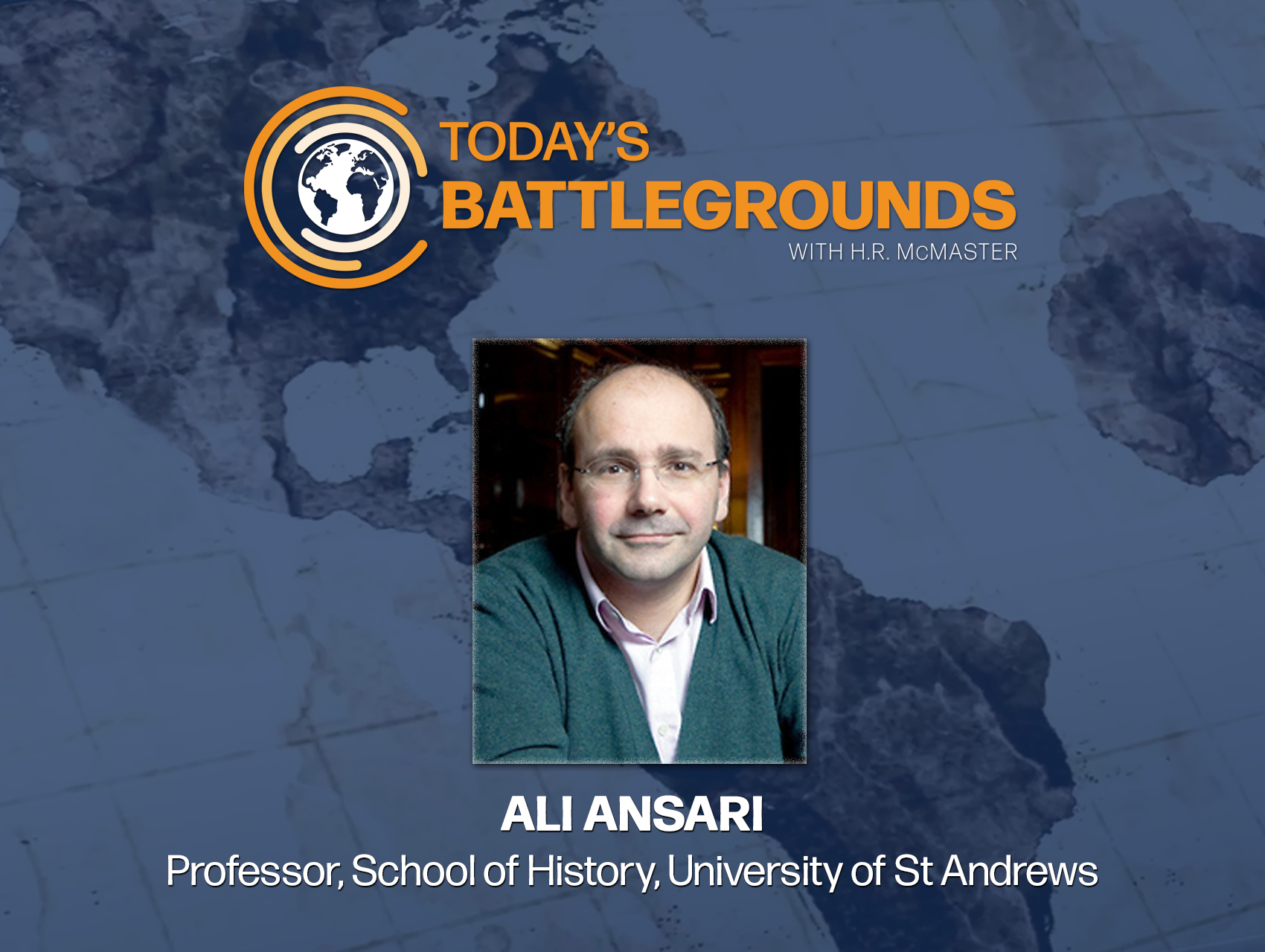
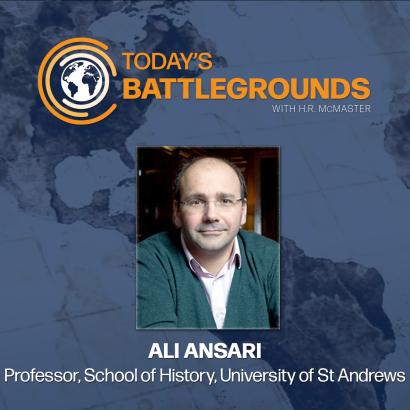
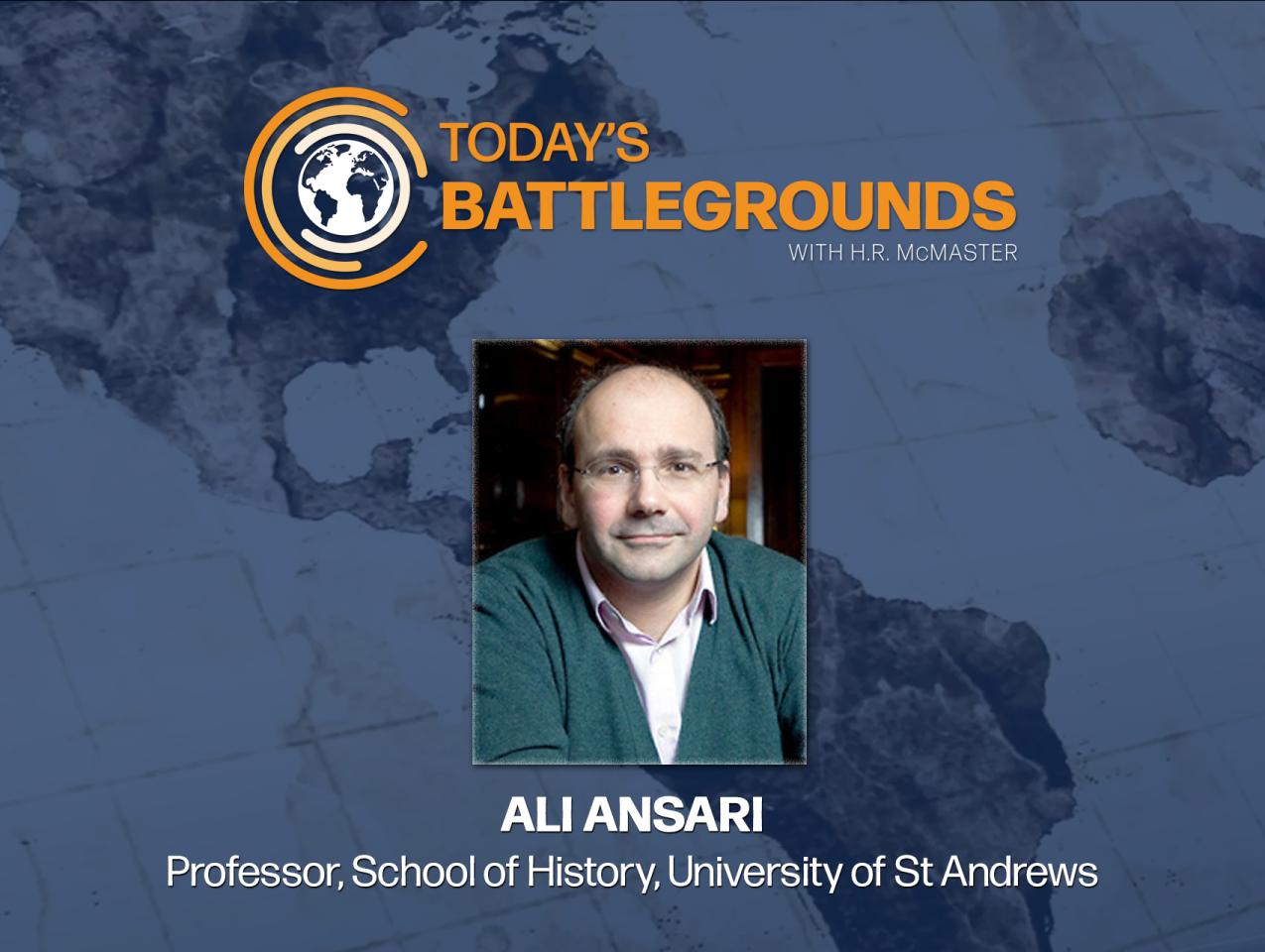
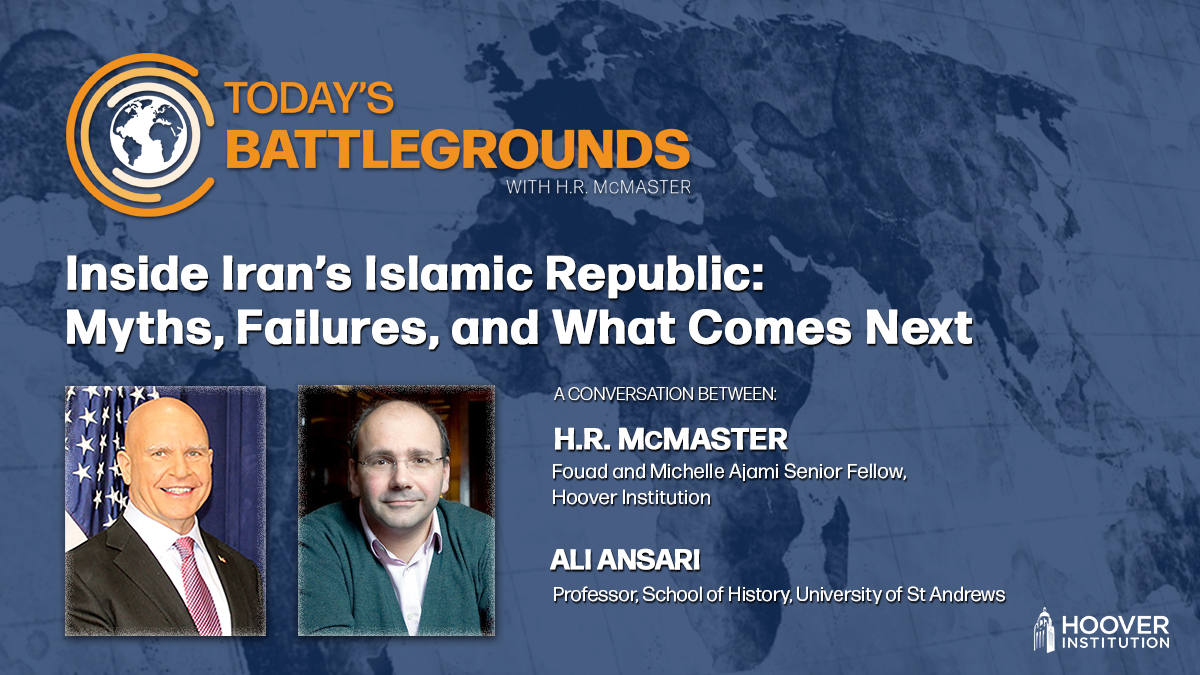
Join Dr. Ali Ansari, Professor of Iranian History and Founding Director of the Institute for Iranian Studies at the University of St Andrews, and Hoover Senior Fellow H.R. McMaster, as they examine the nature of the Islamic Republic, Western misunderstandings about the regime and why engagement strategies have repeatedly failed, and the widening gap between the regime’s propagandized image of strength and the vulnerabilities revealed in recent conflicts. Drawing on recent events, including the 12-day Israeli campaign exposing profound intelligence and air-defense failures, Ansari examines the IRGC’s struggles to reconstitute its terrorist and militia proxies in the region while confronting severe financial and economic crises at home, including shortages of electricity and a growing water crisis in the capital city of Tehran. Despite these mounting pressures, Ansari reflects on Iran’s potential futures, from the emergence of new leadership to the enduring resilience of the Iranian people.
- It surprised many Iranians that Iran lost control of its airspace in about 72 hours. I mean, even those Iranians who don't like the regime were struck by that.
- This is, "Today's Battlegrounds." Our discussions with leaders from around the world consider how history produced the present, and how we can work together to overcome obstacles, to progress, seize opportunities, and build a better tomorrow.
- [Narrator] On this episode of, "Today's Battlegrounds," our focus is on Iran. Our guest, Ali Ansari, is Professor of Iranian history, founding director of the Institute for Iranian Studies at the University of St. Andrews, and a senior associate fellow at the Royal United Services Institute. As a leading historian of modern Iran, Dr. Ansari combines archival research with a deep understanding of Iranian political culture and nationalism. He is a fellow of the Royal Society of Edinburgh, and President of the British Institute of Persian Studies. His books include, "Modern Iran since 1797," and, "Confronting Iran." For centuries, Persia's geographic position has placed its societies at the intersection of imperial ambition and technological exchange. Cyrus, the great founded the Achaemeid Empire in the mid sixth century BC, which stretched to the Balkans, Egypt, and the Indis Valley of India. From the third to seventh century, CE, the Sasanian Empire rivaled Roman, Byzantium, and made Zoroastrianism the state religion. Following the Arab conquest of the seventh century, Iran embraced Islam, but preserved Persian language and identity. Fragmented rule persisted until the Safavids unified the region in the early 16th century and established Twelver Shi'ism. Following wars with Russia and the Ottomans, the 1724 Treaty of Constantinople partitioned Iran's Northern Territories. In 1796, the Qajar dynasty came to power and faced territorial losses to Russia and Afghanistan. Merchants, clerics and reformers forced the constitutional revolution of 1905 to 1906 and created Iran's first modern representative institutions. After years of instability, Reza Khan seized power in a 1921 coup and founded the Pahlavi Dynasty in 1925. His son, Mohamed Reza Shah, assumed the throne in 1941. In 1951, as crisis mounted over foreign control of Iran's oil, Iranian parliamentarian, Mohamed Mosaddegh rose to the position of Prime Minister with the support of a broad nationalist coalition. Two years later, he was overthrown, and the Shah was reinstated with assistance from American and British intelligence services. However, the coup drew heavily on domestic forces, elements of the royal court, senior clergy, parts of the bazaar, and military officers who feared Mossaddegh's challenge to the Shah and the social upheaval unleashed by the oil nationalization crisis. Yet the simplified version of 1953 as a pure foreign imposition became central to the Islamic Republic self-image and its story of victimization at the hands of the West. The Shah pushed for rapid modernization and consolidated power. Through the 1963 White Revolution, he initiated land reform, expanded education, and extended limited rights for women. Many clerics, including exiled, Ayatollah Ruhollah Khomeini, saw these reforms as an assault on religious authority and social order. Khamenei returned from exile in 1979, established the Islamic Republic and imposed Wilayat al-faqih, which blended revolutionary Shi'ism and anti-imperialist doctrine. The regime purged universities and sought to align intellectual life with Islamist ideology. Saddam Hussein invaded Iran in September, 1980, and the Iran, Iraq war cost hundreds of thousands of lives. Yet the regime survived and ultimately compelled a Iraq to accept a ceasefire. Since the late 1980s, the Islamic Republic has waged a sustained proxy and terrorist campaign against the United States, its allies, and regional rivals. Through the Islamic Revolutionary Guard Corps or IRGC and its Quds Force, Iran built and supported networks such as Hezbollah in Lebanon, Shia militias in Iraq, Palestinian armed groups, and later the Houthis in Yemen. Groups responsible for attacks ranging from the bombing of US marines in Beirut, and the Khobar Towers attack to the maiming of American and coalition forces in Iraq and beyond. Six US administrations have oscillated between engaging Iran and applying pressure, often driven by the forlorn hope that sanctions relief or diplomatic outreach would moderate Iran's behavior. President Barack Obama's administration joined the joint comprehensive plan of action regarding Iran's nuclear program in 2015. And President Donald Trump's administration withdrew in 2018. The US military killed Quds Force Commander, Qasem Soleimani and the Iraqi militia commander, Abu al-Muhandis in 2020 as Soleimani was planning to intensify attacks against US personnel and military and diplomatic facilities. After Iranian clients, Hamas and Hezbollah brutally attacked Israel in October, 2023, Iran conducted unprecedented massive missile drone attacks against Israel from its territory in April and October of 2024. After a successful combined defense against those attacks, Israel conducted effective military and intelligence operations against Hezbollah and Iran's proxy army in Syria, while crippling Iran's air defenses and rendering it vulnerable to future attacks. Then in June, 2025, Israel conducted a successful 12 day long errand intelligence campaign that targeted Iran's nuclear and missile programs as well as IRGC leadership. The United States then struck Iran's three deeply buried nuclear facilities. In the last two decades, episodic Iranian protests from the green movement of 2009 to women led uprisings after the murder of Mahsa Amini in 2022, revealed a growing rift between a corrupt and aging revolutionary leadership and a younger society, disillusioned with the theocratic dictatorship. We welcome Professor Ali Ansari as the IRGC struggles to reconstitute its terrorist and militia proxies in the region, while confronting severe financial and economic crises at home, including shortages of electricity and a growing water crisis in the capital city of Tehran.
- Professor Ali Ansari, welcome to, "Battlegrounds." Hey, it is great to have you on this program on, "Today's Battlegrounds" because you know, I've relied so much on your expertise, your insights on around the Middle East over the years, and I'm really excited to share your perspective and your insights with our viewers, welcome.
- Well, it's really good to be here. It's really good to be here, and thank you for the invitation.
- Hey, Ali, I remember talking to you in the early 2,000s, man, I think it was like 20 years ago, and we were both lamenting some of the fundamental misunderstandings about the nature of the Irani regime, its strategy in the region. You know, maybe let's start with the present in terms of the situation inside of Iran and with Iran's proxies. But then what I wanna get to as well is like, what do people misunderstand about the nature of the regime and the strategy that it is been pursuing for, I think, decades now to advance its perceived interests in the region?
- Well, I mean, one of the things that I think the Islamic Republic, and I think we have to be clear that we distinguish the regime from obviously the country or the people. I think that's one of the big sort of misunderstandings or flaws in the way in which people approach the country. So the political system there is very good at presenting an image of itself, and very good at being able to sort of express that either through obviously it's proxies, but also those who are what we might call enablers and others abroad who tend to sort of like echo some of the talking points that they have. And also, on a particular sort of, there's always a sympathetic hearing that you will get from certain groups of people who, because of their dislike of the West in particular and the United States, I should say, will tend to give Iran the benefit of the doubt. And I think the Islamic Republic has done quite well on that and has presented itself almost as a sort of a voice in the wilderness fighting against the rapacious West. And as a consequence, it demands that we give it the benefit of the doubt. But I think the last 18 months have shown many of those sort of views to be a bit hollow that, in actual fact, in some cases it's been summing of a paper tiger. It's facing a series of crises at home. But also, in its conflict with Israel, it's been shown to basically to have fallen short on a number of different areas. I mean, not least really, I think the critical factor actually was last year during the second exchange of missiles and the conflict that happened in October where it became apparent that Iran's air defenses were not quite as strong as they claim them to be. And that basically opened the door, I think, to the 12 day war that we saw. I mean, it was always to my mind a matter of time, really if the Iranians were gonna be, and the regime that is, were gonna continue to be quite as bombasttic and as confrontational as they were, then it seemed to me that it was not unlikely that with the Trump administration in office, that Netanyahu might take his opportunity, which obviously he did. But I think it surprised many Iranians that Iran lost control of its airspace in about 72 hours. I mean, even those Iranians who don't like the regime were struck by that, you know? They had sort of expected in some ways that the regime had a certain sort of ability to at least protect the country. And I think that's been something of a revelation to many people that a lot of the bombast ahead of the war was shown to be fairly hollow after the war.
- I was gonna say, this is something the regime's used over many years, right?
- Yes, absolutely.
- The portrayal of strength, mainly using proxies, but then we kind of aided and embedded the regime in many ways because we never acted like we knew what the return address was. We would deal with these proxies, but then we would never really impose the direct costs on Iran, or we would rarely do so.
- Well, we always tiptoed very carefully around them because we tended to believe the worst case scenario. And, you know, one of the things that, and I'm sure you will have come across this, but I mean, one of the things that always struck me is, I was always of the view that Iran's military strength was somewhat less than it portrayed it to be. But I found talking to many people, including in the military and defense establishments had always erred very much on the side of caution as far as that was concerned, and always sort of believed that the threat Iran posed was much greater. Now, obviously, what the Israelis had done is, they successfully degraded all these proxies, Hezbollah in particular, but also the fall of Syria was a major blow for Iran. But more than that, I think, this idea that Iran, and they're still doing it, by the way, I mean, they still claim to have these thousands and thousands of missiles, and they're now saying that, obviously the next time that conflict comes around they will launch thousands of missiles in a day. How this is possible in the absence of missile launches, I do not know. But I mean, people will repeat this sort of stuff, and it's basically intended to give the impression that Iran is a great power, and of course it presents itself in this way. But in actual fact, you've gotta really, and I hope, as we will explore in this discussion a little bit more, if you dig a little bit under the surface, actually lift the lid on it a little bit and see what is going on inside. You know, what is going on in the politics of Iran today, what is going on in terms of its economy, and the environment, and other things. You'll see that, actually it's not in a very strong position. And that, actually the bombast is there to cover up for the fact that it's very anxious. I mean, in that sense, it's quite similar to what Sadam Hussein used to do in the 1990s where he constantly played on this ambiguity about his nuclear program. And of course it came back to bite him. But the reason in some ways we now know that he did it was because he was trying to deter Iran. I mean, he was basically trying to sort of keep them at bay or keep his opponents at bay and to present himself as a strong leader. Whereas in actual fact, a lot of it was hollower than people generally understood. And I think Iran, in some ways is falling into the same type of trap. It's not really understanding that it has to look internally and see what's going on internally before it can start huffing and puffing abroad.
- You know, Ali, if you go back to really the 2020s, certainly during the Biden administration, hey, it looked like Iran was in a good position in terms of getting, really in effect sanctions relief by the Biden administration not enforcing the sanctions. Undesignating the Houthis, for example, not responding to scores of attacks against US facilities and personnel in the region. And be essentially being able to strengthen this land bridge to the Mediterranean where it supported the Irani militias, the Assad regime that was dramatically increasing the support to Hamas, and especially Hezbollah in Lebanon, you know, getting the numbers of rockets up to 150,000. But I guess in 2023, Ayatollah Khomeini broke with that pattern of using these client, and proxy forces, and terrorist organizations in a way that, in our mantra of deescalation, they could get away with it, they could escalate on their own terms with impunity, and they decided to light that ring of fire around Israel on October 7th, 2023 through the Hamas attacks, and then Hezbollah coming in the next day. What were they thinking, Ali? I mean, what was Ayatollah Khamenei thinking at that point?
- There's a couple of things that are very interesting there to sort of, as I said, dig a bit. So one of the reasons why the West, in my view has handled Iran, the Islamic Republic with kid gloves at times, is because our sort of policy was dominated by the nuclear negotiations and the JCPOA in particular. So we didn't wanna do anything to disturb that. And as consequence, we saw after 2015, you get the agreement, the first thing the Iranians do is they pile in with Russia into Syria and they start expanding their networks. And of course, because of this determination to keep that JCPOA steady, and afloat, and whatever, at least for a time and until Trump obviously withdrew, but at least for that time, we basically gave Iran a bit of a, sort of a carte blanche on various other issues. And then of course, with the Biden administration too, there was this determination to try and get back into the agreement and therefore, they wanted to ease off on some of the pressures that they could have easily have put on Iran, including as you quite rightly say, the sort of oil sanctions and other things. So, what Iran was doing, and the Islamic Republic of Iran was doing basically was using these nuclear negotiations as a means of leverage against the West, and basically to get what they wanted. And I've always felt that their nuclear program has really been a sort of a tactical ploy, a very expensive tactical ploy, I have to say for Iran, but in a sense it was there to try and leverage what they wanted on the sort of geopolitical plane. So that's one element. I think the other element, again, is quite interesting, and I think we've gotta be careful about reading too much strategy in the Iranian... I mean, I know there's a current sort of fad for books on the grand strategy of Iran and this sort of thing. I mean, I always struggle with that because I don't think the Iranians actually have a grand strategy.
- Hey Ali, I used to say, there's also this thing that they are great negotiators. I would say no, all they do is, they just say no until we make concession after concession on our own. That makes us the bad negotiators.
- You're absolute, I mean, you're right. I mean, there obviously are good Iranian negotiators, but the idea that, I used to get this from American colleagues a lot actually, and they say the Iranians are great chess players. And I said, "Well, not really. I mean, they don't think that far ahead," you know? And yes, there are some good chess players, but quite a lot of them are actually rubbish. And their main tactic is the one that you've just outlined is they just sit and wait you out. You know, their idea is that, we have the time, you'll get bored, and then eventually you'll give us what we want. You know, you'll get so exhausted and fed up with it. And you can see this with the JCPOA, actually. I mean, they dragged it out for so long. I think basically the Western negotiators got so fed up that when they did get to...
- Well, even the French were saying, "Hey, this is a really bad deal." We're like, "Oh no, we gotta take this deal." I mean, it was so frustrating.
- No, no, there were lots of errors, I think in that. And it was fundamentally due to the fact that in some ways they misunderstood. I mean, I think we got far too taken up by the fact that Zarif spoke American English, and therefore we sort of assumed somehow he had a sort of deeper, you know, he was very eloquent and loquacious and whatever, and therefore, and he spoke our language, you know? But in actual fact, this is not the case.
- And he was the shop window for them.
- He was the shop window, absolutely. And I mean, I think people now, by the way, are much more alert to what he represents because they've seen him. And now he pretends that he didn't know what was in the agreement and so on. And so he snapped back, he says, complete news to him, apparently. Well, it doesn't say much for their negotiating prowess, does it? If they didn't realize that that element was actually in the agreement. But Khamenei's decision in 2023 to sort of get involved in a big way, I think a lot of this is driven also by the revolutionary guards, and the revolutionary guards in terms of their own image and what they think they want to do. But also, I think, so post 7th of October, the Iranians were great cheerleaders for the 7th of October. Now, whether they knew ahead of time or not about what was gonna happen on that date is a question that can be debated. But the fact is they...
- I'm kind of convinced they did-
- Yeah, there are some people that said they do, yeah.
- Just because of the communications equipment they provided.
- Well, they certainly welcomed it. I mean, they welcomed it with open arms, right? I mean, they thought it was a triumph. And I remember at the time expressing quite a lot of shock myself at some of the rubbish that was coming out of the media in Iran. And the great sort of acclamations of triumph and this, that, and the other. So, for those like yourself, who suspect that they were, you know, had some sort of intimate in involvement, they laid themselves wide open to it. And I think the problem was, for them, was that they quite enjoy sitting on the sidelines, cheering on the others through the fighting. They were giving the Houthis, Hamas, Hezbollah, go on with it, and providing, in a sense moral support. And I think it got to a stage, I mean, in part, because obviously the Israelis were attacking them in Syria and other places. And of course the attack on the IRGC in Syria and whatever, there was this sort of feeling that, why don't they get stuck in? You know, people were saying, this is the moment, we need Iran to be in. Of course the Iranians don't like to do that, principally because they like to have this sort of plausible deniability and they don't want to be involved. They'd rather others did the fighting for them.
- Ali, didn't they also wanna hang on to their biggest deterrent against Israel, which was Hezbollah and its rockets?
- I think they had come to the conclusion, and I think it was Hezbollah that was also saying to them, that, "Look, we're getting hit, you guys need to come in. We need to see a bit of support," you know? And I think in April, when was it? April 2023?
- Yeah.
- I think eventually.
- Yeah, April and then October where the two strikes directly... Just for our viewers, we're talking about April and October of '24.
- No, no, 24, 24, yeah, yeah.
- Which was when Iran decided to strike Israel directly.
- Directly, yeah.
- With both very sizable missile and drone attacks.
- But the interesting thing is that the April attack, if you remember, it was very striking that the Iranian delegation to the UN declared hostilities over before the drones had arrived in Israel. I mean, it was that absurd. I mean, they basically said, "We've done our retaliation. We're we're happy to go home and forget all about it." You know, someone said it was the most extraordinary deescalation, they said that it was quite something. To launch missiles and drones, and before actually any targets had been hit to say, "Well, we've done our bit, we're off." And that basically indicated to many people that they really didn't wanna get involved. I mean, they felt they had to, but they were very cautious about it. And of course, over the summer the pressures mounted, of course, because the Israelis were doing some extremely targeted...
- And US, Israel really didn't make him pay for that except to cripple their air defense capabilities. So remember-
- Well, yes.
- After the April attacks, remember President Biden said to prime Minister, Netanyahu, this is for our viewers who said, "Hey, take the win," remember? "Take the win and just call it quits." And of course, Israel was not predisposed to do that, but did, was relatively constrained. But what they did is, they struck air defense systems in the center of the country .
- And that was the killer, really. And I think in October, which was, as you quite rightly say, it was a fairly discreet strikes. I mean, there was not a lot of hype about it, certainly the October ones. But what was clear as people come back over October is they had shown, and they'd realized actually, that Iran's air defenses were really not up to much, and they'd hit them very hard. So, Iran lay quite exposed from October, 2024. And I think this was the problem. But of course, the Iranians and the Islamic Republic, whatever, and the regime has a remarkable, remarkable capacity for burying its head in the sand and not really seeing what has happened. And they kept basically putting out the notion, the spin, the propaganda, if you will, that everything was fine and they were doing very, very well. Now, all this, by the way, H.R. is completely separate to the domestic crisis that's also gripping the country, which we haven't touched.
- Well, let's talk about these one at a time. Let's go, first of, Ali, how about this? You know, then you have the 12 day campaign, right?
- [A. Ansari] Yeah.
- The Israeli campaign that targets their nuclear capacity, their nuclear weapons programs, their missile programs, and the IRGC leadership in a shocking way. And when I talk about the missile, and can put also the scientists associated with it, then of course, I'm sure the Iranian people have to realize, "Well, hey, this regime can't even protect itself." And so, could you explain really what then happens? And of course, the US comes in and strikes the deep buried sites.
- So yeah, I mean, there are two... Again, I think for me, there are two takeaways from that conflict, really that are quite striking. One is the level of Israeli intelligence penetration of the Israeli system. Now, we all had a good idea that Mossad and other agencies, I suspect also had penetrated the Iranian intelligence and security establishment fairly deeply. I mean, we knew that from the time that they were... I remember the chief military nuclear scientist, Fakhrizadeh had been assassinated back in, I think 2021. Obviously Soleimani had been hit in 2020. But that probably had more to do with hubris on his part, 'cause he was almost announcing his travel plans.
- Well, and his travel plans were designed around, how am I gonna attack US facilities like our embassy in Iraq and drive the Americans out of the Middle East as the first step on the path to destroying Israel and killing all the Jews. I mean, that's really what he was up to.
- Well, I mean, yeah. Again, I think there was, we are partly to blame for this, by the way. I mean, there was a period when Soleimani's sort of street cred went through the roof. I mean, there was a period, if you remember when he had a cover on, was it, "Time on Newsweek?" I can't remember.
- "New Yorker." He had the big, "New Yorker" profile.
- Yeah, and they were sort saying, this guy has defeated Isis and he's done this, that, and the other. And so, again, we're partly to blame for this sort of puffing him up. And I think one of the interesting things about Soleimani, actually is that he became quite unpopular with other members of the IGC. 'cause they were a bit envious of the fact that he was getting so much publicity in the West. And he lapped it up. And I think it clearly went to his head. I mean, he was very lax about his security at that stage.
- But also, Ali, we had demonstrated though that we didn't act like we knew what the return address was for any of this. So he flies into Baghdad-
- Yeah.
- Meets with that jackass, Abu Mahdi al-Muhandis. You know, I just wish Qais al-Khazali had been there too. That would've been perfect. But he was extremely overconfident in this period of time.
- Yeah.
- But then Ali, maybe quickly, I mean, after that we didn't do much to follow up on it. Remember there were the attacks on the al-asad airbase?
- Yes, yes, absolutely, yeah yeah.
- And we didn't respond. There were the attacks on the Saudis, the Aramco facilities that didn't respond in support of...
- Well, that was a huge mistake, by the way. I mean, that was a huge mistake.
- I think so too, and this is under the Trump administration. Then the Biden administration was so desperate to get the deal that they were supplicating to the Iranians. So I think all of this contributed to this perception of weakness, that they can get away with it, right? It being the lighting of the ring of fire, the more support for the Houthis the shutting down the shipping. Everything that they did toward the end of the Biden administration.
- I mean, one of the problems we have, I think in the West is we suffer far too much from tunnel vision, you know? I mean, so I remember after the Afghan withdrawal and the debacle of the Afghan withdrawal, I said at the time, to someone, I said, "You know, the Iranians will be watching this and they're gonna think the US has lost it," you know? I mean, they're just watching it. And they're gonna say, this is a fiasco. And I said, "If you think they're gonna come and sign up to a new nuclear agreement anytime soon, they don't see any urgency in this anymore. Because they've seen how the Americans are carrying on in the Middle East. And then of course, who are they talking to? They're talking to Putin." So, at the time, I think it was...
- Ali, just for our viewers, quickly. The Iranians are not allowing us to talk directly to them. They're making us use the Russians as authors. It was humiliating, it was humiliating.
- No, I mean, so basically in that time when, I think it was Malley, wasn't it? That was basically doing the negotiating.
- Yeah, yeah, it was a guy named Rob Malley.
- Rob Malley, yeah.
- Who was the lead negotiator, operating, really outta the National Security Council staff, yeah.
- And I always said to people, I said, "Don't do this." You know, "Only talk to the Iranians when they're prepared to talk to you directly. Don't sit in a hotel room and have people shuttling from one end of the corridor to the other, or one hotel." Anyway, this sort of thing happened. But then of course, when we get to February, 2022, there's this sort of great expectation that they're about to sign up, the Americans will be back in the JCPOA. And of course, you know what the Russians say to them? The Russians say a couple of things. I mean, they basically don't want to sign up to anything that will prevent the Russians, basically selling arms to arms to Iran. They wanna make sure they can do it so they don't want to be excluded from anything. But the next thing they say to the Iranians is say, "Just hang in there for a bit longer. We're gonna invade Ukraine. We'll get into Kiev in three days, it'll be fine. The Western, the Europeans and the Americans, they're all weak, they're useless. You know, you negotiating hand will be much, much stronger." And of course, those elements around the Supreme leader obviously believe this. And you know, lo and behold, we are where we are. Now at the time...
- And they heard the same from the Chinese, no doubt, Ali, in terms of, remember the joint statement that Putin and Xi Jinping issued just prior to the Beijing Olympics, basically saying, "Hey, you're finished in the West, we're in charge now, get used to it." That was their attitude in early 2022.
- I mean, it's a reading of that mindset that I think we don't understand enough, really what the ideology of the regime is about. And the ideology of the regime is about the decline of the West, and how they're gonna speed along the decline of the West. And they see themselves as good bedfellows of the Russians. Very strange in historical terms, by the way that the Iranians should be jumping into bed with the Russians quite honestly.
- Sure, right, yes. Which is very clear in your excellent new book, "Iran," which I recommend in the Polity series that. I mean, it is a quick read. It's like a long essay, but you'll get all the history you need to know, I think...
- It's a good distillation, I like to think.
- Yeah, it's fantastic, you've done a fantastic job with it. But of course, it was this competition between the Persian and the Russian empires and then part of the great game. You know, the great game that played out in Iran in the early 20th century, late 19th century. But, you know, Ali, I wanna get back to this point of Iran's and Iran's decision making, right? And I think you're right. Our efforts at conciliation with the regime are, I think considered as signs of weakness and are actually provocative at times, you know?
- Well, you need clarity, and you need to know where your red lines are and stick to them, it's very simple actually. But I mean, we didn't. We didn't, in Syria 2013, we kept dropping the ball, really, and turning the other cheek.
- So you're talking about, in particular the growth of the Civil War, the Assad regime's use of chemical weapons-
- Chemical weapons, yeah.
- That mass murdered civilians, and the associated unenforced red line in Syria, 2013 to 2014, which I think there's a direct line between that and the first invasion of Ukraine in 2014 as well.
- No, I think so. I mean, I think this is part of the problem that I see, I don't think in the West there is enough... I hate to say it, but I don't think there's enough joined up contextual thinking. I mean, I know you are a great fan of history, H.R. and I'm gonna push this, but it's this sort of idea that we think historically. And when I say, let's think historically about it, it's not just simply the chronological context, but it's also the broader geographical context in the world. I mean, seeing how things join up. And of course, the Russians, the Iranians, the Chinese, the others, they're all looking, they're all seeing, where is the West weak? What is it signaling, what's it doing? And they wanna take advantage of it. I mean, it's very similar. So what you've gotta do is, you've got to have your red lines, you've gotta stand firm, and you've gotta push back. And the minute you do that, of course, like the bullies in the playground, they tend to back down. But the point is, you have to do that. And interestingly, in the 12 day war, you know, one of the things that I was very struck about, when the Americans entered it for that one day, for that one strike, you could sense the fear in Iran. I mean, there was a palpable worry that, you know, they had always built in their own mindset that they can handle Israel. I mean, they couldn't, particularly, but they sort of felt that they had that sort of capacity to handle Israel. What they did not want was to get involved in a major conflict with the United States. And the key thing for me, actually was the way Trump ended it. So, because he ended it on such a sort of like an upbeat note and said, "Well done everyone, it's very good and we can all go home and it's all ended well." I think the Iranians came away from that thinking, my God, we have survived, it's magnificent. You know, basically we won, you know? I mean, because they'd survived. To my mind, had Trump left it a little bit more ambiguous, actually, and said, this is over but don't get carried away. I think it would've left the Iranians, the regime in particular, a little less certain about how it was gonna proceed. At the moment, the danger we have goes exactly the point that you are making, this sort of sense that the West has in some ways now pulled back effectively. They sort of filled that gap with a lot of their bombast. And of course, in my view, the sort of bombast that they're engaging in actually probably makes the prospect of another round more rather than less likely. They think they're deterring. But of course, if you are threatening Israel with a thousand missiles a day or something, I mean, obviously in Israel, they're gonna start looking at this a lot more seriously than if they felt that Iran had been effectively disarmed. So it's a very difficult game to play. And I don't think the Iranians play it very well, is what I'm saying. I mean, some people in the West think they play it very well. I just don't think they do. And they're constantly getting themselves into trouble over it.
- So, hey, can you take us into Iran now though, in the days after the strike? Because it seemed to me like the leadership was really reeling. I mean, I Ayatollah Khamenei disappeared for a couple days. He made a very weak statement. He announced this kind of new security council to kind of supplant the guardian council. It wasn't really clear who was in charge. The IRGC leadership had been decapitated. And the people began to rise up a bit. And then what we saw is this brutal, I mean, horrible suppression of any kind of dissent with mass executions and so forth. So can you describe the effect of that 12 day campaign, what happened in the aftermath? And then maybe just talk about how the situation inside of Iran has evolved since then, which I think Ali, they seem profoundly weak to me in terms of energy shortages. I mean, heck, the water shortage in Tehran.
- Yeah, that's the real catastrophe, yeah.
- So, can you bring us inside of Iran from the 12 day war to the present, and give us your assessment?
- So basically, my view is that, there's a colleague of mine he said, "You know, the Iranian state is concussed. They received very bad concussion and it's still recovering. It still doesn't really know what it's doing." I mean, in some ways I'd go a bit further and say, it's shell-shocked. I mean, they're suffering from very, very bad PTSD and they really didn't know what hit them. And they're still not entirely clear what their response should be. And I think a lot of the bombast that you've seen since then, including some of the nationalist bombast that you've seen, with a lot of sort of adulation of ancient kings. I mean, as I pointed out to someone, by the way, I said, "Here you have the Islamic Revolution that was founded on a hatred of kings, suddenly, in it's hour of crisis, what does it do? It calls on these ancient kings to come to its rescue and to build up some sort of national solidarity. I mean, if anything tells you about the bankruptcy of the ideology of the Islam Republic, that should tell you. I mean, you know, they haven't gone to religion...
- I guess Cyrus was a really good .
- Yeah, of course, I mean, Cyrus was a good Muslim. I mean, it's this sort of hogwash, right? So that's one thing, I think that has happened. And I think a lot of people, again, as I said, who sort of bought into this argument that there was this enormous upsurge of national solidarity. I think there was an upsurge, I'll say that, of sentiment towards Iran. People felt very affected by it. But I don't think that translated into a sort of a sentiment for the Islamic Republic. I mean, I think you've gotta distinguish the two. And it was very clear when you looked at some of the commentary coming out of Iran that people were saying, "We love Iran, but boy, this Islamic Republic is a complete disaster," you know? I mean, this was the thing. And so, the regime basically...
- And, actually President Trump was saying that to his credit.
- [A. Ansari] Yeah.
- I mean, actually I thought the messaging from him was pretty good in the post 12 day war period in terms of, I wish he had brought up like Baskerville and a couple of things.
- Yeah, yeah, no, no, absolutely. And I mean, I think in some ways, and I mean, I think Rubio in particular has also been very good at also distinguishing, you know, the great Iranian people versus their sort of rubbish government, their rubbish political system. And of course that echoes, that plays quite well with Iranians. I mean, that does play quite well. Now, one of the things I said, and I've argued this, I said, you know, and again, you will know yourself really, I mean, in any conflict situation, particularly when a society gets a bit shell shocked by something, you tend to get this sort of adrenaline rush of people spontaneously react in ways, you know, whatever. And I think there was an element there where people had this sort of nationalist out surge and upsurge. But this is a temporary phenomenon. And the problems that Iran had going into the 12 day war have not been solved by the 12 Day war. They are still there and they're getting worse. And you've highlighted some of these, and it's amazing how the impact of the 12 day war, apart from in some of the sort of foreign press and stuff like that, they've been inviting foreign journalists to go and visit recently. And there's been a lot of talk about this, where the focus is on the possibility of another attack, and building up a certain amount of solidarity. Actually, in Iran, the discussion is about other things. The discussion is, God, how useless were they at defending us? I mean, where were the air raid sirens? Where were the air defense shelters? I mean, there was pretty much nothing, right? The, how was it that the whole cadre of senior leaders were decapitated, yeah? I mean, how did that happen? The intelligence failure as we mentioned. But then as you go forward, I think it goes without saying that, you know, people say Iran faces a political crisis. You know, Iran has been in a political crisis for years, by the way, that's not new. What is new now is the economic crisis and the ecological environmental crisis that's really sort of shaking the country. And we're now getting into a stage, we're now in what? December. And people are saying, very clearly that these problems that have been long in gestation, by the way, H.R, I mean, these things go back to 20 years, 20, 30 years of a complete lack of investment in the infrastructure of the country. I mean, it's that serious, and they now find...
- And just quickly on this, I think what's really important in the West and the US in particular, don't take credit for any of that with sanctions. I mean, actually the Iranian regime did this themselves.
- It's got nothing to do with sanctions. It's got nothing to do with sanctions. And I mean, this is the important point. And you are absolutely right here, again, the ecological environment, nobody sanctioned dams. Nobody sanctioned the management of water in Iran. Yeah, I mean, nobody sanctioned that. This is to do with the absence...
- Or even the oil infrastructure, with the underinvestment in the oil infrastructure.
- Well, the problem in Iran, and this goes back to, I think if we drill deeper into how we understand the nature of the Iranian state and the political economy of the Iranian state, it is fundamentally what we term an extractive state. It takes outta the system, It doesn't put anything back in. And it inherited this fairly powerful state from the Pahlavi monarchs in 1979, a state that had been built over 50 years, patient building of the political economy of the country. It inherited it without a huge fight, to be honest. I mean, if you compare it to other revolutions. You know, the number of people who died for the overthrow of the Shah was pretty low. I mean, their own figures say about 2,800. I mean, it's nothing when you think about it. And they inherited this sort of fairly powerful state, fifth largest army in the world, armed forces, so on and so forth. And basically the history of the Islamic Republic is them having spent down that inheritance. I mean, that's basically what they've done. They've spent it, they've had a great time. They've sponsored their proxies.
- These bunyads with the...
- Yeah, they just take, take, take. They do not have a system which welcomes it. I used to remember talking to foreign companies in Iran in the 1990s, and I used to say though, I said, "Are you not interested in investing in Iran?" And they used to say to me very openly, they said, "We'll, invest in Iran when Iranians are investing in Iran." And I thought, you can't beat that argument, actually. I mean, basically they were saying, because the Iranians aren't investing in Iran, they must know something that we don't. And it was basically this thing that the whole political economy is not built, is not structured around long-term investment. So nobody invests, I mean, nobody invests. And even in the aftermath of the JCPOA, there was a whole year, before Trump actually got in on his first term where oil companies were going in to see if they could secure contracts in Iran. And they couldn't, they couldn't. Nobody would sign a contract with the foreign oil company. Nobody could bring themselves to do it. There was no investment sort of going in. And of course, what's happened is everything is degraded. And when it comes to the ecological atmosphere, and this is the thing that, I mean, I have to say, really does shock me a bit. You know, we spend so much time in the West, quite rightly, discussing the environmental issue and what we must do about climate change. Here we have in Iran, I have to tell you, probably the world's best case study of what happens when you screw things up ecologically. And nobody's paying any attention to it. Nobody's paying any attention.
- I mean, between Iran and the People's Republic of China, they're great examples of what happens when you destroy your environment. I mean, the aquifers are collapsing in Iran, you know? I mean, it's so sad.
- I mean, they're running out water. And to the extent that, and again, the mentality is, and this is a mentality of a people intoxicated with wealth in a way, they become blind to the realities of economic growth, for instance, that, you know, they sort of say now, for instance, people say, "Oh, we must pray for rain. And what we need is a few days of rain, and it will all be solved." And of course, environmental scientists after environmental scientists will say, no, your problem is not drought, your problem is water bankruptcy. And I can't emphasize this enough to people that, you know, we talk about wars, conflicts, political conflicts, their proxies. This is all gonna pale into insignificance compared to what is coming on the ecological front. I mean, and I think people need to get a handle on this, that the consequences of that will be very, very serious indeed. When Pezeshkian the President says, and again, this you shows how unserious politics in Iran is, he sort of says, as a sort of an aside, "I think if we run outta water, we're gonna have to evacuate Tehran." And, you know, nobody sort of stops thinking, says what? Evacuate a city of 15 million? Where are you gonna put them? I mean, it's a complete nonsense. I mean, it's a complete and utter nonsense.
- And it's a country that has so much potential in terms of human capital, and potential, and resources. And it's just been squandered by this theocratic dictatorship. Hey, can I ask you an the impossible question of, what the hell happens now, Ali? What happens? You know, what are the alternative futures for Iran and Iranian people?
- I, you know, I've said this and I've written about this. First of all, I should say as a good historian, good historians never predict. But as one historical thinker said, we are allowed to prophesy. And I think the prophetic element is a little bit vaguer, you see? So we don't like to predict with any sort of exactness. 'Cause I mean, obviously human behavior is not like this. But if history is any guide, and we have to look at history as our guide to this, when Iran has faced capitalisms of this nature, and let's say, the period at the beginning of the 20th century was a period when, you know, during the Great War and others, Iran was occupied, it was fought over. There were very serious famines in the west of the country. There was the Spanish flu, I mean, it was a fiasco. I mean, what you get ultimately is, the situation reaches such a bad state of affairs that one has to sort of hope and expect that there will be a group of individuals, patriotic individuals at least, who will then step up to the plate and say, enough is enough, we have to sort this out. And I fear, however, that the person that, well, maybe not fear, but I think that what you have to look at in a country like Iran where aspects of civil society have been basically smashed, is that, it's those organizations and institutions that exist that will deliver the sort of the man on horseback, as I've said. And again, this is the sort of thing...
- Maybe the IRGC is what you're referring to.
- I personally don't think it's the IRGC because I think the IRGC are a bit of a busted flush. You know, some people say that they're magnificent, this, that, and the other. I don't think they've shown themselves to be terribly good, but I think there are a variety of outcomes. I mean, we could say a democratic transition. I don't think a democratic transition, unfortunately is the most likely consequence in the immediate future. But because what you will need is someone to steady the ship of state, if I can put it that way, and to take it in a different direction. And that will require, I think that sort of strong man.
- Now Ali, there's going to be a secession issue, right? Maybe a crisis .
- A succession. Yeah, the succession is because Khamenei, well, one thing we can be certain of, and I think I can predict, is that Khamenei will die. So, I mean, eventually he will die and then there will be a succession dispute. Now, I used to think, and I I'm very emphatic about this, that his son was being lined up to succeed him. And there were various reasons I had for that. And I think it's still one of the contenders, but I think his situation is much, much weaker now. And I think the situation of the country is much, much more fragile. So the idea that you are gonna get a smooth succession of this nature, I think is unlikely. Now, we may see different stages of development, but I think we're gonna be moving towards basically a sort of a more nationalistic, less religious type of government that will be centered around, probably someone in the military. And it will be someone in the military with a coalition of the willing, if you will, within Iran, who will try and see it through. And they will have to change the nature of the relationship with the outside world. So, the Islamic Republic could stay in name only, but it won't really be an Islamic Republic anymore, and it will be a matter of time .
- So you see this more as a revolt of the elites rather than a popular uprising. Because you know...
- I think at the moment, yes, I think at the moment, yes. I think people, you know, it's very possible that it could be... You know, what you could see is a conjunction event. So you could see a popular revolt, which then catalyzes and encourages the elites to come in and sort of find a way through. But I think what we must be careful about is, you know, refighting the last revolution. So a lot of people sort of look at the last revolution and say that we have to replicate it. Actually, I mean, if you look at Iranian history, there have been various revolts, but quite a lot of 'em are elite led revolts in some way or form. There will be popular points of contention...
- I really enjoyed reading your latest book of the constitutional revolution-
- Yeah, I mean, that's what I think is a more...
- Of the early 20th century.
- Yeah, I think it's a, it's a more likely setup that you're gonna see something between the sort of constitutional revolutionary moment plus the sort of arrival of Reza Khan in 1921. I mean, there will be an element of the Shah. I mean, personally, the reason why I say that, and I don't say it with any sort of enthusiasm, necessarily, but it's just the fact that the situation of the country is going to be so difficult to manage, so difficult to organize, that it will require a certain amount of authority at the center to keep things under control. And I think many people will acquiesce to that. And I mean, if you look at the writings of people in left and right in Iran at the moment, they are talking very openly about this idea of a man on horseback. I mean, they're saying, what we need is a strong man to come and sort this country out. So there's a willingness there among the elites to contemplate that, from both sides of the political equation. And sadly, in some ways for the Iranians, there's still this belief that the savior will come and bail them out. My, what I caution people about this is that, whatever happens, whatever happens, the process of rebuilding will be slow and hard work. That there is no flick of the switch that's gonna rescue this. I mean, it's going to be a process of rebuilding almost from the ground up. Because you know what, you're seeing in...
- Almost five decades of decay, right?
- Yes, absolutely. And I think, this is the thing, you still get people, and I still read it and they say to me, oh, you know, Iran is a very strong and stable country and the Islamic Republic's fantastic. And I go, well, how do you explain the fact that they can't supply water to their own capital city?
- So can we talk about just, I mean, outside like all of our discussions across the last 20 years, this has flown by. But, I do wanna address this final issue with you. There is I think a fundamental misunderstanding among many Americans in particular. And I often hear these kind of tropes, some of which are historical that hey, it's all our fault because of the Mossadegh coup in the early fifties.
- It's very tiresome, actually, very tiresome.
- I've seen President Obama give that speech in Cairo and refer to it, for example. But if you fast forward that today, again, it's still our fault because we misunderstand a regime. If we just welcome them back into the international order, it would strengthen the Republicans in Iran, and they'll be in a stronger position relative to the revolutionaries. Iran will moderate its behavior. There'll be a strengthening of the Mercantile class, which will then challenge the theocratic dictatorship and the IRGC. And I think all of this has been nonsense. In fact, I think it's kind of a propaganda campaign organized by the Iranians with some people who act, and maybe I use this pejoratively, who act as useful idiots for the regime.
- No, there's definitely that element.
- So, what are the misunderstandings that you drew?
- I think the misunderstanding of that is that, there was a time. So, if we go far enough, if you can go back to the Reagan years and Iran-Contra, of course that was the basis of Iran-Contra is that we reach out to the moderates, the moderates will come in or... And I think American administration...
- George H. W. Bush, Clinton and not responding to the Khobar Towers bombing. I mean, you could line 'em up. Every administration has tried it, has tried it.
- I mean, I think there were moments. I mean, I have to say from my point of view, there were moments when a more constructive relationship could have been attempted. And certainly the 1990s there were various...
- Yeah, but I don don't think things were done seriously enough. And I also think it's still a mistake, and this is where I always emphasize that it's still a mistake to suggest that the blame for the failure of certain things is all to do with the West or the United States. There was also lots of internal movements against, for instance, being able to reach out, you know?
- It's a narcissistic view, Ali, we have a narcissistic view. We think that everything is in relation to us, and then what we do or choose not to do is decisive. And so we don't grant authorship to the Iranian regime.
- There's also a terrible self-loathing H.R. which I think the Americans probably inherited from the British, actually.
- It's a perpetual assure, we just keep flagellating.
- You just can't, you know, it's all our fault, you know? And I saw this in the JCPOA negotiations. I mean, I remember, there was all this point about people coming up saying, "Oh, well, you have to remember, we overthrew Mossadegh in 1953, this, that, and the other. These are all valid points, but they're not valid policy points, is what I say. These are historical debates.
- What I got from your work, I mean, the party most responsible for overthrowing Mossadegh was the clerical order, you know?
- Well, they...
- They participated.
- They certainly participated. And there are various sort of arguments to show how they were sympathetic, really more sympathetic to the monarchy than they were to Mossadegh that at the time. I mean, I don't deny, and I think it would be fool hardy to say that the Americans and the British were not involved. Of course they were involved. But the point is whether the coup of 1953 should be treated as some sort of original sin against which everything else that we do, 70 years later or 60 or 70 years later, must be beholden to. And I don't think it makes for good policy. And if you want to talk about things that, you know, if we want to go into a sort of a truth and reconciliation committee, let's by all means do it. And let's get the Iranians in as well and say, you know, look at the stuff you've done.
- Well, and let's bring up some things like the bombings in Beirut in 1984.
- Yeah, yeah, yeah, absolutely.
- Or the host hostages.
- Yeah, yeah, absolutely. I mean, when the Iranians say, or when people complain about the coup 1953, I say, well, the Islamic Republic has implemented coups of its own. I mean, it's not, you know, against its own people, it's repressed its own people. It's done things abroad that are fully shameful. I mean, look what it did in Syria. I mean, so, let's not get sanctimonious about it. And I think for a good policymaker in the West, they should be historically well-grounded. They should understand the relationship, the complexity of that relationship. As I always say to people, you can only feel betrayed if you had a friendship to betray. And this is the difference between the American, Iranian or Anglo, Iranian relationship and say the relationship with Russia, nobody has any sort of friendship with Russia. It's a very pragmatic, instrumentalized relationship. But there's an emotional tie with the United States and Britain actually, which leads people in Iran to feel that they were betrayed. And we feel it too, of course. I mean, with the hostage crisis, obviously in '79 and whatever, so there are emotional bits about it, but it does tell us that actually, there's a much closer affinity even from the Iranian side towards the West than they'd like to say.
- And we have this fantastic Iranian diaspora who was contributed so much to our societies, you know? Across the West as well.
- Well, of course the Iranian diaspora is living proof by the way that given a proper political setup, Iranians can be good Democrats. I mean, they can function in a democratic society, right? I mean, they function very well in European and American societies and the wide Commonwealth and others. So, that also tells us something that the problem in Iran are not the Iranians, the problem in Iran is their political system.
- Yes.
- And you change the political system and it will begin to work. And interestingly, I have to tell you, the first British travelers who went to Iran in the early 19th century, and they built their relations, you know, they came from India and other places, they were the first ones to assess it. I mean, they came to this conclusion, they said, "There is nothing preventing the Iranians from actually progressing other than the fact that their political system is rubbish. And because their political system is extractive, it's oppressive, it's despotic, that the absence of freedom, and Iranian intellectuals in the 20th century would say that true patriotism, and they take this, I'm sure from the Anglo-American tradition, true patriotism cannot flourish in the absence of liberty. And if you don't have liberty, all the rest of it is guff. I mean, it doesn't make sense, you know? And I think they're right. And I think you've seen in Iran, if you strip away that political framework, what you get is a mess. And that's why this needs to be built stage by stage up. And I always say to people, and hopefully you will appreciate this. We don't have enough history in our politics, and we have far too much politics in our history, right? And if we need more history and more grounded understanding of what's going on, we can better handle this and get to a better result for all of us, you know? Not just the West, but also from the Iranians themselves. And as you say, all these Iranians in the diaspora, all these people, what do they want? They wanna live a normal life. They don't wanna go around having this endless antagonism with the United States, Britain, Europe, whatever. I mean, actually, the West is what they look to. They're certainly not looking to Russia and China, you know?
- And ultimately, if there is a shift in the nature of the regime such that its ceases its self-destructive tendencies and its hostility to its neighbors and the West, there's this extremely talented diaspora who wants to rebuild the country as well.
- Yeah, yeah.
- So there's a tremendous potential there. Ali, I can't thank you. No, I would ask, give you the final word though. Like, what else do you think our viewers need to know either about how the past produced the present, the situation in the present, or what we speculate a little bit about, the future? What would you like to say to our .
- Well, I just think it really goes back to, in a sense what we've been discussing, I think a better grounding and a better understanding of the history of the relationship, but the history of Iran itself and the way the Iranians relate to that history will give us a much better handle on how we can negotiate the relationship going forward. I personally feel optimistic about the fact that ultimately, the history of the Islamic Republic will be a blip in the history of Iran. You know, it will not be something that will be, you know, we do not have this issue of an internal enmity between the United States, Iran, and Iran and the rest of the West. And that sooner or later this will be overcome. It may not be smooth, the passing, but the fact is it will happen. And ultimately, the way in which the crisis unfolding in Iran, I think it will happen sooner rather than later. And what we need in the West is, we need to be prepared for change. You know, we need to be prepared for change. And when that change happens, we need to have a good positive response to it.
- Ali I can't think of a better way to end. I mean, I've learned so much from you over the years. For our viewers who want more of you,
- I always feel that we could talk on and on, though.
- You know, I'll tell you, when I was talking with you frequently when I was in the Middle East for years, the Brits actually got jealous. They said, "Hey Ali, he's our guy. What are you talking to him for?"
- That's very kind, that's very kind of you. I'm not sure that's, I'm gonna believe that. I'm gonna believe that because I think that's good for me.
- I'm glad to share you with our viewers and if you want more of Ali, get the book, "Iran from Polity." But then get his other books as well, which I kind of stacked up here, "Confronting Iran," "The modern history of Iran." You can't get enough of .
- And do have a look at my substack if you are really interested in current... 'Cause I keep updating the substack now and then. I mean, they'd be very welcome to look on that if they wish.
- All right, absolutely. And I'll follow you on substack starting immediately as well, so... Hey Ali, thank you. On behalf of Hoover Institution, thank you for helping us understand one of today's important battlegrounds. And hey, we've gotta have you back. And I know our viewers are gonna deeply appreciate your insights and...
- I look forward to it. I look forward and hopefully next time it may be in person. I hope.
- Thanks, Ali, thank you so much.
- Thank you.
- [Narrator] "Battlegrounds" is a production of the Hoover Institution, where we generate and promote ideas advancing freedom. For more information about our work, to hear more of our podcasts, or view our video content, please visit hoover.org.
ABOUT THE SPEAKERS
Ali Ansari is a Professor of Iranian History, the Founding Director of the Institute for Iranian Studies at the University of St Andrews, and a Senior Associate Fellow at the Royal United Services Institute. As a leading historian of modern Iran, Dr. Ansari combines archival research with a deep understanding of Iranian political culture and nationalism. He is a Fellow of the Royal Society of Edinburgh and President of the British Institute of Persian Studies. His books include Modern Iran since 1797 and Confronting Iran.

H.R. McMaster is the Fouad and Michelle Ajami Senior Fellow at the Hoover Institution, Stanford University. He is also the Bernard and Susan Liautaud Fellow at the Freeman Spogli Institute and lecturer at Stanford University’s Graduate School of Business. He was the 25th assistant to the president for National Security Affairs. Upon graduation from the United States Military Academy in 1984, McMaster served as a commissioned officer in the United States Army for thirty-four years before retiring as a Lieutenant General in June 2018.