








- Key Countries / Regions
- Russia
- History
- US
- Political Philosophy
- Comparative Politics
- Determining America's Role in the World
- Revitalizing History
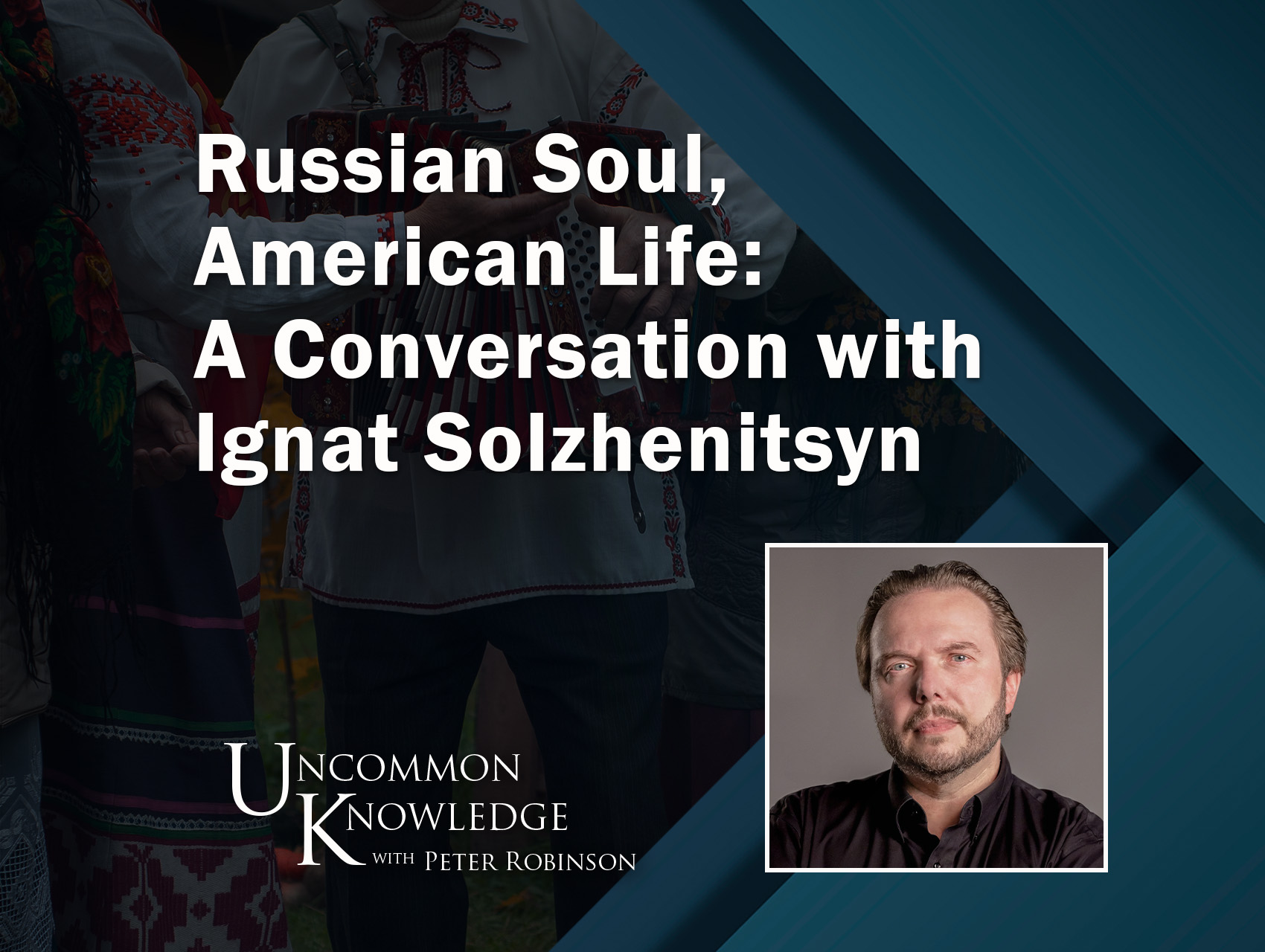
Pianist and conductor Ignat Solzhenitsyn reflects on growing up in exile as the son of Nobel laureate Aleksandr Solzhenitsyn, moving from Soviet persecution to a quiet childhood in rural Vermont. Ignat recounts how music, faith, and Russian culture sustained his family far from home, how cellist and conductor Mstislav Rostropovich helped set him on a musical path, and what it meant to carry a historic name while forging his own life between Russia and America. The conversation ranges from the moral legacy of his father’s The Gulag Archipelago to the emotional power of Russian music, the meaning of freedom, and the enduring truth that the line between good and evil runs through every human heart. It’s a deeply personal conversation on memory, exile, and the choices that shape a life. The episode concludes with Ignat at the piano performing a section from Bach’s Cantata No. 208, Sheep May Safely Graze.
Recorded on October 23rd, 2025.
- What is it like to be a pianist, conductor, and the son of one of the greatest figures of the 20th century? Ignat Solzhenitsyn on "Uncommon Knowledge" now. Welcome to Uncommon Knowledge, recording today in Salzburg, Austria. I'm Peter Robinson. Ignat Solzhenitsyn was born in Moscow in 1972, about two years after his father, the great novelist Alexander Solzhenitsyn, won the Nobel Prize for Literature, and about two years before his father was expelled from the Soviet Union. Growing up in his family's home in exile in tiny Cavendish, Vermont, Mr. Solzhenitsyn began the study of music that would make him a renowned pianist and conductor. Although his principal residence is in New York, Mr. Solzhenitsyn now holds a chair in piano studies at the Curtis Institute of Music in Philadelphia and serves as the principal guest conductor of the Moscow Symphony Orchestra. Ignat Solzhenitsyn, thank you for joining us.
- So pleased to be with you.
- Ignat, your story. In 1974, having published "The Gulag Archipelago," his expose of the Soviet labor camps, your father was charged with treason and expelled from the USSR, you, your mother, and your brothers lived for a couple of decades in Cavendish, Vermont. Population today, I don't know what the population was when you were there, but the population today is still only 1,500.
- Same as it was at the time of the Civil War, the American Civil War
- Is that so? That is a stable town. Here you are in an interview with "The New York Times." I'm quoting you, Ignat. "We grew up with a love for Russian literature, music, culture, and painting." Five Russians in the middle of Vermont. How did this work? You were homeschooled. To what extent were you isolated? To what extent did you participate in the life of Vermont, the life of that town?
- We participated in whatever organic way manifested itself over time, specifically for the children, for my brothers and myself, of course, it was going to school. Not homeschool, no. Going to local public schools, making friends, learning at the school, learning English first and foremost, and then learning everything else, and becoming involved that way, playing sports and all those things that one does in America and elsewhere. With regard to your first point about Russia. Well, our home life was life of exiles, involuntary exiles, not voluntary ones, was suffused with a longing for home, a longing for Russia, a love for Russia, which I suppose would be there regardless if we were still back home or not. And a heightened effort, I think, on behalf of my parents, to instill in the children that love and that appreciation for our rich cultural and religious and historical heritage that might otherwise, of course, dissipate or simply not come to the foreground. And conversely, had we still been back home in Russia, that would have perhaps come much more naturally or organically.
- So conscious instruction in Russian culture, Orthodox theology. There are plenty of people who left Russia to emigrate to the United States and were perfectly happy about becoming Americans and staying here. But if I understand, and of course, your parents could not have known how long this exile would last. They could not have known how long the Soviet Union would continue to exist. They might have supposed that they were here permanently. But if I understand you, they always wished to return.
- They always wish to return home.
- Why, why is this?
- Well, first and foremost, it's what you said. Plenty of people come to America from, and to other countries, as we well know, from another country, with a desire to go and live there, with a desire to become part of that society. And that's fantastic. And of course, America has been that beacon, that shining city on a hill for a long time, and not to take anything away from that or from those people or from America's extraordinary generosity and hospitality over the centuries to such people, but our case was a little bit different. It was very different, to be honest, because it was a family that ended up involuntary, not involuntarily in America.
- Right.
- In your intro, I should just make one correction, almost irrelevant, but maybe not completely irrelevant, that when my father was expelled, we first found ourselves, obviously in those who might remember, in West Germany, but that that's where his plane landed, arranged with the German chancellor and on the highest levels, and then where to go immediately. And Switzerland was the obvious choice because it was close, because my father spoke some German, and because Lenin, whom he was studying for the purposes of his work in the Russian Revolution, which would become "The Red Wheel," of course, had spent, notably some of his exile years whiling away the time and plotting in Zurich. So we were in Zurich for two years. But then the move from Switzerland to the United States, of course, was voluntary, and we were welcomed warmly in the States. But the condition of exile, the condition of being torn away involuntarily from our home country, from our home tongue, from our home culture, from our friends and family and the wider social network, as we would say now, all severed in an instant. This was very difficult for my parents. And those are some of the conditions or circumstances of our life that they sought to mitigate or mollify by the way that they attempted to set up our family home.
- I thought, this is just a, but at some point, when you were a little, you and your brothers were little, did you ever say to your father, "They put you in a labor camp for eight years, why aren't we happy to be out of that place?" In other words, did you have this kind of discussion or was it simply assumed, understood, that he and your mother remained Russian and would go back if they could? How was this communicated to you?
- Russian, Russian is to Soviet, as man is to disease.
- [Peter] All right.
- Solzhenitsyn said on a number of occasions, he wrote it, and he said it. So in our home, we had no trouble distinguishing between Russia, our country, Russia, our people, Russians, our nation, and the Soviet Jack boot that was stomping on our collective Russian face and of course really human face when one thinks about how many other peoples were enslaved by that Soviet machine. So we had no trouble distinguishing that it wasn't the land of Pushkin and Tchaikovsky and Akhmatova, who had exiled Solzhenitsyn and our family, it was the land of Trotsky and Lenin and Stalin, and Brezhnev, to be fair.
- To be fair. To be fair.
- Had the most direct.
- By the way, so your father spent a couple of months at the Hoover Institution, and this program is a Hoover Institution production. You and I were chatting a couple of days ago and you mentioned that that was a very important couple of months, brief as the stay was, for your father.
- It was a profoundly important period of his life, brief as it was in the context of the entirety of his life. And he remained deeply grateful to Hoover for that access that was, allowed him the unfettered access to exactly what he needed in his research. And I think it wouldn't be an exaggeration to say that Russian history will remain grateful to the Hoover Institution not just for allowing Solzhenitsyn to, and of course others, to benefit from those amazing archives, but particularly in the case of Solzhenitsyn, because what he learned at Hoover would dramatically alter his own historians' understanding of what it was that he needed to write about and really what happened in 1917.
- Really?
- Dramatically.
- I'm very happy to hear you say that, because I don't, I hadn't appreciated that point myself. Back to Cavendish, Vermont. Little Ignat, when do you begin to play piano? When does the musical instruction start? Is that something your mother and father prompted you to pursue, or was this something that somehow came up in you organically?
- Yes, it came up entirely organically, almost in a rogue kind of way. Let's start with my father and mother. They, like any cultured people, certainly in Russia, and one would like to think anywhere, love the music, appreciated music, listened to music, went to concerts or opera as time, or budget, etc, would allow, separately, before they ever met each other, and then eventually together. However, they both saw in Russia, and this is much more specific to Russia than it is to the United States, a certain culture of children must learn music. Makes no difference if they like it or not. They will have piano lessons, or they will have violin lessons, and we'll talk about it in 12 years, and we'll see what happens at university time. They did not, and they saw many family dramas and even many tragedies on a kind of micro level of children who were forced to learn, who had, and then this engendered a hate, if not a hatred of music, a kind of a, I never want to think about an instrument again. So if anything, they were a bit biased, not against music, heaven forfend, but against this idea of forcing children to study music. So on the other hand, this farmhouse that we moved into in Cavendish, Vermont, came with, it came as is, with old furniture. It was just being sold with whatever was in it. And included was a little baby grand, a little Sohmer Company baby grand piano. And my brothers were not particularly interested in it, but I was. I wanted to touch it, I wanted to play it, I wanted to poke at it and see what it would do. And so that's how things began, but it took a long time still until something was done about it, because my parents again had no particular desire to have any of the kids study music, nor a professional ear to be able to tell if a child is talented. Only a musician can really tell that, except in maybe exceptional cases.
- But they had a friend called Mstislav Rostropovich. I'm sure I just mispronounced that terribly, but you know who I mean.
- [Ignat] That's a tough one that, you did very well.
- [Peter] Thank you very much. The great cellist. Tell the story, or tell his role in your becoming a musician. Describe that.
- Mr. Rostropovich was a great family friend and a very great cellist and a great conductor.
- He had not been expelled. He had, what was his?
- His situation was he was a half-and-half kind of case. Yes, in other words, it's a little more complicated. No, he wasn't expelled, but his artistic life and that of his wife, the great soprano Galina Vishnevskaya, the diva of the Bolshoi Theater. Not just somebody. The great diva of the Bolshoi for two decades, their lives were made intolerable. Their artistic lives were suffocated by not being allowed to perform, not only at the Bolshoi, not only in Leningrad, not only anywhere else in Moscow, but then not even in the second level cities, and then not the third, anywhere.
- For political reasons.
- For political reasons, because Rostropovich had shielded, had literally welcomed Solzhenitsyn into his own home at a time when nobody else would, at a time when Solzhenitsyn had nowhere to live, in an entirely concrete, specific way, nowhere to stay with the roof over his head because of the stringent passport system that continued in the Soviet Union at that time. One doesn't just live anywhere. It has to be where one is allowed, and it has to be stamped in a passport, and the militia has to sign off. And he had nowhere to go at a certain point, because he was being hounded to such a profound extent. Rostropovich said, "Come, I have a guest house at my dacha near Moscow. That's a nice big house. And then I have a little guest house next to the big house. I'm not using it. Please come."
- Simple act of human generosity from one artist to another, essentially.
- Yes, yes.
- Yes.
- That's all it was. And knowing Rostropovich, that was his nature, too. He was so warm, generous, and incredibly spontaneous. And he wouldn't be someone to think, "No, I should calculate how will this, might this affect, is this good for my career?" He just. That's what he felt, and he did it. But it ended up being a fateful decision for him and for his wife, and their children, too. They had two daughters. And so they were forced out of the Soviet Union in that. That was the purpose. That was the goal. Not to dramatically expel them, but to suffocate them in the ways that if they wanted ever to perform, they needed to go to the West.
- And he heard little Ignat play, and said to your parents, "This boy deserves instruction." Is that roughly right?
- That's it, because I was just doing what I was always doing, which is kind of fooling around and trying to sight read something. And just playing. Nobody ever said anything about it one way or the other, but he heard. And he said, "Okay, you know, how long has he been taking lessons?" And my parents said, "Lessons of what?" And because we were having lessons in a lot of areas, incidentally, in Russian, of course, Russian language and Russian, and mathematics. But not music. And there wouldn't have been anyone to teach us. That's another thing. Even had we, and this wasn't New York City, and this wasn't Moscow, and this was you know, Cavendish, and so it wasn't obvious. And he said, "You're fools." In his inimitably direct way, and so he said, "He needs to have lessons." And of course I'm very grateful for that intervention in his part.
- You end up studying in London. I just find this fascinating. You, again, I'm about to name some names which I will certainly mispronounce. You study with Maria Curcio?
- [Peter] Curcio.
- Curcio, Curcio. She was a student of Artur Schnabel. Schnabel had studied with Theodore Leschetizky. Leschetizky had studied with Carl Czerny, and Czerny had studied with Beethoven. So you come up in the grand tradition. Although it's a German tradition, isn't it?
- Well, it is. It is. And one I'm very proud of, because having that, as you say, kind of ancestral relationship.
- Like the apostolic succession. Laying on of hands.
- It's something like that.
- [Peter] Yes.
- It is. And I should hasten to say that many musicians can claim something of that nature, because Czerny and Leschetizky were so, so important in the teaching of piano, and Liszt also of conducting. And that many can claim a similar lineage. But it underlines how important oral tradition is, if you will, in oral and aural, in music, and how much is passed on just directly from teacher to student. I should also add, since you mentioned the German tradition, that the Russian school, of which we are very proud in Russia and which is famous worldwide, there is a Russian school of, of music in general, and particularly the piano school, the pianistic school, Russian piano school. Actually, when we look at that lineage, it also is descended from Leschetizky.
- Oh, it is, I didn't. So the Rubinstein, the Rubinstein brothers. This is what little I know. One Rubinstein brother, middle of the 19th century, founds the St. Petersburg Conservatory. His brother founds the Moscow Conservatory. And from that moment on, it almost seems as though 80% of the great pianists are Russian or descend from that Russian tradition. In our own time, Horowitz, I won't start, because it'll go on and on and on and on. Trifonoff today, just endless. How did that happen? And is there, can you tell, is there a difference in style? Can you actually tell, is there a distinct difference between the Russian piano tradition and the German?
- Well.
- The tradition which you were trained.
- Yes, I think that one could say the Russian tradition pays a supreme attention to sound production, to the quality of sound that we might conjure from the piano. Speaking of the piano, and by the way, very similar, I think, in violin playing, in string playing. But we can keep the piano here. Maybe more than any other school of playing, including the German. But in the end, as I say, the lineage is ultimately the same. The parentage is the same. And most importantly, since we're talking about, in most cases, interpreting music of others, playing music written by maybe Russian composers, maybe German composers, then the real question that I've always been preoccupied with is what is the sound world? And what is the sound production? And what is, and not just sound, and of course, all the aesthetic and ultimately questions of content that come from the individual composer.
- So can you?
- And that's different.
- When you say sound production, here's what I hear, so correct me. I'm thinking of Vladimir Horowitz and the dynamics. He can be big. He can also be played with immense delicacy. The technique is dazzling. But then there's also a sort of beautiful largo. Is that the kind of thing that you're talking about?
- Well, particularly the first,
- Distinct from pure technique, or what?
- Yeah, particularly,
- When you say sound production, what do you mean? That's what I'm trying to get at.
- How to produce different kinds of sounds from the instrument. The instrument just sits there. And admittedly, each instrument has its own soul and has its own sound and has its own personality. Maybe because traditionally and still today, the best instruments are made by hand, and they're not manufactured en masse, according to Henry Ford. They are assembled individually. They are made by living, breathing human beings who have bad days and who have better days. And each piano is different. That's just the truth. So that's part of it. Each of us individuals, humans, who attempt that sometimes difficult negotiation with the piano or another instrument to see how can we make friends or how can we at least arrive at a cold peace? How can we make our way through this concert? All of that, of course, in the end, is governed by what wisdom and experience we may have acquired, much of which is in our fingertips, not just in our fingers, in that little bit of meat and muscle.
- That tiny pad.
- How to produce sound, how to make things sound one way or another. And you mentioned Horowitz, and it should be noted that Horowitz is undoubtedly one of the great magicians of the piano. And you mentioned delicacy. Horowitz is one of the very few pianists then or now, and maybe ever, and very likely into the future, who really knows how to play pianissimo.
- Yes.
- In other words, very softly.
- Right, right.
- So, Ignat, when you're preparing for a concert, I mean, this is opening the whole world of thinking to me. When you prepare for a concert, learning the music is only one piece of it. You have to learn that instrument, not the piano. That piano. Is that right?
- It is. It is right. It's a huge disadvantage and a challenge that pianists take very seriously. And it's a certain badge of honor, because other, our colleagues, virtually every other instrument.
- They carry around.
- They carry around. And so they always say, "You're so lucky. You don't have to lug this heavy instrument around." You don't have, cellists, you know, poor cellists have the worst of both worlds, because they obviously cannot chuck their instrument. It's too valuable, and it's too, but nor can they put it in an overhead compartment as a violinist can. A cellist has to buy an extra seat, and then negotiate all the way through the different patchwork of rules and regulations. Every country, every different airline. Well, our policy is. And then one has to know those policies better than the airline personnel, and say, "No, no, Delta Airlines," or whoever it may be, "Austrian Airlines actually does allow the cello as long as the ticket," and all of that.
- And you hear all this from a cellist and say, "Cry me a river."
- Exactly, exactly, exactly. Because every time we have to start over, it's like a blind date or something. And we have to go from the blind date to a marriage with grandchildren, children and grandchildren, all in the space of usually a couple of hours that we have to arriving in a city, and sometimes there's a choice of two pianos, sometimes three, very rarely, usually two. And more often, the piano is what it is. That's the piano on stage. And one has to make it work.
- All right. Your dad. Your father's work. 1962, he publishes "One Day in the Life of Ivan Denisovich." Here's from the introduction to the American edition, which is published, as I recall, in the following year, by Jaques Cattell, who was a Ukrainian. Quote, he's writing about your father and about this book. "The author, for eight years an inmate of similar camps, speaks from knowledge. This novel shows what courage was needed to resist and how the Russian people were able to survive as human beings." Close quote. And then, of course, "The Gulag Archipelago" appears between 1973 and 1975. When did you become aware of your father's work? When did you become aware that your father was your father, was Solzhenitsyn? How did that happen?
- I never remember not knowing that.
- Is that so? Is that so?
- Which, of course, cannot be factually correct because obviously there must have been a time when I didn't know that, because everything we know, we learn at some point as we mature or as we grow. I also don't remember not knowing that two plus two equals four. Obviously, there must have been a time I didn't know that. But my point, I think you understand, is that as long as I remember myself, I've understood those things to some degree. Obviously, that understanding broadened and deepened as we went through our childhoods and into adolescence and into everything else that follows. But, my father's work, its incredible importance, not just to him. You know, Papa's doing something very really important. He's a very important person who does important work. That wasn't it. It was that what he's doing really matters. And somehow I don't know how that was conveyed. Certainly it wasn't from the pulpit. It wasn't preached by anybody. I think it's just something we imbibed with that same air through which we imbibe the love of Pushkin and Turgenev and Shostakovich and whoever else. So we just knew that. Probably my mother played an important role in filling in the blanks and explaining. But I don't even remember that. I don't ever remember things like that being explained. Maybe also because I read my father's works, I began to read them from a very young age.
- In Russian?
- Oh, yeah. I didn't speak any English. I didn't read any English.
- I see, I see. So, Ignat, one of the 10,000 things that makes you so fascinating is that you're completely Russian and really completely American in all kinds of ways. So that, that involves, in a certain sense, two separate kinds of standards. Now, if I have the story right, you first returned to Russia, and since you were only two when you left, this would be the first time you could remember Russia, I suppose. You returned to Russia in 1993, and you were touring with your family friend Mstislav Rostropovich through Europe. Do you remember what impression it made on you to return to this country that had meant so much to the family?
- Happiest days of my life.
- Really?
- It was something that, it was something we hoped for. As you said, we couldn't have known how long it would be, when that day would come, if it would come. My father, I should say, always believed.
- [Peter] Did he?
- He always believed.
- believed that it would happen in his lifetime?
- Oh, yes.
- Oh, he did.
- He saw many things that other people couldn't see somehow. And his physical return to Russia was one of those things. One might say, well, what's the big deal? It's a big deal. Well, in one's life, it's a big deal. In other words, in his personal life, it would have been and was and would be a big deal, of course, but especially so because the idea, after everything that had transpired, of Solzhenitsyn physically returning to Russia will have meant that Russia had become free, that communism had fallen, that Russia had been unimaginably transformed. And of course, those were exactly the conditions that transpired and that obtained by the time he did return. So this idea, in other words, he knew what he was seeing in his mind's eye wasn't just somehow, oh, sneak back, or somehow it meant that he would be coming back to a country that had been changed. And he said so, not only always to us privately, he said so publicly on several occasions, including in an interview to the BBC on the second or third day of his exile.
- Really?
- In February of 1974. And that's on the record. Of course, interviewers would say, "Excuse me, and you don't really mean that. When you say return, you mean your books, you mean, you mean, you don't literally mean return." He said, "No, I believe," he said, and he said, "I know it's strange, I know I can't prove it. I know it doesn't make a lot of sense, but I believe that I will be able to return physically."
- All right.
- So for that to have happened, and I didn't want to return until he could. And I ended up, to what you refer, I ended up coming back a few months before he did, but only because I knew something hadn't been yet announced publicly, but I knew that he was in, my parents were going back, and a date was already set. So even though others didn't necessarily know that, but I knew it. So then it was a matter of logistics.
- I want to return to music, but I'd like to talk about Russia and the United States to some extent through your father's eyes, but through yours. So Russia, this layman, this American, I'm not Russian, and you could go back, and I'm not Russian, total American, a layman. But I look at Russian history, to put it very crudely, I look at a country that can't catch a break. We have Alexander II liberates the serfs. This is this movement that there's a moment of an impulse toward freedom in the monarchy and in the aristocracy and the landholders. He liberates the serfs, and is assassinated. Early 20th century, we get the Duma and Stolypin and this movement towards something that looks hopeful. And then the First World War breaks out, and the regime falls, and the Bolsheviks take over. And then we get 1991. Gorbachev ends the Soviet Union officially, Yeltsin comes to power. There's a kind of, it looks to all of us in the West like a democratic coup. And within months, the people we now view as oligarchs begin looting the state assets. And again, we have a country that, it's just every moment that looks hopeful, the hopes are somehow disappointed. Now, why? Why is this history so, so determined in some way, but at the same time so thwarted? How can a country that's so thwarted produce Dostoevsky and Tolstoy and Pushkin and this pianistic tradition, and Rostropovich, and your father, and yet at the same time so fail in the realm of politics and governance? Is that even a coherent question or is it unfair? I don't.
- Very fair.
- [Peter] All right.
- That is Russia's great historical failing. The inability of Russians to organize ourselves, essentially. The inability to, well, the lack of attention, the lack of sufficient attention to an establishment of a proper civil order. Now, you mentioned the bad breaks, which I appreciate hearing. I appreciate it because it shows a thoughtfulness of reading of history on your part and a magnanimity of spirit. And I appreciate it because I also think it's true. A lot of bad breaks, a lot of bad luck in Russian history.
- It's the unluckiest country.
- But.
- All right.
- But, luck is the residue of design and all that. And we make our own luck. And all those really folk, folklore, folk wisdom in every country, in every language that points to the idea or ideal that none of us are powerless in the face of circumstances, that we must make our own lives, and as a nation we must make our own history. And this failing of Russia to do better, and missed chances at various crucial points of Russian history are aspects of our history that my father in particular pointed out tirelessly. And, in him were combined a great patriotism and a great love for his country and a pride in his country, and at the same time a tremendous view.
- He was a builder.
- Yes, and a view, a clear-eyed view of where we went wrong and time and time and time again, at many points, and you illustrated a couple of them, and where we could have and should have gone collectively, that's also difficult because it's individual choices too, that matter even more in a way, but collectively we should have done better. We should have gone another road, and we didn't. And so all of that is part and parcel of being Russian and of Russian history. And at any given moment in Russian history, including today, that's a challenge and an opportunity to see if Russia can do better, and if Russia can better its circumstance in the world.
- Is there, I'm thinking back to 1988 when President Reagan visited, the Cold War was not quite over. The Soviet Union would continue to stagger along until it became officially defunct in 1991. But in 1988, he gave a speech at Moscow State University to the student, and of course, those who are privileged to be in Moscow State University meant your parents were apparat, they were privileged students. And he spoke about democracy. Now, I can say this, because this was a speech I did not write for him, but it was a beautiful speech. But what's striking in retrospect is that if he's talking past the Soviet leadership to the rising generation, is there, is there a rising generation to speak to today?
- Oh, yes, there is.
- There is, there is. So, all right, so this notion that there's a kind of, deep Russia, we use the term deep state in the United States as a term of denigration. But when I say deep Russia, there's a kind of permanent,
- Positive, all right.
- Deep Russia that is Christian and long suffering and thoroughly decent, and that is still there. There's still something to hope for.
- Absolutely. And there's also all kinds of new Russias, including very positive new Russias. And I would just, to offer two examples. One is a kind of, and let's say these are mostly younger generations, which also makes sense.
- Of course.
- And they don't have to be young, but maybe middle age and younger, but those who orient themselves towards those Western ideals, of the ideals, of traditionally Western ideals, and at any rate, ideals with democracy, ideals of free market and so forth. Plenty who would think of Russia's best path in those terms, but also don't discount another current, if you will, that's similarly young or youngish, as the case may be, who subscribe to very similar notions, but perhaps not necessarily orienting them toward the West.
- They want to insist on Russian.
- Not even insist, but just almost allow for the possibility that if we have to do it on our own, if we have to sort of reach those, reach parity, to use some of this modern jargon, in whatever terms, and of course, it's a long wait until parity, let's say economically with the EU or with America, but in the long term to do so in our own way or without being part of that system, but sort of being. There's also that current, and obviously events of the last few years, and not just of the last five years, but really the last 15 and 20 years, have probably amplified that possibility, that Russia and the West, that it will take more time than anticipated for Russia and the West to see, broadly speaking, to see eye to eye.
- All right. The United States. Your father's famous commencement address at Harvard in 1978. I'm quoting him. "A decline in courage may be the most striking feature of that an outside observer notices in the West today. Voluntary self-restraint is almost unheard of. Thus mediocrity triumphs. Destructive and irresponsible freedom has been granted almost boundless space." Close quote. Now, I note that he was saying that in 1978, and then in the 80s, we get a revival in the United States. It's an economic revival. The United States rebuilds its military, there's a regaining of morale, and it's vigorous enough to back down the Soviet Union and finally cause Gorbachev to wrap it up. But I'm not sure that's quite what your father was hoping for, courage. What would they say? What do you, you're your father's son, you've chosen to make your home in the United States, you're married to an American, you have three children, they all speak Russian, I believe.
- Yes.
- You're trained them all to speak Russian. So that is still going on. And yet they're all Americans. Do they feel American? So it feels to me as though, although you are your father's son and you obviously love Russia, you obviously have given it deep thought, you fly back often to conduct in Moscow, you're an American. What would your father have made of the United States today?
- I'm an American and a Russian. In fact, obviously by blood, I'm just Russian.
- Right.
- I love America very much, but exactly what I am or where I fit, I don't know.
- Really?
- I don't know.
- But you feel Russian.
- I do.
- All right.
- But I also am deeply grateful to America, personally. In other words, it's been nothing but a generous.
- Foster home, so to speak?
- Yes, yes, I'm struggling for the right words, but I mean, that'll do. And so many of the principles upon which America still stands, I think, are incredibly important to, not just to Americans, but to people worldwide. Those principles that Ronald Reagan articulated so memorably, with your help, I'm sure, at times, and more than the times, and that matters a lot. So, okay, so that's my perspective, but, as far as those words of my father's, well, I think that they should be seen first and foremost in the political reality in the geopolitical context of 1978.
- Right.
- And in general, the late 70s. Where, well, people say now, well, some of Solzhenitsyn's predictions didn't come true. Absolutely true. Yes, some of them didn't.
- Partly because he,
- Partly because he influenced those events.
- Exactly, right, yes.
- Right, right. Right. But thank God they didn't all come true, of those that were so sobering and even profoundly somber in nature. The decline of courage, I think, was evident in, before Ronald Reagan, before Mrs. Thatcher, before John Paul II, in this collective fever dream in which the West found itself, in that sort of haze of sex, drugs and rock and roll, whatever was happening in the 60s and especially in the 70s, somehow. The 60s just started things. And I'm sure a lot of people say, "Well, that was very good things that started." Maybe, but.
- By the 70s, we should have known better.
- Right, exactly. I mean, how long is the party going to go on? You know, and then you kind of come to and you say, okay, well, I have to get a job, I have to get a life. I have to, in the sort of, in the same way that individuals have to grow up, societies have to grow up. And it seemed that, as you say, America wasn't doing, and the West collectively. And so at the same time, what my father referred to as the Soviet dragon, this, this, this, beast that refused to be satiated, that wanted to swallow more and more and more of that, the famous, the chessboard or the domino effect, as he used that other metaphor from that time. And so one country than another country. Vietnam, but not just Vietnam, but Laos and Cambodia. So all of a sudden, most of,
- Namibia.
- Indochina.
- Moving into Africa.
- Angola. Where is the Soviet interest in Angola? But we had thousands of Soviet advisors there in Angola. Cuba, right on the American doorstep, and so on and so forth. And the basic reaction from the West was passivity, was a barely even noticing, it seemed, that this was happening. And so, coming from that system, understanding inside out what its motivations and desires were as a, and needs were as a cancerous growth, this expansionist, atheist, militant communism. My father knew that it, like a cancer, it cannot survive unless it expands.
- Continues to grow.
- Unless it grows.
- Right.
- Unless someone checks it. And so that utter, or what appeared to be an utter lack of will and even interest in attempting, just attempt to check, maybe I'll fail, but I'll die trying. Well, how about, okay, so let's die trying. Nobody was doing it. And it turned, it ended up turning very quickly. And when we think now from the Harvard address in 1978 to,
- To the fall of the Berlin Wall, just a decade, eleven.
- - Gorbachev tear down this wall, is how many years? Nine years, or, right? But at the time, it seemed that it might never happen. And quite the opposite.
- Right. Ignat, back to music, Russian music in particular. Now, I am about to put things very crudely because I don't know how to talk about music terribly well, but there's something about the depth of Russian music. And I'm talking now about, nineteenth and twentieth century Russian composers, but here's the closest I've been able to come to a possible explanation for why it seems quite so intense and powerful. So Mozart and Bach move you here, and there's something about Russian music that gets you right in the stomach, I feel. Tchaikovsky's, this is in a letter from Tchaikovsky. I know I'm mispronouncing all these names. This is from Tchaikovsky to a friend of his. "It seems that I'm truly gifted with the ability to express the feelings, moods, and images suggested by a text. In this sense I am fundamentally a Russian." So Tchaikovsky bases "Swan Lake" on a fairy tale. Stravinsky bases "The Firebird" on folk legends. Is there something to this that the Russian, the Russian musical, the Russian composing tradition, is telling us stories? Is there something to that?
- I think there is.
- Oh, you do?
- I do.
- I was feeling as though I was being more and more foolish with every word I uttered. But you do, all right.
- Not in the least. Wagner, of course, is the one who comes up with that general unified theory, if you will, of the Gesamtkunstwerk.
- [Peter] Right.
- Gesamtkunstwerk. So this all-encompassing, one way for art, all of art to come together in this glorious synthesis as best expressed by him, Wagner, in his operas. And it must be conceded with joy, with pleasure, readily, with readiness, that Wagner's experiment is a tremendous success. Whether some people love Wagner, worship Wagner, other people's just, other people just admire Wagner, others don't understand Wagner, but Wagner is an extraordinary phenomenon in the history of music. Having said that, there is something about the way that Russian music progressed at warp speed from this is an observation, by the way, of my colleague Valery Gergiev.
- The great conductor.
- The great conductor, who says, in 1813, Russian music was in its cradle, not, of course, religious music, Orthodox church music, which has gone back centuries, and folk music, but Russian, what we call academic music, or what today in the West is called classical music, was in its infancy, 1813. By 1913, Russian music, in a sense, dominates the world. Russian music is at the forefront. You mentioned Stravinsky, "Firebird," "Rite of Spring," 1913. And so in those 100 years,
- Oh, was that 1913?
- 1913, "Firebird," 1911 or 1910. So in that 100 years, Russia caught up so quickly, by the way, in other areas of life, too, economically, for example, where Russia at the time that Russian troops marched through Paris in 1814 to the applause of Europe defeating Napoleon. But economically.
- Thanks for that, by the way.
- There was that moment. But economically, Russia was nothing.
- But by 1914, at the outbreak of World War I, Russia had a huge economy and feeding half of Europe with its, through exporting wheat.
- There was a particular, musically, Russia not only catches up, but it becomes the lead, just as you said. But there's a particular kind of leadership. It's avant garde. You've got Mussorgsky, Stravinsky, Prokofiev, Shostakovich in the 20th century. I'm trying to think how to frame this one. How is it that the country which is in so many, in the countryside, which is 90% of Russia, it's traditional.
- You've got a country which is in all kinds of ways struggling with a feeling of backwardness, and yet there's this musical explosion, which is, I mean, if you're a musician of a particular kind, things were happening in Moscow that weren't happening in Paris. Isn't that right?
- Yes.
- How did that happen?
- How does a flowering of, human talent, occur in a concentrated time and place? I think you're touching on one of the great mysteries of human history, and really the human condition. What exactly is it? What was that recipe in the 4th and 3rd centuries BC, that allowed for all of those great philosophers and playwrights and mathematicians, and.
- Socrates, all, Aristotle, yes.
- How did that happen? How could it all happen in one little speck? Athens. And okay, just a little more broadly, really, it wasn't even Athens and Sparta. Well, wasn't from Sparta, it was Athens. And in that very, very short historical period of time. The founding fathers of the United States, who really, from my understanding, and my study of them, such as it is, are far from being oversold. They're underappreciated, if anything. The range of their knowledge, not just accumulated knowledge about stuff, as they say now, but their knowledge of human nature, their knowledge, their true wisdom. And of course then they disagree with each other and all of that, but the talent and the perspicacity, and the long-term ability to plan and to guess what history may bring, all extraordinary, in this small group of men in a small little pad of earth over a period of 15, 20 years, they were all born and worked together. And then we see that, of course, in art, maybe even more amazingly. And you mentioned Mozart here in the country. Mozart, and the country of Haydn, and the country of Bruckner, and the country where Beethoven worked and where Brahms worked. How could all of those geniuses arise in this small area of our planet over a space of what really, as time moves on, becomes more and more evident, is an extremely compressed period of time? These are questions that must go to, if we could answer those, we could answer a lot about who we really are and what we're capable of. And I would just say then that, that something similar, not quite on that scale, in my opinion, but something similar must have been at work in the cultural life of Russia in those decades before the Great War and the Revolution.
- Ignat, last couple of questions. And the first one, if I may, I'm going to tell you a story, because I think you may be able to explain it to me. But it's something that's puzzled me for many years now. After the fall of the Soviet Union, Mikhail Gorbachev went on a speaking tour of the United States, and he did a conversation. He did this in a number of cities. He sat in one chair, and Michael Reagan, President Reagan's son, sat in another chair and interviewed him. And I helped Mike script the show and suggested some questions for him and so forth. So one of the, and I met Gorbachev and chatted with him backstage, so on. So one of the questions I most wanted to hear him address, and Mike did address this question to him. In 1953, the East European, East Berlin workers rebel, and the Soviets crushed the rebellion. And in 1956, we have the Hungarian Revolution and the Red Army rolls the tanks into Budapest. And in 1968, we have the Prague Spring, and again the Red Army tanks roll into Prague. And then in 1989, we have the various revolutions in Europe, and the Red Army stays in Its barracks. Why did you, Mr. Gorbachev, keep the Red Army in its barracks? So the translator explains all this to Gorbachev. And then Gorbachev says, "Because I shared with Ronald Reagan basic Christian ethics." And the audience gasped, and Gorbachev chuckled and said, "No, no, no, no. I was a good communist, don't mistake me. But let me tell you that when I was a boy growing up in his town in the Urals," he then explained, told the story that his grandfather was the big communist in town. And when the communists would come over to the house for a meeting, his grandfather would put on the mantelpiece a picture of Lenin and a picture of Stalin. And then when the communists left, his grandmother would take them down and put up St. Michael and St. Andrew. And that in his later years, in her later years, his grandmother came to stay with him and Raisa, and she would go to church and say, "I'm off to pray for you atheists." And he said, "So you see, I shared the ethics of Ronald Reagan. I was not going to permit violence and bloodshed." And I thought to myself, now, this is the part I've never been able to figure out, what was going on there? The Soviets told us that they would invent a new Soviet man. And it sounded to me as though in the person of the last general secretary of the Soviet Union, we had an old Russian. We had a Russian who'd been formed by a thousand years of fundamentally Christian history, even though, in his own mind, even though he insisted he was a communist. Does this story make sense to you?
- It does, because you tell it to me, and because we know what he did, or rather didn't do in 1989.
- What he didn't do.
- Gorbachev looks better and better, at least to us in Russia. I mean, I guess he's always looked good to the West in a way. He's a man I could do business with.
- Right.
- This is Mrs. T, right? Early on.
- Yes.
- When maybe many thought that that's very premature. And she's been, I remember that, she was beguiled by his charm, so to speak, before, when Reagan knew better, you know, let's wait and see. And anyway, but it turned out, in a sense, to be true. And, that basic, a basic human decency is something that evidently survived in him, maybe even thrived in him, as, despite that, yes, the through and through, he was not just a communist, he was the communist.
- The communist, right.
- Yes, but in principle, it doesn't make sense because communism and Christianity are entirely incompatible. Entirely incompatible are Christianity, and maybe any religion, but historically, Christianity is communism's greatest enemy. And that was the case for, really, for every general secretary, I suppose, until Gorbachev. So, thank you for sharing that.
- Human beings are complicated. Last question. Here's one of the most famous passages your father ever wrote. This is from "The Gulag Archipelago." "Gradually it was disclosed to me that the line separating good and evil passes not through states, not between classes, not between political parties either, but right through every human heart." What did that mean to you today?
- It means everything. It means that nothing ever changes in our human condition. Nothing ever changes, or it hasn't yet to this point in our development in terms of what challenge faces us, each of us individuals, in that time that we're given on Earth. That challenge is to understand that we are capable of both good and evil, each one of us. He also said, in the same passage he says, "No one is so good that he doesn't have a little bridgehead of evil in his heart." And of course, no one is, the opposite is also true, that no one is irredeemably evil. But maybe the choices we make make us irredeemably evil, or perhaps whatever's the opposite of irredeemably, perfectly saintly. But that's not accident. That's not, we weren't just born that way. That's a result, step by step, of our choices.
- Free will.
- That wonderful analogy, or metaphor, I should say, of Dickens, when Jacob Marley shows up dragging those chains, and he says, "Jacob, but how are you? How are you? I don't remember you wearing any, were you imprisoned, or, where are these chains from?" He says, "No," he said, "I forged them day by day during my life on Earth. With my actions, I forged these chains." And that's what we have the opportunity to do or to reject doing. And so doesn't matter in what country, doesn't matter in what age, doesn't matter under what leadership, under what government. We are always free, each of us, to make that choice. And that's what, the insight that my father had, and one that is so clear, and we just need to follow it and do our best.
- Ignat Solzhenitsyn, thank you. And now a few moments at the piano with Ignat Solzhenitsyn.

