

- International Affairs
- History
- US Foreign Policy
- China
- Democracy
- Confronting and Competing with China
- Revitalizing American Institutions
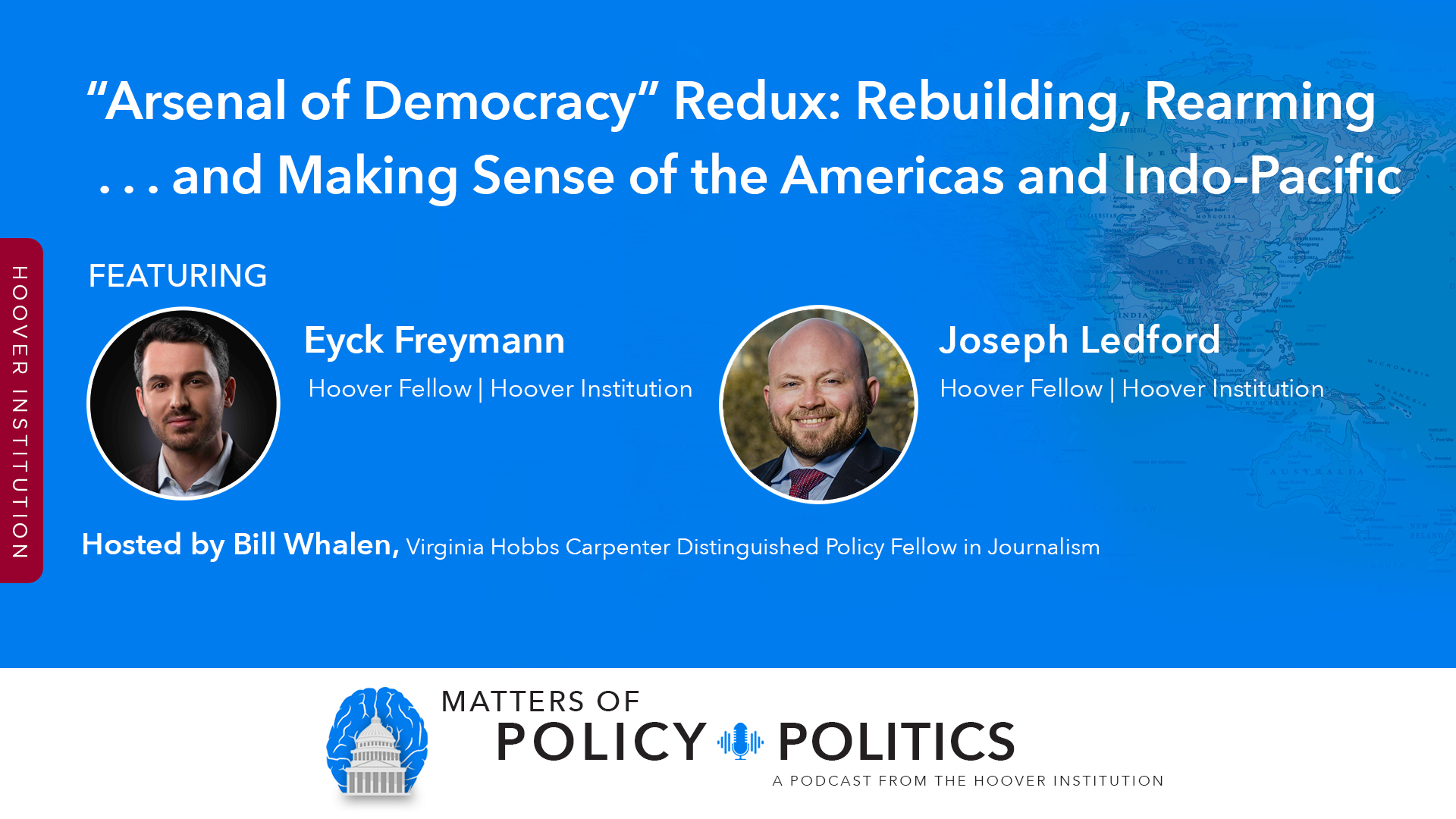
Evidence that history is repeating itself: Franklin Roosevelt’s plea in late 1940 to reimagine his nation as an “arsenal of democracy” willing to defy fascism and arm the free world, compared 85 years later to the question of America deterring China’s growing military prowess while also reexamining its role in the Caribbean (likewise an FDR obsession prior to the Japanese attack on Pearl Harbor). Hoover fellows and historians Joseph Ledford and Eyck Freymann discuss their respective fields of expertise (Western Hemisphere for Ledford and China-Taiwan for Freymann), how those two theaters are intertwined (could a crisis in the Indo-Pacific prompt China to create mischief in the Americas?), plus how to read Beijing’s ambitions (is Xi Jinping too risk-averse to invade Taiwan?) and Donald Trump’s designs on his “backyard” (is Venezuela the beginning or the end of the US engaging in the affairs of its regional neighbors?).
Recorded on January 27, 2026.
- It is Tuesday, January 27th, 2026, and you're listening to Matters of Policy and Politics, a podcast devoted to the discussion of policy research from the Hoover Institution, as well as issues of local, national and geopolitical concern. I'm Bill Whalen. I'm the Hoover Institutions, Virginia Hobbs Carpenter distinguished policy fellow in journalism, but not the only fellow who does podcasts. If you don't believe me, go to our website, which is hoover.org. In fact, go to the following link, which is hoover.org/podcast and you'll see just a whole plethora of stuff we're doing that includes, by the way, the audio version of the Good Fellow show that I have the honor of moderating. And by the time you're listening to this, we'll have a new episode of Goodfellows out with Tyler Cowan, and we're gonna talk about the current intellectual battle going on between globalism, Trumpism and socialism. So you definitely wanna check that out. Now to say the world is a complicated place these days would qualify me for the captain. Obvious of award. We live in a time of war and peace. There's a question of the United States and its rivals worldwide. A question of America's sway, both in far corners of the globe as well as closer to home. And it's the time to examine and reexamine security threats, plus doctrines that have guided American foreign policy for centuries. That includes the Monroe Doctrine, which dates back to December of 1823. This is lot to unpack it an hour's time, but let's get to it. Joining me today is Ike Fryman. He is a historian and Hoover fellow and director of Hoover's Allied Coordination Working Group. He's also a non-resident research fellow at Columbia University's Center on Global Energy Policy, the Institute of Geoeconomics in Tokyo, and the China Maritime Studies Institute of the US Naval War College. Dr. Fryman works on strategies to preserve peace and protect us interest and values in an inc in an area, an era of systemic competition with China. Also sharing his insights today is Joseph Ledford, a Hoover fellow, and the assistant director of the Hoover History Lab, as well as the vice chair of the applied History working Group, historian of foreign US Foreign Relations. Dr. Redford's research and writing focuses on the exercise of American power in the world with a particular emphasis on the world hemisphere. He's also concerned with the role of the presidency and the domestic politics of foreign policy broadly construed. Gentlemen, it's good to see you both.
- Thanks for coming us on.
- So let me begin by saying ain't technology grand. And for those listening who don't quite understand this, Joe and I are together at the mothership here. We're on the campus of Stanford University, but Ike is 13, 13 and a half hours away on the other side of the world in India. Ike, what are you doing in India?
- I'm here chatting with some people about my research and also just taking some days off, staying in a beautiful hotel. I'm headed to the Maldives next week to do research from a forthcoming book about the geopolitics at climate. So stay tuned. More comment on that.
- I was in the Caribbean last week, Ike, but I think you win with Maldives.
- So it turns out it's under Sharia law, something we didn't realize.
- Oh, so that what involves what? Things like matter of wardrobe,
- I'm not sure, but I'm gonna stand my best behavior.
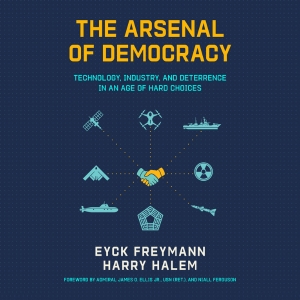
- Okay? You be careful, my friend. Gentlemen, let's start the conversation with a three word phrase, and that phrase would be arsenal of democracy. It is both the title of a book that I co-authored last November, but it's also a phrase that is attributed to the late great Franklin Roosevelt, specifically, it appears in his 16th fire chat. This was on December 29th, 1942 months after Japan, Germany, and Italy had signed the Tripartite Pact. And if you go back and listen to it or read it, here is Roosevelt in very rooseveltian fashion talking about the challenge for America. And he's saying that, look, there's a war going on in Europe right now, and there are people fighting for their survival. And while you may think that you are safe and isolated in the United States, you are not. In fact, if things go wrong in Europe, the Nazis are coming this way. And so what Roosevelt does in its fireside chat is he talks about the need to turn America into his phrase, the arsenal for democracy. And what the arsenal of democracy is, is both rebuilding America's military capability, but at the same time also lending or handing out military technology, military weaponry to those fighting the good fight. So gentlemen, let's begin the conversation this way. Franklin Roosevelt's arsenal of democracy in 1940. What is the American arsenal of democracy in 2026?
- The United States does have the world's most powerful and effective military. And the reason we have that is we do have a pretty substantial defense industrial base already. We can make F 30 fives that can penetrate a Iranian airspace and knock out the nuclear program with any without any casualties. We have more aircraft carriers than any other country by a substantial number. We have the best attack submarines in the world. The United States has durable advantages, and there are reasons why our allies are dependent on our kit. The problem that we face is that the character of warfare is changing, and we see this every day in Ukraine, and we are up against a state capitalist industrial competitor that can produce military items without worrying about profits, right? So they are able to massively outproduce certain things. And whereas quality is always a question at some point, quantity takes on a quality all its own. So as we look ahead to the 2030s deterrence against China held yesterday, it's holding today, I hope it will hold tomorrow. But as we look ahead a few years, China will have substantially more ships, more missiles, more drones, more ability to reconstitute and make even more if they need to. And we are seeing in Ukraine the limits of our ability to backfill certain things like air defense, interceptors or ammunition. And so the question is how we start working with our allies not only to re industrialize the United States, but to coordinate the production of certain things that need to be made in larger number and in a more resilient way. So the arsenal of democracy is, it's something that we've built before. We shouldn't underestimate the the starting point that we have and the advantages we have, but the argument of the book is Roosevelt said at the time, the status quo is unsustainable. We need a new approach. Business as usual won't cut it if we want to get this reindustrialization happened fast enough. Roosevelt made that speech after France had fallen because the situation was like pretty dire. Hopefully we won't have to wait that long before we wake up this time
- To make a direct historical analogy to the speech, the same security dilemmas that preoccupied Roosevelt matter. Now, and I'm not talking about the rise of fascist powers, but let's say the dilemma of hemispheric security. Roosevelt invokes the Monroe doctrine when discussing why we should should support the British against the access powers. And presently, the current administration has reprioritized hemispheric defense in a way that they may not be too comfortable with me comparing them to FDR. But it carries the same kind of strategic logic where prior to the December 29th speech, FDR had a couple of weeks beforehand, taken a tour of the West Indies on the USS Tuscaloosa. Prior to that, in February, he had taken the same ship down to the Panama Canal. And then in August before in 39, he had taken it to the eastern side of, of Canada to Newfoundland. And what FDR had come away with from his so-called fishing trips and engaging with allies and partners in the Western hemisphere that the United States needed to build their defensive perimeters for the threats in its own backyard while preparing for what would be World war. And the, the reason I talk about the same security dilemma is the current administration has identified that China's inroads, it's political, economic, and military inroads in the Western hemisphere are unsustainable, and that the United States will confront China. But at the same time, the rise of transnational criminal organization presents a new security challenge for the 21st century.
- You know, gentlemen, it's interesting. If you read FDRs Fireside chat, reuse this phrase, arsenal democracy, it's not the title of the fireside chat. And you have to go deep, deep into the, into the speech to actually find him say it. But there is one very fascinating passage. I wanna read this to you and and I want you to explain how this translate to modern times. Here's what FDR said back in December, 1940, our national policy is not directed war. Its sole purpose is to keep war away from our country and away from our democracy's, fight against world. Conquest is being greatly aided and must be more greatly aided by the re armament of the United States and by sending every ounce and every ton of munitions and supplies that we can possibly spare to help the defenders who are in the front lines. Okay, Ike, you're sitting in Taiwan. How do you process that?
- That's a very good question. I think the argument that American leaders have often made is it's better to fight them over there than over here. And that argument has worked in Ukraine because Ukraine's forces had been built up by NATO for a decade. But more importantly, because Ukraine has the population, the existing industrial base, the strategic depth and so forth to withstand pressure from Russia in a war that is now dragging into five years, it, Taiwan is not Ukraine in that way. It never will be. It's a fraction of the size. It's already ranged by China's long range missiles. It's completely dependent on the outside world for food and fuel. And there's no land bridge to a NATO ally to backfill Taiwan from behind. So this is a real, this is a real challenge. And it's one reason why if we want to reassure Taiwan that, you know, submission isn't inevitable, if we want to deter Beijing from moving against Taiwan, we need to expand our imagination. There's ways that Beijing can move that don't involve a full scale invasion, at least at first. And therefore we need more tools in our deterrence toolbox than just a very powerful military. But with that said, the powerful military is the fundamental foundation. If China thinks that it can defeat the United States in a high intensity war in the Western Pacific, our problems go way beyond Taiwan, way, way, way beyond Taiwan. It it, this is a question of our ability to defend our treaty allies in the region. It's a question of our ability to prevent China from bursting through the first island chain and becoming a threat to the homeland at some point. So I think the message to Taiwan is we are re industrializing to produce what we need because sustaining our military advantages is non-negotiable. And we understand also that you are being squeezed in all domains through an all domain gray zone coercion campaign to get you to submit to strangle you. And we stand with you and we are going to work with you, and we are gonna work with other regional allies like Japan, but also partners in other regions of the world to make a common front against what China is doing in the gray zone. So the answer to Taiwan is sort of yes and situation. Yes, Taiwan does need to buy some of this and make some of these items itself. It needs to continuous reforms of its military. There's many things that Taiwan must do in terms of readiness, but Taiwan needs to be reassured that we will help form, help 'em for all the possible scenarios that could emerge. That's why it's necessary, but not sufficient.
- Right. So Joe, let me read that passage again by sending every ounce and every ton of munitions and supplies that we could possibly spare to help the defenders who are on the front lines. So Roosevelt is talking about a hot war in 1940 in Europe, but in 2026, are we limiting to you this just to people involved in hot war, people in Ukraine, for example, Israel, or should we be broadening the definition? For example, should we be thinking about, you know, the Baltic nations, which you know, very much fear of Vladimir Putin?
- Yes, we should. We should expand. We should expand our capabilities and our resources to all of our willing allies and partners throughout the globe. The administration seems to be prioritizing, as I mentioned, the western hemisphere. We have on February 11th, this meeting, the, the chairman of the joint chiefs of staff has called for 34 countries, which actually also includes Denmark, France, and Britain to meet in Washington DC to discuss defense cooperation that appears to be entire hemispheric wide defense cooperation and how the United States can bolster the defenses of these three European countries, which have territories in the Western hemisphere, but also every country in the western hemisphere to combat extra hemispheric powers and transnational criminal organizations. Now, of course, none of these countries are engaged in a, a hot war with another nation state. We could quibble over the differences of what it's like to be engaged against non-state actors in your home country. But it seems that the current administration is trying to do this in certain theaters, whether that this is something that the administration is going to apply anywhere and everywhere is obviously subject to question. My position is any country that's willing to re-arm and build up their defenses against countries that are hostile to the United States, we should do everything we can to support them. It is in our national interest, but at the same time, we also have to make sure that we have an adequate stockpile for our own defense.
- Okay, I hope you guys don't think this is like watching the game show Jeopardy, but we're gonna continue with Roosevelt's and Roosevelt for 600 would be talking about the Roosevelt corollary. Joe, and this is not Franklin Roosevelt, but Theodore Roosevelt, I now want to talk about your, your backyard in the Americas. And what is the Roosevelt corollary? It's the, frankly it's Teddy Roosevelt's idea, the United States could intervene in the internal affairs of any Latin American country, guilty of what he called chronic wrongdoing or an impotence, which results in a general loosening of the ties of the civilized society. So Joe, my question to you, what would Teddy Roosevelt think about what Donald Trump has done in Venezuela?
- He would be supportive, although tr I think it's more credit than he deserves for his own corollary. Much of the negative connotation that's ascribed to his corollary is actually the behavior of his progressive successors. TR installed a government under the Platinum Amendment in Cuba and he operated the custom houses, but he didn't intervene as much as, as one might presume, but he was very much concerned with exercising the police power in the Central America, in Central America, in the Caribbean, over dead issues. The Trump administration with the Trump corollary and their colloquial term, the Don Road doctrine, are very conscious of this history and they invoke it in the national security strategy, I think to have a positive identification with the muscular approach to the hemisphere. And the administration is not hesitant to exercise military power. Obviously. They have elevated the issue of transactional criminal organizations and combating it from a law enforcement only strategy to a national security priority, which I think is actually the key passage that's in both the national security strategy and the National Defense strategy. This is paradigm shifting, I think on the same level as the preemptive doctrine in the 2002 NSS. We've already seen through operation absolute resolve and over I think 35, 36 kinetic strikes on narco laden vessels that the United States is in a new chapter of the drug war narco terrorism has replaced communism in the Western hemisphere. And so I think tr would approve whether or not his own record is as extreme or as interventionist as what may lie ahead for us, it certainly falls within his police power and with his concept of maintaining order in the hemisphere.
- I have a question for you, cutting between our two theaters. What does it actually mean for China to have relationships with the Narcos? What, what does it mean for us interests for China to have these relationships with the Maduro regime or with Nicaragua like, or with Cuba substantively like in terms of intelligence or in terms of their ability to do sort of gray zone stuff against our homeland? I mean, how do we even think about how meaningful this is?
- Sure. In Cuba, they've essentially replaced the Soviet Union in Russia as the, the great power supporting the proxy. They have four, five massive signal intelligence stations on Cuba in which they spy on the maritime industry, the space industry, the financial industry civilians, they were the largest military supplier to Venezuela. Venezuela and oil didn't matter that much to China. So even though we're cutting them off from access to oil, that didn't matter as much. But they did operate and support the Maduro regime in Mexico. They support the Sinaloa cartel and the go new generation cartel by providing them with precursor chemicals and the processing equipment to manufacture fentanyl, but also permit the money laundering of the profits. So billions of dollars of money laundering. So Chinese money laundering outfits are now a key threat as determined by the Treasury Department in which it's not just drug trafficking, it's any other illicit activity that takes place in the western hemisphere are able to launder money through Chinese money laundering outfits.
- But what, what is humor me, let's assume we have a, a real crisis with China.
- Sure.
- And the Trump administration has not yet succeeded in, its in its goals for the hemisphere and China tries to activate these relationships to squeeze us. What does that look like based on what we know from open sources?
- Sure. Well, if you've ever been to Panama, you can climb Ancon Hill in which the Panamanian can flag flies proudly above. And you can look down on the port, you can see the Bridge of Americas, and then you can see the ports that are operated by CK Hutchinson. And it doesn't take a strategic genius to realize the kind of drones you could launch out of a container ship and shut down the Panama Canal, which then inhibits us from having a two ocean Navy, which then shuts down a massive amount of commerce, 40 to 45% of all goods that traverse the Panama Canal or to and from American ports. So that's just one stark example of a problem we would have if, let's say we get in a shooting war in the South China Sea, it would be less, let's say that the Chinese Communist Party activates the 200,000 plus members of the Sinaloa cartel to turn Phoenix into a a bloodbath. It's more about the Panama Canal, but also the other strategic ports in which China has an interest or operates throughout Latin America. There's 34 in total, I think, by my last account.
- So I think we've been referencing the book that came out last fall. It's full title is the Arsenal of democracy, technology, industry, and Deterrence in the nature of Hard Choices. You have yet another book coming out in April. It's title is Defending Taiwan as Strategy to Prevent War in China. That book Good timing my friend, because that coincides with Donald Trump going to China. And this is a busy year of diplomacy with China. I believe Xi Jinping is coming to the United States at some point in 2026. Like I think there is something like four bilateral discussions, they're gonna go to occur during 2026. The assumption is they're gonna focus on three Ts trade tariffs, if you will, technology and Taiwan. So question Ike, that first meeting in April in Beijing, how much of that conversation do you think will pertain to Taiwan?
- Well, it's a, it's an important question. It's a question that's very hard to answer
- Right
- At this stage, given what we know about President Trump keeping his options open, and it, it may be the case that we don't know even after the meeting itself, the states and China have one way of speaking about Taiwan in public. We have to assume that they have a much more candid way of speaking about Taiwan in private, the Trump administration has clearly made this strategic decision that they will show restraint in the way that they talk about China and all their strategic documents. So you will read the National Defense Strategy out a few days ago as of this taping. You'll read it in vain for any mention of Taiwan. If you look at the national security strategy too, it's, it's very, very delicate in its discussion of China. I I happen to think that this president and his advisors don't intend to throw Taiwan under the bus. The United States has a one China policy. We've, it has evolved of course with the circumstances, but the core idea of it is unchanged, has been for 50 years. It serves our interests. And I think, you know, Marco Rubio and others recognize that and recognize that it would be very significant if we were to back off of those commitments. It would unravel regional stability. It would not bring the stability that a, a big beautiful deal might hopefully deliver. I, but I think the question is, if Taiwan is off the table in the sense that if, if Trump is not going to budge and meaningfully change the sub and substance of US policy towards Taiwan, what actually is the deal space here? I mean, China can only buy so many soybeans, right? So we know what China wants. China wants the tariffs down, they want the Nvidia chips, they want to chip away at our alliances. They've made pretty clear their objectives. But what do we want from China in return, other than buying ourselves a little more time to get our reindustrialization going to solve our critical minerals dependencies? I'm not sure, but I think there, there's a question of how much pressure Xi Jinping is actually under to cut a deal that's not substantive. There's, you know, as we're taping this, we're just a couple of days after the bombshell story that Xi Jinping has gutted what remains of the central military commission's senior leadership
- Also, I was about to, I was about to ask you about that.
- China's property sector continues to melt down. So it's possible that Xi Jinping is just sufficiently distracted with domestic stuff, that he's happy to take a relatively low substance summit and call it a win and just put the US issue on the back burner for some time. But analytically, like as an analyst, this is a really hard moment to figure out
- The general question I his name, I'm gonna butcher it, so please correct me. It's, I believe it's Jung Yu, I dunno if I got that right or not, but he's the vice chair of the Central Military Commission, which controls the armed forces accused of quote, violations of discipline and law. So he is, he is out of power. But do you connect that to Taiwan in this regard? I've, I've, I hear from, I hear two sides of this. One is, one is my goodness if he's purging the military, he's not in a position to make a move on Taiwan anytime soon. Conversely, historians, I was had a conversation with our colleague Philip Ziko about this the other day. Phil pointed me to the fact that Adolf Hitler in February, 1938 canned a whole bunch of army generals and a whole bunch of generals. And yet there he was 18 months later rolling into Poland. So read into it what you may
- I, I agree with Philip. I think it's just analytically unclear. There's too much that we don't know. We know the Xi Jinping and Jang went way back,
- Right?
- Does that mean that they were friends? Of course, it doesn't mean that they were friends. This is the Chinese Communist Party and frenemies are a, a, a very well-known category in the Chinese Communist Party. Pretty clearly Xi Jinping went into this term. He rather, he came outta the last party of Congress with the Central Military Commission leadership. That was not his ideal lineup. There's the reason why all but one of them are now gone. So there's a question now, does he know who he wants in the key roles? How long will it take to get them installed once they are installed, what is the effect on readiness? There's just a lot of questions and it's hard to know whether she's conflict with John was was personal, whether it was related to corruption, selling nuclear secrets to the United States, which sounds a little like a pretext or whether there was a dis disagreement about Taiwan itself. I just think it's really hard to speculate, but the more general points I would make is China on, on like an elite politics level is like very much a black box. I mean, CXI Jinping is not a man who's given lots of interviews. We don't know his soul. So if we're thinking about how to deter this guy, our strategy needs to allow for many different possible versions of the man because we just don't know the man all that well. Particularly if any given day he wakes up rolls outta bed and is feeling, is feeling positive. So how do we, how do we have a strategy that shows a combination of resolve and restraint so that the ignatious aggressive version of the man will be deterred and the fearful, paranoid version of the man will be reassured. And it's not easy to strike that balance, but one way to do it is not to change the way we communicate our one kind of policy.
- Right, right. Alright, Gerald, let's shift and let's talk about the other world leader who, unlike Xi Jinping gives a lot of interviews, but like Xi Jinping is sometimes hard to, to figure. And that's Donald Trump. And let's talk about Trump and his approach to the Americas. Our colleague, your fellow historian, the great CER Ferguson wrote a very controversial piece in the free press the other day, which would have you believe that Donald Trump is in essence, Mr. Spock, that he plays three-dimensional chess when it comes to foreign policy. And the whole move on Greenland was in fact Trump just distracting from Davos focusing on Ukraine and Israel. So that's what Neil thinks. Interesting feedback on the internet about that. But as we look at the Americas, Joe, what is the Trump plan here? I look, he took out the first couple, he took out Moderno and his wife, but it remains to be seen what the regime will be in Venezuela if it's gonna stay in place, or they're gonna move toward a, a freer election of fear of government. There's the question of Cuba. Trump keeps dropping names of countries that could be on the list, but the question is what will he do? And Mad Trump is always the question of the follow up to the action. We can go in and we can take out leaders, we can do very forceful things. But then, you know, once you've spilled on the aisle, you know, are you gonna stay around for the cleanup?
- Great question. I think it's a mixture of both. Trump clearly improvises and shoots from the hip, but there's also a strategic rationale and a plan from the beginning. You can go back and look at day one and there was a legal predicate laid down in the first slew of executive orders on what is the primary purpose of the US armed forces protecting the homeland. There's a crisis at the southern border and foreign, foreign terrorist organizations. Then you look at the military buildup, which cost a lot of money and divert and forces hard choices from other theaters in which they are making you look at Rubio's first op-ed that he wrote outlining in America's first policy. You look at his first trips abroad, Trump mentioning the Panama Canal in his inaugural speech, which may come as a surprise to some people, but he's been complaining for 20 something years about issues with the Panama Canal. It's just people weren't necessarily listening his, the same with his fixation on Greenland. He has some longstanding beliefs and the United States slowly built under operation southern spear kinetic campaign against transnational criminal organizations and anacon strategy around Venezuela. At the same time, Donald Trump was pursuing closed diplomacy with Nicholas Maduro. In fact, I think being too charitable, continually offering him different versions of an amnesty deal until he rejected the final one on December 23rd. And then we had operation absolute resolved. The United States has too many enemies and the Trump administration is trying to take some away. And certainly they're starting with the easier ones. It's much easier to deal with these regimes in Latin America and the Caribbean than it is China. But at the same time, Trump is similar to Michael Corleone. He's trying to settle all accounts. He has three years left. He's targeting the Cuban regime, which has always been a i, I think a, a source of ire for him. They're putting the pressure on the Cubans, they've now forced, it seems Mexico to stop sending crude oil to Cuba, which was their lifeline, Mexico roughly since about 20,000 barrels a day. But that seems to have stopped. The Trump administration, based on open source reporting, is looking for individuals within the, the Cuban regime to make a deal with, similar to they did with the remnants of the Maduro regime. I'm highly skeptical that that will work. The situation in Cuba is vastly different from the situation in Venezuela. There is not a unified democratic opposition with the charismatic leader that has majority support of the population. Cuba's been ruled for 67 some odd years by the Castro regime. Yes, Raul Castro's, 94 years old. But depending how cognizant he is, he's still somewhat calling the shots. So I do think that the pressure campaign is on Cuba. And then I wouldn't be surprised if we start seeing more movement on Nicaragua. There was talk about moving, removing Nicaragua from caf to Dr, the free trade agreement and, and other issues about preventing exports on minerals.
- But in the Cuba for, we'll get paid a second Ike, but with Cuba, on the one hand you could say, well, if the Cuban regime fell, you have Floridians with ties to Cuba. They could come in and perhaps bring capital in and help set a business and so forth. But how would we set up their economy and would that be our first move? I wrote a great line the other day talking about Iran and they said, you have to understand that one of the possible tipping points in Iran into another society is when they revolt, is when the middle class becomes impoverished. Then you have genuine uprising in the streets and Cubans, you know, live imp poverty right now. So what could the United States do immediately to improve the working conditions in Cuba? The living conditions in Cuba?
- What what we could do immediately?
- Yeah, because you're gonna, I mean this gets complicated because you are gonna have this push and pull in Congress. You, you know, you're gonna hear the words Marshall Plan, Marshall Plan for Venezuela, Marshall Plan for Cuba, Marshall Plan for Iran, even if you'll, sure. But you know, there'll always be a pushback against spending money in other countries, which gets in domestic politics. But also the question of what you install in a country to help improve it. 'cause in Cuba, people's always, people have always talked for decades, well, we'll put in hotels and Starbucks and McDonald's and you know, get a good flavor in the United States, but does that necessarily improve life in Cuba if you just give them, you know, cosmetic things like that?
- Right, great question. Very difficult because the military runs the companies that operate the hotels and the tourism. We also have the thorny issue of the embargo. So this would take some act of Congress. So Congress would actually have to be in session and, and work out some new legislation. We would have to be very creative. And again, I'm skeptical based on the way that the Cubans have set up the government. I mean, they are the masters not only of counterintelligence, but also repression through communist dictatorship. They essentially colonized Venezuelan set up the security apparatus. They have set up a situation in which the United States is gonna have a very difficult time even just improving the everyday lives that you talk about. We, we tried some easing of relations under Obama in which there would be some liberalizing of their economy, and all it did was enrich party members and those in the military that operate the tourist companies and the hotels. I, I just don't see that there's a way for the United States to do this without there being some form of regime change in Cuba, which again, regime changes the dirty word in our political acade vocabulary. So perhaps some regime management. So maybe the CIA is able to repeat its success from Venezuela and find members of the Cuban regime that no longer want to be aligned with the Castro faction and prefer some other, let's say, authoritarian light measures and an acting administration which would implement actual free market reforms, which would permit everyday Cubans to have access to capital and prosper.
- Alright, I'd like to get your gentleman's thoughts on alliances right now. Ike, we look at the Indo-Pacific right now. You have Aus, you have the IP four partners, Australia, Japan, New Zealand, and South Korea. But if we're gonna talk about deterrence with China, is there a need to create something larger and vast, a Pacific nato, if you will. And then Joy, I want you to address the question of what happened to the OAS, the organization of American States, which has been around since about 1890, I think, and exists to improve the life of the Americas. Where, where is it these days? But I could go first.
- Well, you ask about allies. The answer is yes. We need them more than ever,
- Right?
- The United States has never faced an adversary as, as large relative to it, as technologically sophisticated, right? As nimble as China. And the only way we are going to take on this challenge is with what Ru Rush Doshi and Kurt Campbell have called Allied Scale. You know, we have amazing allies in the region, Japan, South Korea, Australia to name three are stepping up And we're beating up on them for reasons that make absolutely no sense. It is, it is one of the great strategic own goals and one of the great mysteries of this administration, you know, just today I was seeing that the, the president is threatening to increase tariffs, again, backing out on his trade deal with South Korea. South Korea has been a model ally. It's doing everything that we're asking in increasing defense spending and taking primary ownership of deterrents on the peninsula. I mean, come on man, like what are we trying to do? Sell some more stakes in, in South Korea. Like they are stepping up in every way that we need them to, if we punish them for their hard work and their, what signals do we send to other allies that we're asking to step up? So I, I argue in my book, moving towards a Pacific NATO is the, is the way, this is not an easy thing to do. The United States tried to do it in the fifties and found that the, it was just too difficult to bridge. But the circumstances
- That was, that was, that was cdo.
- That was cdo,
- Yeah.
- But the situation has changed since then. The domestic politics in Japan are unrecognizable even from five years ago, Japan and South Korea, which have these deep lingering, unresolved historical tensions over what happened in the Pacific War, even under a left wing government in South Korea. They are talking and they are talking about a, a very sweeping defense and eventually intelligence integration. The Japanese are doing all of this stuff with the Filipinos, with the Aussies, with the British, with the French, which will allow them access to regional bases talking about pre-positioning of supplies, maritime domain awareness, all this good stuff. The only way that we can stabilize this region in the long term is if our allies are not only stepping up individually, but they're capable of working with each other in different configurations where we don't have to be in the room, we're forcing them to convene to make it happen. We're moving in this direction, but US leadership could do so much more and we're leaving these opportunities on the table. So as long as that is not the case, the US Japan Alliance is the key stabilizing factor for the whole region. Because if you imagine any contingency in the Taiwan Strait in the Philippines, we will need substantially to be operating out of bases in Japan,
- Right?
- We will at minimum need Japan's logistical support. But if you imagine what some of these more nasty scenarios would look like, if there's missiles flying, the, the private container ships are not gonna run, they're not gonna have insurance. No one's gonna want to fly through a, an an exclusion zone or, or sail through an exclusion zone. So there's gonna be real challenges resupplying civilian populations in allied countries, particularly in, you know, parts of these countries that are not connected by land like the Japan Southwest Islands. So we need contingency planning, not just for how we integrate our militaries, though that's important. We need contingency planning for the economic shock that might happen. So look at China's stockpiling behavior. China's not just building up an arsenal of its own, it's stockpiling protein and it's stockpiling chips and it's stockpiling minerals of every kind. It is this gigantic national stockpiling system where it wants essentially to be able to survive if it's cut off from the world for six to 12 months,
- Right?
- 2 billion barrels of oil in a strategic reserve. 2 billion barrels of oil in the strategic reserve and growing. And what this means is China doesn't have to last forever if it's cut off completely from international trade, it just has to last longer than US allies in the region, which if they buckled would be the end of the coalition. This is a massive contingency planning problem. Stockpiling is part of it. Financial contingency planning is part of it. Defense industrial integration is part of it. There's a whole suite of issues. And I just think that this administration is wasting an opportunity when our allies are willing to have these conversations and they're wasting the time. Because if the big one comes, if it comes next year or the year after that, we will struggle to get ready.
- But could you cobble a Pacific nato, if you will, with the same Article five, in other words, an attack on one is an attack on all given that unlike in the first Cold War, these countries in the other side of the Pacific, they have economic ties to China. In other words, you could have joined NATO in the 1940s or 1950s because you didn't do commerce with the Soviet Union. No commercial threat. But you have an economic connection to China in this day and age.
- So it's, it's an interesting question. That's a sovereign decision that countries like Japan and Australia would have to
- Make, right?
- I can't speak to, I can't speak to them. I think getting Japan and South Korea into a deal like that would obviously be the key to making this what you're describing. That's not easy. This is, this is still a, a very difficult pill to swallow for voters in both Japan and Korea. That said, we shouldn't let the perfect be the enemy of the good. An Article five style collective security guarantee is great if you can get it. But there's a whole lot of stuff short of that, which would be really desirable and helpful, which would strengthen deterrence, which would strengthen the confidence of our allies, which would strengthen our ability to negotiate favorable economic and tech partnerships in the region, which would've all these positive spillover effects to the rest of the world that we should be pursuing. And that's, you know, maritime domain awareness. That's, you know, giving the Filipinos the ability to push back by themselves against China's aggression. And that may be helping them get drones, an industry for producing naval mines. All the rest more work on reciprocal basing. So we just have representatives from each of the key allied militaries on the soil of each of the key allied countries working together in the room, sorting out all of these operational problems that emerge when you need different militaries, different languages to do big things together. We can be doing more joint exercises. So there's, there's a lot of stuff that we can be doing that's low hanging fruit, but like, won't necessarily be straightforward to do. It'll, this, these things take time. Keeping the end goal in mind is I think really useful. But like if we, if you just put that up to a yes no question, I think you're gonna miss the point. Final observation. What does this Pacific NATO thing that we're talking about have to do with the original nato? Well, this is actually a dispute because according to the NATO charter, the, the article five guarantee applies only in the Euro-Atlantic area. So if say China sinks an aircraft carrier in the Taiwans, an American aircraft carrier in the Taiwan went straight, you know, the French and the Danes are not obligated to come to our defense,
- Right?
- And some NATO countries, France have been very opposed to even low level alignment between NATO as an organization and our Pacific friends like Japan. I think that's crazy on a whole set of issues, command and control on cyber, on all of these things about how you make one force work with another. We should be building a pipeline of knowledge that goes in two directions between our Pacific allies and nato. And I think, you know, if this president can really master the art of the deal, one thing we should be asking NATO for, which would be more useful than Greenland, is more coordination between NATO as an institution and our Indo-Pacific partners. That doesn't mean that they'll join nato. The French will definitely let that happen, never let that happen. But there's a whole lot of coordination that can be done.
- I really quickly, if I could ask you a different version of the question you asked me, but regarding Taiwan, I think we and on this podcast have a certain presumption about the American national interest, but could you explain why defending Taiwan is in the American national interest and why it risked an apocalyptic war with China? And this is a very serious, could be it, nuclear holocaust without engaging in hyperbole. This is a very serious situation. Is it existential to the United States? Is it worth the time and the resources that we are committing we will commit? Could you just explain that to the listeners really quickly?
- Well, thank you, Joseph. This is a, a question I'm gonna have to get some practice answering. So, you know, we all know Taiwan makes 90% of the world's advanced semiconductors. Actually 99% of the most advanced Nvidia chips that we're talking about,
- Right?
- So you take that off the board tomorrow, the US economy plunges into a deep painful recession. You hand those fabs operational to China and suddenly China's in the capari seat to achieve AI supremacy. I I do not want my kids growing up in a world where China has full spectrum dominance in ai. You think about what that means for cyber capability, electronic warfare capability, you think of what that means for industrial power, for espionage, run down the list. That's a terrifying, terrifying world. So preventing the Chinese Communist party from achieving supremacy in AI has to be a vital US national interest. Now there's lots of scenarios over Taiwan where the fabs become disabled or destroyed. And that in that case, it's a question of who can reconstitute faster and build up a chip industrial base to compete. That's a different question, but that's a, that is a massive economic shock and a real gamble with high stakes. That's the chips. The second question is the map, right? The first island chain, as you know, Douglas MacArthur recognized in the 1940s contains China's navy onto the sea into, in the seas that are right off its coast. 'cause there's not many navigable waterways between the first island chain and the, the wider waters of the Pacific. If China can flip Taiwan and use it as a forward base, it becomes much harder to defend Japan, the Philippines, and other allies in the region by conventional means. So we would still have nuclear extended deterrents for whatever that's worth, but China could then start squeezing Japan, Korea, the Philippines, and the rest, the way that they have been squeezing Taiwan. And that's a military threat because I don't think we want PLA aircraft carriers zooming around off of San Francisco Bay. But it's also a question of economic order. And what I mean by economic order is our ability to access the markets in the Indo-Pacific region that make all the electronics in the world and all of the, pretty much everything else in the world without which there is no significant supply chain in the world that functions. If China gains the ability to weaponize those economies, the economies of Japan and South Korea and others against us, we are, as the kids say, cooked, we will never achieve economic security. We will never de industrialize. And the point I'm making about Taiwan is China doesn't have to conquer these countries territorially to achieve that goal. They just have to sufficiently knock us out of the region that China can dictate the terms of how other countries in the region trade with us. And that's why Taiwan matters.
- Did did he get it, Joe? Did he get it right?
- He got it.
- Okay, let's talk now, Joe, since I asked Ike about the Pacific Netto, let's talk about OES, the organization of American States. It is housed in a beautiful building in Washington DC not far from the State Department as Surpris as Donald Trump hasn't I it for, for property? But it seems to me that the OAS has been mostly MIA when it comes to conversations about Venezuela and the Americas writ large. Am I correct in that assumption or am I missing something?
- You are an astute observer bill, and, and it's a great question about where the OAS, it's multilateral institution that just a matter so much the hemisphere situates. I would encourage listeners to go and seek out Deputy Secretary of State Christopher Landau speech, the OAS in late July, in which he appeared before it and made the case that either the OAS become a body that is proactive and beneficial to the entire region, or the United States will leave and laid down the marker of what the purpose of it is. Like why does it exist, what can it do that criticizing the us but then asking the US to solve every problem in the region is an untenable position. There seems to have been some positive movement. Subsequently, secretary Rubio spoke with the Secretary General Albert Ronan, I think January 9th. There was a, a small readout of their phone call. So the relationship that we have with the institution is robust, but I still do not necessarily see where it fits in other than there's less criticism of the United States, but there's also more overt support for the United States and the region outside of a few countries that are still governed by leftist governments. Most countries in the Western hemisphere support the United States. A lot of this has to do with the end of the pink tide. There's been a, since 2023, a large wave of conservative leadership that's gonna continue this year, I believe. And certainly in Columbia, not necessarily in Brazil, but you know, El Salvador, Ecuador, Bolivia, Argentina, Chile, Honduras and on. And even after the apprehension of Maduro, very few countries criticize the United States in a way that we might be familiar with about Yankee imperialism. I mean, there were criticisms from the current president of Chile, but the incoming president of Chile was rather supportive. So I, I am not optimistic that the OAS becomes this robust multi lateral institution that I spoke about at the beginning of answering this question. So we'll see. There's no indication that the United States is going to withdraw right now. This administration prefers bilateral engagement. So although there's questioning of multilateral institutions throughout the world, I think we'll still engage with it. But I, I don't think we're gonna look, the United States is gonna look to the OAS to provide some leadership matters in the hemisphere. I think it's just gonna continue in a bilateral way.
- We have about a few minutes left here on the podcast. So let's wind down with this. Ike, I wanna know a little bit more about what you're doing at Hoover this year. Tell me about the Allied coordination group.
- Well, here's the pitch. For a long time the United States has developed policies by itself and has let allies develop their own policies by themselves. And then when there's been a misalignment, theos has dropped its own policy on the Allies desk and say, here you go. Right? And the situation that we are now in with cross domain competition with China is too complex and too fast moving. To continue that way, we need to work with allies to build strategies from the first principles to the operational design on substantive areas of competition with China. And we need to do it in a way that builds trust and relationships, especially among mid-career folks, so that we can continue to work these issues over time. This is a, this is a new group. It's informed by conversations with our colleagues in the UK at the Center for Geopolitics at Cambridge and the Institute of Geoeconomics in Tokyo. So we will have some exciting new working papers coming shortly. I'd say stay tuned.
- That sounds great. And Joe, tell me a little bit about the applied history working group. What do you guys have in the in the pipeline?
- Well, Neil and I are hosting the annual symposium on February 12th on America in the World at two 50, in which we're gonna look at the long history of the United States and how the United States has engaged the world in the past and what this suggests about the United States going forward. We will have a keynote conversation between Neil and Michael Anton, the former head of policy planning in the State Department. And so that is on February 12th of the conversation between Neil and Michael Ton will be live streamed for those who can't be on the Stanford campus to attend in person.
- Yeah, that sounds great. Let me just make an observation here, gentlemen. I've been at the Hoover Institution for over 25 years, and when I first came to Hoover, we were not that rich in historians, but the Hoover of 2026 is a very different animal. We have a group of historians, I'd argue are the rival, if not superior, to any college in America in terms of just the depth and wisdom that you gentlemen provide. So I just wanna say thank you very much for all you do for the institution. Your work is fantastic and my goodness, it certainly is timely. So thank you for being part of the Hoover Institution.
- Thank you, bill. Thank you, bill.
- Okay. You've been listening to matters of policy and politics, a podcast devoted to discussion and policy and research from the Hoover Institution, as well as issues of national, local, and geopolitical concern. If you've enjoyed this podcast, please don't forget to rate, review and spread to our show. If you wouldn't mind, please spread the word, tell your friends about us. The Hoover Institution is Facebook, Instagram, and X feeds. Our X handle is at Hoover, Insta, spelled H-O-O-V-E-R-I-N-S-T. You should also sign up for the Hoover daily report, which keeps you updated on what Joe Ledford and Ike Freeman and their Hoover colleagues are up to. And that's delivered your inbox weekdays, Ike Freeman's book, defending Taiwan, A strategy to Prevent War at China is coming out on April, the April 14th, I believe. 14th or fifth, Ike
- 14th.
- 14th April
- Preorder. Now
- You can pre-order it now. That company named after Big River in South America for the Hoover Institution. This is Bill Whalen. We'll be back soon with a new episode of Matters of Policy and Politics. We're gonna be talking about emerging technology and taking a journey into outer space. You don't miss that. Till next time, take care. Thanks for listening, Joe. Go home to dinner, Mike, go get some breakfast.
- This podcast is a production of the Hoover Institution, where we generate and promote ideas advancing freedom. For more information about our work, to hear more of our podcasts or view our video content, please visit hoover.org.