




As a member of the Clients of Adrian Mulliner (the society for aficionados of both Wodehouse and Arthur Conan Doyle), I hope I may quote from Sherlockian scripture to convey my sincere desire never to inflict upon readers an “endless raving upon politics and upon social questions” (“The Adventure of the Red Circle”). Nevertheless, as I have suggested in a series of essays in this journal, we cannot deny the presence of politics and social questions in the Wodehouse canon. In addition to documenting this content, we might ask if it has any implications for contemporary debates. While political issues and personalities change over time, some questions are evergreen.
For Plum, as a professional writer, questions of free expression were highly relevant. He may not have been testing the limits of British libel law in his fiction, but his time on the Globe undoubtedly made clear the boundaries facing those “writing…fiction for the masses” (“Jeeves and the Old School Chum”). We should not be surprised that one of his short stories directly addressed free speech issues: “Comrade Bingo” (1922). In testimony to his awareness of political currents, it remains relevant to a controversy that continues to vex both Britain and America.
On one level, the story chronicles the failed attempt of Bingo Little to woo the unnervingly named Charlotte Corday Rowbotham, a communist agitator’s daughter, whom he met on a bus. At the same time, the story provides perspective on how to deal with inflammatory speech on controversial topics.
At the center of the story is a revolutionary group, the Heralds of the Red Dawn. While its members are played for laughs, communism was no joke at the time of publication. Lenin had consolidated his victory over the old regime in Russia, and the Soviet Union was officially formed in that year. Public speaking by the Heralds was therefore an example of a “hard test” of free speech because nobody knew whether a movement that wanted to “massacre the bourgeoisie, sack Park Lane, and disembowel the hereditary aristocracy” might catch on in England.
The story also involves the personal touch, as a Red Dawn orator directly criticizes two individuals: Bertie Wooster and Lord Bittlesham. We are therefore reminded that the “outspoken remarks” (Summer Lightning) of those not averse to “giving offense” (Love Among the Chickens) and “who are apt to express themselves in moments of emotion with a good deal of generous warmth” (“Chester Forgets Himself”) can involve individuals as much as ideas. Whether and how such speech should be regulated is a key question raised by the story, and the following paragraphs suggest that Wodehouse came down on the side of the speaker, whether at the level of the ideational or the level of the personal.
An Incident at Hyde Park
In the story, we read that Bertie finds himself at Speaker’s Corner in Hyde Park. This is the famous free speech zone in London, “where blighters of every description collect on Sunday afternoons and stand on soap-boxes and make speeches.” Here is how Bertie describes the scene:
On the edge of the mob farthest away from me a gang of top-hatted chappies were starting an open-air missionary service; nearer at hand an atheist was letting himself go with a good deal of vim, though handicapped a bit by having no roof to his mouth; while in front of me there stood a little group of serious thinkers with a banner labelled “Heralds of the Red Dawn”; and as I came up, one of the heralds, a bearded egg in a slouch hat and a tweed suit, was slipping it into the Idle Rich with such breadth and vigour that I paused for a moment to get an earful.
He then meets Lord Bittlesham, the uncle of his pal Bingo. After exchanging pleasantries, they become the targets of a speaker from the Heralds:
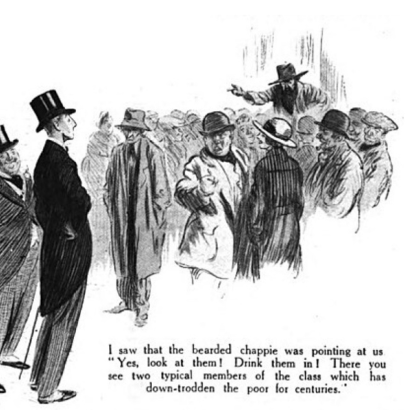
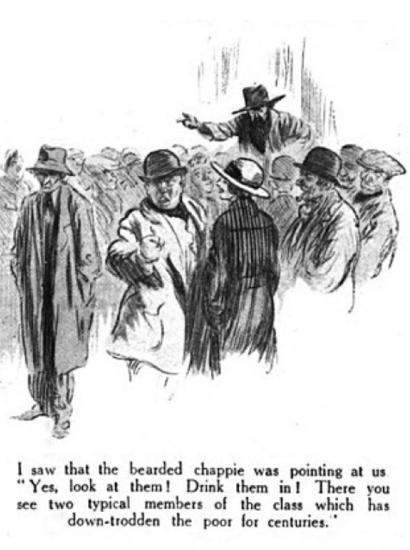
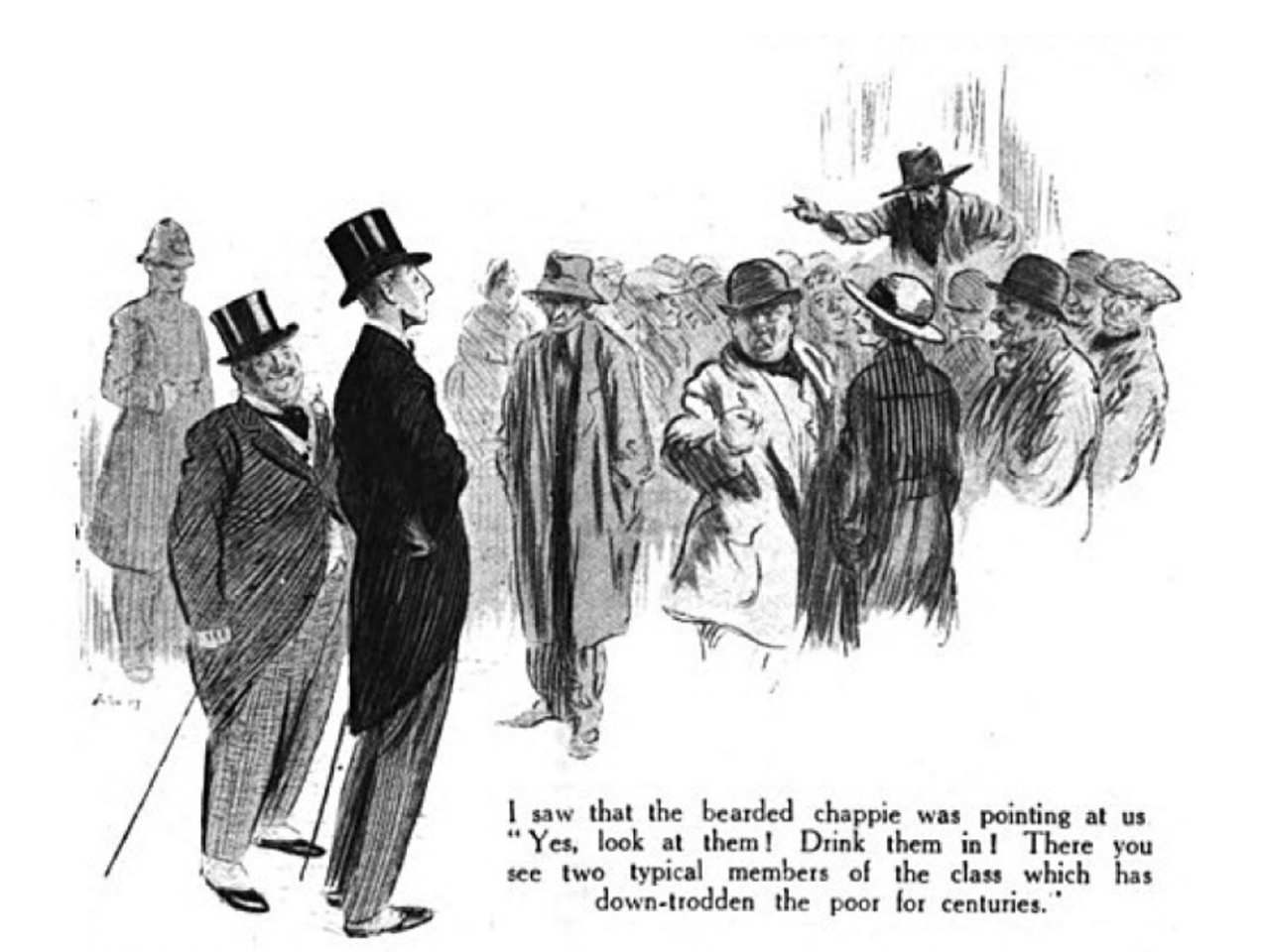
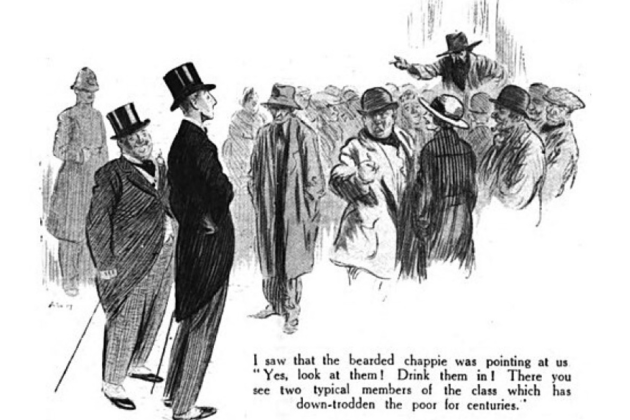
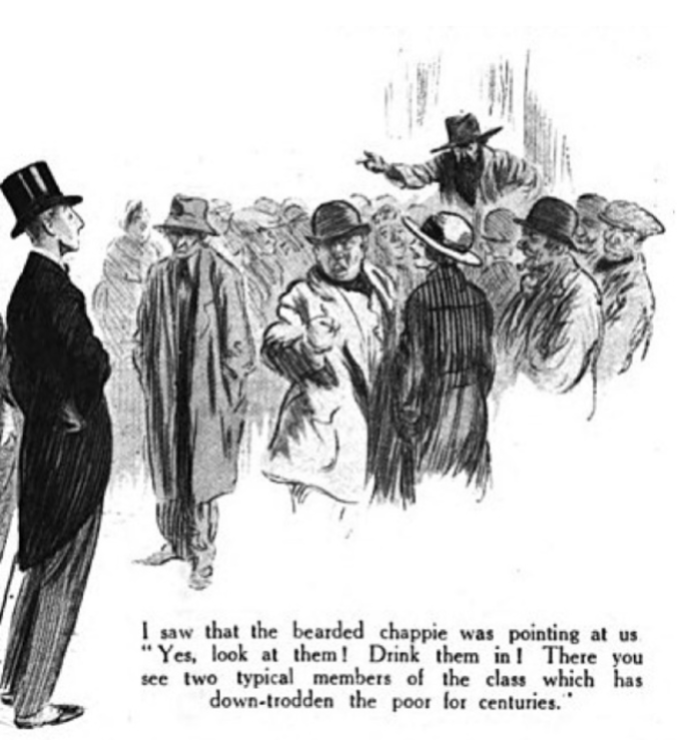
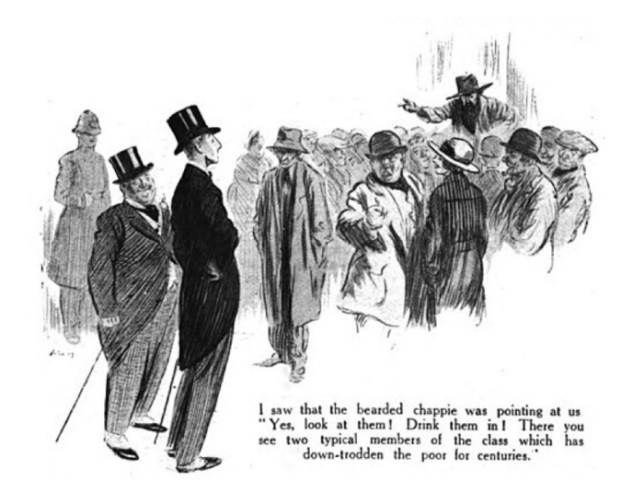
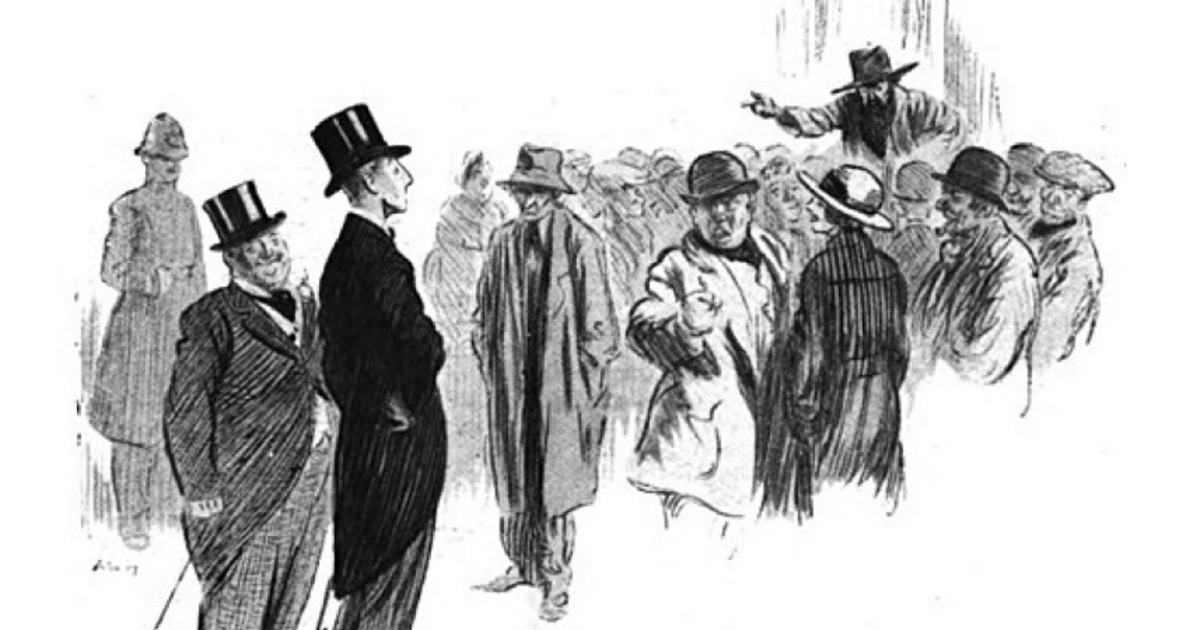
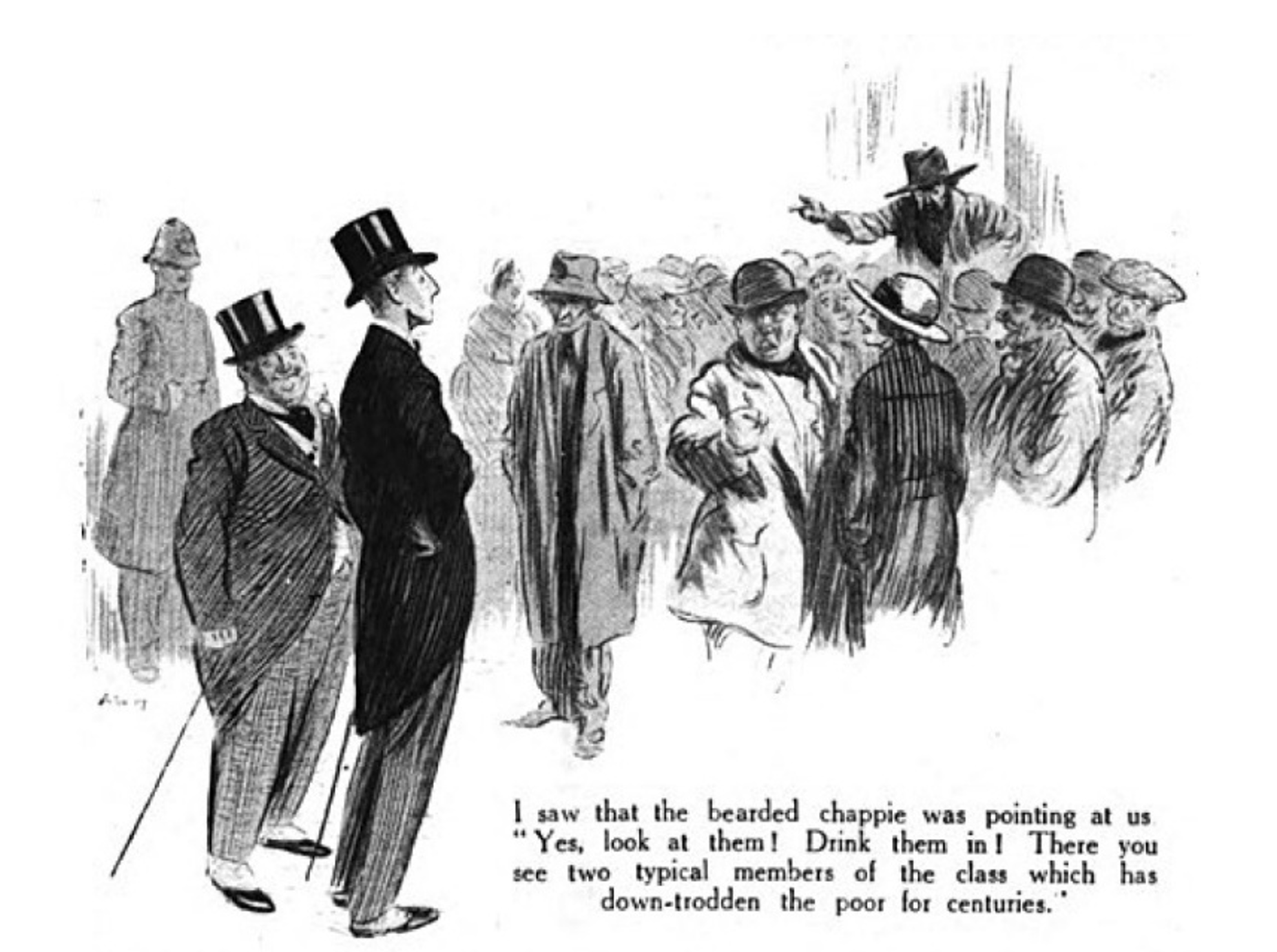
At this moment I suddenly noticed that the audience was gazing in our direction with a good deal of interest, and I saw that the bearded chappie was pointing at us.
“Yes, look at them! Drink them in!” he was yelling, his voice rising above the perpetual-motion fellow’s and beating the missionary service all to nothing. “There you see two typical members of the class which has down-trodden the poor for centuries. Idlers! Non-producers! Look at the tall, thin one with the face like a motor-mascot. Has he ever done an honest day’s work in his life? No! A prowler, a trifler, and a blood-sucker! And I bet he still owes his tailor for those trousers!”
He seemed to me to be verging on the personal, and I didn’t think a lot of it. Old Bittlesham, on the other hand, was pleased and amused.
“A great gift of expression these fellows have,” he chuckled. “Very trenchant.”
“And the fat one!” proceeded the chappie. “Don’t miss him. Do you know who that is? That’s Lord Bittlesham! One of the worst. What has he ever done except eat four square meals a day? His god is his belly, and he sacrifices burnt-offerings to it till his eyes bubble. If you opened that man now you would find enough lunch to support ten working-class families for a week.”
“You know, that’s rather well put,” I said, but the old boy didn’t seem to see it. He had turned a brightish magenta and was bubbling like a kettle on the boil.
“Come away, Mr. Wooster,” he said. “I am the last man to oppose the right of free speech, but I refuse to listen to this vulgar abuse any longer.”
We legged it with quiet dignity, the chappie pursuing us with his foul innuendoes to the last. Dashed embarrassing.
Implications for Free Speech
We see a few notable dynamics in this scene. First, support for free speech in the abstract is not questioned. The Red Dawn chappie was exercising his rights, and at no point did Bertie or Lord Bittlesham, the victims of his tongue, argue that such speech was illegal in any way, nor did they attempt to “cancel” him.
Second, people particularly enjoy free speech when somebody else is at the receiving end: “very trenchant” and “rather well put” said Lord Bittlesham and Bertie, in turn, about the opprobrium aimed at the other.
Third, people like free speech less when they are the target. Each man then sees the speaker as spouting “vulgar abuse” and “foul innuendoes.” Bertie thought it was all “dashed embarrassing,” which often it is.
Fourth, despite this perceived offense, they decide to leave rather than respond in kind. They could have countered the speaker’s arguments, insulted his tailor, or otherwise shouted him down, but they did not. The speaker exercised his right to an opinion, and they exercised their right to ignore him (a right that many people on social media might take more seriously).
Later in the story, we see a constable take a relaxed attitude to free speech in more challenging circumstances. Bingo, in his Red Herald disguise, says the following at Goodwood (the Duke of Richmond’s annual horse racing event) to a crowd riled by the loss of Ocean Breeze:
“But what does Lord Bittlesham care,” shouted Bingo, “if the poor working man loses his hard-earned savings? I tell you, friends and comrades, you may talk, and you may argue, and you may cheer, and you may pass resolutions, but what you need is Action! Action! The world won’t be a fit place for honest men to live in till the blood of Lord Bittlesham and his kind flows in rivers down the gutters of Park Lane!”
The constable refuses to interfere, and the offended Lord exclaims to Bertie: “It’s monstrous! The man definitely threatens my personal safety, and that policeman declines to interfere. Said it was just talk. Talk! It’s monstrous!”
This is a key point in the free speech debate—establishing when expression crosses the line and loses protection. It is understandable that Lord Bittlesham, who previously declared himself “the last man to oppose the right of free speech,” is concerned about the reference to his flowing blood. The constable has to decide whether the Park Lane imagery was a flowery figure of speech or an incitement to violence. He favors the former interpretation, perhaps having difficulty imaging a torrent of “red corpuscles” flowing through West London.
Later, talk turns to action, and Bingo and a Red Herald come to blows, which prompts the constable to intercede:
To grab Comrade Butt by the neck and try to twist his head off was with him the work of a moment. But before he could get any results the sad policeman, brightening up like magic, had charged in, and the next minute he was shoving his way back through the crowd, with Bingo in his right hand and Comrade Butt in his left.
The Wodehouse Theory of Free Expression
We therefore see a consistent approach to freedom of expression in this story: blokes can give vent freely, regardless of how it may offend, but if speech turns into violence, then Authority must restore order. We might summarize Plum’s view as “sticks and stones may break my bones, but words can never hurt me.”
As a fiction writer, former journalist, and lyricist/librettist, it makes sense that Plum would take a strong line on free expression. However, the story suggests that something more is at stake, and not just for individuals but for the nation. In the opening scene, Bertie describes Speaker’s Corner in almost mystical terms:
Now that the Empire isn’t the place it was, I always think the Park on a Sunday is the centre of London, if you know what I mean. I mean to say, that’s the spot that makes the returned exile really sure he’s back again. After what you might call my enforced sojourn in New York I’m bound to say that I stood there fairly lapping it all up. It did me good to listen to the lads giving tongue and realise that all had ended happily and Bertram was home again.
Illustration by A. Wallis Mills for “Comrade Bingo,” published in the Strand magazine, 1922
Plum is coming down on one side of the free speech debate—to let freedom ring, both literally in our ears as well as metaphorically on the page (we should not forget that his account of Red Dawn rhetoric could itself be seen as subversive by some readers in 1922). While the atheist, the red revolutionaries, the perpetual-motion theorist, and the religious missionaries were all controversial in their own way, he does not criticize their ideas or efforts. Whether at Speaker’s Corner or Goodwood, he sees nothing as more important, or more British, than letting all these chappies have their say. This view has clear implications for contemporary debates about whether and how speech and expression should be regulated by government.
While our individual perspectives on this topic will undoubtedly vary, we can all thank Plum for not only discussing an enduring political question but for doing so with humor. Politics is no doubt a serious business, but when seen through the likes of Bertie, Bingo, Charlotte, Lord Bittlesham, the sad policeman, Comrade Butt, and others, the temperature is lowered and we can better reflect on what matters.