



- State & Local
- California
- Politics, Institutions, and Public Opinion
- Campaigns & Elections
- Empowering State and Local Governance
- Revitalizing American Institutions
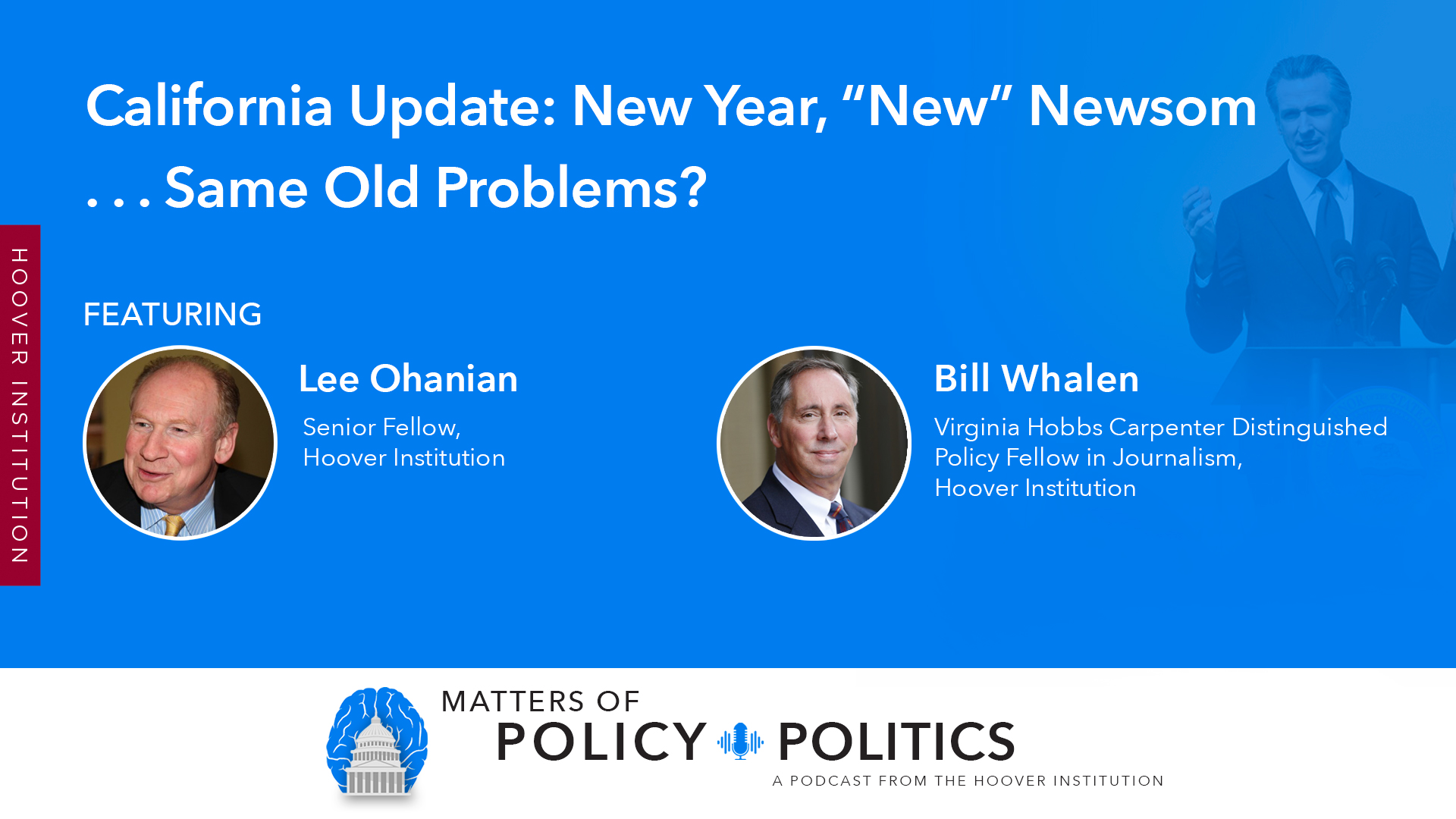
California’s new year begins with a “new” version of Gov. Gavin Newsom – offering Sacramento lawmakers a detailed and in-person State of the State Address, as opposed to recent years when the governor eschewed such pageantry. Hoover senior fellow Lee Ohanian and distinguished policy fellow Bill Whalen, both contributors to Hoover’s California on Your Mind web channel, discuss Newsom’s “rosy” vision of California versus the realities of chronic homelessness, a lack of affordable housing, slow-track high-speed-rail construction, plus a revenue stream overly dependent upon the AI boom. Also discussed: reorganizing state constitutional offices; San Jose Mayor Matt Mahan’s emergence as a Newsom foil and possible gubernatorial candidate; a proposed billionaire tax driving capital out of California; and a lack of Iran-related protests on college campuses despite the considerable Iranian-American population in Los Angeles County.
Recorded on January 15, 2026.
- It is Thursday, January 15th, 2026, and you're listening to Matters of Policy and Politics, a podcast devoted to the discussion of policy research from the Hoover Institution and issues of geopolitical, national and local concern. I'm Jonathan Movroydis, and every month I have the privilege of moderating a discussion on politics and the economic situation of the Golden State with two Hoover fellows and experts on these issues. Bill Whalen and Lee Ohanian. Bill Whalen is a Virginia Hobbs Carpenter, distinguished policy fellow in journalism and the regular host of the show. And Lee Ohanian is a Hoover Senior Fellow and Professor of Economics at the University of California Los Angeles. Both write for Hoover's web channel, California on your mind. Good day, gentlemen. How are you doing?
- Doing well, folks. Hey fellas. Good to see you.
- Good to see you. And happy New Year. California's legislature is back and Governor Newsom has returned to the capitol for, for the first in-person state of the state in decades. And this is framed around honoring California's past and promising future. The speech leaned heavily on familiar themes, democracy under threat, economic strength, declining homelessness and rising education, funding the LA Times called a notably rosy portrait. Newsom also defended high speed rail and floated a late term power shift away from the superintendent of public instruction. And once again, position California as a national model, raising questions about governance priorities and presidential politics. Bill, is it smart politics for Newsom to offer California as a model for the nation?
- In a word, no. If he's gonna get elected president of the United States in 2028, the assumption being that he will leave office in January, 2027 and quickly pivot to a national campaign. If he's not running already. He is not gonna get elected president of the United States based upon the public perception of California or his record in California. Governors have learned this the hard way. Bill Clinton did not run very hard on Arkansas. Michael Dukakis got bogged down by Massachusetts when he ran, so no, but that said, Newsom has to defend California. You cannot stand in front of the legislature and not tout all that you're doing. It's just part of speech writing 1 0 1. Couple of thoughts about this address. It was given at the very beginning of January. Congratulations, governor Newsom. This is what governors historically have done. I worked for Pete Wilson when he was the governor of the nineties. I was his chief speech writer, his second term, collaborated on such speeches. And we went in early January for two reasons. One, a Republican governor having to deal with the Democratic legislature. So kind of going into hostile territory. We felt it was important to give a speech and frame what the governor wanted to do before we had to play defense 1,001 times with legislature for the next few months. Secondly, Wilson was one of about 30 plus Republican governors at the time, all pretty much saying the same thing, be it lower taxes, welfare reform, tougher crime laws, class size reduction, you all remember the greatest hits of the nineties. So we wanted to kind of get the jump on that. An hour and five minute speech by Newsom. And the LA Times is absolutely right. It was very rosy. I wanna get Lee thoughts on this, but I think what this was, and I'm gonna be very cynical here for a moment, if indeed Newsom is running for president, this was a very effective political speech in this regard. Not because he necessarily is dealing with a lot of realistic problems in California, such as high speed rail, not that necessarily he's promoting a broader future because there are a lot of problems, including the budget, which we'll get to in a few minutes. But because you can take this, this speech and just kind of strip it down into its parts, there are a dozen of one little one and two minute snippets in this speech that you can post on social media. You can put on x, you can put on your own account for the governor. You can put it on blue sky. And it all speaks very well to running for president, be it those snippets where he's bashing the president, where he's talking about investing in California education where he is talking about not standing down to the unnamed conservative bullies and so forth. So very politically effective in that regard. But Lee, there is the problem about what exactly the governor is proposing policy wise, and if indeed he's living in the court of reality.
- Yeah, bill, it's, it's cer yeah, it's reality for him, I guess. I mean, he seems very sincere about, about the issues he, he spoke about in his state of the state address. Bill. You know, what I found interesting about this is that this is the first time in how many years? Three years since he has actually given the state of the state at the time of the calendar year, when the state of the state is given, and that he, he did it in front of the legislature
- Last time he went in front of legislature, was in 2020 right before the pandemic. And he, he's never done one this early in January. Usually he's done them in February. And the governor's office will say, well, the governor has a DYS problem with dyslexia, doing big speeches is problematic. So that's why he's not keen on doing this so much. So this was a departure for him, both going back to legislature and doing it this, this early.
- Right? And it's hard not to think that this is really just about politics and about his, about his position himself as a, as a 2028 candidate. It's also the case that the state of the state, I think, I think he has given those as late as summer, perhaps even late summer and
- September last year. Lee, a letter to legislature in September,
- A letter to the legislature in September. So, so here we are with, with the governor, we are all thinking he's running for, he, he'll be running for the Democratic nomination in 2028. So now he's doing it in January, and he is doing it in front of the Senate. You know, bill, he spoke, you know, he spoke about housing and homelessness, and he needs to address those topics because those were really the pinnacle of his campaign way back in, in 2018. He talked about a marshal plan for housing and of course referring to the enormous rebuilding of Western Europe after World War ii. And he talked about 3.5, I believe the number was 3.5 million new housing units by last year,
- Right?
- I don't know the exact number, but I think we got, I think, I think, I think we're only about 20% of what he promised. Now, let but forget about promise, but you know, 20% is about where we were before he took office,
- Right?
- So what we're looking at is it says if he had said nothing about housing,
- Right?
- And, and in the time that he has been governor, the price of the median California single family home has jumped to about $900,000,
- Right?
- Affordability based on California's demographic income, I think it's around 20%, 20, maybe 20 or 25% of California can afford that medium priced home. And that assumes that the buyer has 20% down.
- Right?
- Good luck if you're a renter and you've got 180,000 plus other closing costs to purchase that home.
- Yeah.
- So housing, he is extremely vulnerable on housing. And at the same time, we pass all these housing bills since he's become governor, and none of them have moved the needle. And there's, you know, and the 800 pound gorilla in the room about why housing housing re has an increase is because it is extremely expensive to build housing in California, right? In areas such as San Francisco, I don't know, $700 a square foot in Los Angeles, right? $500 a square foot. So you're looking at 500 to $700,000, 1000 square foot units. And relatively few people can afford those. And if you can, if you can, why not live in a state where 500,000 and 700,000 buys you a mansion?
- So let, let's don, let's don't go deeper into housing, 'cause I want to talk more about that later in the podcast, Lee. But here are two things that stuck out out to me as I, I've listened to this speech. One is, I think high-speed rail has now officially become indefensible in California in this regard. The governor tried to talk about progress, but you know, he didn't talk about miles of track being laid. He just talk about building up to laying down track in Lee. This was something that, you know, Californians first voted on in 2008. So here we are 17 years later, and we still don't have track to talk about. But here's where I think it's become indef defensible. Rather than talking about the viability of the system, the economic importance of it. He just said word's, the effect that, you know, if you make fun of the high speeded rail in California, you're making fun of the good people, the Central Valley, who will be writing this thing. And so that's just, that's just kind of the weakest excuse. But what really caught my attention, Lee, here as a, as a propeller head kind of guy, the governor wants to around with the structure of government. And this is something long overdue in California. What he wants to do, specifically Lee and Jonathan, is he wants to take power from the superintendent of public instruction, an elected official. He wants to have the state Board of Education, which is 11 member body appointed by the governor, and have them take charge of the California part of education, leaving the SPI with a broader responsibility for what the governor called a foster coordination and alignment of state education policies. Lee, I think this is a great idea. I don't understand why California has a superintendent of public instruction, why we just don't have an education secretary, much less a body appointed by the governor. But I think this opens a window lead a lot of governor reorg that if I could play Mad Hatter in Sacramento, that I do. But what do you think about streamlining educationally?
- Well, there are, there's certainly a lot of redundancies within state government. You know, the, the organizational structure hasn't changed for an awful long time in terms of it, in terms of its bones. So that organizational structure came from a different time, different needs, different economy. You know, bill, if I dig Dan into this a little bit, I'm really worried. The, the biggest, the biggest reason is because our educational outcomes, in my opinion, are just so remarkably deficient. Roughly one outta four kids are proficient at federal standards in math and within California public education. And that's just unacceptable. The, and the, and the, the federal bar for proficiency is not particularly high. Only about one in three, even less than that are proficient in reading at federal proficient levels. So these are the individuals who are gonna inherit the California economy in town, right? And so you can't have people who are not basically proficient in math and communication skills running the state. What worries me a little bit about state superintendent is that is a politically accountable position. If you don't go do a good job, voters can vote you out. I worry about a politically appointed board. But you know, on the other hand, Tony Thurman, this is really a shot at Tony Thurman, who has been state superintendent for an awful long time. He just hasn't been effective. His effectiveness has been so low that I don't think he was even invited to the Governor's press conference when he reopened schools from COVID. What is unfortunate for Californians is that when Thurman was elected in 2018, there was another democrat, Marshall Tuck who ran the vote, was extremely close. Something like 49 and a half to 50 and a half Tuck had a record of rapidly turning around the worst schools in California, going from kids who are completely unmotivated, who are not ready to go to college, who basically weren't even graduating, if we want to be honest about it, from high school into high performing schools. There was a guy who could have completely turned around California education. The party, the party machine backed Tony Thurman, he won. And now we're looking at what's happened over the last years and saying, oh, you know what, let's just get rid of the office because it's not doing anything.
- Yeah. Well, I'm sorry. I vote to remove the office because the SPI gives a, his, his or her own version of the state of the state in terms of education, which nobody pays attention to. They're not really much of a force when it comes to doing legislation. They spend the year doing a lot of photo ops in schools. It's just, we don't need to spend that money in that office. So consolidate it and put it under the governor's wing and let the chase big go. But I would open the door here to other Governor Reorgs, government reorgs here, Lee and Jonathan. We have a treasurer and a controller in California. I don't see why you can't merge the two offices and have one person do the two functions. The controller overseas spending in California, the treasurer basically sells bonds on Wall Street. One person could do those jobs. I would abolish Lieutenant Governor's office, either, either abolish it or I'd pair it with the governor. So you run somebody on a ticket. 'cause what history shows you is lieutenant Governors are usually isolated. Governors don't want to share stuff with the office. The LG just sits there waiting for something to happen to the governor, which doesn't. You saw this with Lanie Kunaki this time around when she decided to run for governor, but couldn't crack two or 3% in the polls because she just doesn't have much to show in a way of record. So I'd probably dish that office. And then the third one I would do lead, is I'd get rid of the insurance commissioner, make it an appointing of the guy. If you wanna have an office, just have a gubernatorial pointy. And here's the problem. The idea with like PI is, you're gonna have a watchdog office. The insurance commissioner's gonna watch over the, over the industry. We have seen with recent insurance commissioners is, is a problematic relationship
- Bill. You know, what we, we live in the most in what should be the most technological technologically advanced state in the country with Silicon Valley. Just think about how many functions within state government could be streamlined using ai. You mentioned some, it's really hard to argue that the controller and the treasurer should be two different people. And the insurance commissioner, oh my God, that has just been a disaster within, within the state. It is so hard to buy homeowner's insurance. Now what you can buy is ex as a, as a homeowner who lost my home insurance, and then I had to find new home insurance that was about, you know, it was about 60% more expensive. This is happening everywhere within California. And Ricardo Lara, who is the insurance commissioner, he's, he was in the, in the news recently about very expensive trips he was taking, right in his, in, in his, in his role as insurance commissioner. Home insurance has gotta be fixed. It hasn't been, I mean, it's just as simple as that. So that, that has been an enormous problem within California.
- You know, the year last column for California in your mind, last year was titled Not the year Bad Governance. I'm just curious, since we're beginning 2026, the governor's, given his big speech legislature is starting to move on Bills I, one of which I want to talk about in a few minutes. What, what are you using as parameters in 2026 for bad versus good governance? Are you looking at a certain issue or a certain bill? What, how are you gonna judge good versus bad?
- Yeah, you know, unfortunately, there's just so, so many areas you can point to. Education, transportation, bill, you mentioned high speed rail and what, what a fiasco that has become. You mentioned it was indefensible. I, I, I totally agree with that. And you know, again, not to pile on the governor, but in his first state of the state address, or actually I believe it was his inaugural address many years ago, he talked about how high speed rail connecting LA to San Francisco, which was the dream that was sold to us as voters when we approved an early $10 billion bond. He said, that's just not realistic. That's when he could have simply said, you know what, we have other priorities and you know, we don't have endless revenue. We are gonna put this, we're gonna put this on ice for a while.
- Instead, he spent 24 hours doing damage control saying, no, I'm not killing the project. Here's what I meant to say.
- Yeah, yeah. And building Bakersfield to Merced,
- Right?
- That might be ready in seven to nine years at a cost of about $35 billion, which no one believes is economically reasonable without the rest of the system. And there is no path forward for another a hundred billion dollars to bill the rest of the system. So I think, I think the governor made a mistake back, back then. But, but in terms of, but we're not gonna see, you know, high speed rail's not gonna get any better. It is gonna submit a lot more money. It is gonna move forward as a sales pace. I think a lot of people would love to see some type of productive vision about homelessness. We spent tens of billions of dollars and it has gotten worse. Now, the governor talked about how there is a 9% reduction, and he was crowing about that. He said, look at California. We're a model for the rest of the country. Some other states are doing worse and homelessness. We got 9% better. Well, you know, there's an important asterisk next to that, which is that not all communities of care, which are the regions that that count, the homelessness, not all of them, I don't believe all of them have reported that the number 9% reduction, I believe is based on an incomplete count. I may be wrong about that, but I believe it's based on incomplete count, an account that appears to be too low. The RAND Corporation was a nonpartisan research organization in the Los Angeles area, wrote a very detailed report talking about just how under count, just how much of an under count is, is occurring in LA and LA County. The legislative analyst office has, based on medical records, has identified perhaps as many as 300,000 unhoused within California, which is much, much higher than the official count. So we need to, I think we need a complete redo on a framework for homelessness, which in my opinion is enormous expansion of the ability to put these people into inpatient psychiatric treatment. You get 'em off the streets, you put them on the path to a better life. And people living in San Francisco, west la, other area, San Diego, other areas with enormous amounts of homelessness, that's an improvement for everyone. So that's what I would love to see. I don't expect to see that. So, so Bill, I expect 2026 to look a lot more like 20 to look a lot like 2025. Hopefully we don't waste as much money as we did in 2025.
- Simple exercise for journalists out there. Maybe you and I can do this in our column writing as well, Lee, the governor's going to talk about year versus year. And so when he talks about homelessness being down, that's a very convenient way to do it. I think an enterprising reporter or somebody like us with time on our hands to write about this, we need to go back to 2019 and say, here's what the governor inherited and here's what he's leaving California with. So what was the homeless population in 2019? Where's the homeless population today? And how much money have you spent on homelessness over that period of time? And just do that on issue after issue. Because to put it in presidential terms, are you better off after eight years of Gavin Newsom than you were before? So that's how I'd approach it. But one problem with, with this governor is gonna be, and we can segue here, Jonathan, is the budget, which he surpri had a little surprising news in his state of the state, which, but there's a long-term problem here. But Jonathan, go ahead and tee us up.
- Yeah. In his address, governor Newsom un unveiled what he framed as a fiscal escape hatching additional 42 billion in general fund revenue for three years, right? Which is driven largely by high tech salaries and AI related gains. That windfall, he claims reduces what had been projected to be an $18 billion deficit next year to a $2.9 billion shortfall pending the May revise nuisances budget now stands at 348.9 billion. Nearly triple Florida's $117 billion budget and far above California's $321 billion current budget. When Newsom took office in 2019, that budget was 214.8 billion. These assumptions are contested while the Department of Finance is betting that the AI driven stock boom will continue. The non-partisan legislative anal analyst office projects a $35 billion shortfall over the next three fiscal years. Wearing that current ai Eric revenue growth is unlikely to persist. Gentlemen, what are the pros and cons of being so dependent on AI growth? Is there soon gonna be an AI bubble? Even if AI accelerates productivity while displacing jobs outside the tech sector? Does that ultimately undermine the state's broader revenue base? Lee,
- I'm gonna let, I'll let the economist answer the AI question, but let me just add a little bit more to this. The $42 billion surprise. Yes. It's from ai, yes, it's from tech workers. Also the governors bean counters did something, in retrospect is very clever. They kind of factored in a worse case scenario for Trump and tariffs affecting California. And so they anticipated far less revenue. It's turned out the tariff situation has not as been as devastating to California's economy as, as naysayers suggested. So that also attributed to the windfall. But here's the problem. I, again, I worked in state government. I can tell you that every governor plays fast and loose with the state budget. You put your thumb on it. Back in the nineties when I was involved in this sort of stuff, we'd always anticipate a few billion dollars from Washington to counter legal immigration, which we knew wouldn't be there. But we'd say it was coming anyway for the sake of balancing our budget. So here you have a supposed $3 billion shortfall, but it's the ominous warning from the Lao's office saying, in effect, the AI bubble can't continue. So Lee, this is kind of the question at the hour in California, you know, back in the nineties, the California economy was driven by trade tourism and this emerging thing called technology. Well, now we have, technology is a very dominant part of the California economic landscape and ai, AI in particular. But you know, AI strikes me as problematically, it is the future. Obviously it also takes away jobs, doesn't it? So I think it has all kinds of economic impact.
- Yeah, bill, you know, California is, is somewhat unique in this, in how it funds government. It relies enormously on personal income taxes. And among those personal income tax collections and an, a huge amount comes from the top 1%, from really the top one half of 1%. So Bill Whalen is an enterprising startup. He's a tech genius. He starts ai, an AI company. We do an IPO billionaire overnight. The state benefits from a revenue win for all from that IPO and the but from the, the in, from the income realized from that. So that's what the, that's what the state is thinking about. We have had these revenue roller coasters, you know, for as long as we can remember. When the stock market does well, cash flows in. And that's what we're seeing right now. Cash has gone into Sacramento partially because of the stock market. The state finance department bill, as you noted, is thinking that's going to continue. So there's two budgets out there right now. There's one coming from the gov from the governor, and then there's an evaluation of that from the nonpartisan analyst office. And they're really, really quite different. And this is very concerning because the legislative analyst office called the budget projection alarming. I cannot remember when they have ever used that type of language. They're use, they're typically very conservative, plain than vanilla. They do not use those kind of words. I've never seen the word alarming. And here's where it really, here's where where it really bites. We are, we are in fiscal year 25, 26, the budget we're looking at right now, which is for the governor's calling for close to $350 billion. Yep. That is nearly a 75% increase since the governor took office. Jerry Brown's last budget, I believe was around 200 billion. And the governor's now proposing a $350 billion. But debt,
- It's actually, the numbers are actually, it's, so Newsom walked in, the first Newsom budget was two 14.8, and if this one goes through, it'll be 3 48 0.9. So it'd be 62% by my math
- Budget. Yeah,
- But here's, here's what kind of drives me nuts about the coverage of the budget for all the agonizing over the $2.9 billion shortfall. When you go, my math is crude here, but if you go from three 21 billion to almost three 50, it's about an eight to 9% increase in spending. So you're just talking about slowing the increase in spending.
- Yeah. And Bill, where this becomes really problematic, the LAO, their projection,
- Right,
- Is that the state's reserves. So we have this thing you, this euphemistically called the rainy day fund that's supposed to be for emergencies, right? The LAO projects. We will essentially be out of reserves, which is the ability, the ability to absorb economic shocks and continue to pay for programs when revenues are unexpectedly low. They're expecting we're gonna be essentially out of revenues in about a year and a half.
- Yeah, Lee, we had a hundred billion, we had a hundred billion dollars surplus about three years ago. What, what happened? Poof.
- Yeah. That, that surplus, you know, over a few months went from a hundred billion ostensible surplus. And then once we recognized what was going on with revenues and temporary COVID funds, we have been running just chronically on deficits every year. Again, the LAO, by fiscal year 29 30, it's, it is projecting a negative $100 billion reserve fund. That is, we will go have gone in the, not only we won will won't have any reserves left is projecting we'll have negative a hundred billion reserves. So obviously you can't get to that is come, you know, push comes to shove. We have to spend a lot less, or we have to find a lot more revenues according to the LA, they are much more pessimistic than the governor.
- You know, Lee, a real interesting character who's emerging in this is Matt Mayhan, the mayor of San Jose. He has been a very vocal critic of the governor when it comes to homelessness. They clashed over that. And now if you go to the mayor of social media feat, he is all over Sacramento by de facto the governor on the budget and just calling it a house of cards. And we can't go on like this, Lee, we still have until I think March the sixth for people to announce her governor. But boy Mayor Mahan sir, sounds gubernatorial these days.
- He really does. And it's, it's very interesting because he's a Democrat and he's calling out people within his own party.
- Yeah, - They've talked, you know, he's not, you know, he is not naming names, but it's pretty obvious who he's calling out.
- Right. You know, Lee, you mentioned that the 1% in California, the one half of the 1% really kind of carry the weight on taxes here, Jonathan. Why would the state of California wanna put a ballot measure up that would essentially kill the goose at las of Gold Bank?
- So in June, by June, we'll know whether a proposed one-time tax on California resident billionaires makes the November ballot, or whether it quietly disappears during the budget negotiations.
- Right?
- This measure backed by the SEIU United Healthcare Workers West would impose a 5% tax on, on people with a net worth over 1 billion as of January 1st, 2026, payable over five years with proceeds earmarked for healthcare education, food assistance supporters of course, frame it as a fairness measure and the critics warn it could, it would accelerate capital flight, distort startup compensation and shrink the tax base. Some high profile billionaires have provided negative signals among them. Peter Thiel, Larry Page, and Palmer Lucky. So kick this back to you all, Lee, is there any real precedent for wealth taxes actually working, raising durable revenue without triggering avoidance, capital flight or long-term economic damage?
- Jonathan, it's interesting. A number of countries tried wealth taxes 30 to 40 years ago, including Italy and Spain, I believe Germany. They all drop them. And the reason is because they're very expensive to implement. It requires a lot of oversight in some cases becomes very, very difficult to value wealth. You know, Jonathan, you got that Picasso hanging in your, in your living room, you're keeping your kids from throwing spitballs at it. You know, how much is that worth? So then you, so you have to bring in appraisers to do this. So among those countries that tried, well, tax is one that remains is Norway. But Norway is losing their high, their most productive people. They're wealthiest people. One, one individual. I believe he, he noted that he had paid more, I think as much or perhaps nor nor nor in Norway, taxes as anyone there. Yeah, he real, he relocated to Italy. Now, the real, the challenge within the United States is that if this did come onto the ballot, and if it was passed, it would be of course, challenging courts. I suspect it would be found to be unconstitutional. But in any case, it's a lot easier to move within the United States than moving from one country to another. And you know, we're already seeing that Bill, you know, I have seen estimates perhaps as much as I believe a trillion dollars
- Yep.
- Leaving California in the form of, and these are typically tech people. You know, those who, you know, Larry Page who, who co-founded Google, Peter Thiel, who, who may be relocating to, to Florida. So this hasn't even, you know, so this is several months from po even knowing of signed ballot and, and you've got people moving already. So this is,
- But you have to, but you have, but you have to move already because one of the very clever call it insidious little provisions in this initiative is that it applies to every California billionaire who is living in the state as of January 1st, 2026. In other words, they're anticipating if the thing passed in November the day after the election, every billionaire would back up and go, no. So if you're already here in the state, you are trapped. So you saw this exodus late in the year, and that's the trillion dollars, which some venture capitalists say has already had. But you know, Lee, what's interesting is you have the, you have the SEIU healthcare Workers West pushing this thing. And as Jonathan alluded to, June is the crunch time here. It's when the budget's being settled, maybe they could be bought off with some sort of budget deal as it pertains to healthcare spending or it goes forward. Now the governor has said he will fight this. We'll see how much capital he puts into fighting it, if you will. But, you know, Lee, what's interesting is I'm not sure that the left understands necessarily the world of billionaires in finance in this regard. There are some billionaires who are very rich in cash. And so if Leo Hanian is worth a billion dollars, he can write a check to $50 million to the state of California and, you know, not feel it. But for some billionaires, this is gonna cause a lot of pain in terms of how they're gonna come up with the 5%. You might see some people having to sell off parts of their company, and now you're getting into the very culture of your company. So this is just a a, a very hot mess coming California's way.
- Yeah, the, the S-E-I-S-E-I-U thought they were being clever by trying to yeah, essentially backdate the tax obligation of 2025. And so you've got billionaires saying, okay, well guess what I'm a, I'm a resident of, I'm a resident of Florida or Texas or Nevada as of as of as of January 1st, 2026. And Bill, you know, there, you know, not to get into the complexities of, of voting shares, but the way the bill is written is that the obligation could be much higher than people expect because people like, I mean, you know, some of these founders will have on paper a relatively small fraction of shares outstanding, but they have controlling interest because of differences between class A and Class B stock. So there's a clause within, within this proposed wealth tax that could make their tax obligation based on their controlling interest and not necessarily the number of shares they actually have. So this could just, in principle, it could bankrupt some of these people. Right. So I'm not surprised they're leaving. It's a, it's a terrible idea in my opinion. And Bill, you know, this was ruminating last year, back, last summer, and I'm surprised if the governor really, you know, if the governor wanted to keep that, keep those people in California, which we really need these people in California, they're incredibly imaginative, creative, innovative. There's only, you know, a few dozen people like this in the entire world. We need them in California. The governor should have the, the, the governor should have put the kibosh on this back last summer.
- He, yeah, there only about a couple hundred billion, couple hundred billionaires in California. Were talking about. One other problem here, Lee, is the fiscal side of this. You're gonna raise all this revenue through the tax. It's gonna go into public healthcare programs, education programs, food assistance programs and so forth. This is not one time spending, this is not taking a hundred billion dollars in putting it into the high speeded rail, for example. This is gonna be ongoing government spending. So what happens when you run out of that revenue? You're gonna have to go back and reax the billionaires. You're gonna have to tax millionaires to keep feeding the beast at his government. Whatcha gonna do
- Well, yeah. And know bill budgets are fungible, a dollar not spent. We can say that the, we can, and you know, of course the message is going to be, well this is gonna be for healthcare and this is gonna be for education, but budgets are fundable fungible. $1 in this bucket can be moved to $1 in that bucket, even if it's just implicit. So, but that's the marketing ploy used to try to draw, used to try to draw voters in. Realistically, it, you know, there's never a one time change in California or really any, any political, any political issue. We were supposed to have a 12.3% surtax on income back around 2010. Guess what? It's still around. And this fall we'll be voting to make it permanent. And I suspect that will go through. So this is just an awful idea. The governor should have squashed this several months ago. And I can't help but think that the reason he hasn't is that he wouldn't have gotten any political points for it if he had just kind of kept it under the Raider last summer. But if he can squash it now, and we'll see, we'll see how much he does that will get him some political capital.
- We
- Will, I kept, I kept these wonder, I kept these amazing people in California. Our tax base is not, is not, is not depreciating. Look at this great job. I did.
- Yeah. So interesting times, Jonathan. So billionaires might be getting squeezed if this an issue goes through and apparently Wall Street's to blame for California's housing woes.
- Yeah, it's interesting that President Trump and Governor Newsom have found some alignment on an issue. And that issue is affordable housing. Trump is calling for bans on institutional buyers of single family homes. And Newsom in the state of the state of address as we that we've been talking about has said quote, it's shameful that we allow private equity firms in Manhattan to become the biggest landlords in many of our cities. Over the next few weeks we'll work with the legislature to combat this monopolistic behavior, strength and accountability and level of playing field for working families. That means more oversight and enforcement in potentially changing the state tax code to make this work. The message is resonating. Tom Steyer, who we spoke about earlier, is now running hard against Wall Street as well, even as California continues to fall short of its own housing targets. Question if housing is going to be a central political issue, Lee, what's the real fix?
- Yeah, the real fix is to build where it's cheap to build. So a few months ago we talked about how just the construction costs in California, including regulatory costs and other costs that go into finally moving some people into four walls and a roof. They're just enormously high. You just can't, you know, and nothing, nothing pencils out. You know, you build a, you, you spend $500,000 to build a 1000 square foot apartment in Los Angeles, guess what? The an off an awful lot of people in Los Angeles simply cannot afford that apartment. So the only solution that I see is you build where land is much less costly and you build, you build using manufacturing manufactured and modular housing that's built in factories. That's really the only solution to California's housing crisis. Only so many people have the income to afford to be able to live in San Francisco or LA or San Diego or anywhere along the California coast. The solution is built is building away from the California coast. And it's just, I think it's just that a non nonsense to think that corporations owning housing is, is a bad idea. Do, do we wanna have mom and pops running Google or GM or Nvidia or Microsoft or IBM? No, of course not. So that's, that's, that's a total non sequitur in my opinion.
- Lee one what? Yeah, Lee, one challenge with the modular prefab idea is actually building the module and prefab homes, pre-building them, if you will. California's understand doesn't right now have the capacity. Are we gonna have to bring in essentially a, a model day Henry Kaiser to, to create plants across California to start building houses?
- Yeah, yeah. I mean if you want to create new housing in California, that's what you do. The, the median household income in California is probably about a hundred, a hundred thousand dollars, which means a rental payment according to industry standards of no more than 30% of pre-tax income goes into your monthly rent payment. That's $2,500 a month. You've gotta be able to build housing that's profitable at a rent of $2,500 a month. There's simply no way to do that without building away from the coast and without being able to use a mass production which reduces cost substantially.
- So let's say you do invest more in modular and prefe homes, so now you're cutting down the price of actually constructing a home lease, but you still have regulatory woes to deal with. So it's not like you're free from the regulatory side of it.
- Yeah, yeah. You still got a lot of regulation and communities placed enormous development fees because local governments are having their own budget crises. So they see a new development coming and they say, okay, this is a revenue cash count, so that needs to be dealt with as well. The governor to credit led a change in the California Environmental Quality Act a couple of months ago, but that change, which exempts some construction from detailed SQL review reviews is only within urban infill settings. It doesn't apply as far as I know to residential development in, in less developed settings. But those less developed settings are ones that I'm thinking about, which is where you can build for a much lower cost. So yeah, the regulatory side still needs to be addressed substantially. Newsom, I don't think's going to do. It's, so that's a can that's being kicked down to the road, down the road to the next governor.
- So Lee went and down in Sacramento, as with homelessness, spend a lot of money and there's now talking to legislature doing a 10 billion, that's billion with the B $10 billion bond that crapped out last year. This Lee would be $7 billion for the state's multifamily housing program, which is issues, low interest loans to build and maintain permanent transitional rental housing for lower income households. $2 billion leave for wildfire prevention, rental assistance, and a billion dollars in low income, first time home buyer assistance and helping with down payments. What what say you to that?
- Yeah, all this is just really is sparking up the wrong tree. And to see that, just go back a few decades back to the, the forties, the fifties, the sixties. This was a period of time where California, you know, California's population almost tripled between 1940 and 1970. So just think about that going from about, I don't know, around six or 7 million people to about 20 million people. That's just a huge enormous growth. The price of California housing during that go-go period where the population almost tripled the change in California housing prices relative to the nation stable. It wasn't until we started piling on regulations that bandwidth that began with the California Environmental Quality Act around 1970. It wasn't until governments became really, really involved in the housing process that we started losing affordability. So yeah, the regulatory side is huge and that is, everybody talks about it like the oli yo, the old ones it, Yogi Ber, everybody talks about the weather, nobody does anything about it. This is one of those issues where we can do something about it, but it's not happening.
- Yeah. One thing about housing fascinates Lee is here you have a legislature with a lot of progressive whims, but also very influenced special, special interest. Lemme po you to one bill in particular AB 1157. So in January in the legislature you have this window to quickly review bills that were killed last year and decide if you're gonna bring 'em up again this year. So along came AB 1157, which would've lowered the statewide rent cap to 2% plus inflation. Lee, it went down. It's not gonna be considered this year why the California Building Association doesn't like it.
- Yeah, yeah. I mean, yes, patently a bad idea. So I'm glad the state made that change.
- Right? - I believe LA County implemented something very similar to this recently, and it's a terrible idea because what it means is that a landlord's costs are gonna be rising at the rate of inflation. You know, perhaps higher, perhaps lower, but there's gonna be raising in the, at the rate of inflation, but rent costs are gonna be held down. So you're gonna get to a point where rental houses is unprofitable and once rental housing becomes unprofitable, you're not gonna see any more rental housing. So this is, this is kind of a bandaid, you know, this is a bandaid measure that's gonna make items, that's gonna make housing affordability, rental affordability worse down the road. So I'm glad the state made this decision. LA County wasn't, wasn't quite as,
- Yeah,
- Sensible on this.
- This is shaping up as a, a really interesting ballot for November potentially in that you have, you have progressive red meat in the form of the billionaire tax, progressive red meat in the form of the $10 billion housing bond from legislature goes down that road. But then you have conservative red meat in the form of voter ID on the ballot finally in California. So be fascinated to watch how it effects turn out on both sides.
- Gentlemen, I'd like to close out this episode about looking at Iran from the, the mounting pressure against the Islamic Republican Republic of Iran. From the people who are protesting against that regime as well as the crackdown, the violent crackdown from the regime on its own people. California is home to, I think, the largest population of Iranians outside Iran. Many of them who fled in immigration waves after the 1979 Islamic Revolution there. Jamen, could you reflect on what this group has meant to the Golden State? If I recall correctly, I think the highest concentration of Iranian Americans are in the Los Angeles area, Lee.
- Yeah, that's right. Many are around the Beverly Hills area in west Los Angeles. It's a demographic that tends to be really quite wealthy. Very, very productive, very entrepreneurial, a large fraction. It is interesting, a large fraction are Jewish, so they have, yeah, they, they left many, many years ago. So it's an economically powerful and very productive group. And there is, there's no love lost among that group for, you know, the very repressive and oppressive regime that you see now in Iran. And you know, when you talk to these folks, they never refer to as Iran, they refer to as Persian, which of course is the historically the historical name for that, that area. So these are people that I think would love to see a regime change.
- Yeah, it's interesting. If you go to the corner of western, of Westwood Boulevard, of Wilkins Avenue in Los Angeles, the city is called it Persian Square. There are all kinds of nicknames for, for this part of Los Angeles. Little Loran, little Persia TEUs, one of my favorites here, but a couple observations here. Number one, this is the story of California in that people come here from other parts of the world escaping oppression, and they find opportunity to a better life in California, the I Radian get overlooked. There was this horrible, horrible show on Bravo several years ago called Shas of Sunset. And it profiled filthy rich Iranian Americans living very dysfunctional lives in Southern California. And basically it did, it did for the Iranian community, what the Kardashians did for the Armenian community. But the Armenian's also another example of people who escaped in their case of genocide and came to Southern California and found a better life. But what stands out is this, I walk most days to my office at the Hoover Institution, which means I walk across the Stanford campus and you see ne a peep about this on the Stanford campus right now. Whereas last year with Israel and Palestine and Gaza, you had encampments and people protesting all the way to the point of vandalism occurring in the president's office. But the students at Stanford don't seem to be much moved by the atrocities in Iran. And Lee, I imagine it's much the same down in, in UCLA, there were public protests in downtown Los Angeles. Let's point that out. But still, it's just the relative silence on college campuses that I find ast.
- Yeah, there does seem to be a double standard when it comes to Gaza. That's the easiest sell in the world to the progressive left. But when it comes to what's going on in Iran, what's going on in Africa place like the Congo and the sedan Nigeria where many Christians have been killed. Yeah, there's an area peak that is, that is just completely off their radar screens and I just don't know what you'd have to do to get it on their radar screens.
- Yeah. Final note on this, raise up Pavi, the, the former Crown Prince of Iran, the son of the depose Shaw. He may go back to Iran, he may try to lead some transition to democracy. He is a Californian and I think he has Lee a, a degree from USC that he picked up along the way. I, there might be a role for the Hoover Institution here, maybe we should close with this and that we have people like Larry Diamond who are very active in democracy at Hoover. He'd be a good voice to help to help the Iranians. He did this with the Iraqis after the 2003 invasion. We have economists who could help Iran figure out how to, how to rebuild an economy and have a market-based economy. So I think there's a role for think tanks like us and helping, helping a country like Iran get back on its feet if indeed that regime falls.
- Yeah, I mean the Hoover, so the Hoover institution's been around now over 100 years and it was founded on the principle of, of establishing peace. So it would right be in the Hoover's historical wheelhouse.
- Okay, well I'll see you Terry Ley
- Bill, not so soon. Okay,
- Well thank you gentlemen. Happy New Year and look forward to touching base next month. Okay. Take care guys. Thanks fellas. You've been listening to matters of Policy and Politics, a podcast of the Hoover Institution. Don't forget to subscribe to this podcast wherever you might hear it. Also, get alerted to new episodes of the show and the latest articles at California on your mind from Bill and Lee by signing up for the Hoover Daily report at hoover.org/hdr. That's hoover.org/hdr. I'm Jonathan Movroydis sitting in for Bill Whalen moderating, who will be back for another episode of Matters of Policy and Politics next week. Thank you for listening.
- This podcast is a production of the Hoover Institution, where we generate and promote ideas advancing freedom. For more information about our work, to hear more of our podcasts or view our video content, please visit hoover.org.