







- Science & Technology
- Understanding the Effects of Technology on Economics and Governance
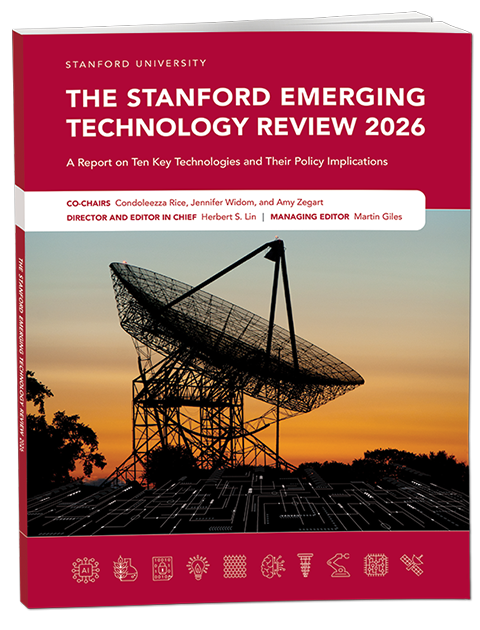
A new edition of the Stanford Emerging Technology Review, the product of a major technology education initiative for policymakers, has just been released. SETR was created as an easy-to-use reference tool that harnesses the expertise of Stanford University’s leading science and engineering faculty in ten major areas: artificial intelligence, biotechnology and synthetic biology, cryptography and computer security, energy technologies, materials science, neuroscience, quantum technologies, robotics, semiconductors, and space. Download the report here and subscribe here for news and updates.
US technology policy is no longer the unique province of government that it used to be. Federal and state officials struggle to keep up with technological advances and their implications. At the same time, inventors and investors are struggling to reconcile commercial opportunities and national interests in a world where technology, economics, and geopolitics have become inseparable.
More than ever, understanding the landscape of discovery and how to harness technology to forge a better future requires working across sectors, fields, and generations. Engineers and executives need to better understand the policy world to anticipate how their decisions could generate geopolitical advantages and vulnerabilities, and how they can seize opportunities while mitigating risks to the nation. Government leaders need to better understand the academic and business worlds so that well-intended policies don’t end up exacerbating societal harms or dampening America’s innovation leadership and the geopolitical advantages that come with it. And both government and industry need to better understand the foundational role that America’s research universities play in the ecosystem that has made the United States the world’s innovation leader since 1945—and how that model is now weakening at home while China is racing to copy it.
The Stanford Emerging Technology Review (SETR) initiative is the first-ever collaboration between Stanford University’s School of Engineering, the Hoover Institution, and Stanford’s Institute for Human-Centered Artificial Intelligence. We launched this effort with an ambitious goal: transforming technology education for decision makers in both the public and private sectors so that the United States can seize opportunities, mitigate risks, and ensure the American innovation ecosystem continues to thrive.
This is our third annual report surveying the state of ten key emerging technologies and their implications. It harnesses the expertise of leading faculty in science and engineering fields, economics, international relations, and history to identify key technological developments, assess potential implications, and highlight what policymakers should know.
In the past year, SETR experts have briefed senior leaders in the private sector and across the US government—in Congress, the White House, the Department of Commerce, the Department of Defense, and the intelligence community. We have organized and participated in dozens of Stanford programs, including multiday congressional staff boot camps in AI, biotechnology, and emerging technologies more broadly; roundtables for CEOs, national media, state and local leaders, and officials from European partners and allies; and workshops convening leaders across sectors to develop new insights that advance space policy, America’s biotechnology strategy, defense innovation, and economic statecraft.
Democracies come together
American innovation leadership is not just important for the nation’s economy and security. It is the linchpin for maintaining a dynamic global technology innovation ecosystem and securing its benefits for the United States and the world.
Put simply, it matters whether the global innovation ecosystem is led by democracies or autocracies. Democratic countries promote freedom and thrive in it, while authoritarian countries do not. Freedom, in turn, is the fertile soil of innovation, and it takes many forms: the freedom to criticize a government; to admit failure in a research program as a step toward future progress; to share findings openly with others; to collaborate across geographical and technical borders with reciprocal access to talent, knowledge, and resources; and to work without fear of repression, persecution, or political reprisal.
But the United States cannot succeed alone. Robust international collaboration, especially with allies and partners, is essential for bringing together the best minds to tackle the world’s toughest challenges, accelerating technological breakthroughs and advancing American values, not just our interests.
Planting for a new world
Universities, along with US national laboratories, are the only institutions that conduct research on the frontiers of knowledge without regard for potential profit or foreseeable commercial application. This kind of research is called basic or fundamental research. It takes years, sometimes decades, to bear fruit. And it often fails, because fundamental research is in the business of asking big, hard questions to which nobody knows the answers. But without this kind of research over long periods of time, future commercial innovations would not be possible. Commercial research builds on openly published academic work to develop quantum computing start-ups, for example, whose work could help identify new materials or develop medicines that save millions of lives.
Much of our daily life depends on breakthroughs that would never exist without years of federal investment in fundamental research inside universities. The internet, radar, magnetic resonance imaging (MRI) machines, and the global positioning system (GPS) for navigation are just a few examples. Today’s AI revolution began fifty years ago with university research into neural networks.
Universities have work to do to fulfill our mission of promoting serious and searching inquiry, restore civic discourse, and regain the trust of the American people. Making cosmetic changes and hoping to return to the way things were will not be enough; this is a moment to reimagine and reinvigorate higher education in service of discovery and the nation. At the same time, the current challenges across US campuses should not distract from the urgent need to ensure American research universities have what it takes to make the breakthrough discoveries of tomorrow. We are harvesting today the research seeds planted decades ago. But we are not planting for the future as we once did.
To be sure, the rising dominance of private industry in innovation brings significant benefits. But it is also generating serious and more hidden risks to the health of the entire American innovation ecosystem. In some areas, technology and talent are migrating from academia to the private sector, accelerating the development of commercial products while eroding the foundation for the future.
The ability for universities—or anyone outside of the leading AI companies—to conduct independent analysis of the weaknesses, risks, and vulnerabilities of AI (especially the large language models recently in the news) will become more important and simultaneously more difficult. Further, the more that industry offers unparalleled talent concentrations, computing power, training data, and the most sophisticated models, the likelier it is that future generations of the best AI minds will continue to flock there, potentially eroding the nation’s ability to conduct broad foundational research in the field.
Science and technology: the starting point
Stanford University has a unique vantage point when it comes to technological innovation. And Stanford has a rich history of policy engagement, with scholars and alumni who serve at the highest levels of government as well as institutional initiatives that bring together policymakers and researchers to tackle the world’s toughest policy problems. Generations of Stanford engineering faculty, students, and staff have had profound impact through their discoveries.
Today, technology policy and education efforts are often led by policy experts with limited technological expertise. The Stanford Emerging Technology Review flips the script, enlisting many of the brightest scientific and engineering minds at the university to share their knowledge of their respective fields by working alongside social scientists to translate their work to nonexpert audiences. We start with science and technology, not policy. And we go from there to emphasize the important interaction between science and all aspects of policy.
Ensuring continued American leadership in science and technology is essential, and it’s a team effort. We hope this third edition of the Stanford Emerging Technology Review continues to spark meaningful dialogue, better policy, and lasting impact. The promise of emerging technology is boundless if, like our founding fathers, we are willing to pursue bold ideas and take determined action.